Writing about Writing Archives - Page 22 of 27 - A Brave Writer's Life in Brief A Brave Writer's Life in Brief
  • Start Here
    • For Families
      Multiple Ages
    • Ages 5-7
      Beginning Writers
    • Ages 8-10
      Emerging Writers
    • Ages 11-12
      Middle School Writers
    • Ages 13-14
      High School Writers
    • Ages 15-18
      College Prep Writers
  • Shop
    • Product Collections
    • Bundles
    • Writing Instruction Manuals
    • Literature & Grammar/Punctuation
    • Composition Formats
    • Literature Singles
    • Homeschool Help
    • Book Shop
    • Special Offers
  • Online Classes
    • Class Descriptions
    • Class Schedule
    • Classroom
    • How Our Classes Work
    • Our Writing Coaches
    • Classes FAQ
  • Community
    • Brave Learner Home
    • What’s Happening
    • Blog
    • Podcast
    • Calendar
    • Brave Writer Lifestyle
  • Cart
  • My Account
    • My Online Classes
    • My Account
  • My Account
    • My Online Classes
    • My Account
  • Start Here

    If you’re new to Brave Writer, or are looking for the best products for your child or family, choose from below:

    • For Families
      Multiple Ages
    • Ages 5-7
      Beginning Writers
    • Ages 8-10
      Emerging Writers
    • Ages 11-12
      Middle School Writers
    • Ages 13-14
      High School Writers
    • Ages 15-18
      College Prep Writers
  • Shop

    If you’re already familiar with Brave Writer products, go directly to what you’re looking for:

    • Product Collections Browse the full catalog in our shop
    • Bundles Everything you need to get started
    • Writing Instruction Manuals Foundational Writing Programs
    • Literature & Grammar/Punctuation Grammar, Punctuation, Spelling & Literary Devices
    • Composition Formats Writing Assignments for Every Age
    • Literature Singles Individual Literature Handbooks
    • Homeschool Help Homeschooling Tools and Resources
    • Book Shop Books associated with Brave Writer Programs
    • Special Offers
  • Online Classes
    • Class Descriptions
    • Class Schedule
    • Classroom
    • How Our Classes Work
    • Our Writing Coaches
    • Classes FAQ
  • Community
    • Brave Learner Home
    • What’s Happening
    • Blog
    • Podcast
    • Calendar
    • Brave Writer Lifestyle
  • Search
  • Cart

Search Bravewriter.com

  • Home
  • Blog

A Brave Writer's Life in Brief

Thoughts from my home to yours

Archive for the ‘Writing about Writing’ Category

« Older Entries
Newer Entries »

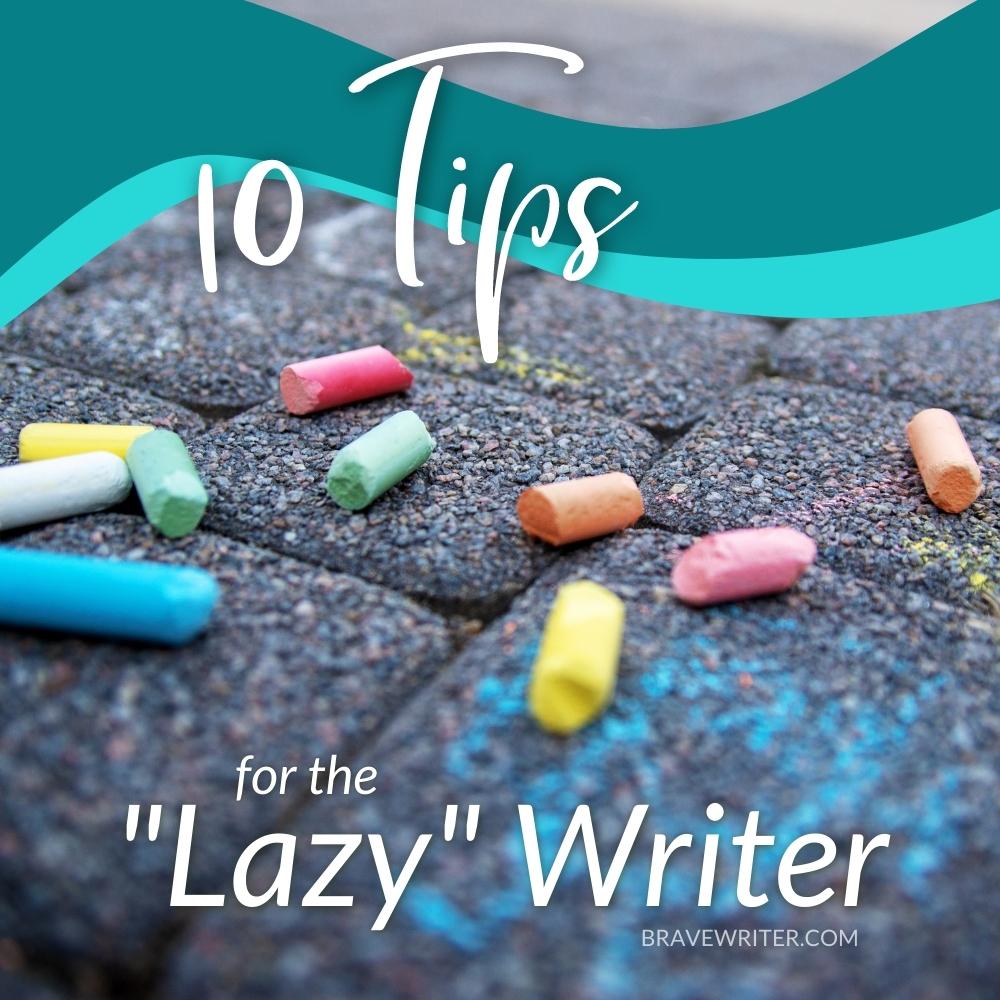
10 Tips for the “Lazy” Writer

10 Tips for "Lazy" Writer

There are tips, practices, tools, and helps that make writing easier. Don’t believe for a minute that your kids are lazy!

Ten ways to encourage writing today:

  1. Put out gel pens and black paper
  2. Instant Message or text with your child
  3. Light candles and listen to music while writing
  4. Write a sentence on a white board that is provocative yet unfinished, like: “If I could do whatever I wanted today, I would….”
  5. Write together (at the table, everyone at the same time)
  6. Write at the mall, jotting down fashion observations
  7. Give a shoulder massage before writing
  8. Comment on 3 status updates on social media
  9. Rewrite the ending to a favorite movie or book (make it melodramatic, sad, angry, happy, or include aliens!)
  10. Write on a clipboard, under a table, lying on a trampoline, up in a tree, with sidewalk chalk on the driveway

Writing is about freedom to express without the pressure that comes from straight jacket formats. Formats are only helpful once kids feel FREE to write.

Let me say it again: You can’t produce good writing that fits a format until you’ve spent hundreds of hours writing without caring one whit about format. Once you feel as easy writing as you do talking, formats are a snap of the fingers to teach and follow.

So play with words today.

Growing Brave Writers

Posted in Brave Writer Philosophy, Writing about Writing, Writing Exercises | 1 Comment »

What I hate about writing

DSCN8039.JPGI wrote in my journal this morning. Not a handwritten flower-covered lined paper book. No, I opened a Word doc and started typing. I find handwriting too slow and too painful, like many of your kids. Gosh, I can’t remember the last time I used handwriting for journaling.

Anyway, I was reading someone else’s blog this morning—a published someone, a someone with a book that’s popular right now, but who is also in my Facebook feed (I had to ask myself, “Are we friends? Have I met her?” I couldn’t remember). In any case, she’s clearly a writer. She has that “thing” that I associate with writerly writers—the cleverness, the snark, the sharing of personal experience in that candid, use-the-“f”-word-because-I’m-irreverent-and-it’s-2012 way. I do understand this.

I feel like I’ve been versions of that person. I remember taking breaks from journaling (I’ve kept a journal/diary since 4th grade). I would stop when my own writing nauseated me. I’d notice that I was more interested in the sound of my own voice than in the ideas. Or I’d notice that I was literally reading my writing back as I wrote, imagining how it would sound once I was dead and my fan-following had discovered this one unwritten journal and they were poring over my last insightful words. As those embarrassing images would slip into view, I’d clap the book closed and go on a journaling fast. It was a true fast—hard to stay with it, sneaking chances to write anyway (letters were always a great “diet cheat”).

This morning I felt fed up—with words, with thoughts, with being pushed to have new ideas or insights that pinged off someone else’s personal journey. So I wrote about it. Hypocrite. Here I am, doing the same danged thing. Writing about writing.

It’s like my number one pet peeve: song lyrics about songs. “I have to say I love you, in a song” or “This song’s for you,” or “So I wrote it down in a song.” Seriously. Sing a song… Don’t sing about singing a song.

Yet I’m writing about writing this morning.

And I just wanted to say that it’s okay with me if you’re not insightful when you write. I’d rather be bored than manipulated. I’d rather read about your day than about your cosmic revelation. In fact, I really really like reading about someone’s day and finding the take away for myself (you don’t need to tell me what I should take away). Sometimes it’s enough to sit next to someone else’s life around the Internet campfire and just be with it. Not every experience has to drip with meaning.

Sometimes there is no meaning. Sometimes one word in back of the other is all there is to write. Sometimes you don’t know what you mean until years later when you reread your old journals with horror and realize that you “knew” all along you were supposed to leave, but made excuses using contrived insight to make you stay.

What I hate about writing is that it teases you into believing your thoughts are important. They are. I say that to you every day here in Brave Writer. But they’re also astonishingly mundane… because we’re all the same essentially. Getting by on one word, one idea, one over-wrought insight at a time.

Have a good day. 🙂 (I included a photo with this post to cheer it up.)

Posted in Writing about Writing | 2 Comments »

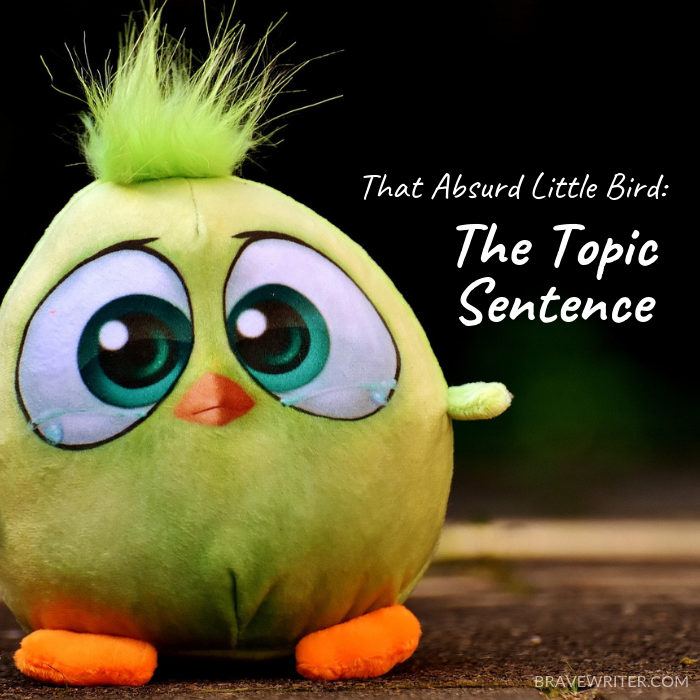
That Absurd Little Bird: The Topic Sentence

The Topic Sentence

If you want to see my dyed gray hair stand on end, talk to me about the importance of the initial topic sentence.

“My left earlobe is very attractive for three reasons.”

“I like anchovy ice cream more than pizza.”

“Captain Diaperpants is an entertaining book and I highly recommend it.”

Need I go on? ::yawn::

Truth is: The topic sentence is to the paragraph what support hose are to varicose veins. We don’t really want to be aware of the work they’re doing. They offer support, yes, but why announce that fact to the world? The best ones are hidden in the compelling-to-read prose.

I was lurking on the Internet and read a whole bunch of sample paragraphs on a writing site for homeschooled students. The curriculum writer stressed the importance of both the topic sentence and structured, orderly writing as hallmarks of correct writing. She then conceded that this kind of writing would be “stiff and stilted and even boring in most cases,” but it didn’t matter. Didn’t matter? In what universe? The point was to learn to write these orderly, cardboard, stiff, spiritless, uninspired, i-n-s-i-p-i-d paragraphs (::grinding teeth::) with duty and diligence no matter how painful to the reader.

Oh break my writerly heart!

Reverse the curse of the initial topic sentence.

Here’s how:

  • Start in the middle.
    Don’t tell me all I need to know in the first sentence. Once I find out that you are a black belt in karate, what interest do I have in reading how you earned the belt? Start with the struggle, facing the board as you prepare to sever it in half as with a cleaver. Leave me hanging out there, flapping in the breeze, worried and curious.
  • Get me involved.
    Use sensory detail to suck me into the scene without revealing your point until I’m hooked: “I sneezed when I leaned over the basket of cumin to examine it for bugs. The spicy fragrance reminded me of kasbahs and Moroccan stews. Unfortunately, I found myself in a modern Farmer’s Market in downtown Cincinnati instead. I miss North Africa.”
  • Put the main idea at the end of the paragraph.
    Most freewriting will start with a typical topic sentence that generalizes about the subject for writing. That’s fine when getting your thoughts together. To help hide the know-it-all sentence when you revise, move it to the end and see what happens. Like in the sample above—the topic sentence is last to appear. It’s so much happier modestly revealing itself at the end.

I know, I know. I didn’t even talk about the all important topic sentence in academic writing or in subsequent paragraphs. We’ll get to that another day.

For now, hook me, seduce me, scare me, move me, grab me by the collar, and don’t let me go. Lure me into your writing by concealing the point. That’s the point! (And that second-to-last sentence you just read, the one pretending not to be a topic sentence, is the topic sentence for this piece, artfully concealed until the end, incidentally…)

Groovy Grammar Workshop

Posted in Language Arts, Writing about Writing, Young Writers | 6 Comments »

« Older Entries
Newer Entries »
  • Search the Blog

  • Julie Bogart
  • Welcome, I’m Julie Bogart.

    I’m a homeschooling alum -17 years, five kids. Now I run Brave Writer, the online writing and language arts program for families. More >>

    IMPORTANT: Please read our Privacy Policy.

  • New to Brave Writer? START HERE

  • FREE Resources

    • 7-Day Writing Blitz
    • Brave Writer Lifestyle Program
    • Brave Writer Sampler: Free Sample Products
    • Freewriting Prompts
    • Podcasts
  • Popular Posts

    • You have time
    • How writing is like sewing
    • Best curriculum for a 6 year old
    • Today's little unspoken homeschool secret
    • Do you like to homeschool?
    • Don't trust the schedule
    • You want to do a good job parenting?
    • If you've got a passel of kids
    • You are not a teacher
    • Natural Stages of Growth in Writing podcasts
  • Blog Topics

    • Brave Learner Home
    • Brave Writer Lifestyle
    • Classes
    • Contests/Giveaways
    • Friday Freewrite
    • High School
    • Homeschool Advice
    • Julie's Life
    • Language Arts
    • Movie Wednesday
    • Natural Stages of Growth
    • One Thing Principle
    • Our Team
    • Parenting
    • Philosophy of Education
    • Podcasts
    • Poetry Teatime
    • Products
    • Reviews
    • Speaking Schedule
    • Students
    • Writing about Writing
    • Young Writers
  • Archives

  • Brave Writer is a participant in the Amazon Services LLC Associates Program, an affiliate advertising program designed to provide a means for sites to earn advertising fees (at no extra cost to you) by advertising and linking to amazon.com

    Content © Brave Writer unless otherwise stated.

What is Brave Writer?

  • Welcome to Brave Writer
  • Why Brave Writer Works
  • About Julie
  • Brave Writer Values
  • Frequently Asked Questions
  • Speaking Schedule

Brave Writer Program

  • Getting Started!
  • Stages of Growth in Writing
  • The Brave Writer Program
  • For Families and Students
  • Online Classes
  • Brave Writer Lifestyle

…and More!

  • Blog
  • Classroom
  • Store
  • Books in Brave Writer Programs
  • Contact Us
  • Customer Service
  • Brave Writer Staff
© 2026 Brave Writer
Privacy Policy
Children's Privacy Policy
Help Center