Writing about Writing Archives - Page 24 of 27 - A Brave Writer's Life in Brief A Brave Writer's Life in Brief
  • Start Here
    • For Families
      Multiple Ages
    • Ages 5-7
      Beginning Writers
    • Ages 8-10
      Emerging Writers
    • Ages 11-12
      Middle School Writers
    • Ages 13-14
      High School Writers
    • Ages 15-18
      College Prep Writers
  • Shop
    • Product Collections
    • Bundles
    • Writing Instruction Manuals
    • Literature & Grammar/Punctuation
    • Composition Formats
    • Literature Singles
    • Homeschool Help
    • Book Shop
    • Special Offers
  • Online Classes
    • Class Descriptions
    • Class Schedule
    • Classroom
    • How Our Classes Work
    • Our Writing Coaches
    • Classes FAQ
  • Community
    • Brave Learner Home
    • What’s Happening
    • Blog
    • Podcast
    • Calendar
    • Brave Writer Lifestyle
  • Cart
  • My Account
    • My Online Classes
    • My Account
  • My Account
    • My Online Classes
    • My Account
  • Start Here

    If you’re new to Brave Writer, or are looking for the best products for your child or family, choose from below:

    • For Families
      Multiple Ages
    • Ages 5-7
      Beginning Writers
    • Ages 8-10
      Emerging Writers
    • Ages 11-12
      Middle School Writers
    • Ages 13-14
      High School Writers
    • Ages 15-18
      College Prep Writers
  • Shop

    If you’re already familiar with Brave Writer products, go directly to what you’re looking for:

    • Product Collections Browse the full catalog in our shop
    • Bundles Everything you need to get started
    • Writing Instruction Manuals Foundational Writing Programs
    • Literature & Grammar/Punctuation Grammar, Punctuation, Spelling & Literary Devices
    • Composition Formats Writing Assignments for Every Age
    • Literature Singles Individual Literature Handbooks
    • Homeschool Help Homeschooling Tools and Resources
    • Book Shop Books associated with Brave Writer Programs
    • Special Offers
  • Online Classes
    • Class Descriptions
    • Class Schedule
    • Classroom
    • How Our Classes Work
    • Our Writing Coaches
    • Classes FAQ
  • Community
    • Brave Learner Home
    • What’s Happening
    • Blog
    • Podcast
    • Calendar
    • Brave Writer Lifestyle
  • Search
  • Cart

Search Bravewriter.com

  • Home
  • Blog

A Brave Writer's Life in Brief

Thoughts from my home to yours

Archive for the ‘Writing about Writing’ Category

« Older Entries
Newer Entries »

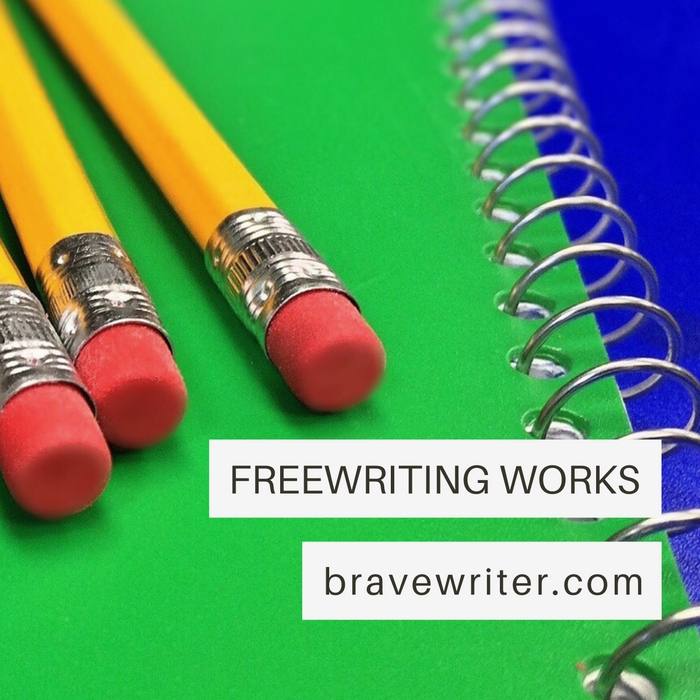
Freewriting Works

Freewriting Works

So I was sitting under an umbrella on my blue yoga mat on the concrete and soaked stands watching Liam play lacrosse. This is what mothers do. We sit in the cold rain and wind to watch our kids get blindsided by a high check to the helmet and slammed to the AstroTurf so that they only play five minutes of the 60 minute game. It is reassuring to have the coach call today to check up on Liam who is certain he cracked a rib (I’m still not sure, but he didn’t play again).

Powerless to mother Liam, once he was off the field sitting on a wet bench in the whipping high winds recovering from strep throat and dizziness (I know – ugh!), I took up a chat with the mom to my right. She’s a reading specialist in our local elementary school. Quickly she discovered that I homeschool and run a business that teaches writing. I so appreciated her next question:

“So do you have a philosophy of writing?”

Brilliant! I don’t think anyone in casual conversation has ever asked me that. I dove in: Peter Elbow? Freewriting? Nurturing your writer? Supportive, validating feedback?

No on Elbow, no on freewriting, but yes on nurturing and supportive feedback. Thus a discussion ensued where we compared notes on how to encourage kids to talk, to express thoughts, to get their ideas out of their heads and onto paper. As I explained how freewriting works, a mom two wet bleachers below us, wheeled around to interrupt.

“Excuse me, I couldn’t help over hearing you. Please don’t mind me. It’s just that freewriting changed my son’s life.”

“Oh really,” I replied, excited to hear her “testify”!

“In third grade, my son had a teacher who completely changed my son’s life. Well, his writing life anyway. She taught her students how to write to a timer, how to put their thoughts to paper regardless of how they came out. Suddenly my son who had been a reluctant writer found his voice! He learned to write!”

She went on, as only moms can. She let us know that today, in junior high, when he has an assignment to complete at home and is stumped by it, she only has to say the name of that teacher and the word “freewriting” and suddenly he will check into himself and start writing. She was utterly blown away by how powerful that one practice has been in his life for the last four years.

Needless to say, the reading specialist next to me took note! She followed this testimonial with questions for me, comparing notes on how she might improve her students’ freedom in writing and thinking. I loved her comments that while she spends a lot of time helping kids to “read aloud,” it occurred to her last week that what these kids really needed was someone to talk to about what they were reading. We brainstormed some questions she could ask and how she could encourage better comprehension.

Despite the freezing cold rain, the whole space felt warmer simply from savoring the idea that children are valuable and can be led into greater and greater self-expression through supportive, friendly conversation and, of course, freewriting.

Freewriting Prompts

Posted in Brave Writer Philosophy, Friday Freewrite, Writing about Writing | 3 Comments »

Do You Ever Teach Writing Formats to Young Children?

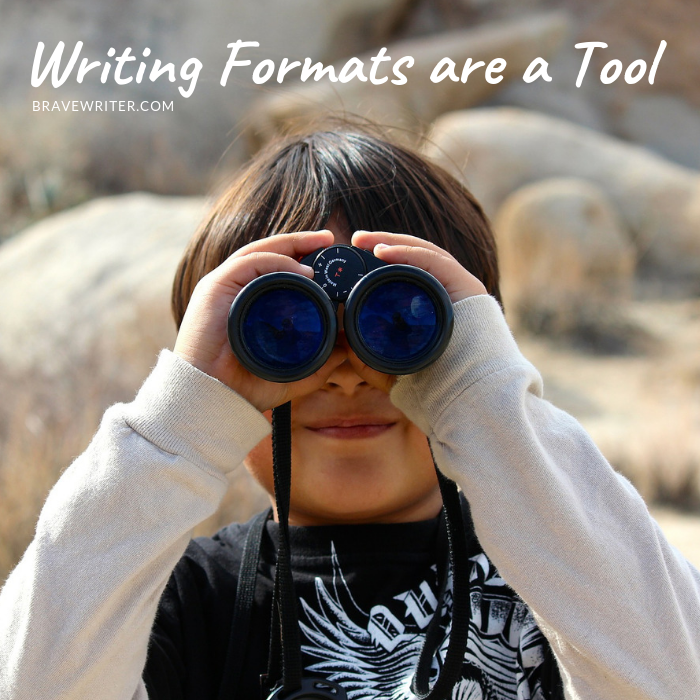
Writing Formats are a Tool

The process of learning writing formats is very similar to how we learn to speak.

One of our BW moms asked me this week about teaching formats to her daughter who is now comfortable with writing. Does the Brave Writer philosophy eschew with formats all together? Is there ever a time to identify a topic sentence, to explain a descriptive paragraph, to teach the difference between argumentative and narrative paragraphs?

The answer is most assuredly, “Yes.”

Writing involves the use of formats as surely as speech does. We often follow unconscious formats as we speak. We greet each other according to conventions we learn along the way, we answer the phone and give directions according to formats we’ve internalized after years of talking and emulating other speakers. Eventually, some of us make an effort to learn how to give a speech or business presentation. We are trained to make a sales pitch or to close a deal.

All of these speech formats come long after we’ve internalized speaking as a primary means of communication.

With writing, it works the same way. As your child shows confidence and competence in freewriting, revision and editing, it is perfectly fine to discuss writing formats and to even “give them a whirl.” Most formats can be found on the Internet (descriptive, narrative, expository and argumentative paragraph instructions proliferate).

The tendency (for unconfident parents and not quite convinced writers) is to forget about writer’s voice, freedom, saying something that is meaningful rather than regurgitating what is expected, when faced with formats. My advice is to see formats as a new tool to help shape your child’s original quirky self into a recognizable format.

“Writing formats are a tool to help shape your child’s original quirky self into a recognizable format.”

Click to Tweet

In other words, if you are writing a poem, rhyme is a common feature of poetry. Putting your thoughts into meter and end rhyme is part of the fun of that writing style. Likewise, if the writer’s topic lends itself to description, then focus on sensory observations and organize the writing around a journey through the senses rather than falling into the temptation to narrate an event or to explain how to peel an orange (rather than describing it). A descriptive paragraph is a paragraph whose focus is description… that means that it needs to show me, rather than tell me.

A format in writing acts as a kind of container for the original thoughts and metaphors that the writer brings to the topic. My suggestion for brave writers, then, is that freewriting, exercises like the keen observation or musical language assignments ought to precede the attempt to write to a format. Get lots of ideas, images, words, thoughts out onto the page before imposing a format. Then, take the format and see how the ideas your writer has put forth can be organized to suit a specific format. Rearrange, embellish, adapt and shuffle until the writing is both an expression of a person and fits into the desired format.


Tags: writing formats
Posted in Brave Writer Philosophy, Writing about Writing, Young Writers | Comments Off on Do You Ever Teach Writing Formats to Young Children?

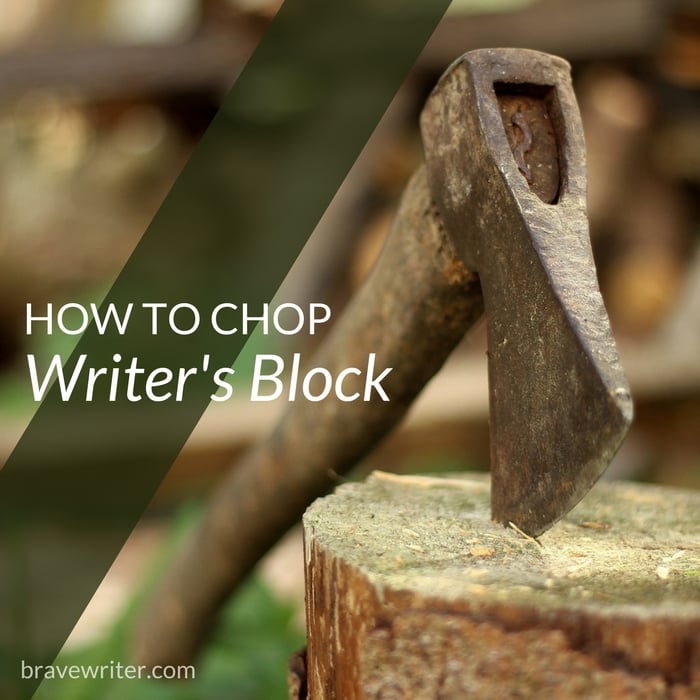
How to Chop Writer’s Block

How to Chop Writer's Block

Once you understand what Writer’s Block really is, you can chop it down to size and move on.

Everyone gets it. You do.

Professional writers do.

I do, regularly.

What is writer’s block? It’s the feeling of paralysis that hits you when faced with a blank page or blank screen. It’s that stuck moment where you can’t move past the last sentence. It’s the lurching sensation in your stomach. It’s the headache that sets in. It’s the urge to check email, start dinner, change laundry loads or pick up the phone to call your sister.

A lot has been written about writer’s block because it is such a universal problem.

Yet we rarely suspect that our kids are suffering from writer’s block. What is it that makes us assume that they are lazy, resistant, disobedient, unwilling, or bad writers when they say they have nothing to write about?

I suggest we reframe our thinking and ask ourselves, “Is my child suffering from writer’s block?” What if we make a huge leap and assume that the obstacle the child is facing is one that is common to writers everywhere of every age and skill level? Perhaps we will be moved to help “unblock” our young writers rather than feeling that we are somehow failing as writing instructors.

Writer’s block is nothing more than the sense that the attempt to produce writing will fail, will fall short of expectations.

Click to Tweet

Writer’s block is nothing more than the sense that the attempt to produce writing will fail, will fall short of expectations. These expectations come from lots of sources: teachers, parents, the publisher, the editor, the best friend, an Internet audience, customers, and perhaps the harshest critic of all: the self. We are not just blocked, we are afraid.

Here are a couple of tips for helping your kids through writer’s block.

  1. Be kind.
    Sympathize. Relate your own writing struggles. If you regularly struggle with writing yourself, choose to take the same risk as your child. Write together, at the same time. Pick a freewriting prompt and work through it in front of your child. Be sure to include the kinds of comments that you feel at the time (this is hard, I don’t like this, I wish I had something to say) so that your child knows it’s okay to do the same.
  2. Get physical.
    Rub your child’s shoulders, ask her to stand up and stretch, to flex and straighten fingers. If it helps, go for a brisk walk outside or take a few jumps on the trampoline. Run around the yard with the dog. Then come back to writing.
  3. Change locations.
    Go to a coffee shop and write there. Climb a tree and write while sitting in the branches. Lie on the floor and write. Go outside (if it’s a nice day) and write while sitting on a blanket. Write next to a window. Write in the basement. Write after standing on your head for thirty seconds.
  4. Use your eyes.
    If words won’t come, spend time thumbing through a magazine looking at pictures. Pull out an art book and look at the paintings. Look out a window. Walk through the house and find something new to see (something you haven’t noticed in awhile). Flip through a photo album. Hook up to the Internet and click through a website devoted to images. Look at the comics in your newspaper. Sometimes words will follow visual stimulation.
  5. Admit your feelings.
    The best way out is through. If you can’t get beyond the feeling of stuckness, it sometimes helps to say so and explore why or what is in the way. Some kids need to do this verbally (to write it out feels like torture). But for other kids, writing their frustration leads to the writing they do want to do. So allow for “venting” before serious writing.
  6. Tomorrow’s another day.
    Scarlett O’Hara may have been right. Sometimes it’s better to wait for the day to pass before writing again. Try tomorrow.

Of course, for chronic writer’s block, it may be that your child is recovering from previous bad experiences with writing. If that is the case, the best way out of that jungle is to retreat from writing to dictating. He talks and you write down what he says. He’ll need to rebuild his sense that what he has to say has value and deserves to be recorded and enjoyed.

Writers are not always writing; editing and revising take time too! If today is not a good one for generating original new content, consider that this might be a great day to work on something else that’s related, such as reworking an older draft.

Brave Writer Online Writing Class Powerful Fiction Techniques

Powerful Fiction Techniques is the ultimate class for experiencing what revision can do to pages of words. Discover the liberation and joy of revising your work!

If your teen has been wishing someone would help take his or her fiction to the next level, this class is for your passionate fiction writer or budding novelist!

Tags: cures for writers block
Posted in Writing about Writing | Comments Off on How to Chop Writer’s Block

« Older Entries
Newer Entries »
  • Search the Blog

  • Julie Bogart
  • Welcome, I’m Julie Bogart.

    I’m a homeschooling alum -17 years, five kids. Now I run Brave Writer, the online writing and language arts program for families. More >>

    IMPORTANT: Please read our Privacy Policy.

  • New to Brave Writer? START HERE

  • FREE Resources

    • 7-Day Writing Blitz
    • Brave Writer Lifestyle Program
    • Brave Writer Sampler: Free Sample Products
    • Freewriting Prompts
    • Podcasts
  • Popular Posts

    • You have time
    • How writing is like sewing
    • Best curriculum for a 6 year old
    • Today's little unspoken homeschool secret
    • Do you like to homeschool?
    • Don't trust the schedule
    • You want to do a good job parenting?
    • If you've got a passel of kids
    • You are not a teacher
    • Natural Stages of Growth in Writing podcasts
  • Blog Topics

    • Brave Learner Home
    • Brave Writer Lifestyle
    • Classes
    • Contests/Giveaways
    • Friday Freewrite
    • High School
    • Homeschool Advice
    • Julie's Life
    • Language Arts
    • Movie Wednesday
    • Natural Stages of Growth
    • One Thing Principle
    • Our Team
    • Parenting
    • Philosophy of Education
    • Podcasts
    • Poetry Teatime
    • Products
    • Reviews
    • Speaking Schedule
    • Students
    • Writing about Writing
    • Young Writers
  • Archives

  • Brave Writer is a participant in the Amazon Services LLC Associates Program, an affiliate advertising program designed to provide a means for sites to earn advertising fees (at no extra cost to you) by advertising and linking to amazon.com

    Content © Brave Writer unless otherwise stated.

What is Brave Writer?

  • Welcome to Brave Writer
  • Why Brave Writer Works
  • About Julie
  • Brave Writer Values
  • Frequently Asked Questions
  • Speaking Schedule

Brave Writer Program

  • Getting Started!
  • Stages of Growth in Writing
  • The Brave Writer Program
  • For Families and Students
  • Online Classes
  • Brave Writer Lifestyle

…and More!

  • Blog
  • Classroom
  • Store
  • Books in Brave Writer Programs
  • Contact Us
  • Customer Service
  • Brave Writer Staff
© 2026 Brave Writer
Privacy Policy
Children's Privacy Policy
Help Center