Writing about Writing Archives - Page 12 of 17 - A Brave Writer's Life in Brief A Brave Writer's Life in Brief
  • Start Here
    • For Families
      Multiple Ages
    • Ages 5-7
      Beginning Writers
    • Ages 8-10
      Emerging Writers
    • Ages 11-12
      Middle School Writers
    • Ages 13-14
      High School Writers
    • Ages 15-18
      College Prep Writers
  • Shop
    • Product Collections
    • Bundles
    • Writing Instruction Manuals
    • Literature & Grammar/Punctuation
    • Composition Formats
    • Literature Singles
    • Homeschool Help
    • Book Shop
  • Online Classes
    • Class Descriptions
    • Class Schedule
    • Classroom
    • How Our Classes Work
    • Our Writing Coaches
    • Classes FAQ
  • Community
    • Brave Learner Home
    • What’s Happening
    • Blog
    • Podcast
    • Calendar
  • Cart
  • My Account
    • My Online Classes
    • My Account
  • My Account
    • My Online Classes
    • My Account
  • Start Here

    If you’re new to Brave Writer, or are looking for the best products for your child or family, choose from below:

    • For Families
      Multiple Ages
    • Ages 5-7
      Beginning Writers
    • Ages 8-10
      Emerging Writers
    • Ages 11-12
      Middle School Writers
    • Ages 13-14
      High School Writers
    • Ages 15-18
      College Prep Writers
  • Shop

    If you’re already familiar with Brave Writer products, go directly to what you’re looking for:

    • Product Collections Browse the full catalog in our shop
    • Bundles Everything you need to get started
    • Writing Instruction Manuals Foundational Writing Programs
    • Literature & Grammar/Punctuation Grammar, Punctuation, Spelling & Literary Devices
    • Composition Formats Writing Assignments for Every Age
    • Literature Singles Individual Literature Handbooks
    • Homeschool Help Homeschooling Tools and Resources
    • Book Shop Books associated with Brave Writer Programs
  • Online Classes
    • Class Descriptions
    • Class Schedule
    • Classroom
    • How Our Classes Work
    • Our Writing Coaches
    • Classes FAQ
  • Community
    • Brave Learner Home
    • What’s Happening
    • Blog
    • Podcast
    • Calendar
  • Search
  • Cart

Search Bravewriter.com

  • Home
  • Blog

A Brave Writer's Life in Brief

Thoughts from my home to yours

Archive for the ‘Writing about Writing’ Category

« Older Entries
Newer Entries »

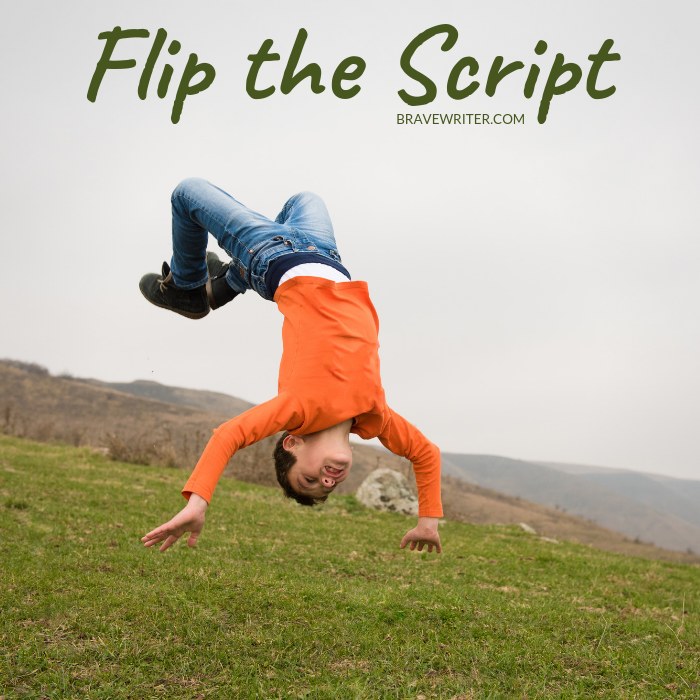
Flip the Script!

Flip the Script

A mother of ten called me to ask about writing. She had never heard of Brave Writer until a friend of hers shared about it enthusiastically. She wondered how it compared to her favorite writing program and why she should consider switching.

We had a great conversation. One of the issues that emerged in the phone call struck me as worth sharing here.

I want to say it to everyone.

It’s okay to use more than one writing program.

As you gain confidence in your home education abilities, what you’ll find is that it is your philosophy of learning and education that governs how you use any material you bring to your children. The curriculum will no longer be in charge. You will be.

So this mom shared how she used to be a slave to the rubric of the writing program she loved. Then one day her college-aged son told her that he had discovered in college that there was more to writing than formats or structure.

It was a moment for her. It changed how she saw writing. The next thing you know, she felt less worried about the rubric. When her next child wrote, she was okay with a few flaws in the final product and was more interested in the process that produced the paragraph.

As we chatted more, it became apparent that she had evolved a lot as a home educator in all these years. She is comfortable in her own skin, she feels free to switch things up for a change of pace to keep her own interest in homeschooling burning, she feels curious to try Brave Writer because she’s excited to have another set of tools to play with.

This is how it ought to be for all of us. It takes time to get there. You cling to the books and programs you trust at the front end of home education. But as it goes along, you evolve, you discover that you have opinions, you have children reporting their opinions, and you realize that YOU are in charge of how your kids move forward (not a book, not a theory, not a program).

Feel free to add other voices to your writing instruction. I’m one. But there are so many good ones out there! I recommend many of them in The Writer’s Jungle—the ones who’ve completely changed my life and my writing.

I always recommend reading published writers who write about writing. They’re usually hilarious and smart, cynical in all those delicious ways, and uniquely sympathetic to the struggle to confront a blank screen. You might also:

  • Join a writing support group.
  • Take a poetry class at the local community college.
  • Put your kids in the library poetry slam group!
  • Act out a scene of Shakespeare as a family, to ingest the language and amazing number of metaphors.
  • Buy a book of writing prompts and use those for your freewrites.
  • Learn to draw instead of write. Those processes are so similar in how they work with your brain, you’ll find that one informs the other and vice versa.
  • Read fan fiction. Write it!

Writing is so big. It’s much bigger than a book that tells you how to write an essay.

And remember: essay writing lasts for 8 years of your child’s life (9th grade through senior in college). If your kids go on to get an MA in the social science or humanities, it will go on a little longer. If he or she goes on to be a Ph.D., that means they like writing.

But for the rest of us, the shelf life of an essay in anyone’s life is two terms of a presidency. That’s it!

But writing—all the kinds we do all our lives—goes on for good! Get into it. Add new colors to your homeschool instruction. Don’t worry about “purity” of philosophy. Try stuff, see how it feels, keep what works, chuck what doesn’t.

Flip the script—see what’s on the back of the page.


Write for Fun: Fly High

Posted in Homeschool Advice, Writing about Writing | Comments Off on Flip the Script!

Value Your Child’s Voice

Value Your Child's Voice

We talk about writing voice in the writing process quite a bit in Brave Writer. We want the writing your kids do to sound like them—to have their vocabulary, inflection, quirky personality, and sense of humor. We don’t want them to sound like a copy of Aesop or the writer of X, Y, Z curriculum. We don’t want them to produce rote writing where no one can tell who wrote it, so devoid of voice it is.

So we start with freewriting.

But what happens when we give freedom to express and little shows up? What if what we find on the page is lifeless and dull, the utter opposite of what shows up in the bathtub or at an amusement park?

Even worse: what if what shows up really does in fact sound like your child, but it’s lifeless and dull (according to you) and feels like the barest beginnings of original thought?

So let’s back up a step.

“Writing voice” is two words. The real word we want to explore is “voice” all by itself.

Peter Elbow (my writing mentor) describes it this way:

“Most children have real voice but then lose it. It is often just plain loud: like screeching or banging a drum. It can be annoying or wearing for others. ‘Shhh’ is the response we get to the power of real voice.

“But, in addition, much of what we say with real voice is difficult for those around us to deal with: anger, grief, self-pity, even love for the wrong people. When we are hushed up from those expressions, we lose real voice.”

Here’s where we sometimes go wrong as parents. We are busy, our children are young and inexperienced. When they risk saying what they really think in the ways they want to really say what they think, we sometimes move into what I call “civilize the savages” mode. We are more worried about the appearance of what they say than what it is, in fact, they are saying.

If your children develop the habit of shutting down their real ideas, thoughts, preferences, wishes, and dreams around you, they will also turn off “real voice.” Then when you go to writing with them, they will turn to you and expect you to tell them what words ought to fill the page, just like they now wait for you to show them what thoughts are acceptable to say out loud.

Writing is a risk, but so is speaking. We must create space for both the prudent, acceptable, “makes Mama proud” words and the “Oh I hope she doesn’t really feel that way” words. We need to pause and let the rumble of language flow through our kids verbally and they must know that you are interested, receptive, and open-minded enough to hear it (without freaking out) in order for them to find their written voice.

You can start today:

Eye contact and a focused minute of conversation where you really hear what one of your kids is saying is the beginning of fostering an environment where what your child means to say becomes the norm for what is written.

You may have to change your own perceptions of what writing is too. It may be that you use an artificial voice when you write—the one the teacher told you sounded more grown up, or the one that keeps you from being perceived as impolite, or the one you use to project a cheery disposition.

Maybe you don’t even write because the risk feels too great and you avoid it.

Take some time to explore how much space there is in your self, in your children, and in your home to express authentic voice (verbally first, in writing second). See what you can do to expand that space…

Baby steps:

“You look angry—want to tell me about it? Want to yell about it?”

“Your giggly, silliness is cracking me up! I want to be as silly as you!”

“It’s okay to be really sad right now. Tell me about it.”

“I hate that too, sometimes.”

“You are so smart using all those big words!”

“I would love to hear you tell me more about that story! Go for it. I want every tiny detail.” (Instead of insisting on summary)

See what happens… I know for me, I have to put my phone down and walk away from the computer. I also find that it’s easy to tune out my kids when the topic doesn’t interest me or they are struggling to find the words. I have to remind myself to pay attention and to care. You can’t do it every time, but you can do it some of the time, for each child in a rotating way. Be mindful and conscious.


Brave Learner Home

Posted in Brave Writer Philosophy, Homeschool Advice, Writing about Writing | Comments Off on Value Your Child’s Voice

Revision is Not Editing

Revision is Not Editing

In Brave Writer, we separate the ideas of revision and editing. Revision is “casting new vision” for the original piece of writing. It’s a “re-imagining” of the original content. You have what you want to say, now you are considering all the various ways it can be said.

Your freewrite/draft is the jet stream of thought. It’s all of it rushing out of the writer onto the page willy-nilly.

Revision is not, now, taking that freewrite/draft and fixing commas or identifying run-on sentences. It’s not addressing tone or spelling mistakes. Those practices fall under the category of “copy-editing.”

Revision is that drastic over-haul type work that literally changes the draft sometimes so completely, the original is hardly recognizable in it any more (except maybe some sentences or the germ of the idea). Revision is where you hunker down and look at specific thoughts expressed insufficiently in the draft, and then determine how to expand them, how to enhance them, how to deepen the content or insight or facts-basis.

Revision IS writing.

In fact, most writers would say that revision is the craft, is the heart of being a writer.

What I find in parents (and even in those who claim to be writing instructors) is a tendency to skip this part of the process. They move right to editing and call it revision.

When asked to give revision notes or support, they draw a blank or they praise what’s good or they give general comments like, “Be sure you think about your audience” or “It’s a good idea to make sure your points are in a solid sequence.”

This kind of general feedback isn’t helpful to writers. What helps is to become a child’s creative partner. What you want to do, what you need to learn how to do, is how to create a dynamic partnership of idea generation.

For instance, you might see a flat-footed opening line (note: they are all flat-footed in the first draft – it’s completely rare that the first line stays the same in well revised writing). Your job isn’t to point out that it is flat-footed or could be revised. It isn’t to assign the task of making it better to your child. It’s literally to brainstorm ideas for improvements. Let’s say the child is writing about white water rafting, you might try something like this:

“I wonder how we can make this opening line grab the reader’s attention. Let me think, let me think. What if we start with the experience—Let’s get in the boat. Are you in it? What’s happening now? Close your eyes. What do you see? Blue? What shades?”

You’re jotting things down as they come out of your child’s mouth. Then you say:

“How about the water? I can imagine there’s a spray. Is there? Yes? Where did it hit? What is a water spray like? Does it remind you of anything? Oh good one! The spray of a garden hose when your brother aims it at you. Good one! Yes! Let’s jot that down.”

You’re wool-gathering. You’re collecting

  • images,
  • experiences,
  • thoughts,
  • curiosities,
  • comments,
  • ideas.

You aren’t telling your child what to do. You’re helping your child think freshly about what is already on the page. You are providing the dialog partner the way you would in conversation:

“Then what happened? Oh wait, how did you get there? That must have been amazing! What did your brother say?”

But now, you are focused on writing and you are providing the conversational partnership that your child’s writer needs. You are thinking in writing categories but having discussions about it (natural ones). You aren’t an English teacher. You are an interested friend, partner, ally.

Do you see the difference? Stop the generalizations and get into conversations. Help get those words out.

Then, when you go back to that opening sentence, you have a selection of things to choose from that might grab the reader’s attention. Together, you can find the one and write it in a way that makes magic.


Curious about Brave Writer?

Posted in Brave Writer Philosophy, Homeschool Advice, Language Arts, Writing about Writing | 5 Comments »

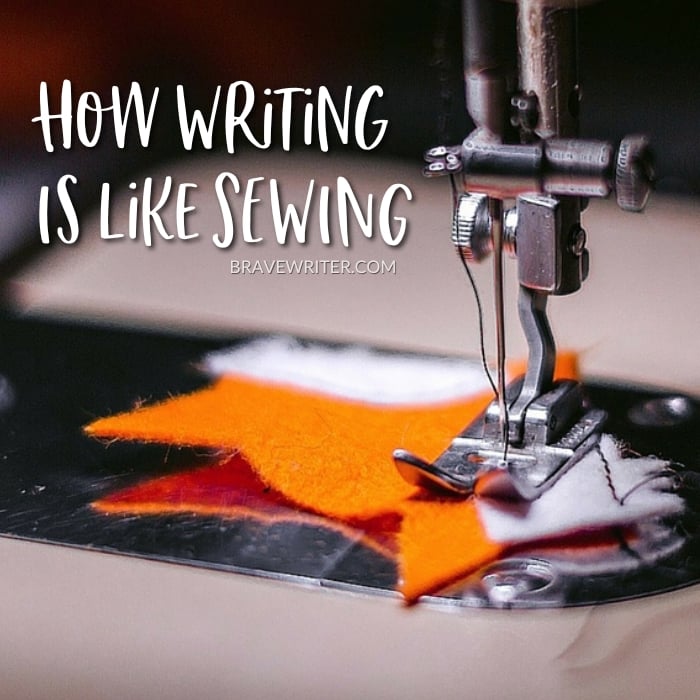
How Writing Is Like Sewing

Brave Writer How Writing Is Like Sewing

A fundamental confusion exists around how to teach writing. I’ve spent two decades looking for just the right metaphor to explain how a parent facilitates writing growth. Then the other day, on the phone, I stumbled upon a perfect metaphor.

Let’s look at learning to use a sewing machine.

A sewing machine makes it possible to create all kinds of sewing products—anything from hemming a pair of pants, to constructing a quilt, to producing an evening gown. The machine doesn’t do it for you. You have to know how to use the machine, and you have to develop skills: how to sew straight seams or how to drop in a sleeve or how to gather a drape. You need to learn how to create casings, and how to use the zig zag, and what the tension dial does.

When learning the skills needed for sewing, students start with scrap fabric. They don’t pick a dress pattern and then sit down to the machine. Usually they have to learn how to thread the needle and bobbin, they have to sew lots of straight lines and learn how to turn corners and how to backstitch the end of a seam so that it doesn’t unravel.

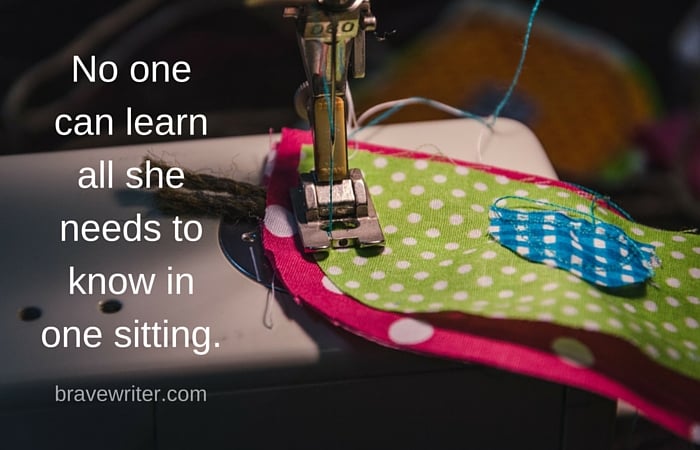
No one can learn all she needs to know in one sitting or even one year of sewing. There are levels of skill that are gained over time, as comfort with the machinery, and dexterity, and familiarity with the properties of sewing are internalized and mastered.

How Writing is like Sewing

But it is possible at each stage of development to introduce a little project. At first, these might be things like bean bags (squares) or a string dress (no pattern, but the dress uses casings). As the student gets comfortable, making an a-line dress for a doll from a pattern becomes possible and a thrill! Producing a doll quilt is the first step toward making one for a bed.

Eventually, the student of sewing learns tricks to make the process easier and faster. They can size up a pattern to know if it’s too difficult or too easy, and can make changes to make the pattern work.

Sewing is not about the dress patterns or quilts. Sewing is a set of skills that can be applied to patterns.

Let’s drive home the analogy to writing.

Firstly, the original writing process is discovered using scrap language—whatever is in the mind and mouth of the child at the time. The writing is interest-driven and exploratory. The child is gaining facility with the practice of accessing language, ideas, insights, and information from within and getting those words to the page in a variety of ways (all different styles of “language stitching”).

Secondly, the child learns to use the mechanics of writing similar to learning to use the sewing machine. How to thread the bobbin, how much pressure to put on the pedal, how to backstitch, how to zigzag, how to set up the buttonholer—these skills enable sewing. Similarly, the functional skills needed to run the machinery of writing are spelling, grammar, punctuation, handwriting and/or typing. And in Brave Writer, we believe that in the beginning that’s best learned through copywork (someone else’s writing).

Thirdly, students create writing projects which are the dress patterns of writing. Now that older children understand how the machine works and can use it with evolving skill, they can manage the demands of the machine, so it’s time to make a dress or placemat or quilt!

How Writing is like Sewing

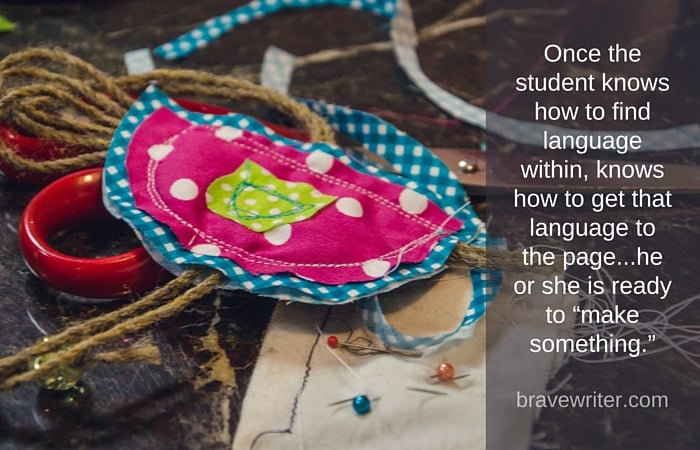
In writing, once the student knows how to find language within, knows how to get that language to the page, and how to handwrite, expand, revise, and edit it, he or she is ready to “make something” —to write a report or letter, to write a poem or a dialog, to write a story or ad copy, to write an essay.

The point is—don’t hand your brand-new-to-writing student the equivalent of an evening gown dress pattern and expect it to turn out right on the first try, just because there are “clear instructions.” Writing is a set of skills practiced independently of assignments, leading up to developmentally appropriate writing projects that reinforce and expand evolving skills.

3 components of a complete writing program:

  1. Mastery of the original writing process (Growing Brave Writers)
  2. Rehearsing the mechanics of writing (Quill, Dart, Arrow, Boomerang, Slingshot)
  3. Writing projects to put mechanics and original writing together (Jot it Down, Partnership Writing, Building Confidence, Help for High School, and Online Classes)
Brave Writer Products

Tags: Mechanics
Posted in Brave Writer Philosophy, BW products, Writing about Writing | 2 Comments »

It really is enough

The tricky part of homeschooling, and particularly writing, is that you can’t see the growth as it happens. Looking back shows you the growth. But looking back happens when they head off to college… or Europe, or get married. That feels a teensy bit late.

In other words, the very thing you need to reassure you that you are doing a good job with your kids is invisible to you as you do that “good job with your kids.” You’re required to put your faith in the process, rather than confidence in observable results. (Or, alternatively, you have to change how you measure what you see.)

  • It’s enough to read aloud to your kids, to have your children copy some of those words into a little notebook, to have them take a stab at writing some of those words without looking while you dictate them aloud. It’s enough if this happens once a week or 20 times in a year, and some years even fewer times.
  • It’s enough to catch a few of their brilliant thoughts or quirky ideas in writing for them, once in a while, so they know that what’s inside them deserves to be on paper too.
  • It’s enough to linger at dinner, discussing some topic like the puns in Seinfeld or why Pocahontas the Disney movie is both so good you want to keep watching it but so bad (if you compare it to history) that you feel guilty for loving it.
  • It’s enough to sing to your kids at bedtime once in a while or listen to their stories or to tell them some ridiculous saga you made up that goes on and on and stops making sense after a few weeks but you both love just the same.
  • It’s enough if your kids read and read and read the same book series over and over again and it seems like they will never discover another author as wonderful as JK Rowling or Brian Jacques or Suzanne Collins or Ian Fleming or Jeff Kinney. One day you’ll notice… oh hey! She’s reading another book by someone else.
  • It’s enough if you listen to what your kids say, if you have big juicy conversations about the stuff that interests them, if you laugh at funny sounding words and use absurdly big ones around them just to trick them and tickle their linguistic imaginations.
  • It’s enough if they read a little poetry, look up a few song lyrics, memorize a couple tongue twisters, learn to tell a few really funny jokes, and figure out the delicious humor of Will Shakespeare in one of his comedies (in a movie of course).
  • It’s enough if they cast their thoughts onto a page, freely, attending only to the ideas or the sound of the words, and know they have a receptive audience in you.
  • It’s enough if they play with other writing forms, if they learn how to mop up their own mechanics, if they attempt half a dozen essays in high school, figuring out what it means to have a point of view that they assert and then how to back it up because it matters to them.

We make it so difficult. We expect our kids to match some other agenda than the one that delivers them happily into an authentic writing life.

Less is more—less hand-wringing, fewer assignments, less control, less nagging, fewer criteria.

More is more—more conversations, more reading, more delight, more time, more space, more passion for language, more opportunities to play with words, language.

I’m here to help when you lose your nerve or your way.

Posted in Brave Writer Lifestyle, Homeschool Advice, Writing about Writing | 2 Comments »

« Older Entries
Newer Entries »
  • Search the Blog

  • Julie Bogart
  • Welcome, I’m Julie Bogart.

    I’m a homeschooling alum -17 years, five kids. Now I run Brave Writer, the online writing and language arts program for families. More >>

    IMPORTANT: Please read our Privacy Policy.

  • New to Brave Writer? START HERE

  • FREE Resources

    • 7-Day Writing Blitz
    • Brave Writer Lifestyle Program
    • Brave Writer Sampler: Free Sample Products
    • Freewriting Prompts
    • Podcasts
  • Popular Posts

    • You have time
    • How writing is like sewing
    • Best curriculum for a 6 year old
    • Today's little unspoken homeschool secret
    • Do you like to homeschool?
    • Don't trust the schedule
    • You want to do a good job parenting?
    • If you've got a passel of kids
    • You are not a teacher
    • Natural Stages of Growth in Writing podcasts
  • Blog Topics

    • Brave Learner Home
    • Brave Writer Lifestyle
    • Classes
    • Contests/Giveaways
    • Friday Freewrite
    • High School
    • Homeschool Advice
    • Julie's Life
    • Language Arts
    • Movie Wednesday
    • Natural Stages of Growth
    • One Thing Principle
    • Our Team
    • Parenting
    • Philosophy of Education
    • Podcasts
    • Poetry Teatime
    • Products
    • Reviews
    • Speaking Schedule
    • Students
    • Writing about Writing
    • Young Writers
  • Archives

  • Brave Writer is a participant in the Amazon Services LLC Associates Program, an affiliate advertising program designed to provide a means for sites to earn advertising fees (at no extra cost to you) by advertising and linking to amazon.com

    Content © Brave Writer unless otherwise stated.

What is Brave Writer?

  • Welcome to Brave Writer
  • Why Brave Writer Works
  • About Julie
  • Brave Writer Values
  • Frequently Asked Questions
  • Speaking Schedule

Brave Writer Program

  • Getting Started!
  • Stages of Growth in Writing
  • The Brave Writer Program
  • For Families and Students
  • Online Classes
  • Brave Writer Lifestyle

…and More!

  • Blog
  • Classroom
  • Store
  • Books in Brave Writer Programs
  • Contact Us
  • Customer Service
  • Brave Writer Staff
© 2026 Brave Writer
Privacy Policy
Children's Privacy Policy
Help Center