Describe your favorite way to snuggle up and fall to sleep. What rituals do you associate with sleeping?
Archive for the ‘General’ Category
Why Brave Writer online classes and discussions work
A funny thing happened to me this fall. Instead of teaching acting, like I used to at our local homeschool co-op, I now teach writing. This probably seems perfectly natural to you – that I would teach writing at the behest of our co-op families. However, I resisted this invitation for years. It was nice to take a break from writing on Mondays and to make use of those latent acting/directing skills. Plus, no papers to grade. I mean, honestly, that’s a no-brainer.
But after the co-op lost its high school writing teacher, I accepted their invitation to teach. This year I’ve got two in-person classes. We meet once per week. We use my materials. The kids have a syllabus to follow. I give them as much help and feedback on their writing as I can.
But what have I noticed? Their writing, while improving, does not improve as quickly as my online students’ writing does. Additionally, in class, student attention wanes, they treat the work we do together like assignments to get done, not a process to unfold. Likewise, in one of the two classes, these kids are very quiet. I have to use all my jokes, tricks and insider slang to get them to break out of their shells and speak up.
Online, I’ve been leading the Boomerang novel discussions all fall and for the last two weeks, Jon and I have team taught the Slingshot movie discussion. I have no eye contact, body language, visual aids or white boards to help me. We aren’t even all “in the same room” (online) at the same time. Students from around the world participate when and where they can – before swim meets, after finishing math, while listening to iPods, with the TV on in the background, flopped in a bed, poised over a family computer in the middle of the family room. In short, I have no control over the conditions under which they learn from me. I simply throw out questions and they respond when they can.
The difference between the two contexts and the results are striking!
First of all, there is no set class time when you learn online. Participants come and go when it is convenient to them. They don’t have to show up tired or hungry or distracted. They can come back later when they are ready to engage. It also means that there is something to read every day and often many times in one day: new questions, new responses, discussion between class members.
Second, all comments are written. That means that any response is required to be in writing. And yet because these discussions are not essays, the students don’t feel like they are writing. They feel like they are talking! That means that students are being led into written language to express their ideas, without having the consciousness of writing. That natural process of organizing and crafting sentences into a coherent thought (one that lasts longer than the few minutes it took to create it) leads to growth in formal writing. These conversations online are foundational to the healthy development of better essays.
Third, it’s easier to support a comment with a quote when you write it down. In my “in-person” classes, students have to come up with what they want to say instantly, on the fly, without time to flip through a book and find support for their answers. In the online discussions, students can read the question, leave the computer, flip through the book or rewind the DVD, think about their ideas, discuss them with mom or dad and then come back and post a response. They can quote directly from the text (or movie) to make their points. This practice is the bedrock of all academic writing. Yet in “in-person” classes, there is no space for this kind of exploration in writing. All writing projects tend to be polished essays. There’s no space for this unstructured written analysis.
Fourth, a camaraderie exists in online communities that I haven’t found in in-person classes. For one thing, it’s highly distracting to me as a teacher to have students chatting and making little jokes to one another when I’m in front of the room teaching. However, in an online context, students can start side conversations with each other which don’t distract at all from the main discussion. Students simply create a new thread for the topic of choice and those interested read and post. Meanwhile I can be explaining symbolism in another post and never be bothered by the side conversation.
Fifth, online discussions allow for a greater diversity of students than local classes. We have kids from around the world in our classes and discussions. Students from Australia, Canada and England are common enough, but we’ve also had kids from Thailand, Malaysia and Germany. Many of these are either military or missionaries, but their experiences abroad contribute to the diversity of opinions and input from which students benefit.
Lastly, I find online communication much more personal. There’s a tedium that sets in when I see a stack of twenty papers, all on the same topic, waiting for my feedback. I know that no matter what I write, only one student will see the words, read them and then file the paper unlikely to engage further with the feedback. Online, I give feedback that everyone reads. Multiple students benefit from every comment I make and more importantly, students respond to my feedback, asking for clarification, revising the portion that needed it and getting another follow up remark. In other words, online feedback is far superior to anything I can achieve in a live classroom. There’s hands-down no comparison.
It struck me as humorous this morning that online classes and discussions were so successful for the teaching of writing. We tend to think that if we have someone in person, we really have them, we really get what they want to convey. Yet my experience has been the opposite. In fact, I’d go so far as to say that teaching kids to write in a classroom is like trying to teach swimming without a pool. You can discuss all the strokes, you can show movies of how it’s done, you can have kids turn in movies of how they applied what you taught them… but if you never get in the pool together, your teaching will never be as relevant as you’d like.
Brave Writer classes and discussion groups are the swimming pool of writing. My teachers and I are in the water with your kids, swimming alongside, helping them with their strokes. We can see all their writing abilities up close and personal. And they get the fun of playing in the water, not just talking about it.
For more information about our winter class schedule, click here.
For more information about the Boomerang, our 7th-9th grade novel discussion group, click here.
How to Build a Snowman in Ten Easy Steps
At the beginning of September we reviewed some ideas together in The Writer’s Jungle. You will see which one inspired this piece… (There’s a writing sample in The Writer’s Jungle called “How to Make a Peanut Butter Sandwich” on which this piece is based.) The other day, Kimberly was in the bathroom. She rarely goes into the bathroom without a book or at least something to do. I think she thinks she can spend an undefined amount of time on the potty, well, because after all, she can’t help that she has to go! Well, this time she had gone in without a book and yelled to her sister, “Hey, Nicole! Bring me a piece of paper and a pencil and a book to write on!” I was only vaguely aware of what was going on.
It was only another trip to the bathroom for my bookworm, so I didn’t take much notice. I didn’t see the result of that trip until a couple of days later when she showed me what she had jotted down. I laughed. I enjoyed seeing my daughter on the paper. I was reading silently, but hearing her voice saying what I was reading. I was impressed that she would do this on her own and is finding ways to enjoy writing. She then typed it up and added all the flourishes to her work on the computer. She knows more about the computer than just about anyone in our home! She put together some PowerPoint presentations last year that were great, some academically inclined and some just for fun. She has produced some really great pieces of writing since KWB and since I have been able to learn so much through you and BW.
I was the one panicked at the beginning of the year about schedules and covering material. Since your responses in so many different ways, the blog, ScratchPad, personal responses from you and others and the One Thinging High School and the One Thing Copywork and Dictation course, things around here have changed SOOOO much for the better. My kids are much happier, they are learning more for learning’s sake and we are having fun doing it together.
Thanks so much for your inspiration and thoughtful teaching.
Sincerely,
Dona
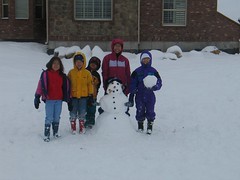
How to Build a Snowman in
Ten Easy Steps
by Kimberly McGuire
1. Beg your mom to let you go outside when there is plenty of snow on the ground.
2. Put all your outdoor clothes on and then sulk and whine because your little brother has to come outside with you. (You know that he will want to help you build your snowman and that leads to…well…disaster.)
3. Go outside and start gathering lots of snow and form it into a big round ball. This will be the base of your masterpiece.
4. Throw snowballs at your brother to keep him from jumping on the base of your snowman. Also, threaten him that “I’ll tell Mom!”.
5. Gather more snow and form it into a slightly smaller ball than the base. (Do this while your little brother is tattling on you.)
6. Make the snowman’s head pretending to listen to your little brother telling you that Mom said to be nice and…blah…blah…blah…blah.
7. Be kind to your brother and let him help you. (Let him do all the scouting around for things-all the hard work.) Tell him he must find two pieces of coal, five round stones that are not big, two sticks, one large carrot and five more round stones.
8. Sit down and relax. Watch your brother, the slave, complete his mission.
9. Use the two pieces of coal for the snowman’s eyes, the five stones for his mouth, the two sticks for his arms, the carrot for his nose and the extra five stones for his buttons. Enjoy your snow sculpture (also known as a snowman)!
10. Never mind. Complain because your brother decided that your snowman looked ugly, and so he threw a fit and punched it until it toppled over!!!