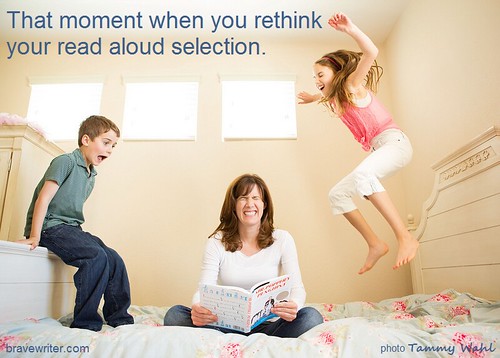
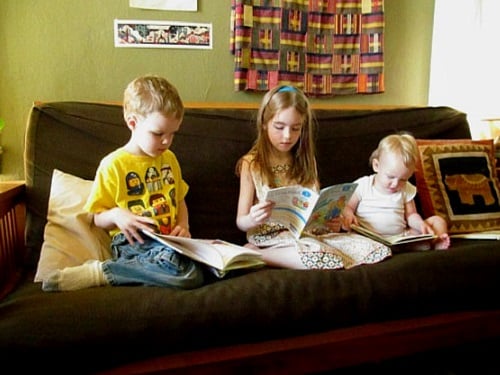
Image by Tammy Wahl. Used with permission.

Image by Tammy Wahl. Used with permission.
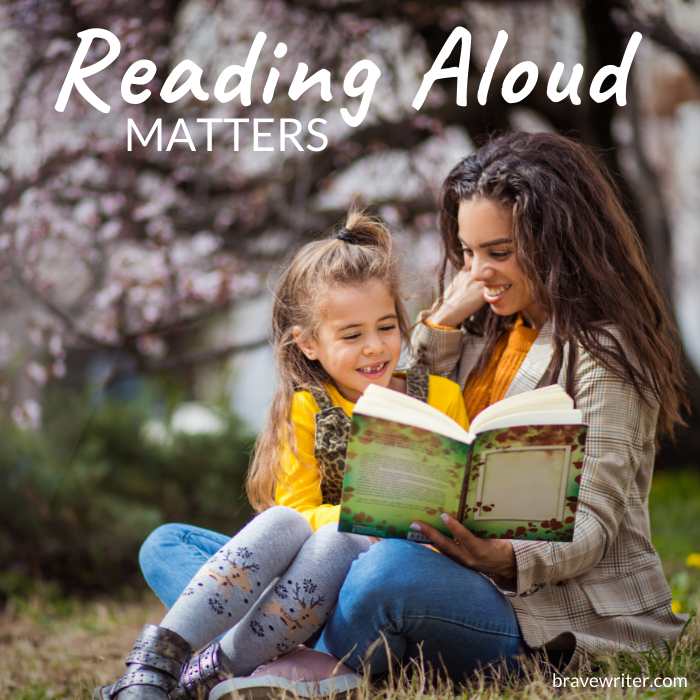
I spent hours of my adult life nestled in the corner of the sectional, feet tucked under me, with a book in my hands. Sometimes a baby sucked on a bulging breast at the same time, and one of those babies didn’t like to listen to my voice resonating through my chest cavity. Some well-timed nips to the nipples drove home that message. Ouch!
Other times a toddler couldn’t be calmed or a middler would knock over the orange juice onto the carpet and the book would get flung back into the library basket. Reading time over! Waving the white flag.
We made it a daily priority to read together for an hour. Read aloud time signaled the start to our homeschool day. It was the “coming together” of all of us of all the ages in all our stages, and it told us: “Yes, we homeschooled today.”
Over hummus and olives one Friday night in my friend’s kitchen (homeschoolers really rock the social scene), a bunch of my mom friends and I became animated as we swapped titles and our various reactions to the children’s novels we had read over nearly 10 years time. Better than a book club! We drank wine, we got misty over Anne of Green Gables, and had a wide variety of reactions to Moccasin Trail and Across Five Aprils.
We also laughed about the books that bored us but that thrilled our kids. For instance, I have no idea what happens in any Redwall book. I got through (operative phrase there) the first one (not as delighted by the woodland feasts and feisty creatures in chain mail as my kidlets), but then somewhere during the second installment, I discovered I could make a shopping list, consider the benefits of dying my hair, and respond to angry posters online all in my head while reading, without skipping a sentence. So I’d merrily read along and space out, until that one moment that was sure to give me away at the end of any given chapter:
“Mom what do you think is going to happen next?’
Blink. “Um…” I scrambled. “I have a hunch the bad guys are preparing to attack the Abbey.”
Yes! That is what they thought! They knew it!
And that, friends, is the correct answer to any question about plot in Redwall. You’re welcome. You may return to kitchen remodeling in your mind.
While in this vigorous conversation about kids’ lit, one of the moms made a remarkable statement:
“I can’t figure out how you all have time to read aloud. We never have time. That’s the one thing we’ve never done in all our years. I just don’t see how it could be fitted in.”
For a tense moment, you could have heard an olive drop to that tiled floor. We were stunned, because what quickly became clear is that there were even a few us (I plead guilty to this charge) who sometimes got little more done in a day than reading aloud. I couldn’t imagine what homeschool would be if you didn’t read books to your kids.
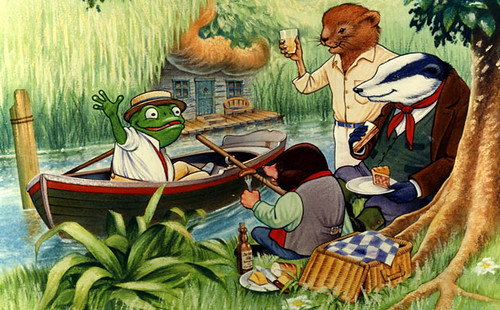
If I had been forced to supervise workbooks all day, every day, for 5 kids, for 17 years without fiction? Without discovering Seamus Heaney’s Beowulf or Robert Peck’s Soup? Not getting to read The Shadow Spinner or become enchanted by Toad and Mole and Badger in The Wind and the Willows?
My laundry basket of library books, the wide array of reading lists, the hours spent using my voice to share my emotional reactions in real time to the plights and adventures of heroes and heroines I grew to love as my own possession… This was/is the teaching that is/was homeschool to me… to us.
Homeschoolers rightly think reading to our children is about getting them to hear quality language or to learn about history in a story-format or to become familiar with great literature. It is those.
But it’s also this: When you read aloud, your children discover your values and your humanity. They see tears form in the corners of your eyes. They notice the catch in your throat as you describe a tender scene of connection between two estranged characters. They hear you roar with laughter over an inside joke or a cultural touchstone and they want “in” and expect you to help them “get it.”
And then you talk. About the book! About that awesome story and your surprise at the ending or how glad you are that it did end well. Forget that odious word “narration” for a moment (it has been used to drub tedious recounting out of children when a Big, Juicy Conversation will do so much more).
Reading aloud is the chief way in the homeschool you show who you are to your children—and they show themselves to you. It’s the core of education.
I can’t think of any more important practice in the homeschool than the sacred read aloud time.
Read to your children every day that you can. You won’t regret it.
Stuff Every Parent Needs to Know About Reading

Great phone call today. Here’s the gist:
Mom: What do I do when my son [age 11] retells the details of a book or movie or story, but he can’t tell me the overarching narrative that goes with it? Like he can’t say the main plot points. He rambles and gets caught up in details that are non-essential to the plot, but he tells them with so much accuracy and depth, I hate to stop him.
Adults summarize. They can pick out the main points and sequence them. They’ve read 1000s of stories, watched as many films, and are well aware of the narrative arc (plot diagram) by virtue of time on the planet and years logged reading/absorbing “story.”
Kids don’t have this background, and can’t summarize like you. They’re younger. Story is fresh for them. They are beguiled by subplots and character quirks and twists. They chase the shiny object called “weapons,” “cute puppies,” “sassy friends,” “weird creatures,” “magic spells” or “epic battles” and report all that is filling their imaginations to the brink of enthusiasm. When you ask them to tell you about the story, the most exciting, fascinating points overflow. They can’t “sort” the images and emotions. They aren’t likely to sequence events into the narrative arc. They retell the memorable moments, with detail, reliving them in front of you.
Of course, most adults have completely lost the ability to trap details to that extent. Our brains are too busy for detail. We save the important markers and ditch the quirky dialog or style of weaponry. Children can retell with amazing accuracy. We have too many digits, words, experiences, memories, obligations in the way of uncluttered retelling. We hang onto the big picture and file it under “mental notecard” – as in, if asked, this is what I share.
Being able to summarize is a fairly sophisticated skill. It is possible to cultivate, but please don’t think it a superior skill to retelling in detail. For now, here’s how I want you to proceed:
Start by listening, really closely. Ask real questions that help you understand who, what, where, and when as the child relates the particular scene. You can jot down the responses on separate sheets of paper per scene or image or dialog. Keep these on a table in front of you. Ask for key details (names, places, why such-and-such happened).
Print a plot diagram (a simple one).
Then, with these notes in front of you both, ask some of these questions to help sort the information just shared:
1. Pick up one of the stories: Did this event happen at the beginning, or in the middle, or near the end of the story/film/book? Move the note you took to the right place on the table along the narrative arc. Do that for each of the scenes you’ve jotted down.
2. Ask the child what moment decided the outcome (the climax)? It may be difficult to identify the single one (there are lots of sub-plots in most stories). But the BIG one happens near the end. So direct your child’s attention to the end of the plot line. You can even discuss ones that were important along the way, but weren’t the final key determining factor. That’s a good conversation to have!
3. Talk about the characters. Which character is the most important to the story (without whom, there would be no story)? It’s usually obvious, but not always! The main character is called “the protagonist” and that is the one who is a part of the climax. We figure out who is important by how much we care about what happens to that character. A guide to identifying that character, then, is “Whose story do we care the most about?” Of course, your child may love a character in the subplot, but then you can expand backwards and say, “Who do you think the author wants us to care most about?” That will help differentiate.
4. Now talk about the antagonist (the character that wants to thwart the goal of the main character). Who stands to gain by interrupting the progress of the protagonist?
5. Lastly, ask about the events your child narrated to you. Are these related to the protagonist’s plight? Or are they about side-kick characters? If they are “side-kick characters,” we call these scenes part of the “sub-plot.” A sub-plot keeps the story interesting, adds detail to the main plot, and supplies a distraction or complication when the author needs one. Figure out whether the memorable scenes are plot or subplot.

Once you’ve collected this data, see if you can put it in a meaningful whole. You might narrate back to your child all the information you’ve collected and demonstrate what it means to put it in sequence. Once you’ve done that, you can ask your child to correct you, add to it, or try his/her own hand at it! Overtime, you can ask the child to take over and create the narration from this material from scratch.
Work with what your kids give you! Help them sort it out. Model what it looks like when it matches what you are hoping to hear. Then give them the chance to do it, with your help.
Do not abandon your child to your expectations and then wring your hands when they fail. Teach! That’s your job and your privilege.
 Our Arrow Book Club provides an online discussion space for students (ages 10-12) to discuss literature using literary analysis vocabulary without the pressure of writing “essays.” Homeschool students especially need the chance to talk about what they read—-yet the busy mother-of-many doesn’t always have time to take the discussion to a written form.
Images: Children reading by Brave Writer mom, Kort / Girl reading on bed by Personal Creations (cc)