
Reading Archives - Page 8 of 8 - A Brave Writer's Life in Brief A Brave Writer's Life in Brief
  • Start Here
    • For Families
      Multiple Ages
    • Ages 5-7
      Beginning Writers
    • Ages 8-10
      Emerging Writers
    • Ages 11-12
      Middle School Writers
    • Ages 13-14
      High School Writers
    • Ages 15-18
      College Prep Writers
  • Shop
    • Product Collections
    • Bundles
    • Writing Instruction Manuals
    • Literature & Grammar/Punctuation
    • Composition Formats
    • Literature Singles
    • Homeschool Help
    • Book Shop
    • Special Offers
  • Online Classes
    • Class Descriptions
    • Class Schedule
    • Classroom
    • How Our Classes Work
    • Our Writing Coaches
    • Classes FAQ
  • Community
    • Brave Learner Home
    • What’s Happening
    • Blog
    • Podcast
    • Calendar
    • Brave Writer Lifestyle
  • Cart
  • My Account
    • My Online Classes
    • My Account
  • My Account
    • My Online Classes
    • My Account
  • Start Here

    If you’re new to Brave Writer, or are looking for the best products for your child or family, choose from below:

    • For Families
      Multiple Ages
    • Ages 5-7
      Beginning Writers
    • Ages 8-10
      Emerging Writers
    • Ages 11-12
      Middle School Writers
    • Ages 13-14
      High School Writers
    • Ages 15-18
      College Prep Writers
  • Shop

    If you’re already familiar with Brave Writer products, go directly to what you’re looking for:

    • Product Collections Browse the full catalog in our shop
    • Bundles Everything you need to get started
    • Writing Instruction Manuals Foundational Writing Programs
    • Literature & Grammar/Punctuation Grammar, Punctuation, Spelling & Literary Devices
    • Composition Formats Writing Assignments for Every Age
    • Literature Singles Individual Literature Handbooks
    • Homeschool Help Homeschooling Tools and Resources
    • Book Shop Books associated with Brave Writer Programs
    • Special Offers
  • Online Classes
    • Class Descriptions
    • Class Schedule
    • Classroom
    • How Our Classes Work
    • Our Writing Coaches
    • Classes FAQ
  • Community
    • Brave Learner Home
    • What’s Happening
    • Blog
    • Podcast
    • Calendar
    • Brave Writer Lifestyle
  • Search
  • Cart

Search Bravewriter.com

  • Home
  • Blog

A Brave Writer's Life in Brief

Thoughts from my home to yours

Archive for the ‘Reading’ Category

Newer Entries »

5 Ways to Encourage Reading

DSCN3202.JPG

Sometimes you love to read, your kids love to hear you read, and the whole family walks around with a nose in a book or up against the screen of a Kindle. But maybe your family has a kid or two or three who finds the work of reading a deterrent to actually doing it. They love stories—books on CD, movies, cartoons. They may enjoy comic books. But the sustained effort to read a novel is challenging. And being the conscientious wonderful parent that you are, you are now worried. What to do!

I have a few tips today to offer you. Feel free to add more in the comments.

1) Create a cozy reading space.
Hidey-holes are particularly popular. Pick a corner of a room where people are (no isolated space gets used in a homeschool family so make this space a part of the family activity), prop a pillow or two up against the wall and place one on the floor (a bean bag chair works too, or a futon). Next to the floor-level cushiony space, situate a basket with books in it (tempting ones, a range – fiction, non-fiction, short, long, easy, challenging). Next to the basket, add a small low table with a lamp on it. Or alternatively (to “up the cool factor”), put a clip light in the basket for the child to attach to the book itself to provide lighting. Be sure (if it’s winter where you are) to add a cozy blanket to snuggle under. Specify that the corner is for reading, not for any other activity. Any child may go there any time he or she wants to read, even if only for a couple of minutes. (In big families, you may need several hidey-holes—don’t forget hidey-holes under tables or near fireplaces or behind sofas, too.)

2) Write personal notes in the book that the child is going to read.
My daughter does this for siblings when she loans a book. She writes notes at particular moments in the story in the margins for the sibling to read. These might be comments like “Bet you didn’t see that coming!” or “Isn’t so-and-so a jerk?” or “Tell me when you get to this chapter so we can discuss. It’s so infuriating!” Knowing that these notes are in the margins waiting to be discovered can help a child sustain attention to keep reading just so he or she can see what you wanted to say to him or her.

3) Light a candle for “reading time.”
Everyone in the family reads while the candle is lit. Start with 5 minutes of silent, family reading and build over a period of weeks to 15 or 20. During the “reading time,” no one will get up to get a glass of juice or a snack for a sibling or child. No one will pull out the Legos and build a fort (unless you have some pre-readers who need to do something while everyone reads). When the candle is extinguished, reading time is over, talking and noise resume.

4) My mom’s tip for reading worked wonderfully for my siblings and me.
She sent us to bed at whatever bedtime was the current one. But she always told us we could stay up as late as we liked as long as we were reading in bed. This strategy had two benefits. First, we found ourselves reading every night because, in part, it meant we got to stay up late. Second, we wanted to go to bed to read to find out what happened after we fell asleep with the light on the night before—it made the whole “getting to bed” routine much less of a big deal and it turned all of us into readers!

5) Go to the library on a regular basis.
Even if you have digital books aplenty, there is something about walking through the stacks and getting to pick out your own books that makes the library a fabulous incentive for reading. Don’t worry if your child picks books and doesn’t read them or doesn’t finish them. The accumulation of information, language, and story from repeated visits, paging through books, reading some, ignoring others, will generate more reading later. Only good can come of it!
Posted in Brave Writer Lifestyle, Brave Writer Philosophy, Language Arts, Living Literature, Reading | 3 Comments »

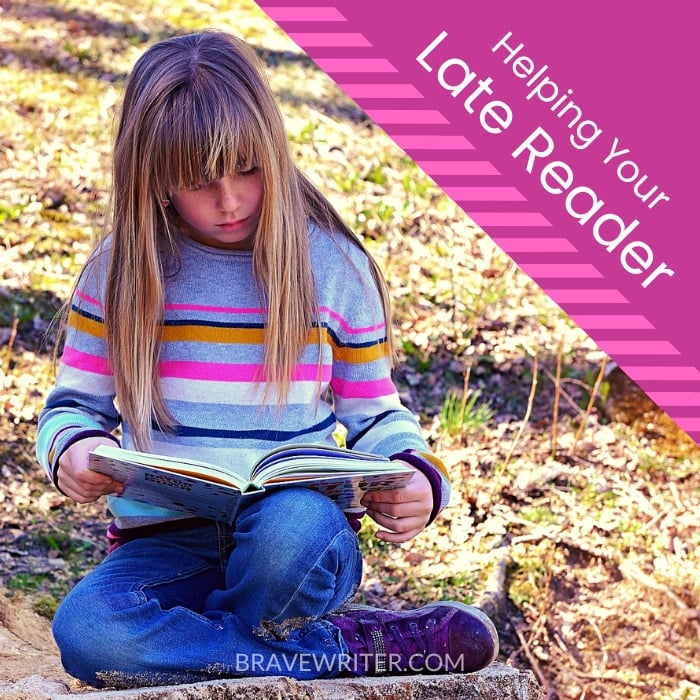
Helping Your Late Reader

Brave Writer Late Reader

Let’s look at what you can do with late readers in your family.

Your Child Is Not the Problem

First of all, don’t fall for the idea that if your kids were in school, they’d be reading. Plenty of kids fall through the cracks in school too, and many are put in the wretched position of having to be identified as poor readers by virtue of being gathered together into a late readers group! Not only that, the primary function of school is to get a group of kids to assimilate skills and information at about the same pace. That means falling behind is a problem to be solved. It means that your child is a problem to be solved. At home, there is no “falling behind.” Your child is not a problem. The only goal is to move at a pace that supports and affirms your child’s progress.

Second, reading is a challenging skill to adopt. It’s a bit like learning to ride a bike. At first, the reader’s “balance” is all off. The sounding out of certain letters comes quickly while putting them together, skipping silent ones, adjusting to capital letters after being used to lowercase (and vice versa) creates lots of stall outs (where you think your child has made progress and suddenly she slips back to bleary-eyed pauses). Support your daughter’s attempts by modeling sounding out, putting your finger under the letters, affirming good attempts, and so on. Just like training wheels.

On bikes, some kids use training wheels a lot longer than they need to. They like the security. Same with reading. Your children may prefer to put their own fingers under the letters, may like to look to you for confirmation that they are sounding out correctly, they may memorize certain pages of a book to help them “feel” like they are reading. These acts are all part of a normal progression toward reading and are not to be dismissed.

The Breakthrough Moment

Eventually, a breakthrough moment occurs and your child will “get it.” In fact, when a child catches onto reading, he skips all kinds of phonetic steps and is suddenly reading digraphs and several syllable words that you never taught him because he “caught” on to what reading is, feels like. Just like bike riding – a sudden balance. You only learn to read once. It’s a kind of art and skill that can be transferred to any language, any alphabet once mastered. It does happen for just about everyone who attempts it, if they persist in their attempts to get it.

Still, if your child hasn’t caught on by 8, 9 or 10, panic is totally reasonable! I’ve lived it. The trick is to not shame your child into reading. I know this approach doesn’t work because I’ve tried it. It’s too easy to criticize your child as not trying hard enough, not paying attention, ignoring your perfectly clear explanations for how letters make sounds that blend together. But with a motivated a child? A child who wants to read but is not successful? What are the odds that he or she is being willfully resistant or lazy? Totally unlikely! In fact, if anything, a mounting internal pressure is growing. Shaming your child for failure adds to that pressure and makes it even harder to learn!

Think of it this way: you shouldn’t shame your child for not yet reading the same way you wouldn’t shame your child for bedwetting. It’s hard enough to be a kid who can’t read at 9 years old! There are plenty of kids in Sunday school, on the soccer team, at the slumber party who can read, who can play board games with cards, who can fill out forms and read billboards and menus, to remind your non-reading children that they not yet successful.

Your job is to support your child through this difficult passage by reminding her that she will definitely, most assuredly, absolutely read one day. That a day is coming and will come when reading will “click,” and on that day, you will have the most fabulous celebration! Until then, here’s what you will do to help.

1. Try various phonics programs.

Don’t assume that one didn’t work so none will work. A process of elimination is a good idea. Listen to your child. If he or she doesn’t like a program, then that’s a clue that it’s not right for that child.

2. White boards are wonderful.

Write short notes or single words and leave those up for a day. You might even try all sound alike words (we did this a lot). Listing sound alike words like cat, hat, mat, fat, bat then reading them, then looking for those items to tag in the house with the words can be a way to jump start the process of putting sounds with letters with items.

3. Take extended breaks.

Don’t keep pushing, pushing, pushing. If you reach a threshold, take a week or month off. Tears, resistance, and more tears are your clue that a break is a must! Take it.

4. You might try a different alphabet.

I know this sounds absurd. But see if you can approximate for your own experience the struggle it is to read and sound out by forming words with the Greek alphabet, for instance. It may help you to remember what you have to do to remember which letter makes what sound. If you struggle with your child, you’ll be on the same team (not one who knows it all and one who knows nothing).

5. Reward all progress.

Hugs, kisses, laughter, cookies. Then take a break.

6. Intercede for your child.

If you know your kid will be in a context with readers and reading matters to the context, give a private head’s up to the leader (Brownies, Sunday School, art class, piano lesson, camping trip). Ask the leader not to call on your child to read anything aloud, and ask the leader to assign someone as a buddy to your child to do the reading on his or her behalf. If you forget to do this, you may face the uncomfortable moment where a leader mocks your child as pretending not to be able to read to get out of group work. I’ve experienced this and it is painful and horrific so don’t forget to prepare the circumstance to support your 9, 10 year old who can’t yet read!

7. Read to your non-reader every day.

Keep the joy of reading uppermost! Help your child experience the pleasure of reading vicariously so that the motivation to work on it remains high.

8. Get help from a language and reading specialist.

I did it for two of my kids and that help (the amazing Rita Cevasco of Rooted in Language) was invaluable! If your child is really struggling then it’s well worth the money to have an expert analyze and offer you some strategies you may not have tried yet.

Hope these help!


Stuff Every Parent Needs to Know About Reading


Growing Brave Writers

Posted in Brave Writer Philosophy, Learning Disabilities, Reading | Comments Off on Helping Your Late Reader

Newer Entries »
  • Search the Blog

  • Welcome to Brave Writer!

    Help your kids make breakthroughs in writing. Brave Writer, founded by Julie Bogart, helps parents raise confident writers through freewriting, copywork, dictation, living literature, Poetry Teatime, and more!

    IMPORTANT: Please read our Privacy Policy.

    Start here.

  • FREE Resources

    • 7-Day Writing Blitz
    • Brave Writer Lifestyle Program
    • Brave Writer Sampler: Free Sample Products
    • Freewriting Prompts
    • Podcasts
  • Popular Posts

    • You have time
    • How writing is like sewing
    • Best curriculum for a 6 year old
    • Today's little unspoken homeschool secret
    • Do you like to homeschool?
    • Don't trust the schedule
    • You want to do a good job parenting?
    • If you've got a passel of kids
    • You are not a teacher
    • Natural Stages of Growth in Writing podcasts
  • Blog Topics

    • Brave Learner Home
    • Brave Writer Lifestyle
    • Classes
    • Contests/Giveaways
    • Friday Freewrite
    • High School
    • Homeschool Advice
    • Julie's Life
    • Language Arts
    • Movie Wednesday
    • Natural Stages of Growth
    • One Thing Principle
    • Our Team
    • Parenting
    • Philosophy of Education
    • Podcasts
    • Poetry Teatime
    • Products
    • Reviews
    • Speaking Schedule
    • Students
    • Writing about Writing
    • Young Writers
  • Archives

  • Brave Writer is a participant in the Amazon Services LLC Associates Program, an affiliate advertising program designed to provide a means for sites to earn advertising fees (at no extra cost to you) by advertising and linking to amazon.com

    Content © Brave Writer unless otherwise stated.

What is Brave Writer?

  • Welcome to Brave Writer
  • Why Brave Writer Works
  • About Julie
  • Brave Writer Values
  • Frequently Asked Questions
  • Speaking Schedule

Brave Writer Program

  • Getting Started!
  • Stages of Growth in Writing
  • The Brave Writer Program
  • For Families and Students
  • Online Classes
  • Brave Writer Lifestyle

…and More!

  • Blog
  • Classroom
  • Store
  • Books in Brave Writer Programs
  • Contact Us
  • Customer Service
  • Brave Writer Staff
© 2026 Brave Writer
Privacy Policy
Children's Privacy Policy
Help Center