Podcasts Archives - Page 5 of 127 - A Brave Writer's Life in Brief A Brave Writer's Life in Brief
  • Start Here
    • For Families
      Multiple Ages
    • Ages 5-7
      Beginning Writers
    • Ages 8-10
      Emerging Writers
    • Ages 11-12
      Middle School Writers
    • Ages 13-14
      High School Writers
    • Ages 15-18
      College Prep Writers
  • Shop
    • Product Collections
    • Bundles
    • Writing Instruction Manuals
    • Literature & Grammar/Punctuation
    • Composition Formats
    • Literature Singles
    • Homeschool Help
    • Book Shop
    • Special Offers
  • Online Classes
    • Class Descriptions
    • Class Schedule
    • Classroom
    • How Our Classes Work
    • Our Writing Coaches
    • Classes FAQ
  • Community
    • Brave Learner Home
    • What’s Happening
    • Blog
    • Podcast
    • Calendar
  • Cart
  • My Account
    • My Online Classes
    • My Account
  • My Account
    • My Online Classes
    • My Account
  • Start Here

    If you’re new to Brave Writer, or are looking for the best products for your child or family, choose from below:

    • For Families
      Multiple Ages
    • Ages 5-7
      Beginning Writers
    • Ages 8-10
      Emerging Writers
    • Ages 11-12
      Middle School Writers
    • Ages 13-14
      High School Writers
    • Ages 15-18
      College Prep Writers
  • Shop

    If you’re already familiar with Brave Writer products, go directly to what you’re looking for:

    • Product Collections Browse the full catalog in our shop
    • Bundles Everything you need to get started
    • Writing Instruction Manuals Foundational Writing Programs
    • Literature & Grammar/Punctuation Grammar, Punctuation, Spelling & Literary Devices
    • Composition Formats Writing Assignments for Every Age
    • Literature Singles Individual Literature Handbooks
    • Homeschool Help Homeschooling Tools and Resources
    • Book Shop Books associated with Brave Writer Programs
    • Special Offers
  • Online Classes
    • Class Descriptions
    • Class Schedule
    • Classroom
    • How Our Classes Work
    • Our Writing Coaches
    • Classes FAQ
  • Community
    • Brave Learner Home
    • What’s Happening
    • Blog
    • Podcast
    • Calendar
  • Search
  • Cart

Search Bravewriter.com

  • Home
  • Blog

A Brave Writer's Life in Brief

Thoughts from my home to yours

Archive for the ‘Podcasts’ Category

« Older Entries
Newer Entries »

[Podcast #335] How to Build Mathematical Imagination Through Everyday Life, Play, and Curiosity

Brave Writer Podcast

What if math felt less like drudgery and more like discovery? 

In this Brave Writer podcast episode, we explore “mathematical imagination” and the many ways math is already alive in everyday family life. We talk about counting, measuring, predicting, sports, video games, art, nature, and how curiosity can turn numbers into something meaningful.

We also share practical ways to make formal math time more inviting, from manipulatives and mystery-based activities to math tea times and even bubblegum math. If you’ve ever wanted to help your child experience math as a language for describing the world, this conversation is for you. 

Tune in, then come tell us what math looks like in your home.

Show Notes

For many of us, math was taught as a subject of procedures: memorize the facts, follow the steps, get the answer. It often felt detached from daily life, as though numbers only mattered on worksheets and tests.

But math is far more alive than that.

Math is one of the ways we describe the world. It helps us make sense of time, quantity, distance, proportion, patterns, and change. When we begin to see it that way, math becomes less about performance and more about perception. It becomes a way of noticing.

That shift can change everything for our kids.

Math is already happening

One of the gifts of homeschooling is that we are not limited to a single hour of “math time.” We live with math all day long. We check the clock. We divide food fairly. We estimate how long something will take. We compare measurements, track the weather, count steps, budget money, and notice patterns in nature.

Children encounter mathematical ideas long before they can explain them formally. A young child counting toes, sorting objects, or asking whether thumbs are fingers is already exploring categories, quantity, and comparison. A child measuring sunflower growth or guessing how many windows are in the house is practicing estimation and observation. These are not distractions from math. They are the beginning of it.

When we treat these moments as meaningful, we help our children build a relationship with math that starts in curiosity rather than anxiety.

Make math tangible and relevant

Children understand ideas more deeply when they can touch them, test them, and connect them to something they care about.

That might look like using edible manipulatives for multiplication, baking to explore fractions and measurement, or weighing ingredients on a kitchen scale. It might look like comparing Fahrenheit and Celsius, noticing patterns in flower petals, or graphing how many leaves fall from a tree over the course of a week.

It may also show up in places we do not immediately recognize as academic. A child playing Minecraft may be calculating resource efficiency. A child managing a farm simulation game may be comparing rates of return. A sports-loving child may already understand scoring systems, percentages, and statistical comparisons better than we realize.

The point is not to force a lesson onto every interest. It is to notice where math already matters and help our children make that connection consciously.

Wonder matters as much as practice

Of course, children do need practice. Some parts of math require repetition, concentration, and patience. Not every lesson will feel magical.

But understanding grows best when it is supported by meaning.

When children can see what math is for, the formal work begins to make more sense. The symbols are no longer floating in space. They are attached to real experiences, real questions, and real discoveries.

This is why prediction, mystery, and surprise can be so powerful. Estimating how many beans are in a jar, wondering whether your wingspan matches your height, or mapping the solar system across your neighborhood invites children into math through fascination. They want to know the answer because the question belongs to them.

That is a very different posture than simply finishing a page.

Create an environment that invites attention

Sometimes the activity itself is hard. When that happens, we can still make the experience more welcoming.

A special snack, a candle, a clipboard, a favorite seat by the window, a cup of tea, a small ritual before beginning. These quiet choices can transform the emotional atmosphere around math. Children are more willing to stay with challenging work when the environment feels calm, personal, and pleasant.

We do not need to make every lesson entertaining. But we can make room for comfort, dignity, and delight.

Help children see the world mathematically

What we want is bigger than correct answers. We want children to notice patterns, ask questions, compare systems, make predictions, and understand relationships. We want them to see that math is not a disconnected school subject but one of the tools humans use to interpret reality.

When we nurture mathematical imagination, we are doing more than teaching arithmetic. We are helping our children become more observant, more thoughtful, and more confident in the face of complexity.

Math does not have to begin with a workbook.

It can begin with a question, a game, a measuring tape, a recipe, a sky full of stars, or a child who wants to know why.

Resources

  • Explore the Journey North Mystery Class archives
  • Encounter solar system planet sizes and distances in this fun activity
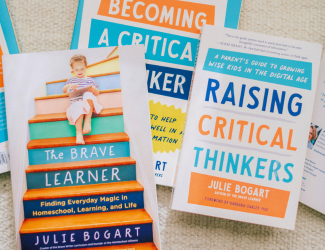
  • Find our favorite books for kids and parents in the Brave Writer Book Shop
  • Visit Julie’s Substack to find her special podcast for kids (and a lot more!) 
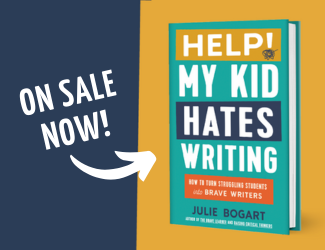
  • Purchase Julie’s newest book, Help! My Kid Hates Writing
  • Find community at the Brave Learner Home 
  • Learn more about the Brave Writer Literature & Mechanics programs
  • Start a free trial of CTCmath.com to try the math program that’s sure to grab and keep your child’s attention
  • Subscribe to Julie’s Substack newsletters, Brave Learning with Julie Bogart and Julie Off Topic, and Melissa’s Catalog of Enthusiasms
  • Sign up for our Text Message Pod Ring to get podcast updates and more!
  • Send us podcast topic ideas by texting us: +1 (833) 947-3684
  • Interested in advertising with us? Reach out to media@bravewriter.com

Connect with Julie

  • Instagram: @juliebogartwriter
  • Threads: @juliebogartwriter
  • Bluesky: @bravewriter.com
  • Facebook: facebook.com/bravewriter

Connect with Melissa

  • Website: melissawiley.com
  • Substack: melissawiley.substack.com
  • Instagram: @melissawileybooks
  • Bluesky: @melissawiley.bsky.social

Produced by NOVA

Brave Writer Podcast

Posted in Podcasts | Comments Off on [Podcast #335] How to Build Mathematical Imagination Through Everyday Life, Play, and Curiosity

[Podcast #334] Rescuing Reluctant Writers: Brave Writer Online Classes

Brave Writer Podcast

What if an online writing class didn’t mean Zoom fatigue, rigid schedules, or one more thing to manage?

In this Brave Writer podcast episode, Melissa Wiley talks with Kirsten Merryman about what makes Brave Writer’s online classes so different: asynchronous discussions, text-based coaching, warm instructor feedback, and a structure that makes room for all kinds of learners.

We explore:

  • how real writing growth happens,
  • why parents learn right alongside their kids,
  • and which classes might be the best fit for your family, from Story Switcheroo to Essay Prep.

Kirsten Merryman is Brave Writer’s Vice President of Operations and former director of online classes. She is also a longtime homeschooler, writing coach, and curriculum creator who has helped shape Brave Writer’s approach to supporting both parents and young writers.

Join us to discover how writing support can feel personal, practical, and surprisingly freeing.

Show Notes

What Makes Writing Instruction Actually Work?

Every homeschooling parent has felt it: your child has something interesting to say, but the moment writing begins, the struggle starts.

What should be an act of expression can quickly turn into frustration, avoidance, or tears. It can feel tempting to focus on the obvious fixes, grammar, punctuation, spelling, structure. But what if strong writing begins somewhere else entirely?

The truth is, writing growth doesn’t start with correction. It starts with connection.

When children feel safe to put words on the page, when they know a reader is genuinely interested in what they mean, writing begins to open up. That shift can change everything.

Writing Is More Than Mechanics

It’s easy to think of good writing as clean writing.

We want our kids to use correct punctuation, organize their thoughts, vary sentence structure, and produce polished final drafts. Those skills matter. They help writing communicate clearly.

But mechanics are not the heart of writing.

The heart of writing is having something to say and believing it is worth saying. Children need space to discover their ideas before they can refine them. They need to experience writing as communication, not just as a performance of correctness.

That’s why messy first drafts matter. Real writers do not sit down and produce polished work in one pass. They draft, rethink, revise, and shape their language over time.

When we expect children to do everything at once, think of something meaningful, express it clearly, spell it correctly, punctuate it properly, and organize it neatly, we often make writing feel heavier than it needs to be.

Response Builds Confidence

One of the most powerful things we can offer young writers is a real reader.

When someone responds to a child’s writing with interest, something shifts. A comment like “This made me laugh,” or “I can really picture this,” or “You taught me something here,” does more than encourage. It helps the child see that writing has a purpose.

They are not just completing an assignment. They are reaching another human being.

That kind of response builds confidence. It also teaches. When children hear what is working in their writing, they begin to recognize their own strengths. They start to notice voice, detail, humor, rhythm, and insight.

This is often more useful at the beginning than a long list of corrections.

Once a child feels invested in their own words, revision starts to make sense. Improving the writing no longer feels like punishment. It feels like making something meaningful stronger.

Practical Ways to Support Writing at Home

Small shifts in how we respond to writing can make a big difference.

One helpful practice is to read as a reader first. Before correcting anything, notice what stands out to you.

You might:

  • point out a vivid word or phrase
  • mention a line that made you smile
  • reflect back an idea that felt strong or surprising
  • ask a curious question about something they wrote

Another useful approach is to separate drafting from editing. Let your child get the ideas out first. Save grammar, spelling, and punctuation for later passes.

It also helps to let children write about topics they truly care about. When a child is invested in the subject, they are far more willing to stay with the process.

Even reluctant writers often have strong opinions, deep interests, or a quirky sense of humor waiting to show up on the page.

The Real Goal

Many of us were taught to approach writing as correction first. We learned to look for what was wrong before we noticed what was alive.

But strong writing instruction begins by helping children experience themselves as writers.

That means noticing effort. It means honoring risk. It means looking for the spark in a rough draft and trusting that polish can come later.

Our goal is not simply to produce error-free papers.

Our goal is to help children develop fluency, ownership, and confidence so they can grow into writers who know they have something to say.

And when that happens, the mechanics become easier to teach, because the child is no longer just trying to finish.

They are trying to communicate.

Resources

  • Explore our upcoming Brave Writer class schedule
  • Got questions about classes? Reach out to us at help@bravewriter.com
  • Find our favorite books for kids and parents in the Brave Writer Book Shop
  • Visit Julie’s Substack to find her special podcast for kids (and a lot more!) 
  • Purchase Julie’s new book, Help! My Kid Hates Writing
  • Find community at the Brave Learner Home 
  • Learn more about the Brave Writer Literature & Mechanics programs
  • Start a free trial of CTCmath.com to try the math program that’s sure to grab and keep your child’s attention
  • Subscribe to Julie’s Substack newsletters, Brave Learning with Julie Bogart and Julie Off Topic, and Melissa’s Catalog of Enthusiasms
  • Sign up for our Text Message Pod Ring to get podcast updates and more!
  • Send us podcast topic ideas by texting us: +1 (833) 947-3684
  • Interested in advertising with us? Reach out to media@bravewriter.com

Connect with Julie

  • Instagram: @juliebogartwriter
  • Threads: @juliebogartwriter
  • Bluesky: @bravewriter.com
  • Facebook: facebook.com/bravewriter

Connect with Melissa

  • Website: melissawiley.com
  • Substack: melissawiley.substack.com
  • Instagram: @melissawileybooks
  • Bluesky: @melissawiley.bsky.social

Produced by NOVA
Brave Writer Podcast

Posted in Podcasts | Comments Off on [Podcast #334] Rescuing Reluctant Writers: Brave Writer Online Classes

[Podcast #333] Resisting FOMU, the Fear of Messing Up

Brave Writer Podcast

What if the biggest obstacle in your homeschool isn’t what you’re missing—but the fear that you’re doing it wrong?

This week on the Brave Writer podcast, we explore “fear of messing up” and how perfectionism quietly shapes our expectations, decisions, and confidence as parent educators.

We unpack:

  • where that pressure comes from,
  • how it shows up (hello, endless curriculum switching),
  • and why chasing the “perfect” method keeps us stuck.

We also share practical ways to shift your focus toward connection, curiosity, and process—plus tools like interval training and a flexible writing app to support real learning.

Ready to trade perfection for progress? Let’s rethink what success actually looks like.

Show Notes

Let Go of Getting It Right

Every homeschooling parent has felt it: the quiet worry that you might be doing it wrong.

You plan carefully, choose materials thoughtfully, and try to create meaningful learning experiences. But then your child resists, or something doesn’t click, or you see another family doing it differently—and suddenly, doubt creeps in.

What if that fear isn’t a sign you’re failing—but a sign you’ve been taught to expect perfection?

Much of us were shaped by systems that measured success by correctness. One hundred percent. Right answers. Completed work. Over time, we internalized the idea that learning should look polished and predictable.

But real learning rarely looks like that.

The Myth of the “Right Way”

It’s easy to assume there’s a correct path through education—a sequence of subjects, skills, and milestones that guarantees success.

Once you start homeschooling, that assumption quickly unravels.

Different philosophies emphasize different things. Some prioritize structure and sequence. Others focus on curiosity and exploration. Even school systems don’t agree on what should be taught or when.

There is no universal roadmap.

That realization can feel unsettling at first. But it also offers relief. If there isn’t one right way, then you’re free to respond to the learners in front of you.

The goal shifts from “getting it right” to “paying attention.”

Process Over Outcome

When we fixate on outcomes—reading by a certain age, mastering a concept on schedule—we start to measure every moment against a future result.

That creates pressure. And pressure often leads to frustration for both parent and child.

Learning happens in the present.

It happens when your child wrestles with a problem, asks a question, or makes a connection. It happens in the middle of the attempt, not just at the moment of success.

When we focus on process instead of outcome, we begin to notice those moments. We see growth where we once saw gaps.

And we create space for learning to unfold.

The Trap of the Endless Quest

One common response to uncertainty is to keep searching for something better.

A new curriculum. A different method. A promising system that seems like it might finally make everything work.

But constant switching often creates more disruption than progress.

Children need time to settle into a rhythm. What looks imperfect on the surface may actually be working just fine underneath.

Before changing course, it helps to ask: is something truly broken, or am I reacting to discomfort?

Sometimes the most productive choice is to stay the course.

Building Competency and Confidence

If perfection isn’t the goal, what is?

A more helpful aim is competency and confidence.

  • Competency grows through practice, variation, and time. It doesn’t require flawless performance—just steady engagement.
  • Confidence grows when children feel safe to try, struggle, and try again. Mistakes become part of the process, not evidence of failure.
  • Progress includes missteps. Choosing a program that doesn’t work or hitting resistance in a subject is information, not failure.
  • Growth happens when we stay responsive—adjusting, supporting, and continuing forward rather than starting over.

This applies to us as well.

We are learning how to homeschool in real time. We will choose materials that don’t fit. We will have days that feel off. We will question our decisions.

None of that means we’re doing it wrong.

It means we’re in the middle of learning.

The Long View

There will be moments that feel like missteps. A program that didn’t work. A subject that took longer than expected. A season that felt unproductive.

But those moments are not the whole story.

Learning is built over time—through repetition, adjustment, and lived experience.

What matters most is not whether every decision was perfect, but whether you stayed engaged, responsive, and willing to keep going.

That’s where growth happens.

And that’s more than enough.

Resources

  • Pacemaker: pacemaker.press
  • Julie’s Substack post on this topic: http://juliebogart.substack.com/p/fomu-fear-of-messing-up
  • Find books mentioned in this episode in the Brave Writer Book Shop
  • Brave Writer class registration is open! 
  • Visit Julie’s Substack to find her special podcast for kids (and a lot more!) 
  • Purchase Julie’s new book, Help! My Kid Hates Writing
  • Find community at the Brave Learner Home 
  • Learn more about the Brave Writer Literature & Mechanics programs
  • Start a free trial of CTCmath.com to try the math program that’s sure to grab and keep your child’s attention
  • Subscribe to Julie’s Substack newsletters, Brave Learning with Julie Bogart and Julie Off Topic, and Melissa’s Catalog of Enthusiasms
  • Sign up for our Text Message Pod Ring to get podcast updates and more!
  • Send us podcast topic ideas by texting us: +1 (833) 947-3684
  • Interested in advertising with us? Reach out to media@bravewriter.com

Connect with Julie

  • Instagram: @juliebogartwriter
  • Threads: @juliebogartwriter
  • Bluesky: @bravewriter.com
  • Facebook: facebook.com/bravewriter

Connect with Melissa

  • Website: melissawiley.com
  • Substack: melissawiley.substack.com
  • Instagram: @melissawileybooks
  • Bluesky: @melissawiley.bsky.social

Produced by NOVA
Brave Writer Podcast

Posted in Podcasts | Comments Off on [Podcast #333] Resisting FOMU, the Fear of Messing Up

« Older Entries
Newer Entries »
  • Search the Blog

  • Julie Bogart
  • Welcome, I’m Julie Bogart.

    I’m a homeschooling alum -17 years, five kids. Now I run Brave Writer, the online writing and language arts program for families. More >>

    IMPORTANT: Please read our Privacy Policy.

  • New to Brave Writer? START HERE

  • FREE Resources

    • 7-Day Writing Blitz
    • Brave Writer Lifestyle Program
    • Brave Writer Sampler: Free Sample Products
    • Freewriting Prompts
    • Podcasts
  • Popular Posts

    • You have time
    • How writing is like sewing
    • Best curriculum for a 6 year old
    • Today's little unspoken homeschool secret
    • Do you like to homeschool?
    • Don't trust the schedule
    • You want to do a good job parenting?
    • If you've got a passel of kids
    • You are not a teacher
    • Natural Stages of Growth in Writing podcasts
  • Blog Topics

    • Brave Learner Home
    • Brave Writer Lifestyle
    • Classes
    • Contests/Giveaways
    • Friday Freewrite
    • High School
    • Homeschool Advice
    • Julie's Life
    • Language Arts
    • Movie Wednesday
    • Natural Stages of Growth
    • One Thing Principle
    • Our Team
    • Parenting
    • Philosophy of Education
    • Podcasts
    • Poetry Teatime
    • Products
    • Reviews
    • Speaking Schedule
    • Students
    • Writing about Writing
    • Young Writers
  • Archives

  • Brave Writer is a participant in the Amazon Services LLC Associates Program, an affiliate advertising program designed to provide a means for sites to earn advertising fees (at no extra cost to you) by advertising and linking to amazon.com

    Content © Brave Writer unless otherwise stated.

What is Brave Writer?

  • Welcome to Brave Writer
  • Why Brave Writer Works
  • About Julie
  • Brave Writer Values
  • Frequently Asked Questions
  • Speaking Schedule

Brave Writer Program

  • Getting Started!
  • Stages of Growth in Writing
  • The Brave Writer Program
  • For Families and Students
  • Online Classes
  • Brave Writer Lifestyle

…and More!

  • Blog
  • Classroom
  • Store
  • Books in Brave Writer Programs
  • Contact Us
  • Customer Service
  • Brave Writer Staff
© 2026 Brave Writer
Privacy Policy
Children's Privacy Policy
Help Center