[Podcast #348] Kids Don’t Learn the Way You Think They Do
What if educational rigor isn’t about children sitting still, pushing through tedium, and finishing every worksheet without complaint?
In this Brave Writer podcast episode, we reimagine rigor as a meaningful challenge: the kind children willingly embrace when the goal matters to them. From math games and secret codes to bird lists, comics, Pokémon tea time, and writing that reaches an interested audience, we explore how hard work becomes inviting when it is rooted in:
- play,
- connection,
- and curiosity.
We share practical ways to build reading, writing, handwriting, spelling, math, and science skills without draining the joy from learning.
Join us as we rethink what rigorous learning can look like at home.
Show Notes
Rigor That Feels Like Play
What do we mean when we say we want a “rigorous” education for our children?
Too often, rigor gets mistaken for stamina in the face of tedium. A child sits still. A child finishes the page. A child copies the sentence, corrects the punctuation, completes the math problems, and does it all without complaint. We breathe a sigh of relief. Surely learning happened.
But children show us another version of rigor all the time.
Watch a child learn to skateboard. Watch them try a video game level again and again. Watch them build a dam in the gutter, invent a secret code, memorize Pokémon stats, or spend an hour trying to make the perfect paper airplane. Children are not afraid of hard work. They are afraid of hard work that seems pointless.
That distinction matters.
The question is not, “How do we make our children do difficult things?” The better question is, “What makes the difficulty worth it?”
A child learning to read may not care about fluency as an abstract future goal. But they may care very much about reading a comic strip, decoding a Pokémon card, finding out what the sign says, or reading a note left on their bedroom door. A child who resists handwriting may suddenly painstakingly write bird names in a field journal because those birds “count” only if they write them down. A child who groans over copywork might happily label the whole house in a fantasy language or secret code.
That is rigor. Not because it looks impressive on paper, but because the child is investing effort, attention, and persistence in a meaningful challenge.
Find the Living Context
Our work as home educators is to identify the skill, then find the living context where that skill matters. Reading, writing, spelling, math, observation, memory, narration, revision, and critical thinking do not have to live inside isolated worksheets. They can live inside board games, read-alouds, homemade mailboxes, whiteboard jokes, audiobooks, captions, nature journals, family games, poetry teatime, and the elaborate worlds our children are already building.
This does not mean we abandon skill-building. It means we stop confusing correction with growth. A child who misspells a word, stumbles over a line, or writes a thin sentence is not failing. They are still falling off the beam. Our job is not to stand at the bottom with a red pen. Our job is to stay close enough to say, “You got me interested. I want to hear more.”
Feedback is most useful when the child can do something with it right away. Connection keeps the learning alive.
We do not need to explain the academic value of every playful moment. Children do not need to hear, “This is one-to-one correspondence” while moving a game piece across a board. They do not need a lecture on geology before smashing sequins into clay to see how pressure changes what is hidden inside. We can notice the learning quietly. We can write it down later.
The brave learner is not only the child. It is us.
We are learning to observe. To adapt. To enter the play. To make the next challenge just interesting enough that the child reaches for it.
That is the kind of rigor that lasts.
Resources
- Learn a new language with Talkbox! Try it out at talkbox.MOM/brave
- Join us for our free Brave Writer Summer Camp on July 22nd and 23rd!
- Find our favorite readalouds and nonfiction in the Brave Writer Book Shop
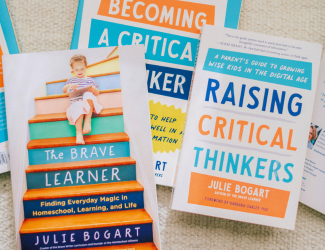
- Registration begins July 20 for Gamers Write! Minecraft Edition, Becoming a Critical Thinker, and other awesome Brave Writer classes!
- Visit Julie’s Substack to find her special podcast for kids (and a lot more!)
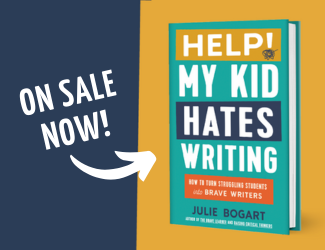
- Purchase Julie’s new book, Help! My Kid Hates Writing
- Find community at the Brave Learner Home
- Learn more about the Brave Writer Literature & Mechanics programs
- Start a free trial of CTCmath.com to try the math program that’s sure to grab and keep your child’s attention
- Subscribe to Julie’s Substack newsletters, Brave Learning with Julie Bogart and Julie Off Topic, and Melissa’s Catalog of Enthusiasms
- Sign up for our Text Message Pod Ring to get podcast updates and more!
- Send us podcast topic ideas by texting us: +1 (833) 947-3684
- Interested in advertising with us? Reach out to media@bravewriter.com
Connect with Julie
- Instagram: @juliebogartwriter
- Threads: @juliebogartwriter
- Bluesky: @bravewriter.com
- Facebook: facebook.com/bravewriter
Connect with Melissa
- Website: melissawiley.com
- Substack: melissawiley.substack.com
- Instagram: @melissawileybooks
- Bluesky: @melissawiley.bsky.social
Produced by NOVA