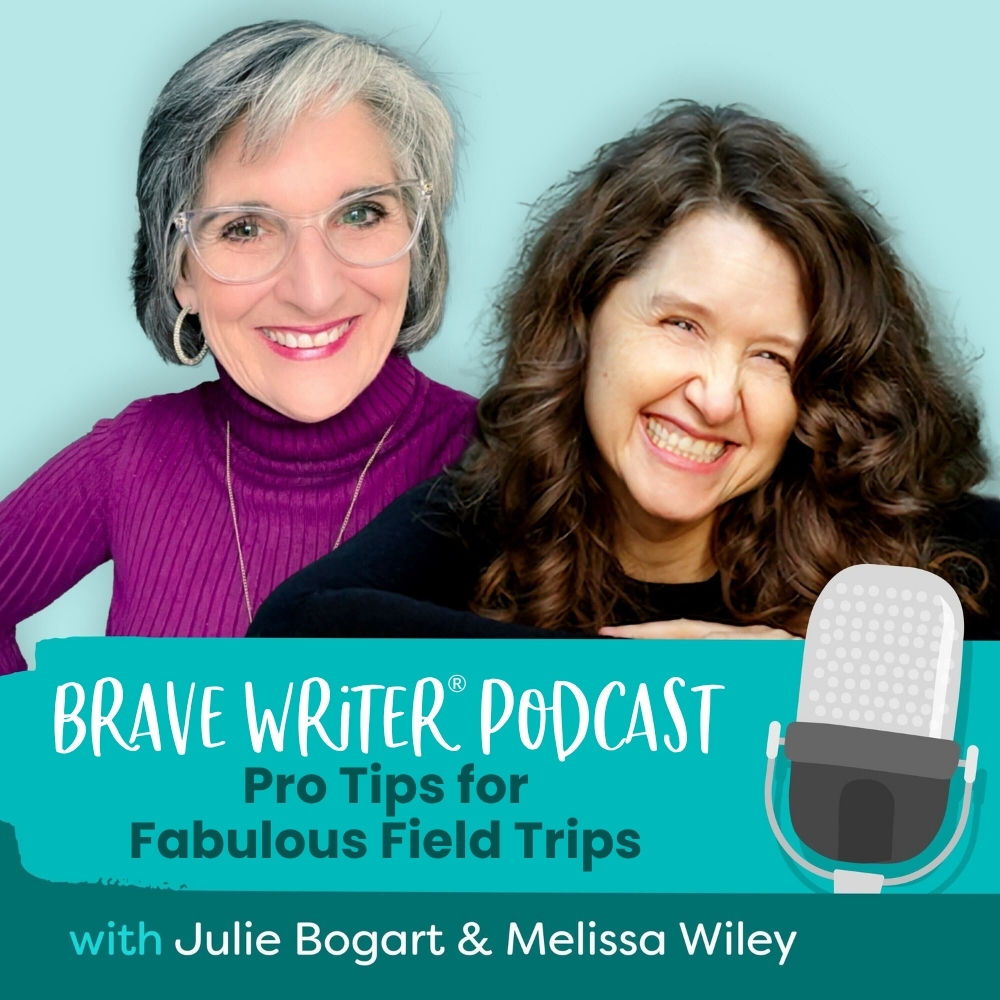
[Podcast #350] Pro Tips for Fabulous Field Trips
What if some of the richest learning in your homeschool happened after you walked out the front door?
In today’s Brave Writer podcast episode, we explore how to plan family outings that turn science, history, art, literature, music, sports, and local culture into hands-on experiences.
We share:
- what to pack in a reliable go-bag,
- how to prepare children for unfamiliar environments,
- and why a little advance exposure can make an outing more exciting.
You’ll also hear dozens of affordable field-trip ideas, from factory tours and art scavenger hunts to author homes, grocery stores, women’s sports, and geocaching.
Grab your calendar, choose an adventure, and make room for learning beyond the lesson plan.
Show Notes
Learning Beyond the Lesson Plan
Some of the most memorable days in a homeschool year begin when we close the books, pack a snack, and head out the door.
Field trips give children something a worksheet cannot: direct contact with the world. They can look through a telescope, stand inside a historic building, watch a guitar being made, hear an orchestra tune its instruments, or recognize a painting they first saw on a postcard.
These experiences do not interrupt learning. They are learning.
Make Leaving Easier
The hardest part of a family outing may be getting everyone into the car. A little preparation can lower that barrier.
Keep a go-bag packed with snacks, water, wipes, sunscreen, bandages, writing supplies, and extra clothes for younger children. Add a few simple creative materials, such as small notebooks or watercolor pencils. Children can sketch during the outing and revisit their drawings at home.
Next, put outings on the calendar before the homeschool year fills up. Sit down as a family and choose eight or ten possibilities. Some may need specific dates and advance tickets. Others can simply be assigned to a month.
The point is to turn “We should do that someday” into a plan.
Prepare Children for Success
Before visiting a museum, theater, factory, or historical site, talk about what the family will encounter.
Children may need to practice using a quieter voice, reading posted signs, standing away from artwork, or staying close to an adult. When expectations are introduced playfully at home, parents are less likely to spend the outing correcting behavior.
Preparation also builds anticipation. Show children a picture of the painting they might see, the machine they will watch, or the planet they may view through a telescope. Recognition is exciting. A child who spots something familiar often feels an immediate connection to it.
Look Locally
You do not need a famous attraction nearby to plan a meaningful field trip. Every community has stories, industries, landscapes, foods, and gathering places worth exploring.
Look for observatories, nature centers, factories, farms, historic neighborhoods, cultural festivals, author connections, murals, local theaters, college sports, and walking tours. Visit a grocery store that serves a culture different from your own and let each child select something new to taste. Search for geocaches near your destination. Attend a minor league game where the seats are affordable and leaving early is no tragedy.
Art museums can become more inviting with a scavenger hunt. Children might search for animals, wheels, flowers, or a painting pictured on a postcard. A nearby trail can become a year-long nature study when you revisit it in autumn, winter, spring, and summer.
Let One Experience Be Enough
A successful outing does not have to launch a new family identity.
You may go skiing once and decide it is not for you. You may try disc golf, attend a ballet, or visit a battlefield without turning the experience into a unit study. It still counts.
Our children do not need us to manufacture a perfect educational outcome from every excursion. They need opportunities to encounter the world, notice what draws their attention, and build memories with us.
Choose one place. Pack the bag. Put the date on the calendar.
Then go see what happens.
Resources
- Registration is open now for Building Brave Writers: Description, Becoming a Critical Thinker, and other awesome Brave Writer classes!
- Check out the special offer at Talkbox.MOM/brave and start speaking a new language with your kids from day one!
- Start a free trial of CTCmath.com to try the math program that’s sure to grab and keep your child’s attention
- Find watercolor pencils (along with our favorite readalouds and nonfiction) in the Brave Writer Book Shop
- Visit Julie’s Substack to find her special podcast for kids (and a lot more!)
- Find community at the Brave Learner Home
- Learn more about the Brave Writer Literature & Mechanics programs
- Subscribe to Julie’s Substack newsletters, Brave Learning with Julie Bogart and Julie Off Topic, and Melissa’s Catalog of Enthusiasms
- Sign up for our Text Message Pod Ring to get podcast updates and more!
- Send us podcast topic ideas by texting us: +1 (833) 947-3684
- Interested in advertising with us? Reach out to media@bravewriter.com
Connect with Julie
- Instagram: @juliebogartwriter
- Threads: @juliebogartwriter
- Bluesky: @bravewriter.com
- Facebook: facebook.com/bravewriter
Connect with Melissa
- Website: melissawiley.com
- Substack: melissawiley.substack.com
- Instagram: @melissawileybooks
- Bluesky: @melissawiley.bsky.social
Produced by NOVA