Natural Stages of Growth in Writing Archives - Page 6 of 6 - A Brave Writer's Life in Brief A Brave Writer's Life in Brief
  • Start Here
    • For Families
      Multiple Ages
    • Ages 5-7
      Beginning Writers
    • Ages 8-10
      Emerging Writers
    • Ages 11-12
      Middle School Writers
    • Ages 13-14
      High School Writers
    • Ages 15-18
      College Prep Writers
  • Shop
    • Product Collections
    • Bundles
    • Writing Instruction Manuals
    • Literature & Grammar/Punctuation
    • Composition Formats
    • Literature Singles
    • Homeschool Help
    • Book Shop
    • Special Offers
  • Online Classes
    • Class Descriptions
    • Class Schedule
    • Classroom
    • How Our Classes Work
    • Our Writing Coaches
    • Classes FAQ
  • Community
    • Brave Learner Home
    • What’s Happening
    • Blog
    • Podcast
    • Calendar
  • Cart
  • My Account
    • My Online Classes
    • My Account
  • My Account
    • My Online Classes
    • My Account
  • Start Here

    If you’re new to Brave Writer, or are looking for the best products for your child or family, choose from below:

    • For Families
      Multiple Ages
    • Ages 5-7
      Beginning Writers
    • Ages 8-10
      Emerging Writers
    • Ages 11-12
      Middle School Writers
    • Ages 13-14
      High School Writers
    • Ages 15-18
      College Prep Writers
  • Shop

    If you’re already familiar with Brave Writer products, go directly to what you’re looking for:

    • Product Collections Browse the full catalog in our shop
    • Bundles Everything you need to get started
    • Writing Instruction Manuals Foundational Writing Programs
    • Literature & Grammar/Punctuation Grammar, Punctuation, Spelling & Literary Devices
    • Composition Formats Writing Assignments for Every Age
    • Literature Singles Individual Literature Handbooks
    • Homeschool Help Homeschooling Tools and Resources
    • Book Shop Books associated with Brave Writer Programs
    • Special Offers
  • Online Classes
    • Class Descriptions
    • Class Schedule
    • Classroom
    • How Our Classes Work
    • Our Writing Coaches
    • Classes FAQ
  • Community
    • Brave Learner Home
    • What’s Happening
    • Blog
    • Podcast
    • Calendar
  • Search
  • Cart

Search Bravewriter.com

  • Home
  • Blog

A Brave Writer's Life in Brief

Thoughts from my home to yours

Archive for the ‘Natural Stages of Growth in Writing’ Category

Newer Entries »

Partnership Writing is here!

PartnershipWritingYou wanted:

Developmentally appropriate writing projects for your middlers.

Step-by-step instructions with models.

A weekly and monthly plan that puts it all together.

You got it!


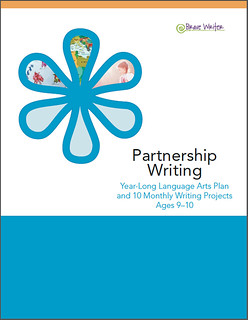
Partnership Writing
The Year-Long Language Arts Plan
and 10 Monthly Writing Projects
(9-10 year olds)

Partnership Writing is the second in our series of products that gives you developmentally appropriate writing projects for your kids in the partnership writing stage of development. Jot It Down! is the first.

Have you wondered why your writing assignments stall? Do you wonder why your kids give you a blank stare after you ask them to fill a blank page? Do you have a tough time creating writing assignments that are both creative (interesting) and academically sound (preparatory for essay writing)?

And just how do you put together a program that includes copywork and dictation, as well as the language rich environment you hope to foster in your home, while still teaching original writing?

Partnership Writing tackles it all!

It can work alone (as a tool you use to boost the power of your writing efforts with your kids) and it can work in tandem with other Brave Writer products: The Writer’s Jungle (the manual that teaches YOU how to teach writing), and The Arrow (the tool that provides you with great literature to read, grammar, spelling and punctuation help, and copywork/dictation passages).

Plus we have special bundles on the website for Partnership Writing + The Writer’s Jungle and/or The Arrow.

To learn more about the Partnership Writing stage of development (usually 9-10 year olds, but also good for younger advanced writers and older kids who struggle), you can check out our Getting Started with Brave Writer page. You can also listen to a podcast by me where I explain what Partnership Writing is.

This is the perfect product for you if you need help thinking of writing projects and want to know how to plan them for a month at a time.
Partnership Writing gives you the
practical,
step-by-step implementation of
what to write,
not just how to write.

DOWNLOAD A FREE SAMPLE!

Posted in BW products, Natural Stages of Growth in Writing, Young Writers | Comments Off on Partnership Writing is here!

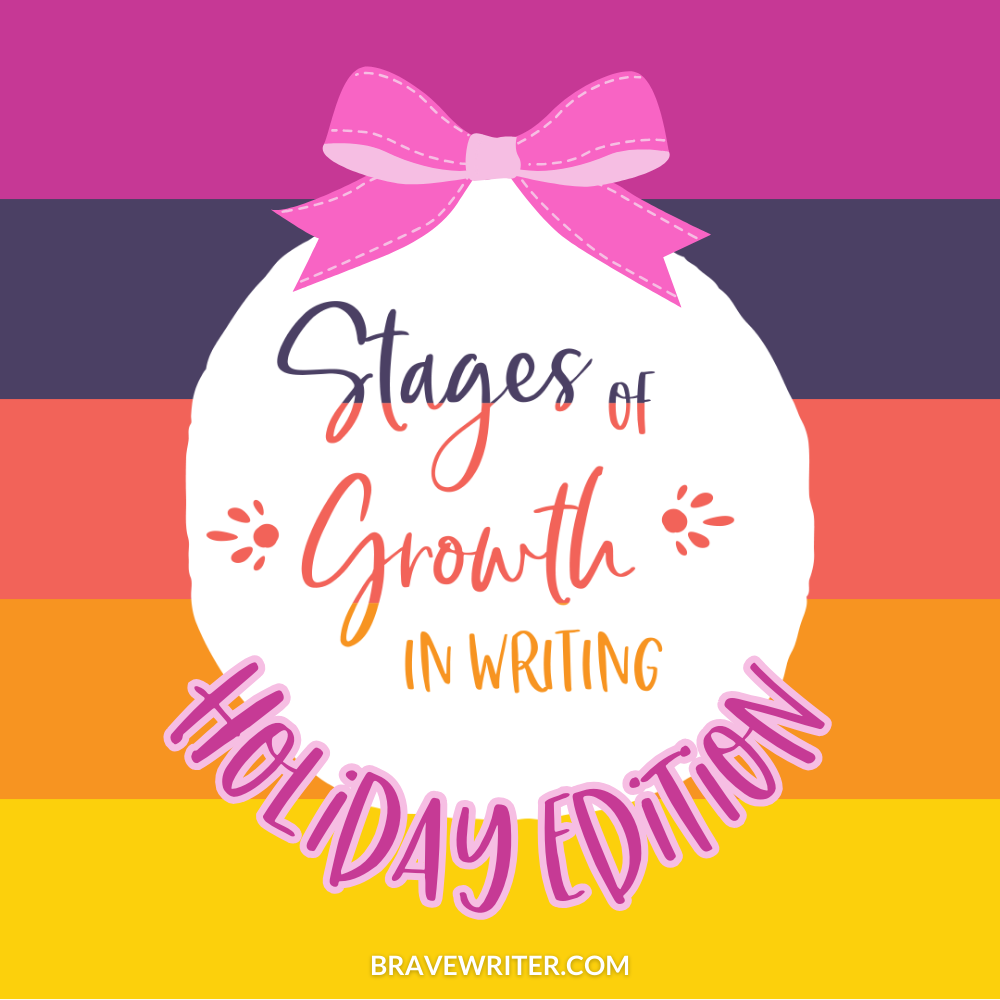
The Natural Stages of Growth in Writing: Holiday Edition!

Natural Stages of Growth in Writing Holiday Edition

After completing the five part series about the Natural Stages of Growth in Writing, I thought it might be nice to see how you can apply those insights to writing through the holidays!

This is a great season to capitalize on natural writing opportunities (rather than relying on contrived assignments). Below are some of the most obvious ideas along with ones you may not have thought of! They’re also organized to fit with the Natural Stages of Growth.

Jot it Down (kids who can handwrite and/or copy writing):

  • caption photos in a family holiday letter
  • write out tags for wrapped gifts
  • create placecards for your holiday meal
  • write gift wish lists
  • address envelopes for holiday cards

Partnership Writing (you help with transcription):

  • all of the above in “Jot it Down” works well with Partnership phase too
  • retell and write a short description of the year’s biggest highlight for family letter
  • copying lyrics from holiday music
  • writing a list of special traditions to remember
  • putting holiday events on a posted family calendar
  • thank you notes for gifts received

Building Confidence was Faltering Ownership (kids who are writing, but are still not high school level):

  • interview family members for holiday letter
  • write your own memories of the year and send in holiday letter
  • journal about each holiday event and bind in a little notebook at the end of season
  • plan and execute a New Year’s party (including invitations, games, food to purchase)
  • copy cookie recipes onto notecards, make cookies

Transition to Ownership/Great Conversation (junior/high school level):

  • take control of the family holiday letter (interview family members, organize, and execute)
  • take photos of the season, caption, and scrapbook as the month goes along
  • keep a notebook of quotable quotes from the family
  • write a meaningful description of what the holiday means to you personally and consider sharing
  • reflect on a significant piece of reflective literature by freewriting or journaling about it

Stages of Growth in Writing

Tags: Natural Stages of Growth in Writing
Posted in Brave Writer Lifestyle, Natural Stages of Growth in Writing | 4 Comments »

How Kids Learn to Write: You Can’t Run Before You Can Walk

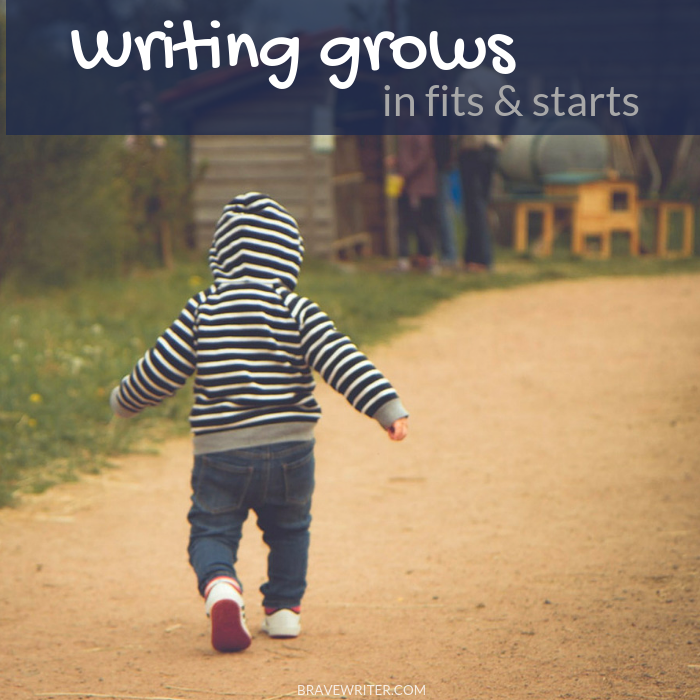
Writing grows in fits and starts

During the last week, I’ve had some emails and forum questions that tend in the same direction:

How does all this freedom of expression translate into the writing forms I’ve heard so much about and feel my child must learn, I mean, he does have to write an essay at some point, right?

Let’s begin at the very beginning, a very good place to start.

Writing ought to be compared with learning to talk. Lots of mistakes and babbling accompany the first attempts to speak. Lots of spelling errors, incomplete thoughts and poor idea development attend the first efforts to write. Like speech, writing grows in fits and starts. Speakers babble and make funny sounding sentences for the first three years of speech (1-4). Usually by age five, they are highly fluent speakers, even though they don’t yet have an adult’s vocabulary.

Writers usually begin to write at age 9 or 10. (They may have begun handwriting at ages 5-7, which is a different skill than writing). If we give them the same amount of time to grow in writing as speaking, we could say that by the ages of 12-13, our young writers are becoming somewhat fluent in their ability to get words onto paper. These words may be poorly spelled and punctuated, but by and large, our kids can sit down and write a sentence without straining to think of how to form the letters or how to spell their regular vocabulary. (This is not the same thing as being a good speller, however, because most kids make some shocking spelling errors right up to 18.)

Kids who are writing without struggle at ages 12-14 have been given a gift. It means that they have not been scarred by poor writing programs, teacher feedback and grades, or canned assignments that blunted what could have been their natural inclination toward self-expression in writing.

Imagine if you tried to teach your young speaker to talk by correcting every sentence/phrase, by parsing the grammar and commenting on the organization? What if you determined the topics for speaking and deemed certain topics “off limits”? What if speaking were limited to one portion of the day?

Am I taking this analogy too far?

I don’t think so. Speaking is seen as a necessity because it is modeled around us all the time by everyone. We assume that all kids will learn to speak and that every topic is relevant because speaking is about communicating…

Hmmmm. Are you starting to see what we’ve done to writing?

Imagine another scenario. You see writing the same way you see speaking. You write because it is a vehicle for communication. You enjoy writing, you read your writing to your husband when it’s funny, you write notes to your kids when you leave money from the tooth fairy, your send email and cards to family and friends, you keep lists and you journal in your scrapbooks. In short, writing is a natural means of communication that you use in daily life and everyone knows it. No off limits topics there either.

Kids will write if they see it as a vehicle for communication
with as much relevance to them as speaking.

Click to Tweet


Your kids will write… if they see that writing is a vehicle for communication that has as much relevance to them as speaking. We must regain our trust that writing is a natural process and that it has intrinsic value at any and every level. (It isn’t only valuable when it is packaged in an academic format.)

Yeah, but Julie, I want to know about essays?

Okay, I’m getting to that.

So now you see the connection between writing and speaking as long as we’re talking about “non-school” fare.

Let’s take it a step further. Once you have a fluent speaker, there are opportunities to use “speech” for other purposes besides asking for money to buy a computer game or to order pizza. These include things like speech and debate, acting, oral reports, leading Bible studies, hosting a party, making a toast, giving a presentation, leading a meeting, working as a hostess or tour guide…

These are all ways that people take the skill called “speech” and order it to fit a certain format. Native speakers can easily learn the formats, and they will be able to execute those skills with success. We don’t expect the same level of “formatted speech” from our 3-5 year olds.

Writers learn writing craft once they are comfortable and fluent with written self-expression. I believe that high school and college are the times for that training. Some kids will naturally begin in junior high and will follow patterns they’ve observed in the writing they read. But really, if you think about it, kids who’ve been writing for 4-5 years will be the most able to relax when faced with the essay format or the research paper. They won’t be struggling with the basic experience of writing. They will know how to get their words onto paper. In turn, they will be ready to follow a set of specific writing requirements.

That’s the order of the process.

I’ll post more about how that transition occurs some other day. For now, can you start to see how this works?

–julie


The Writer's Jungle Online

Tags: learning how to write
Posted in Brave Writer Philosophy, Natural Stages of Growth in Writing, Writing about Writing | 1 Comment »

Newer Entries »
  • Search the Blog

  • Julie Bogart
  • Welcome, I’m Julie Bogart.

    I’m a homeschooling alum -17 years, five kids. Now I run Brave Writer, the online writing and language arts program for families. More >>

    IMPORTANT: Please read our Privacy Policy.

  • New to Brave Writer? START HERE

  • FREE Resources

    • 7-Day Writing Blitz
    • Brave Writer Lifestyle Program
    • Brave Writer Sampler: Free Sample Products
    • Freewriting Prompts
    • Podcasts
  • Popular Posts

    • You have time
    • How writing is like sewing
    • Best curriculum for a 6 year old
    • Today's little unspoken homeschool secret
    • Do you like to homeschool?
    • Don't trust the schedule
    • You want to do a good job parenting?
    • If you've got a passel of kids
    • You are not a teacher
    • Natural Stages of Growth in Writing podcasts
  • Blog Topics

    • Brave Learner Home
    • Brave Writer Lifestyle
    • Classes
    • Contests/Giveaways
    • Friday Freewrite
    • High School
    • Homeschool Advice
    • Julie's Life
    • Language Arts
    • Movie Wednesday
    • Natural Stages of Growth
    • One Thing Principle
    • Our Team
    • Parenting
    • Philosophy of Education
    • Podcasts
    • Poetry Teatime
    • Products
    • Reviews
    • Speaking Schedule
    • Students
    • Writing about Writing
    • Young Writers
  • Archives

  • Brave Writer is a participant in the Amazon Services LLC Associates Program, an affiliate advertising program designed to provide a means for sites to earn advertising fees (at no extra cost to you) by advertising and linking to amazon.com

    Content © Brave Writer unless otherwise stated.

What is Brave Writer?

  • Welcome to Brave Writer
  • Why Brave Writer Works
  • About Julie
  • Brave Writer Values
  • Frequently Asked Questions
  • Speaking Schedule

Brave Writer Program

  • Getting Started!
  • Stages of Growth in Writing
  • The Brave Writer Program
  • For Families and Students
  • Online Classes
  • Brave Writer Lifestyle

…and More!

  • Blog
  • Classroom
  • Store
  • Books in Brave Writer Programs
  • Contact Us
  • Customer Service
  • Brave Writer Staff
© 2026 Brave Writer
Privacy Policy
Children's Privacy Policy
Help Center