BW products Archives - Page 44 of 53 - A Brave Writer's Life in Brief A Brave Writer's Life in Brief
  • Start Here
    • For Families
      Multiple Ages
    • Ages 5-7
      Beginning Writers
    • Ages 8-10
      Emerging Writers
    • Ages 11-12
      Middle School Writers
    • Ages 13-14
      High School Writers
    • Ages 15-18
      College Prep Writers
  • Shop
    • Product Collections
    • Bundles
    • Writing Instruction Manuals
    • Literature & Grammar/Punctuation
    • Composition Formats
    • Literature Singles
    • Homeschool Help
    • Book Shop
  • Online Classes
    • Class Descriptions
    • Class Schedule
    • Classroom
    • How Our Classes Work
    • Our Writing Coaches
    • Classes FAQ
  • Community
    • Brave Learner Home
    • What’s Happening
    • Blog
    • Podcast
    • Calendar
  • Cart
  • My Account
    • My Online Classes
    • My Account
  • My Account
    • My Online Classes
    • My Account
  • Start Here

    If you’re new to Brave Writer, or are looking for the best products for your child or family, choose from below:

    • For Families
      Multiple Ages
    • Ages 5-7
      Beginning Writers
    • Ages 8-10
      Emerging Writers
    • Ages 11-12
      Middle School Writers
    • Ages 13-14
      High School Writers
    • Ages 15-18
      College Prep Writers
  • Shop

    If you’re already familiar with Brave Writer products, go directly to what you’re looking for:

    • Product Collections Browse the full catalog in our shop
    • Bundles Everything you need to get started
    • Writing Instruction Manuals Foundational Writing Programs
    • Literature & Grammar/Punctuation Grammar, Punctuation, Spelling & Literary Devices
    • Composition Formats Writing Assignments for Every Age
    • Literature Singles Individual Literature Handbooks
    • Homeschool Help Homeschooling Tools and Resources
    • Book Shop Books associated with Brave Writer Programs
  • Online Classes
    • Class Descriptions
    • Class Schedule
    • Classroom
    • How Our Classes Work
    • Our Writing Coaches
    • Classes FAQ
  • Community
    • Brave Learner Home
    • What’s Happening
    • Blog
    • Podcast
    • Calendar
  • Search
  • Cart

Search Bravewriter.com

  • Home
  • Blog

A Brave Writer's Life in Brief

Thoughts from my home to yours

Archive for the ‘BW products’ Category

« Older Entries
Newer Entries »

The most beautiful example of Keen Oberservation

Email:

Julie, I did the Keen Observation exercise with the kids on Monday. What a lovely time. I really can’t fully express (in the limited time available) how much I appreciate your program and your blog. There is a sense of yoga about it – being in the moment, being where you are in terms of skill, a deepening of experience with reality. Thank you.

I thought you might like my description of what we did. I let Mary Poppins and Ms Frizzle out to play.

Immersion Learning

—

What a truly awesome visual to go along with the powerful and delightful comments her kids made. That’s what I call keen observation for sure!

Posted in Brave Writer Philosophy, BW products, Language Arts, Writing Exercises | Comments Off on The most beautiful example of Keen Oberservation

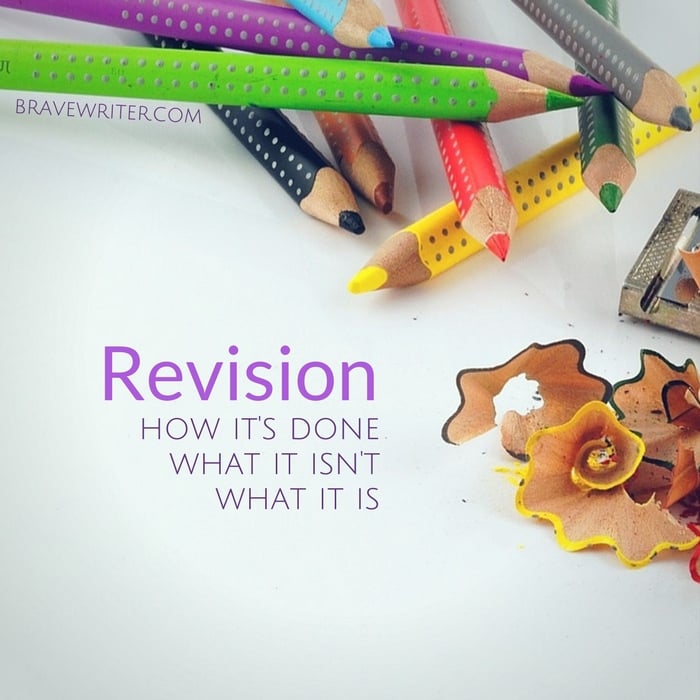
Revision: How It’s Done

Revision

The most frequent question I get via email is how to revise a freewrite. I give lots of detail about how to do just that in The Writer’s Jungle and hope you’ll take advantage of one of our packages to get your own copy. Revision is rarely addressed in writing curricula. The typical “check list” approach to revision is a shadow of what true revision is all about.

The goal of a writing piece is to make it good to read. Simply double checking for writing elements and proper punctuation is not what takes a piece from raw writing to polished final copy. Revision is that critical step where the writer, with the help of an ally (editor, you), takes a fresh look at the original draft with an eye to improving it in essentials, in readability, in power.

Let’s look at revision philosophically then practically:

I separate the terms “editing” from “revising.” When they’re used interchangeably, the act of correcting mistakes takes over.

Rather than the real work of expanding and enhancing the writing, moms in particular zero in on mechanical errors and superficial changes. These are never satisfying to writers who want their ideas to rate as the most important aspect of their writing.

Editing is truly that last step to make sure that typos are gone, mechanics are working, spelling is accurate and overall appearance is pleasing and error-free.

Revision, on the other hand, is all about making the writing better – clarity, precision, accuracy, detail, factual support, depth, insight, vivid language, expanded argument, and so on. Revision means giving “new” vision to the original piece of writing. Revision is the step in writing that shows that you, the writing coach, care about the content, and therefore care about the writer.

Instead of rewriting the contents of the revision chapter here, let me throw out some things you can do even as early as tomorrow to get the ball rolling. Then if you need more help, purchase a copy of  The Writer’s Jungle to help you.

Ask your kids better questions.

Sometimes we make the mistake of asking for feelings, as in “Why did you like going on the roller coaster?” instead of asking, “What did the car sound like going uphill on the track?” Or instead of “How do you feel about spring?” suggest: “Identify three flowers by name that we saw on our hike and let’s think about creative color names for their blooms.” Questions are the way you narrow the focus of a particular idea while expanding the content in writing. Be specific, ask for details, facts and comparisons.

Find the middle and start there.

The best opening lines are usually somewhere in the middle of the freewrite. Once your kids get rolling, their more creative energy finds its rhythm. Take the best sentence and put it at the front of the piece. Don’t worry if it is out of context. Start with it and then figure out how to make it introduce the piece. “My lunch roared to the front of my mouth,” might be the best way to start a piece about the picnic. Follow it with details about that experience and how you held the food back, before explaining the near-puking experience with the more mundane, “That’s what happens when I eat my aunt’s deviled eggs on picnics.”

Identify code words.

Sometimes I call them “label” words. These are words like “cool,” “fun,” “awesome,” “lousy,” and “stupid.” Underneath these words lives a world of experience waiting for good questions to draw it out. You can do that. Design good questions to get to the bottom of why an experience was awesome or stupid. Take it one at a time and allow for more writing.

Weed out repetitive sentences.

“I walked through the park, looking behind me each step of the way. I kept looking back, to see if someone was following. It took me a long time to get there because I was looking behind me so much.” There are three sentences here that could be collapsed into one. You can either dump two and keep one, or you can combine two and eliminate one. Or you can read all three and then write a brand new one that captures the essence of them all. Learning how to put a strike out line through your own writing is a liberating sensation. It teaches you that you have power over your own words and that there are more where those came from.

Revising isn’t scary if you have a handle on how to do it. Too many of us are locked down in generalities and wishing for more words to appear without much coaching.

Pretend this is Little League and you have to teach your son how to hit a baseball. You won’t keep saying, “How do you feel about the ball whizzing by you each time you swing?” You will say, “Can you tell me what you see as the ball comes over home plate? Are your eyes open? Where are your feet? What angle is your body to the pitcher?” and so on. You’ll want to give specific coaching tips to help your child bat effectively.

Same goes for writing. Coach, gives tips, ask good questions, eliminate what doesn’t work. Before you know it, you’ll have a renewed piece of writing worth sharing with readers.


Keep reading: Revision is Not Editing


Brave Writer Online Classes

Posted in Brave Writer Philosophy, BW products | 2 Comments »

Hurry! Last minute registrations for KWI, HH and Adv. Comp

Kidswrite Intermediate, Hand-Holders and Advanced Composition all start Monday. They all have space. You may not see them again until the next school year. Don’t miss your chance to get in on these important classes.

Quick notes: Kidswrite Intermediate is one of the most unique writing courses on the market! We use exploratory writing tools (specially created by me, Julie Bogart) to draw out the rhetorical thinking and linguistic creativity necessary for powerful academic essay writing and crafting in high school and college. I’m telling you – learning to write a dusty dry essay just doesn’t cut it. We’ve got to help our teens translate that spark and writing aliveness into a forceful, compelling academic writing style. Who teaches that? We do! Sign up today. Your teens will love it. It’s the most energizing, surprising class they’ll take this year. Nothing like what they’ve done before.

Hand-Holders is a brand new tool created on request from countless Brave Writer Moms. After working through KWB or The Writer’s Jungle, many moms want the comfort, accountability and support of a BW instructor to help them continue to guide their children into productive writing projects. Christine Gable, instructor, is especially equipped to help you. She’ll give you all the tools and support you need to finish out the school year strong!

And last, but most certainly not least, is Advanced Composition which I teach! I don’t get to do the online classes as much as I used to so don’t miss this chance to put your teens with me. I use all my academic experience to help your kids be up to the minute in their preparation for what colleges expect in their essay assignments. If you wonder what other kinds of essays your kids will be called on to write, these are the ones: definition and textual analysis are commonly assigned in the undergraduate programs. Don’t miss this last minute chance to get your teens ready for fall (if they’re seniors) or for the coming year of writing (if they’re juniors). I’ll happily take some precocious sophomores, too.

Register here ASAP.

Posted in BW products, General, Tips for Teen Writers, Young Writers | Comments Off on Hurry! Last minute registrations for KWI, HH and Adv. Comp

February classes still have some openings

Brave Writer winter class registration continues with openings in classes starting in February.

The Winter Class Schedule for 2009 can be seen in full at the website. These are the classes that are starting immediately and still have openings. Don’t miss your chance to get the New Year off to the write start. 🙂

Kidswrite Basic (Only two family spots left. Hurry!)
February 2 – March 13

SAT/ACT Essay (Only three spots left)
February 2 – February 27

Kidswrite Intermediate (8th-10th grade – many slots available and won’t be offered in spring)
February 16 – March 27

One Thing: Freewriting (Specifically offers support to those whose kids need additional support in the writing process.)
February 16 – March 27

Just So Stories (Designed for kids who love animals and silly word play)
February 23 – March 20

Please email me if you have questions about classes or registration.

Julie

P.S. Remember: Class Registration is still open and live. Come register!

Posted in BW products, General | Comments Off on February classes still have some openings

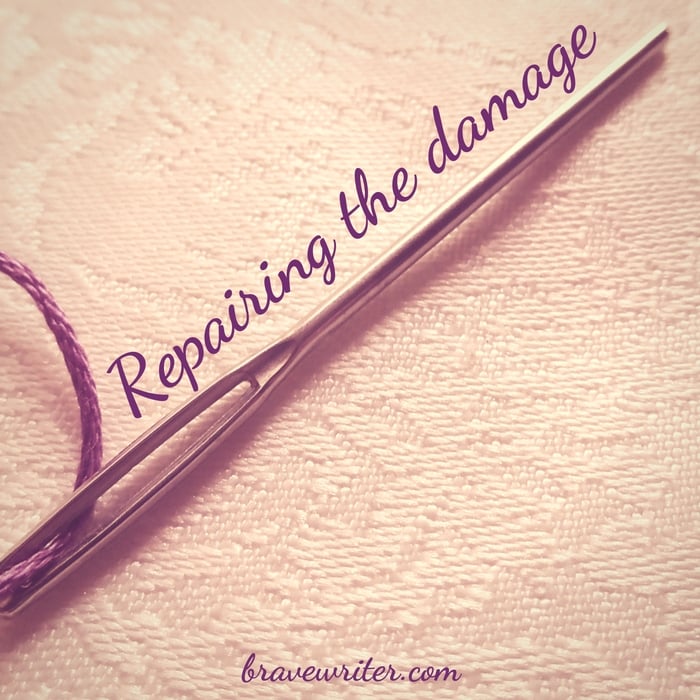
Repairing the Damage

Repairing the damage

What do you do? You’ve been trying to teach your child to write using the curriculum that your best friend swears by. Your daughter, though, is slowly wilting under the structure, the requirements. She finds herself less and less willing to face the blank page. She says her hand hurts or she hates the topic, or she doesn’t think writing matters. She finally knuckles under and produces three paltry lines of stiff prose, not at all revealing the sparkle in her personality or her grasp of the topic.

In frustration, you tell her to try harder, you reduce the size of the project, you offer to write things down for her… nothing works. She continues to show you her unhappiness and you wonder to yourself if she’s just lazy, willful or both.

I like to say in workshops, in my writings, that writing problems are reasonable. We parents don’t really want to believe that because it would mean that there is some solution we haven’t yet thought of that will get our kids writing again. It’s almost easier for us if the problem our child is having is seen as a character flaw (then we can require things, punish, reward, or shame our kids into “behaving”). We are much more adept at moral lessons than creative writing solutions. We can lecture and model diligence, discipline, hard work, and denial of feelings much more easily than we can make meaningful suggestions about how to get that pen moving again through some writing solution.

Yet if it’s true that your child is generally cheerful (you know, apart from the normal doses of grouchiness that all kids and adults feel from time to time), listens to you reasonably well in other areas (will hop up to grab the napkins for lunch if you ask, helps you unload the groceries, doesn’t mind feeding the dog, will come when you call while at a store, etc.), and is mostly willing to do other areas of schoolwork (math pages, reading, history, handwriting), a problem with writing really can be understood to be a problem with writing (as in, writing feels overwhelming, hard, confusing, painful, stressful, or perplexing).

Rather than the moral lectures, let’s start over and help our kids tackle writing with a different strategy.

Repairing the Damage

1) Apologize for any way that you’ve not taken complaints seriously as a writing problem.

You can simply say, “I know I’ve been hard on you about writing and it occurred to me last night that you really are struggling with writing, not with self-discipline. I see how eagerly you tackle the games you play, how you willingly help me with the dishes, how you play with your siblings and try to help them have a good time. So I know you’re a great kid. I’m realizing, however, that the way we do writing in this family is not workable. I’m going to help us shift gears and figure out a new way to do writing so that it is no longer the painful torture it has been for you. I’m sorry for being so hard on you.”

2) Write down a list of complaints.

To take your child seriously, write down a list of his chief complaints about writing. Help him to be as specific as he can. Let him see you taking him seriously by making a nice long non-judgmental list. At the end, ask him to reread it to be sure you got it all down. Then sign and date it together. Let him know you take these complaints seriously and are going to do what you can to tackle each one.

3) Take a break from writing.

Together, decide that you will take a break from writing. You can determine a time length, if you like, just be sure that you don’t make it so soon as to not be meaningful. So a two day break is meaningless. But a month is more of a real break. For some kids, a month will feel too soon. I have one child who took three years off of writing. That’s right – three years! (In that time, however, he wound up doing some writing initiated by his own imagination and desire that I supported… by the end of the three years, he told me he felt ready to tackle writing again in a more systematic way.)

4) Determine whether the list includes possible learning disabilities or language processing disorders.

Here are things to think about: Does your child mostly complain about handwriting (holding the pencil, making the letters, hurting hand, tires quickly, etc.)? If that’s the case, it is possible that your child has dysgraphia or some other handwriting impediment. Does your child complain about the struggle to think of anything to say? If so, ask if that is also true in speaking. Does your child struggle to get the words out in talking? Does your child find it difficult to recite an experience or to sequence her ideas verbally? If so, the problem could be a cognitive processing issue, not a writing one. If you suspect some issue that impairs the writing process, get an evaluation done to rule out any of these problems.

5) Research writing.

Finally, you need to get your own philosophy of writing nailed down. The Brave Writer website is chock full of help for you. I strongly recommend the Brave Writer Lifestyle section as a way to immerse yourself in the benefits of this philosophy of writing. You’d also do well to purchase The Writer’s Jungle so that you can educate yourself about how to nurture your young writers. You’ll find step-by-step support and advice for teaching writing to your kids.


Learn more:
Listen to our “Manage the Damage” podcast.

Posted in Brave Writer Philosophy, BW products | Comments Off on Repairing the Damage

« Older Entries
Newer Entries »
  • Search the Blog

  • Julie Bogart
  • Welcome, I’m Julie Bogart.

    I’m a homeschooling alum -17 years, five kids. Now I run Brave Writer, the online writing and language arts program for families. More >>

    IMPORTANT: Please read our Privacy Policy.

  • New to Brave Writer? START HERE

  • FREE Resources

    • 7-Day Writing Blitz
    • Brave Writer Lifestyle Program
    • Brave Writer Sampler: Free Sample Products
    • Freewriting Prompts
    • Podcasts
  • Popular Posts

    • You have time
    • How writing is like sewing
    • Best curriculum for a 6 year old
    • Today's little unspoken homeschool secret
    • Do you like to homeschool?
    • Don't trust the schedule
    • You want to do a good job parenting?
    • If you've got a passel of kids
    • You are not a teacher
    • Natural Stages of Growth in Writing podcasts
  • Blog Topics

    • Brave Learner Home
    • Brave Writer Lifestyle
    • Classes
    • Contests/Giveaways
    • Friday Freewrite
    • High School
    • Homeschool Advice
    • Julie's Life
    • Language Arts
    • Movie Wednesday
    • Natural Stages of Growth
    • One Thing Principle
    • Our Team
    • Parenting
    • Philosophy of Education
    • Podcasts
    • Poetry Teatime
    • Products
    • Reviews
    • Speaking Schedule
    • Students
    • Writing about Writing
    • Young Writers
  • Archives

  • Brave Writer is a participant in the Amazon Services LLC Associates Program, an affiliate advertising program designed to provide a means for sites to earn advertising fees (at no extra cost to you) by advertising and linking to amazon.com

    Content © Brave Writer unless otherwise stated.

What is Brave Writer?

  • Welcome to Brave Writer
  • Why Brave Writer Works
  • About Julie
  • Brave Writer Values
  • Frequently Asked Questions
  • Speaking Schedule

Brave Writer Program

  • Getting Started!
  • Stages of Growth in Writing
  • The Brave Writer Program
  • For Families and Students
  • Online Classes
  • Brave Writer Lifestyle

…and More!

  • Blog
  • Classroom
  • Store
  • Books in Brave Writer Programs
  • Contact Us
  • Customer Service
  • Brave Writer Staff
© 2026 Brave Writer
Privacy Policy
Children's Privacy Policy
Help Center