Brave Writer Philosophy Archives - Page 40 of 139 - A Brave Writer's Life in Brief A Brave Writer's Life in Brief
  • Start Here
    • For Families
      Multiple Ages
    • Ages 5-7
      Beginning Writers
    • Ages 8-10
      Emerging Writers
    • Ages 11-12
      Middle School Writers
    • Ages 13-14
      High School Writers
    • Ages 15-18
      College Prep Writers
  • Shop
    • Product Collections
    • Bundles
    • Writing Instruction Manuals
    • Literature & Grammar/Punctuation
    • Composition Formats
    • Literature Singles
    • Homeschool Help
    • Book Shop
    • Special Offers
  • Online Classes
    • Class Descriptions
    • Class Schedule
    • Classroom
    • How Our Classes Work
    • Our Writing Coaches
    • Classes FAQ
  • Community
    • Brave Learner Home
    • What’s Happening
    • Blog
    • Podcast
    • Calendar
    • Brave Writer Lifestyle
  • Cart
  • My Account
    • My Online Classes
    • My Account
  • My Account
    • My Online Classes
    • My Account
  • Start Here

    If you’re new to Brave Writer, or are looking for the best products for your child or family, choose from below:

    • For Families
      Multiple Ages
    • Ages 5-7
      Beginning Writers
    • Ages 8-10
      Emerging Writers
    • Ages 11-12
      Middle School Writers
    • Ages 13-14
      High School Writers
    • Ages 15-18
      College Prep Writers
  • Shop

    If you’re already familiar with Brave Writer products, go directly to what you’re looking for:

    • Product Collections Browse the full catalog in our shop
    • Bundles Everything you need to get started
    • Writing Instruction Manuals Foundational Writing Programs
    • Literature & Grammar/Punctuation Grammar, Punctuation, Spelling & Literary Devices
    • Composition Formats Writing Assignments for Every Age
    • Literature Singles Individual Literature Handbooks
    • Homeschool Help Homeschooling Tools and Resources
    • Book Shop Books associated with Brave Writer Programs
    • Special Offers
  • Online Classes
    • Class Descriptions
    • Class Schedule
    • Classroom
    • How Our Classes Work
    • Our Writing Coaches
    • Classes FAQ
  • Community
    • Brave Learner Home
    • What’s Happening
    • Blog
    • Podcast
    • Calendar
    • Brave Writer Lifestyle
  • Search
  • Cart

Search Bravewriter.com

  • Home
  • Blog

A Brave Writer's Life in Brief

Thoughts from my home to yours

Archive for the ‘Brave Writer Philosophy’ Category

« Older Entries
Newer Entries »

Revision is Not Editing

Revision is Not Editing

In Brave Writer, we separate the ideas of revision and editing. Revision is “casting new vision” for the original piece of writing. It’s a “re-imagining” of the original content. You have what you want to say, now you are considering all the various ways it can be said.

Your freewrite/draft is the jet stream of thought. It’s all of it rushing out of the writer onto the page willy-nilly.

Revision is not, now, taking that freewrite/draft and fixing commas or identifying run-on sentences. It’s not addressing tone or spelling mistakes. Those practices fall under the category of “copy-editing.”

Revision is that drastic over-haul type work that literally changes the draft sometimes so completely, the original is hardly recognizable in it any more (except maybe some sentences or the germ of the idea). Revision is where you hunker down and look at specific thoughts expressed insufficiently in the draft, and then determine how to expand them, how to enhance them, how to deepen the content or insight or facts-basis.

Revision IS writing.

In fact, most writers would say that revision is the craft, is the heart of being a writer.

What I find in parents (and even in those who claim to be writing instructors) is a tendency to skip this part of the process. They move right to editing and call it revision.

When asked to give revision notes or support, they draw a blank or they praise what’s good or they give general comments like, “Be sure you think about your audience” or “It’s a good idea to make sure your points are in a solid sequence.”

This kind of general feedback isn’t helpful to writers. What helps is to become a child’s creative partner. What you want to do, what you need to learn how to do, is how to create a dynamic partnership of idea generation.

For instance, you might see a flat-footed opening line (note: they are all flat-footed in the first draft – it’s completely rare that the first line stays the same in well revised writing). Your job isn’t to point out that it is flat-footed or could be revised. It isn’t to assign the task of making it better to your child. It’s literally to brainstorm ideas for improvements. Let’s say the child is writing about white water rafting, you might try something like this:

“I wonder how we can make this opening line grab the reader’s attention. Let me think, let me think. What if we start with the experience—Let’s get in the boat. Are you in it? What’s happening now? Close your eyes. What do you see? Blue? What shades?”

You’re jotting things down as they come out of your child’s mouth. Then you say:

“How about the water? I can imagine there’s a spray. Is there? Yes? Where did it hit? What is a water spray like? Does it remind you of anything? Oh good one! The spray of a garden hose when your brother aims it at you. Good one! Yes! Let’s jot that down.”

You’re wool-gathering. You’re collecting

  • images,
  • experiences,
  • thoughts,
  • curiosities,
  • comments,
  • ideas.

You aren’t telling your child what to do. You’re helping your child think freshly about what is already on the page. You are providing the dialog partner the way you would in conversation:

“Then what happened? Oh wait, how did you get there? That must have been amazing! What did your brother say?”

But now, you are focused on writing and you are providing the conversational partnership that your child’s writer needs. You are thinking in writing categories but having discussions about it (natural ones). You aren’t an English teacher. You are an interested friend, partner, ally.

Do you see the difference? Stop the generalizations and get into conversations. Help get those words out.

Then, when you go back to that opening sentence, you have a selection of things to choose from that might grab the reader’s attention. Together, you can find the one and write it in a way that makes magic.

Curious about Brave Writer?

Posted in Brave Writer Philosophy, Homeschool Advice, Language Arts, Writing about Writing | 5 Comments »

How Writing Is Like Sewing

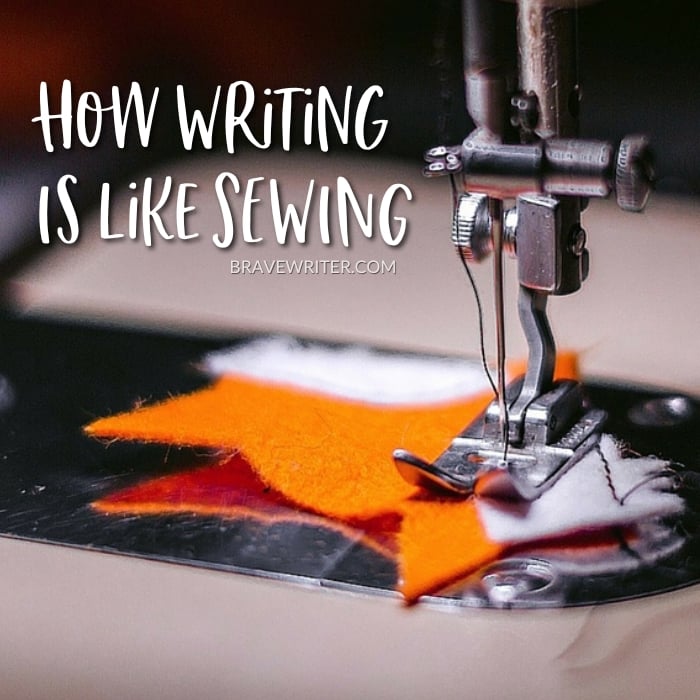
Brave Writer How Writing Is Like Sewing

A fundamental confusion exists around how to teach writing. I’ve spent two decades looking for just the right metaphor to explain how a parent facilitates writing growth. Then the other day, on the phone, I stumbled upon a perfect metaphor.

Let’s look at learning to use a sewing machine.

A sewing machine makes it possible to create all kinds of sewing products—anything from hemming a pair of pants, to constructing a quilt, to producing an evening gown. The machine doesn’t do it for you. You have to know how to use the machine, and you have to develop skills: how to sew straight seams or how to drop in a sleeve or how to gather a drape. You need to learn how to create casings, and how to use the zig zag, and what the tension dial does.

When learning the skills needed for sewing, students start with scrap fabric. They don’t pick a dress pattern and then sit down to the machine. Usually they have to learn how to thread the needle and bobbin, they have to sew lots of straight lines and learn how to turn corners and how to backstitch the end of a seam so that it doesn’t unravel.

No one can learn all she needs to know in one sitting or even one year of sewing. There are levels of skill that are gained over time, as comfort with the machinery, and dexterity, and familiarity with the properties of sewing are internalized and mastered.

How Writing is like Sewing

But it is possible at each stage of development to introduce a little project. At first, these might be things like bean bags (squares) or a string dress (no pattern, but the dress uses casings). As the student gets comfortable, making an a-line dress for a doll from a pattern becomes possible and a thrill! Producing a doll quilt is the first step toward making one for a bed.

Eventually, the student of sewing learns tricks to make the process easier and faster. They can size up a pattern to know if it’s too difficult or too easy, and can make changes to make the pattern work.

Sewing is not about the dress patterns or quilts. Sewing is a set of skills that can be applied to patterns.

Let’s drive home the analogy to writing.

Firstly, the original writing process is discovered using scrap language—whatever is in the mind and mouth of the child at the time. The writing is interest-driven and exploratory. The child is gaining facility with the practice of accessing language, ideas, insights, and information from within and getting those words to the page in a variety of ways (all different styles of “language stitching”).

Secondly, the child learns to use the mechanics of writing similar to learning to use the sewing machine. How to thread the bobbin, how much pressure to put on the pedal, how to backstitch, how to zigzag, how to set up the buttonholer—these skills enable sewing. Similarly, the functional skills needed to run the machinery of writing are spelling, grammar, punctuation, handwriting and/or typing. And in Brave Writer, we believe that in the beginning that’s best learned through copywork (someone else’s writing).

Thirdly, students create writing projects which are the dress patterns of writing. Now that older children understand how the machine works and can use it with evolving skill, they can manage the demands of the machine, so it’s time to make a dress or placemat or quilt!

How Writing is like Sewing

In writing, once the student knows how to find language within, knows how to get that language to the page, and how to handwrite, expand, revise, and edit it, he or she is ready to “make something” —to write a report or letter, to write a poem or a dialog, to write a story or ad copy, to write an essay.

The point is—don’t hand your brand-new-to-writing student the equivalent of an evening gown dress pattern and expect it to turn out right on the first try, just because there are “clear instructions.” Writing is a set of skills practiced independently of assignments, leading up to developmentally appropriate writing projects that reinforce and expand evolving skills.

3 components of a complete writing program:

  1. Mastery of the original writing process (Growing Brave Writers)
  2. Rehearsing the mechanics of writing (Quill, Dart, Arrow, Boomerang, Slingshot)
  3. Writing projects to put mechanics and original writing together (Jot it Down, Partnership Writing, Building Confidence, Help for High School, and Online Classes)
Brave Writer Products

Tags: Mechanics
Posted in Brave Writer Philosophy, BW products, Writing about Writing | 2 Comments »

It’s the Writer, Not the Writing

It's the Writer, Not the Writing

It’s tempting to see writing as something a person does, as assignments to complete, as skills to acquire for an academic or career purpose.

It’s tempting to evaluate the writing a person does as though it is a set of math problems—measurable, impersonal, external.

It’s tempting to push for completion, because the assignment or project has a due date or has to be done for the end-of-the-year evaluation.

The paradigm shift is this:

Writing is not like other subjects. Writing is closely related to the self, no matter what the content. Even mothers sending me email get nervous thinking I will read their questions, and wonder what I will make of them, because they are undressing their minds right in front of me. What will I see? How will I react?

How much more kids feel that way?

  • Take the “school definition” out of writing (beware of the ghost of public school past).
  • Focus on the “writer” more than the “writing.”
  • Tears mean the lesson is over for the day.
  • Partial work is valuable.
  • Progress happens through a series of attempts, not through wrestling a single project to the perfected finish.
  • Self-expression is a risk and needs you to treat it gently.
  • Support helps—and help is helpful (not damaging, not cheating, not short-cutting).

Academic formats require as much “soul investment” as fan fiction and diaries. You must be just as gentle and curious with an expository essay as you were with the story about your child’s pet gerbil.

Writers express what lives inside them. Writing is the form it is put in. Expression deserves respectful care. Mechanics deserve minimal care. Expression matters the most. Mechanics are marginally important.

Work on the two components (mechanics and expression) separately and teach your writer to take responsibility for editing mechanics and getting someone to help him or her see what he or she can’t see without a second set of eyes.

That’s it. That’s all the attention mechanics deserve. They do not make or break the essence of the writing. They merely punctuate it, so someone else can approximate the tone and meaning the writer intends.

Brave Writer not brave writing.

Learn More: The Difference Between Brave Writer and Other Programs

Posted in Brave Writer Philosophy, Homeschool Advice, Writing about Writing | Comments Off on It’s the Writer, Not the Writing

« Older Entries
Newer Entries »
  • Search the Blog

  • Julie Bogart
  • Welcome, I’m Julie Bogart.

    I’m a homeschooling alum -17 years, five kids. Now I run Brave Writer, the online writing and language arts program for families. More >>

    IMPORTANT: Please read our Privacy Policy.

  • New to Brave Writer? START HERE

  • FREE Resources

    • 7-Day Writing Blitz
    • Brave Writer Lifestyle Program
    • Brave Writer Sampler: Free Sample Products
    • Freewriting Prompts
    • Podcasts
  • Popular Posts

    • You have time
    • How writing is like sewing
    • Best curriculum for a 6 year old
    • Today's little unspoken homeschool secret
    • Do you like to homeschool?
    • Don't trust the schedule
    • You want to do a good job parenting?
    • If you've got a passel of kids
    • You are not a teacher
    • Natural Stages of Growth in Writing podcasts
  • Blog Topics

    • Brave Learner Home
    • Brave Writer Lifestyle
    • Classes
    • Contests/Giveaways
    • Friday Freewrite
    • High School
    • Homeschool Advice
    • Julie's Life
    • Language Arts
    • Movie Wednesday
    • Natural Stages of Growth
    • One Thing Principle
    • Our Team
    • Parenting
    • Philosophy of Education
    • Podcasts
    • Poetry Teatime
    • Products
    • Reviews
    • Speaking Schedule
    • Students
    • Writing about Writing
    • Young Writers
  • Archives

  • Brave Writer is a participant in the Amazon Services LLC Associates Program, an affiliate advertising program designed to provide a means for sites to earn advertising fees (at no extra cost to you) by advertising and linking to amazon.com

    Content © Brave Writer unless otherwise stated.

What is Brave Writer?

  • Welcome to Brave Writer
  • Why Brave Writer Works
  • About Julie
  • Brave Writer Values
  • Frequently Asked Questions
  • Speaking Schedule

Brave Writer Program

  • Getting Started!
  • Stages of Growth in Writing
  • The Brave Writer Program
  • For Families and Students
  • Online Classes
  • Brave Writer Lifestyle

…and More!

  • Blog
  • Classroom
  • Store
  • Books in Brave Writer Programs
  • Contact Us
  • Customer Service
  • Brave Writer Staff
© 2026 Brave Writer
Privacy Policy
Children's Privacy Policy
Help Center