Brave Writer Lifestyle Archives - Page 21 of 26 - A Brave Writer's Life in Brief A Brave Writer's Life in Brief
  • Start Here
    • For Families
      Multiple Ages
    • Ages 5-7
      Beginning Writers
    • Ages 8-10
      Emerging Writers
    • Ages 11-12
      Middle School Writers
    • Ages 13-14
      High School Writers
    • Ages 15-18
      College Prep Writers
  • Shop
    • Product Collections
    • Bundles
    • Writing Instruction Manuals
    • Literature & Grammar/Punctuation
    • Composition Formats
    • Literature Singles
    • Homeschool Help
    • Book Shop
  • Online Classes
    • Class Descriptions
    • Class Schedule
    • Classroom
    • How Our Classes Work
    • Our Writing Coaches
    • Classes FAQ
  • Community
    • Brave Learner Home
    • What’s Happening
    • Blog
    • Podcast
    • Calendar
  • Cart
  • My Account
    • My Online Classes
    • My Account
  • My Account
    • My Online Classes
    • My Account
  • Start Here

    If you’re new to Brave Writer, or are looking for the best products for your child or family, choose from below:

    • For Families
      Multiple Ages
    • Ages 5-7
      Beginning Writers
    • Ages 8-10
      Emerging Writers
    • Ages 11-12
      Middle School Writers
    • Ages 13-14
      High School Writers
    • Ages 15-18
      College Prep Writers
  • Shop

    If you’re already familiar with Brave Writer products, go directly to what you’re looking for:

    • Product Collections Browse the full catalog in our shop
    • Bundles Everything you need to get started
    • Writing Instruction Manuals Foundational Writing Programs
    • Literature & Grammar/Punctuation Grammar, Punctuation, Spelling & Literary Devices
    • Composition Formats Writing Assignments for Every Age
    • Literature Singles Individual Literature Handbooks
    • Homeschool Help Homeschooling Tools and Resources
    • Book Shop Books associated with Brave Writer Programs
  • Online Classes
    • Class Descriptions
    • Class Schedule
    • Classroom
    • How Our Classes Work
    • Our Writing Coaches
    • Classes FAQ
  • Community
    • Brave Learner Home
    • What’s Happening
    • Blog
    • Podcast
    • Calendar
  • Search
  • Cart

Search Bravewriter.com

  • Home
  • Blog

A Brave Writer's Life in Brief

Thoughts from my home to yours

Archive for the ‘Brave Writer Lifestyle’ Category

« Older Entries
Newer Entries »

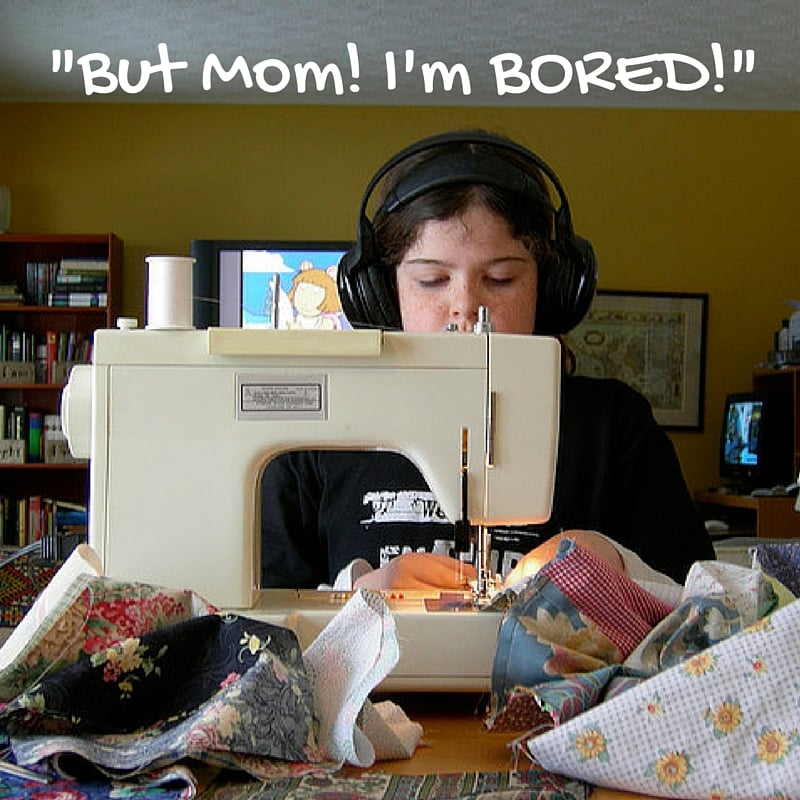
“But I’m bored!”

What to do when your kid is bored?

There’s a difference between boredom, and the quiet space and time that lead to new activity.

Children are without resources. They come into the world wholly dependent on you to show them the way, to provide for them, to create their environment.

When a child complains, “I’m bored,” it usually means that the current environment appears flat. They can’t see the possibilities any more. They’re used to the furniture, the materials, the toys, the games, the places these are housed. Routine and predictability are good for a smoothly flowing life, but they can be the enemy of creativity.

Rather than abandoning your child to his or her boredom, help your child to reinterpret the space. You don’t need to make suggestions (bored kids are notorious for shooting down each one as tedious, too difficult, not interesting). The suggestions feel coercive to the bored person, and not like they will create the relief being sought.

Rather, boredom can foster creativity if the parent wisely redirects the child into reflection combined with seeing the old with new eyes. Rather than saying, “Go play with your Legos,” you might say, “I wonder how else Legos can be used besides for building things…”

You might offer, “I bet if you hid behind the couch for 15 minutes with your flashlight, you might get some new ideas.”

Sometimes feeding your child helps. You could say, “While you figure out what to do next, have some crackers and cheese.”

You could turn your child loose with a new, more advanced tool.

“Take pictures with my camera while you figure out what you want to do.”

“What if you put on make up to look like (favorite character right now) while you think about what to do next? Use my kit upstairs.”

“If you want to use the mixer (or any appliance) for a new project, let me know and I’ll show you how it’s operated.”

“I find drawing helps me think of things to do. Do you want to borrow my ‘special Mommy markers’ for added magic?”

You can share methods that have helped you conquer your boredom:

“Maybe you will find something to do by clicking around the Internet for 15 minutes.”

“When I get bored, I page through magazines, walk around the block, read a chapter from a book, drink tea, go exercise… Any of those sound good to you?”

And you can do things silently:

  • Put a new hat or scarf on top of the dress-up clothes and move the basket to the middle of the room.
  • Arrange the library books on a coffee table in a stack.
  • Add brand new drawing utensils or decks of cards to the game drawer.
  • Bring the sheets and blankets downstairs out of the linen closet and tell your kids they can use them any way they want.
  • Put the microscope on the table when it’s not scheduled for use.

Your role in facilitating creativity is to help foster an environment that awakens curiosity to explore a new function or new pursuit, that relieves the mundane from its tedium, and that leads to new uses of old things. Your job isn’t to solve the boredom with a scripted activity.

If after giving your kids these incentives, they continue to look bored, just know that this is the quiet, evolving space that leads to a new idea. You can offer comfort for the process:

“I bet it’s frustrating when nothing interests you… no matter what! I hope it doesn’t last long. Let me know if you need something from me.”

Then move on.

It won’t be too long before the new interest arises.

Tags: cures for boredom
Posted in Brave Writer Lifestyle, Brave Writer Philosophy, Unschooling | Comments Off on “But I’m bored!”

The Quest for Tea

DSCN3023.JPG

I’m forever in search of the perfect cup of tea.

I woke up thinking about how when we were poor, living in a cramped condo with two babies and three kids, I bought Lipton tea bags. They were inexpensive and I drank pots of tea each day, even though I had already experienced *real tea* and sadly, Lipton was not it.

My British midwife introduced me to tea during my first pregnancy. I lived in Morocco at the time. Each month, I drove an hour and a half to visit my midwife in the country’s capital for my check up. On the second visit, she offered me a cup of tea.

I gave her a quizzical look and said, “Ann, you know I can’t drink caffeine. I’m pregnant!”

Ann countered in her clipped English accent: “Julie, you don’t really think that British women give up tea, just because they’re pregnant! Sit down. Have a biscuit.” Then she poured the best tasting cup I had ever had.

I haven’t looked back.

I’ve drunk tea through all my pregnancies, while nursing, traveling, moving, working, homeschooling, and each morning of my life since.

I now invest in PG tips (I rationalize the expense, saying that since I don’t smoke, I can afford outrageously priced tea leaves). I get the triangle bags because they ensure better water flow, so I’ve been told.

I’ve owned Brown Bettys (squat clay teapots made in Britain) and I’ve used the Pfaltzgraff Yorktowne crockery teapot and mugs, happily, accidentally discovered and secured for $5.00 at a garage sale. Each purchase—I declare an improved tea experience!

I use a tea cozy to keep the pot warm. I warm the mugs with a swish of hot water to ensure proper heat to receive the tea.

Yet as I’ve lamented before, I never quite replicate the taste of tea I enjoy when I visit an authentic tearoom, or worse, when I sit in the kitchen of a British friend who unfussily pours me perfectly steeped, deep brown tea from an old pot in a cracked mug.

The next step will be investing in an electric kettle, for surely that is the missing element.

I don’t know why I felt like sharing about tea this morning. It’s just here, staring at me, like the old companion it is.

We have snow flurries in Cincinnati on the second day of spring. I’m thinking about my basketball brackets and my son in Paris and my daughter in New York and my three other kids local and busy with their grown-up lives… and remembering when I woke up with a cup of tea and our read aloud book in hand. I’d sit in the rocker and they’d be on the floor or strewn on the couch ready to listen.

Tea and read alouds—that’s how our days together began.

Now they read on their own… and drink tea, too—and share their love of both with the people in their lives. Tea and books—the grand connection point.

Cheers!

Posted in Brave Writer Lifestyle, Family Notes, Poetry Teatime | 1 Comment »

Extra-ordinary kids!

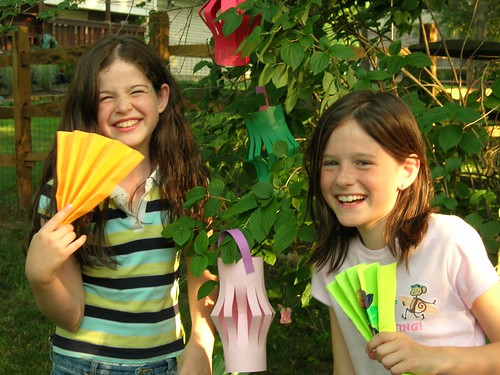
DSCN1199.JPG Caitrin and best friend Sarah with handmade lanterns for their Japanese tea party.

Have you read the book about the homeschooled kids who built a canoe in the basement, whittling the wood from felled trees? Or what about the teens who figured out how to cross breed fish in their creek, or built eco-friendly low-cost dwellings in their backyard as practice for working with Habitat for Humanity?

I remember reading about a kid who played with blocks as a child but then went on to write symphonies in college, after mastering the violin, and learning to conduct a symphony. Somehow these were related.

Then there are the kids who’ve read all of the classics and have taught themselves Latin and/or Greek. Others have performed on a Broadway stage, joined a prestigious ballet company, or have tried out to be Olympic athletes. All homeschooled.

Other impressive homeschoolers got into Harvard, or wrote best selling fiction (The Inheritance Series, anyone?), or worked as interns at the state government house!

Meanwhile, you’ve got runny noses, a daughter whose handwriting resembles scrawl, and a son whose main ambition seems to be punching pixels on a screen by thumping a button on a controller. You can’t imagine that your kids, your garden variety kids, will ever be so extraordinary. You feel mildly guilty about that. (I know I did.)

Perhaps your homeschooled children seem “extra” “ordinary” – as in “more ordinary than usual” – to you!

I found myself inspired and discouraged at the same time when I’d read about successful older homeschooled kids. I couldn’t see how my brood would ever get there.

First of all, we were appallingly bad at science (so scratch cross-breeding and habitat building). We had so many kids, I couldn’t imagine being able to afford supporting a lifetime habit of acting or ballet or singing or violin or lacrosse or gymnastics, let alone accommodating all those rehearsal/practice schedules!

And as far as boat-building in basements—I was lucky if we could find the basement floor, let alone make space to build in it.

Yet I plugged away with our books and our homeschool parties, our math pages and our co-op, committed to what I could do—how I could make my home a place where creativity had a chance to flourish, and where ambitions were accommodated as best as we could.

I couldn’t see the seeds being planted. I couldn’t know how they’d take root.

I wasn’t privy to how my children processed our experiences together, and how these memories became anchors of insight that led my kids to aspire to and achieve some of the amazing things they’ve now done. I never saw most of it coming. Truly.

On this side of homeschooling, I want to encourage you not to worry about the outcomes. The smallest acts of enthusiasm, support, and opportunity lead to big choices down the road. Your job isn’t to think of the great things your kids can do or should be doing some day.

Your job is to make sure that today, they have something interesting:

to read,
think about,
observe,
and enjoy.

Or as Charlotte Mason says, ” “Something to love, something to do, and something to think about.”

Find that sweet spot each day, no matter how briefly visited. These collect into a childhood of impressions that shape how they will choose to spend their teen years and eventually, their adulthood. They don’t have to “change the world” or impress anyone. All they need is the freedom to keep making choices that enhance their enthusiasm for being contributing people—human beings who want to share who they are with others using their unique constellation of gifts and passions.

That’s it.

You can do that.

You already are.

Posted in Brave Writer Lifestyle, Brave Writer Philosophy, Family Notes, Homeschool Advice | 3 Comments »

Giving Wishes

If you can't give your child what she wants, you can give it to her in a wish.
 

If you can’t give your child what she wants,
you can give it to her in a wish.

For instance, if she tells you she wants her own horse (yet you live in an apartment and don’t have the funds or lifestyle to support a horse), you don’t need to crush the vision with practicalities. Instead, give it to her in a wishful fantasy.

Wouldn’t it be wonderful to own a horse? What would you name it? Where would you ride it? What would it look like? Do you know what type of horse you’d want to own? Shall we look them up online? Would you want to show the horse in competitions? Ride the horse over jumps? Learn dressage? Or would you prefer to ride bareback over hills alone, looking at the sunset?

Of course you don’t simply shoot questions at her as if pulling the trigger to a BB gun. You want to give her the chance to live her fantasy with you for a little emotional vacation. Let her describe the horse’s mane and color, where she would ride, how she would care for the horse, why a horse would be such a dear companion at this stage in her life.

If possible, assist the fantasy with practical possibilities even if they fall short of the ultimate fantasy:

  • Maybe we can ride horses at the local stable this month.
  • How about we check out some good old films about horses and watch those over the next week?
  • Let’s pick a horse to follow in the upcoming series of horse races and get to know its life story.
  • I know there’s a saddle shop in town. Maybe we can learn how they are made, feel the smooth leather with our hands, and ask about local horseback riding while we’re there.
  • I wonder if we can take a family vacation to a dude ranch one year.
  • Our homeschool group may have a family with a horse we can visit. Let’s ask.

The thing about kids is that they enjoy possibilities far more than we do. They aren’t jaded, haven’t had their dreams dashed, don’t manage the checkbook, aren’t limited in their energy. There’s no need to “smack down a dream” before it has a chance to emerge. Give it some breathing room—allow it to manifest in conversation, illustrations, reading, narration, writing, and play. Then find the little pieces of the fantasy that you can support/provide, and find a way to incorporate these into your child’s life.

Sometimes magic happens and the little bit of wind you blow into those sails leads to the fulfillment of the bigger dream, too. Kids have a way of conjuring wonderfulness from nothing, which is one of the reasons we love having them in our lives.

Wishful thinking is a gift, not a thing to be disparaged.

Image by David Michalczuk (cc cropped, text added)

Posted in Brave Writer Lifestyle, Homeschool Advice | 1 Comment »

3 Spectacular Strategies for Success

The expression, “Go big or go home!” might apply here (though for our purposes, “Go big AT home” would be more appropriate). However, one of the 3 Spectacular Strategies is about going really really small, as in tiny, as in minisculilio (perhaps the reframe might be: “Go so small it’s like this HUGE commitment to staying in the confines of ‘going really really tiny’—maybe like “Going Big INTO Small!”).

Let me set the context. Sometimes we homeschooling parents assemble all these Reasonable Goals for the school year. We believe in plodding along, managing our children’s progress, assessing their growth and making incremental, prudent adjustments. We divvy up the workbook into its perfectly apportioned pages-to-be-done-each-day for the 180 day school year and then, carefully, carry out the plan one-painstaking-day-at-a-time, requiring compliance from the students (our beloved cherubs), at times deviating from the Sacred Plan into a Cul-de-sac of Guilt when we unwillingly take a day off…

Then we ramp up the familiar and try again. And again. And… a… gain.

Then we hit the wall of resistance, or poor performance, or tedium, and we wonder how we can get back on track.

Sound familiar? Sound exhausting? Sound crazy-making?

Break the cycle.

Ditch the plan… for these 3 strategies.

1. Go BIG!!

You want to study the Gold Rush? BUILD your own gold mining sluice from scratch for the next week. Or next two weeks. Get the wood, find a design, order some fool’s gold from an online store, grab a hammer and nails, saw and saw horses, and put the thing together. For the whole two weeks. No grammar lessons. No math pages. No phonics. Just pure bigtime indulgence throwing educational caution (and the nagging voice of the Ghost-of-Public-School-Past) to the wind!

Don’t worry if you fail at sluice-building (half the time you go big, you will). So much learning happens in the process of a failed sluice project! You can always shift gears and bury the fool’s gold in your sandbox. Add water and use pie tins to swish the gold into view.

Invite friends to help find gold. Sing “O Susanna.” Eat sugared beans with hot dogs. Make sarsaparilla from scratch. Wear Levi’s and flannel shirts. Pin the gold nugget on a map of Sutter’s Creek!

Ditch the plodding text book study. Stop the labor of daily grind learning. Instead when you come across a worthy topic, Go Big!

Other examples of Going Big (all at once, all hands on deck, all in, no other competing subjects):

  • Colonial Times: Dye fabric with beets, onion skins, and paprika. Dip candles. Make cardboard stocks and pose in them. Sing “Yankee Doodle.” Assemble colored paper flags and stick a circle of silver or white stars to represent the colonies on the flag. Write letters on parchment with fountain pens and seal them with sealing wax.
  •  

  • Birds: Observe them. Get a field guide and binoculars; identify them. Go to places where birds are (nature centers, woods, beaches, the zoo). Take a birding walk with a local birding group. Name the birds that come to your backyard. Feed them. Draw them. Photograph them. Get a raw chicken and observe and name all the parts as you manipulate the body. Identify where the feathers attached themselves. Show the innards. Discuss. Dissect an owl pellet. Collect feathers. Watch Youtube videos of eggs hatching. Watch “Winged Migration” (the film).
  •  

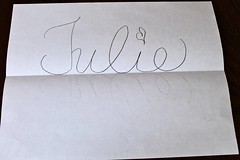
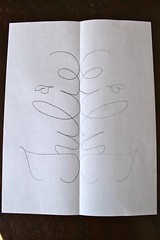
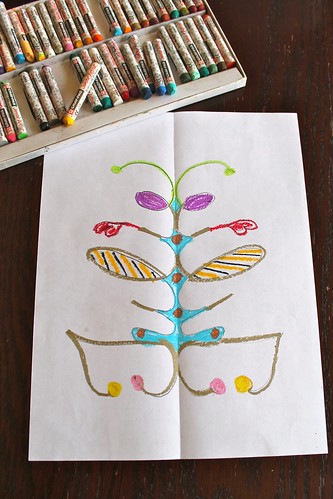
  • Cursive handwriting: Make a bug using your cursive handwriting. Take a white sheet of paper, fold it lengthwise in half, turn it sideways so the middle of the page is the line you write on. Handwrite (in soft pencil led) your first name (use italics for letters that ordinarily go below the line in cursive). Fold the page back together and rub until the mirror impression shows on the flip side. Open the page. Trace over the mirrored impression of the name so it stands out. Color the “name” to look like a bug! Try other words and make more bugs. Cut them out and mount them on the kitchen windows. (See photos for the process.)

UntitledUntitledUntitled

2. Go Really Really Small

The temptation is to do more, better, and different all the time. But what if you flip the script? Choose deliberately to do only one tiny part of the lesson today. Call this event: “The Mini Lesson.” It could become a “thing” you go to when kids are exhausted and you need to change the tone of the home. You might yell: “Time for a Mini Lesson!”

For instance, what if you choose to require the barest minimum-est amount of the required “thing”? What if you told your kids:

“You only have to do one math problem today, but I want to see you get the right answer. You can spend as much or as little time as you need. Just be sure you get the answer right. If you do, there’s a surprise for you. Yes, you can ask me for help or to check as you go and I’ll hint at the errors for you to fix.”

Then offer your child one problem that uses the math concepts you want to emphasize. For instance, if you are working with addition and subtraction, create a problem that uses both: (7+6) — (5+1) = ? You can certainly make the problem more or less complex depending on the skill you want to teach. It might be a perfect time to do ONE word problem.

Create a meaningful really little reward:

    a pack of gum,
    a tin of mints,
    a row of stickers,
    a rub-on tattoo,
    a new pencil,
    lip balm,
    two cookies,
    a bouncy ball,
    a mini Slinky.

Naturally, you can use the same really really small lesson with handwriting: One letter, one time (perfect, beautiful, clear, proportioned, accurate). Or one word, or one sentence. Give full attention to perfectly shaped letters. Expect accurate copying, correct letter-to-letter correspondence. Keep the selection short. Admire it when it’s complete.

Apply the really really small lesson to a household practice:
Set the timer for one minute. Pick up toys on the floor for a single minute, in a race, to get as many off the ground as possible. Do it twice that day… Once in the morning and once in the afternoon. You can yell “Ready set go!” and “Ding! You’re done.” Make it a community challenge: “If the whole floor gets cleared, we all get gum!”

A really really small lesson can be a single sentence that needs editing (a mini mini version of the Reverse Dictation practice in the Arrow, Boomerang, and The Writer’s Jungle).

A really really small lesson could be one logic puzzle, or one fact memorized, or one page of a book read aloud. Pick the item you are worried about, pick one short requirement, and use this mini lesson format to give it square, deep, brief attention.

3. Collaborate

Why go it alone? Put your kids together in pairs. Have the older teach the younger. Capitalize on the elder children’s maturity and advanced skills. The principle that applies: “You learn more when you teach!”

If one child needs to drill multiplication tables, send the one who knows them outdoors with the one learning them. Give them a frisbee and tell the older one to call out “3 times 4,” and the other will toss it back: 12!

Have a younger child read aloud to an older child as she learns to read.

Ask a younger and older child to bake together. Empower an older sibling to teach a younger sibling to:

    use the washing machine,
    tie shoes,
    tell time,
    hopscotch,
    find the main idea in a paragraph,
    identify the hero and the villain in a movie,
    put together a puzzle,
    work a page of sentences in Winston Grammar,
    create a list of homonyms,
    memorize a nursery rhyme or small poem…

The point is—have your kids do stuff together, with the bigger kids in the role of teacher or leader.

As a collaborating family, you can create a slew of ideas together to make history come to life, for example. Each child contributes an idea and then you all do them as a family, one at a time, until they are completed. For instance, if you study a country like Japan, you might have several ideas created by the kids:

  • Craft tissue paper cherry blossoms
  • Make a felt Japanese flag
  • Eat tempura with chopsticks
  • Sit on the floor with cushions to eat the meal at a coffee table
  • Draw a map of Japan
  • Learn Japanese greetings, including how to bow
  • Watch anime!
  • Perform a Japanese tea ceremony

Not all ideas have to come from you! On the contrary, kids love knowing that they made a meaningful contribution to the project. Don’t rule out the weird ideas—”I want to see a Komodo Dragon!” Find out where one lives (at a zoo?) and go to it. Or at the least, find a documentary to watch together to learn about the creature. Giving each person something to contribute helps the whole team to feel invested. Learning will happen for each person in a grade appropriate way, according to their skills. That’s what you want!

Lastly, you can add families to your projects any time you feel lonely. Two families creating a henna party to celebrate “1001 Arabian Nights” is much more fun than one! Studying tide pools with your best friends at the beach for a picnic is better than going alone. You get the idea.

To review:
Go Big!
Go really really small…
~Collaborate~

Tell me how it goes (or has gone, if you already live this way).

Posted in Brave Writer Lifestyle, Brave Writer Philosophy, General, Homeschool Advice, Unschooling | 2 Comments »

« Older Entries
Newer Entries »
  • Search the Blog

  • Julie Bogart
  • Welcome, I’m Julie Bogart.

    I’m a homeschooling alum -17 years, five kids. Now I run Brave Writer, the online writing and language arts program for families. More >>

    IMPORTANT: Please read our Privacy Policy.

  • New to Brave Writer? START HERE

  • FREE Resources

    • 7-Day Writing Blitz
    • Brave Writer Lifestyle Program
    • Brave Writer Sampler: Free Sample Products
    • Freewriting Prompts
    • Podcasts
  • Popular Posts

    • You have time
    • How writing is like sewing
    • Best curriculum for a 6 year old
    • Today's little unspoken homeschool secret
    • Do you like to homeschool?
    • Don't trust the schedule
    • You want to do a good job parenting?
    • If you've got a passel of kids
    • You are not a teacher
    • Natural Stages of Growth in Writing podcasts
  • Blog Topics

    • Brave Learner Home
    • Brave Writer Lifestyle
    • Classes
    • Contests/Giveaways
    • Friday Freewrite
    • High School
    • Homeschool Advice
    • Julie's Life
    • Language Arts
    • Movie Wednesday
    • Natural Stages of Growth
    • One Thing Principle
    • Our Team
    • Parenting
    • Philosophy of Education
    • Podcasts
    • Poetry Teatime
    • Products
    • Reviews
    • Speaking Schedule
    • Students
    • Writing about Writing
    • Young Writers
  • Archives

  • Brave Writer is a participant in the Amazon Services LLC Associates Program, an affiliate advertising program designed to provide a means for sites to earn advertising fees (at no extra cost to you) by advertising and linking to amazon.com

    Content © Brave Writer unless otherwise stated.

What is Brave Writer?

  • Welcome to Brave Writer
  • Why Brave Writer Works
  • About Julie
  • Brave Writer Values
  • Frequently Asked Questions
  • Speaking Schedule

Brave Writer Program

  • Getting Started!
  • Stages of Growth in Writing
  • The Brave Writer Program
  • For Families and Students
  • Online Classes
  • Brave Writer Lifestyle

…and More!

  • Blog
  • Classroom
  • Store
  • Books in Brave Writer Programs
  • Contact Us
  • Customer Service
  • Brave Writer Staff
© 2026 Brave Writer
Privacy Policy
Children's Privacy Policy
Help Center