Julie Bogart, Author at A Brave Writer's Life in Brief - Page 398 of 480 A Brave Writer's Life in Brief
  • Start Here
    • For Families
      Multiple Ages
    • Ages 5-7
      Beginning Writers
    • Ages 8-10
      Emerging Writers
    • Ages 11-12
      Middle School Writers
    • Ages 13-14
      High School Writers
    • Ages 15-18
      College Prep Writers
  • Shop
    • Product Collections
    • Bundles
    • Writing Instruction Manuals
    • Literature & Grammar/Punctuation
    • Composition Formats
    • Literature Singles
    • Homeschool Help
    • Book Shop
  • Online Classes
    • Class Descriptions
    • Class Schedule
    • Classroom
    • How Our Classes Work
    • Our Writing Coaches
    • Classes FAQ
  • Community
    • Brave Learner Home
    • What’s Happening
    • Blog
    • Podcast
    • Calendar
  • Cart
  • My Account
    • My Online Classes
    • My Account
  • My Account
    • My Online Classes
    • My Account
  • Start Here

    If you’re new to Brave Writer, or are looking for the best products for your child or family, choose from below:

    • For Families
      Multiple Ages
    • Ages 5-7
      Beginning Writers
    • Ages 8-10
      Emerging Writers
    • Ages 11-12
      Middle School Writers
    • Ages 13-14
      High School Writers
    • Ages 15-18
      College Prep Writers
  • Shop

    If you’re already familiar with Brave Writer products, go directly to what you’re looking for:

    • Product Collections Browse the full catalog in our shop
    • Bundles Everything you need to get started
    • Writing Instruction Manuals Foundational Writing Programs
    • Literature & Grammar/Punctuation Grammar, Punctuation, Spelling & Literary Devices
    • Composition Formats Writing Assignments for Every Age
    • Literature Singles Individual Literature Handbooks
    • Homeschool Help Homeschooling Tools and Resources
    • Book Shop Books associated with Brave Writer Programs
  • Online Classes
    • Class Descriptions
    • Class Schedule
    • Classroom
    • How Our Classes Work
    • Our Writing Coaches
    • Classes FAQ
  • Community
    • Brave Learner Home
    • What’s Happening
    • Blog
    • Podcast
    • Calendar
  • Search
  • Cart

Search Bravewriter.com

  • Home
  • Blog

A Brave Writer's Life in Brief

Thoughts from my home to yours

Author Archive

« Older Entries
Newer Entries »

Email: Books and Movies

Julie, it’s been a long time since I’ve been in a schooling situation where books and movies are discussed in terms of plot, settings, and I can’t even remember what else to mention in that list – is there any way you may be able to do a blog entry about it, for people who may need a little reminder of how to do so? It’s easy for my kids to describe what they’re reading, and to discuss the storyline, but what sorts of things should I be pointing out, or bringing to their attention, etc? Thanks so much for your consideration!–
Susan
—
Hi Susan.
Great topic for multiple blog entries. Books and movies (because they are built on plots) can be discussed in similar ways with your kids. They also have some differences which can lead to fruitful discussions. Let’s talk first about what they share: plot. I’ll continue this series over the course of the week so stay tuned.

Plot: The narrative arc of most stories can be easily detected by using a little rubric I took from Anne Lamott’s writing classic Bird by Bird. She suggests the rubric: ABDCE (action, background, development, climax, ending). Most movies in particular start with action (often with credits popping through the opening scenes). The action is usually a set up for the storyline but not the key event. In books, the writer is not as often compelled to start with action, but in a similar way, must grab the reader’s attention and will do so with an opening hook.

Following that opening action, the plot will expand to share the background of the primary characters and story so that you understand the purpose of the opening action. The Pirates of the Caribbean is a good example of this kind of opening which transitions into background. During the background, you will often be given insights that act as foreshadowing events. These are events that tell you of the impending doom/danger that lies ahead, or of the potentially successful resolution of the problem presented. Usually following the background (which can be a few paragraphs or scenes, or much longer if the plot is complex) the plot moves into development of the story. Development is characterized by a series of set-ups and frustrations. You are offered possible solutions to the key problem the story sets out to resolve, but the characters are repeatedly frustrated because the obvious solution is thwarted time and again.

The climax is the moment the story has been waiting for all along. You often know what the climax will or should be after the opening scenes. When you come to the climax, it feels like the do or die moment (the boy will or won’t get the girl, the criminal will or won’t get caught, Dorothy will or won’t go home). Following the climax, a very short ending (usually) follows to wrap up any dangling details. In some books, the ending lasts longer than in movies because the author takes the time to give a few fleshed out scenes that might develop as a result of the resolved climax. A great illustration of this contrast is the way the movie Pride and Prejudice ends (with the nuptial kill between Darcy and Miss Bennett) and the way the book ends (with the recounting of who lived happily ever after and who did not).

When watching movies that are based on books, you ought to pay attention to the ways in which movies alter the book’s narrative in order to make it more action based, to heighten the frustration the viewer feels (usually movies create more crises than books), and to get to the climax more quickly (they have less time to develop the story and subplots). You can ask yourself if the movie successfully modifies the book, note whether or not the changes work for the movie and if you agree with those choices. You can also discuss what choices you might make if you were to modify a book into a movie format.

We’ll look at characterization next.
Posted in General, Living Literature, Wednesday Movies | Comments Off on Email: Books and Movies

Friday Freewrite: I’m bugged

What is something that really bugs you?

Posted in Friday Freewrite, General | Comments Off on Friday Freewrite: I’m bugged

Where did “Ring a Ring o Rosie” come from?

If you’ve ever wondered about the origins of your favorite nursery rhymes, check out this site. Pick one for copywork and then read about where it comes from. Fascinating stuff.

And did you know there are two versions of Humpty Dumpty, for instance?

Humpty Dumpty poem

Humpty Dumpty sat on a wall,
Humpty Dumpty had a great fall.
All the King’s horses, And all the King’s men
Couldn’t put Humpty together again!

Alternative Words…

Humpty dumpty sat on a wall,
Humpty dumpty had a great fall;
Threescore men and threescore more,
Could not place Humpty as he was before.

Posted in Copywork Quotations, General | 1 Comment »

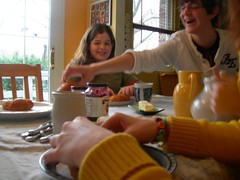
Teatime at our house


Teatime
Originally uploaded by juliecinci.

When we’re in a pinch, we use croissants and jam for teatime. They can be frozen after purchase and easily reheated in the oven when we need them. Johannah is gone more than she’s home now, but when she’s here, we try to have our teatimes so that she can join us.


Posted in General, Poetry Teatime | Comments Off on Teatime at our house

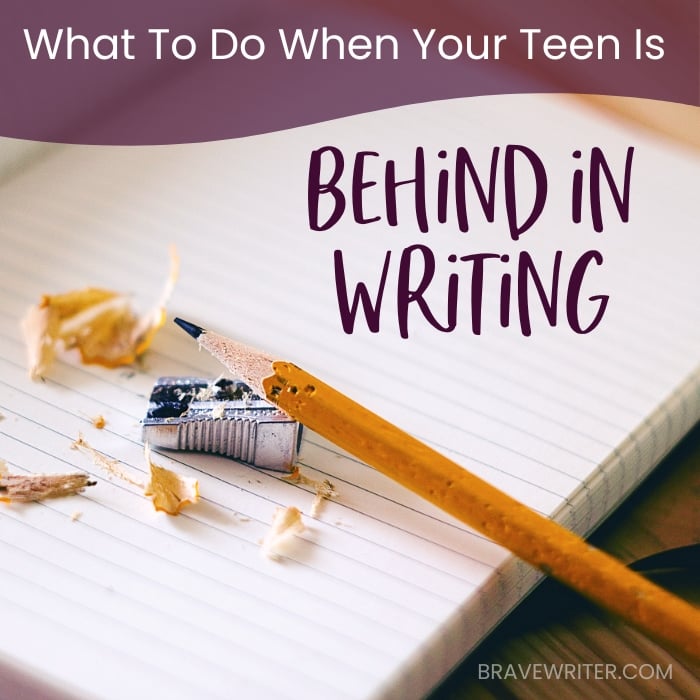
If Your Teen Is Behind in Writing

Brave Writer

It’s downright scary when your child turns 16 and still can’t write (or won’t write or hates writing or avoids writing). Panic sets in and moms respond in one of two ways:

  • they clamp down and expect more writing
  • or they give up and close their eyes to the problem hoping it will get fixed later, in college.

These are two totally understandable approaches to the realization that your teen is still not writing well and college is only two years away.

I want to offer you a third approach:

Start over.

Before I share what I mean by starting over, read the following list to determine if your teen is behind in writing (I use masculine pronouns because far more male teens struggle with writing than females, but this list applies to everyone):

  • No writing program you’ve used has ever worked for him.
  • He hates holding a pencil and avoids any work that requires handwriting.
  • He still finds spelling a challenge and misspells homonyms and easy words regularly.
  • You face a “big scene” whenever you give feedback or try to help him write.
  • His writing is unclear, doesn’t develop logically, and sounds like a second grader wrote it, not a soon-to-be adult.
  • His thoughts are undeveloped and his writing doesn’t show the extent of his verbal vocabulary.
  • He has never written more than a paragraph or two and has no idea how to write an essay or any format beyond freewriting.
  • He is unskilled in punctuation even though you’ve taught him how to punctuate.
  • He seems to understand the instructions while you talk with him, but he goes completely blank once you leave and can’t remember what he was supposed to write once you leave him to work on his own.
  • He can’t keep his ideas in his head while he is writing them down. The pencil “makes” the thoughts “disappear.”
  • He must have supervision while he writes or he will wander off to do something else.
  • He needs leading questions in order to write.

If your child exhibits more than half of these symptoms, you have a delayed writer on your hands. You may also have a teen with a language processing disorder. I want to talk about the difference between the two.

For teens who are simply delayed in writing, it’s possible to get back on track and quickly. As I stated above, you’ll want to start over. You’ll need to let your teen know that what you’ve done to the present point has not worked.

How to Wipe the Slate Clean

In order to do so, you need to enlist your teen’s interest in becoming a competent writer. There’s not a lot that can be done if your teen is unconvinced of writing’s importance to his future.

Once you have a willing teen, I recommend beginning with the “Jot it Down” phase of writing. You’ll jot down your teens thoughts as he’s thinking them and expressing them verbally. You’ll begin with his areas of expertise and interest rather than typical “school” topics. Your goal is to foster writing skills (the skill called “dredging up words from inside to commit to paper”), not to master subject matter. So separate those goals right off the bat.

As you write out his thoughts for him, you’ll go back to the writing together to do the revising and editing. Talk about the writing, talk about ways to improve it, talk about how to reorganize it so that it makes more impact.

Do it all together.

Stick to topics of interest while you work through this phase.

You will follow the stages of development in order starting from the beginning. If you do this, your teen will move more quickly through the stages of growth because of his age and maturity and can (believe it or not) reach a level of high school competence in just two short years.

If you follow these steps, however, and you discover that your child makes no progress or continues to become frustrated by the mechanics of writing combined with the generative thinking required, I strongly urge you to get learning disability testing.

Don’t wait.

Auditory and language processing disorders don’t always show up in full strength until high school when mom takes more of a background role in home education and the teen is now responsible for proactive work. (Incidentally, my own son, who is 19 and in college, gets accommodations from the learning center at his university. Knowing in advance means you can look at colleges that are supportive of students with learning issues so that your young adult has a successful experience!)

Yesterday I attended the wedding of one of my first teen students. Seven years ago, he was sixteen and not writing. His mother came to me desperate to overcome his writing struggles. We began at the very beginning. Her son was cooperative and worked hard. Within two years, he became a competent (though not brilliant) writer. By the time he finished college, he wound up earning A’s in his writing classes. Knock my socks off!

It can be done.

Your teen can overcome years of frustration one step at a time with love and support. And if he is fighting a disability, find out so that he can get the kind of support that will make him successful.


Writing with Teens: 5 Posts You Don’t Want to Miss


Brave Writer Natural Stages

Posted in Brave Writer Philosophy, General, Tips for Teen Writers | 3 Comments »

« Older Entries
Newer Entries »
  • Search the Blog

  • Julie Bogart
  • Welcome, I’m Julie Bogart.

    I’m a homeschooling alum -17 years, five kids. Now I run Brave Writer, the online writing and language arts program for families. More >>

    IMPORTANT: Please read our Privacy Policy.

  • New to Brave Writer? START HERE

  • FREE Resources

    • 7-Day Writing Blitz
    • Brave Writer Lifestyle Program
    • Brave Writer Sampler: Free Sample Products
    • Freewriting Prompts
    • Podcasts
  • Popular Posts

    • You have time
    • How writing is like sewing
    • Best curriculum for a 6 year old
    • Today's little unspoken homeschool secret
    • Do you like to homeschool?
    • Don't trust the schedule
    • You want to do a good job parenting?
    • If you've got a passel of kids
    • You are not a teacher
    • Natural Stages of Growth in Writing podcasts
  • Blog Topics

    • Brave Learner Home
    • Brave Writer Lifestyle
    • Classes
    • Contests/Giveaways
    • Friday Freewrite
    • High School
    • Homeschool Advice
    • Julie's Life
    • Language Arts
    • Movie Wednesday
    • Natural Stages of Growth
    • One Thing Principle
    • Our Team
    • Parenting
    • Philosophy of Education
    • Podcasts
    • Poetry Teatime
    • Products
    • Reviews
    • Speaking Schedule
    • Students
    • Writing about Writing
    • Young Writers
  • Archives

  • Brave Writer is a participant in the Amazon Services LLC Associates Program, an affiliate advertising program designed to provide a means for sites to earn advertising fees (at no extra cost to you) by advertising and linking to amazon.com

    Content © Brave Writer unless otherwise stated.

What is Brave Writer?

  • Welcome to Brave Writer
  • Why Brave Writer Works
  • About Julie
  • Brave Writer Values
  • Frequently Asked Questions
  • Speaking Schedule

Brave Writer Program

  • Getting Started!
  • Stages of Growth in Writing
  • The Brave Writer Program
  • For Families and Students
  • Online Classes
  • Brave Writer Lifestyle

…and More!

  • Blog
  • Classroom
  • Store
  • Books in Brave Writer Programs
  • Contact Us
  • Customer Service
  • Brave Writer Staff
© 2026 Brave Writer
Privacy Policy
Children's Privacy Policy
Help Center