Julie Bogart, Author at A Brave Writer's Life in Brief - Page 243 of 481 A Brave Writer's Life in Brief
  • Start Here
    • For Families
      Multiple Ages
    • Ages 5-7
      Beginning Writers
    • Ages 8-10
      Emerging Writers
    • Ages 11-12
      Middle School Writers
    • Ages 13-14
      High School Writers
    • Ages 15-18
      College Prep Writers
  • Shop
    • Product Collections
    • Bundles
    • Writing Instruction Manuals
    • Literature & Grammar/Punctuation
    • Composition Formats
    • Literature Singles
    • Homeschool Help
    • Book Shop
  • Online Classes
    • Class Descriptions
    • Class Schedule
    • Classroom
    • How Our Classes Work
    • Our Writing Coaches
    • Classes FAQ
  • Community
    • Brave Learner Home
    • What’s Happening
    • Blog
    • Podcast
    • Calendar
  • Cart
  • My Account
    • My Online Classes
    • My Account
  • My Account
    • My Online Classes
    • My Account
  • Start Here

    If you’re new to Brave Writer, or are looking for the best products for your child or family, choose from below:

    • For Families
      Multiple Ages
    • Ages 5-7
      Beginning Writers
    • Ages 8-10
      Emerging Writers
    • Ages 11-12
      Middle School Writers
    • Ages 13-14
      High School Writers
    • Ages 15-18
      College Prep Writers
  • Shop

    If you’re already familiar with Brave Writer products, go directly to what you’re looking for:

    • Product Collections Browse the full catalog in our shop
    • Bundles Everything you need to get started
    • Writing Instruction Manuals Foundational Writing Programs
    • Literature & Grammar/Punctuation Grammar, Punctuation, Spelling & Literary Devices
    • Composition Formats Writing Assignments for Every Age
    • Literature Singles Individual Literature Handbooks
    • Homeschool Help Homeschooling Tools and Resources
    • Book Shop Books associated with Brave Writer Programs
  • Online Classes
    • Class Descriptions
    • Class Schedule
    • Classroom
    • How Our Classes Work
    • Our Writing Coaches
    • Classes FAQ
  • Community
    • Brave Learner Home
    • What’s Happening
    • Blog
    • Podcast
    • Calendar
  • Search
  • Cart

Search Bravewriter.com

  • Home
  • Blog

A Brave Writer's Life in Brief

Thoughts from my home to yours

Author Archive

« Older Entries
Newer Entries »

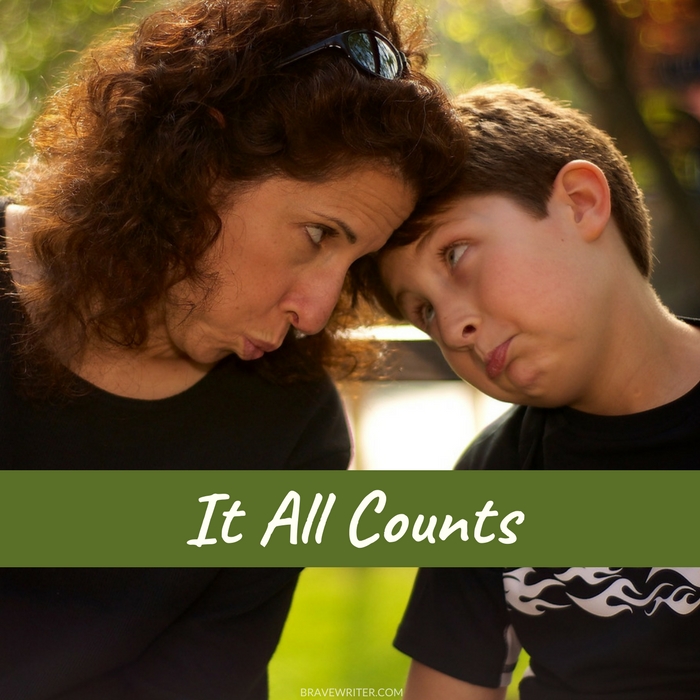
It All Counts

It All Counts

Today’s thought: It all counts

  • The dish washing,
  • the foot rubbing,
  • the tub bathing,
  • the skip counting in the car,
  • the singing at the tops of your lungs together off key,
  • the carefully copied passage,
  • the shopping for groceries,
  • the spontaneous walk in the neighborhood,
  • the sorting the laundry into the right colored piles,
  • the charging of the dead phone,
  • the pause to text your sick mother-in-law,
  • the five minutes you take to regroup,
  • the gentle way you overlooked your child’s Big Mess,
  • the fifth book read after lunch when you usually only read three,
  • the naps (oh yes, the naps count!),
  • the petting of the dog,
  • the recitation of a few historical facts,
  • the listening carefully when your child explains how to beat level five,
  • the cuddles,
  • the enthusiastic cheer for small successes and big ones,
  • the science experiment you finally got through with all the right ingredients,
  • the trampoline jumping,
  • the needed and taken break…

This stuff also counts:

  • The short word,
  • the worry,
  • the rushing,
  • the aimlessness that takes over when exhausted,
  • the bickering,
  • the harsh tone when a child is simply being a child,
  • the endless pages of material a child already knows,
  • the push, push, push to work harder on what a child isn’t ready for,
  • the conversations with a spouse overheard by the child,
  • the missed opportunities to play,
  • the loss of contact with a teen,
  • the blankness that sets in when sick of homeschooling,
  • the lost moment when a child was excited but you were distracted,
  • the anxiety that something’s wrong,
  • the blues,
  • the bad math book that you spent too much on,
  • the co-op where a bully mistreats your one child,
  • the much-needed, not-taken break…

You get to choose what will count in your homeschool.


Brave Writer Lifestyle

Posted in Homeschool Advice, Parenting | 1 Comment »

Two Ways to Grow Teens

Homeschooling teens

Teens present a challenge to parents who are used to the cozy snuggly younger years of wide-eyed curiosity about lady bugs. Teens can become bored by the wonder of the world around them as they navigate the far-more-interesting-to-them inner world of their thoughts, emotions, and yearnings.

That first teen—how I pity her or him! Parents don’t want to be awakened from the dreamland of their perfect, precious child. They want to prolong innocence and enchantment.

Teens want risk and adventure. They want to prove to themselves that one day, they will in fact be competent adults who live in the world outside the living room walls. They can’t know that they will be successful in that world until they get their hands on it—until they are out in it!

How do we—the anxious parents of these gawky, voice-changing, hair-growing, newly curvy bodies—give them what they need without panic and anxiety?

There are two critical pathways to the expansion of self:

1. Witness
2. Encounter

Witness

One way to grow is to increase your exposure to a world that is different from your familiar one. We adults do that every day by reading the news, or watching television, or listening to radio. We “witness” the events from around the globe via film or satellite, we read interesting discussions about those events, we listen to interviews with people who live in the midst of those events, and we receive stories through movies, memoirs, and novels of people who live very differently from us. This “witness” to the experiences of others expands our worldview and rearranges what we understand as normative or important. We discover our values differently when they are held up next to the values of others (whether those others live down the street or across an ocean).

For teens—they “witness” a larger world in much the same ways, if they are given the chance! They have the Internet—which offers them Twitter, Facebook, bulletin boards for affinity-related discussion, news organizations, blogs like Tumblr, and more. It’s easy to want to limit the use of the Internet, but it’s almost impossible to do so successfully (teens can work around just about any limit you set). It’s even better to create conversation around what they learn there and to be a willing conversation partner for the cognitive growth that is happening at breakneck speed in that space.

They also witness the larger world through novels and films. These two vehicles help teens to absorb the motivations and complexities of being human in unfamiliar (or very familiar!) contexts. They can read, take time off, read more, and process it all safely at home with you.

Witness provides teens with a chance to explore unfamiliar territory at arm’s length. The experience is under their control. They can shut down the computer, they can turn off the television, they can close the book. They are free to sample or deep dive, to agree or disagree without consequence to their life’s situation.

Homeschooling teens

Encounter

Encounter is the more challenging, more impacting way to grow. Encounter is not at arm’s length. Encounter means being overwhelmed (all five senses) with the experience so that you can’t escape it nor package and manage it. For instance, you might “witness” what life is like in Iran by reading a book like Reading Lolita in Tehran. But to encounter life in Tehran, one would have to go and stay there! Travel is one level of encounter (visiting a place for a short stay). An extended stay working in a foreign country is another level of encounter. Moving to live in a foreign country is the most intense form of encounter.

In terms of raising teens, encounter can look a few ways. It is meeting someone who embodies whatever life experience and values are his or hers (that differ from your own). It is befriending someone who comes from a different background. It is visiting the sites where other views take place (for instance, going to a temple for a visit when you are studying about that religion, especially when it is not your religion; another example—visiting a plantation in the South when you grew up in the North hating plantations as representations of slavery).

Encounter is eating the food, hearing/speaking the language, wearing the clothing, adopting the customs.

Encounter is deliberately putting yourself in the uncomfortable position of being with someone different from yourself and allowing that experience to impact you.

We help our teens grow when we give them both opportunities. They love risk and adventure! When you allow them to develop affinities, to explore their curiosities, and to meet/know people who are different from them, you help their brains! They will experience the kind of cognitive growth critical to being critical thinkers and healthy adults!

Cater to their natural inclination to take “thought-risks” and put them in contact with material and people who challenge their assumptions. Celebrate the results (whatever they may be!). Remember: no teen retains the values developed at 14 and 17. Are you today the same person you were at 15? I doubt it.

Everyone adopts positions to try on like shoes when they are teens. So let them adopt away! If you create space for a teen to imagine herself into a viewpoint, she will also have space to move through and out of it too, if she gets more and new information from witnessing or encountering!

It’s an exciting time to parent, if not a little nerve-wracking at times.

Try not to grip too tightly, and enjoy the ride.


Help for high school writers

Posted in Homeschool Advice, Tips for Teen Writers | 1 Comment »

Be More Interested in Thinking than Thoughts

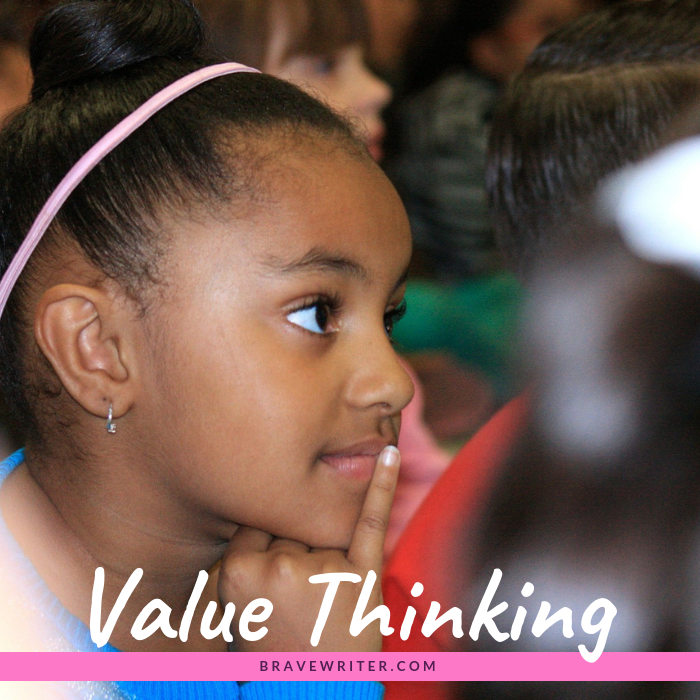
Value Thinking more than Thoughts

When someone shares a strong opinion—even when unsubstantiated by facts and data—it’s easy to feel that it is your obligation to enlighten said person with the “truth” —the truth that has eluded them until they happened upon your smarter, more capable mind.

A child is necessarily younger and less experienced with the world than you are, so their opinions will come from a different (more limited) space. But those conclusions and thoughts are no less logical to the child, no less important, no less “true” in his or her own mind’s eye.

I don’t know anyone who has kept every opinion formed at age ten throughout the rest of life. Kids, teens, young adults, heck OLD adults, routinely revise their notions of what is true, right, and good all the time, as they add experiences, information, and relationships to their lives. Our job as parents isn’t to “safeguard” a particular set of ideas or beliefs (no matter how much we may hope that our kids will adopt a particular set).

Our job is to value cognitive processes that show our kids are learning to reflect on their thinking. We don’t do this to manipulate our kids to adopt our way of thinking. We do it to enhance the powers of thought that our kids are exhibiting.

Example.

When Johannah first became interested in animal rights, she wanted to find a way to make a difference. For her, that meant adopting veganism as her lifestyle. It would have been easy to forbid it (since I had to cook for six other meat-lovers in the family and her choice would be inconvenient) or to combat it with my experiences (I grew up vegetarian and I “knew” that she wouldn’t want to be one forever) or to rebut it with my own set of facts about health.

But what I could see in her commitment wasn’t an opinion about animal rights nearly as much as it was an expression of how she “took in” impacting information and then applied it to her life. She was showing me that when she took something seriously, she would make a corresponding choice to back it with her actions! What an amazing development in a young person—to not just rant about ideas, but to put into practice a highly inconvenient lifestyle choice to back up her convictions!

As a result, our family accommodated this choice. In fact, two more kids chose to become vegans as a result of watching this commitment lived out. We had lots of discussions about how we make commitments and to what causes. It was not easy for my three vegans to understand my choice to not be vegan, for instance. Just my own lifestyle provided them with a chance to learn how to peacefully co-exist with difference—different:

  • experiences,
  • thoughts,
  • choices,
  • facts.

Today, only one of the three is still vegan. They have their new reasons for why they live differently now. These new choices show growth in how they nuance commitments and what they believe. As I suspected, their ideas morphed and grew just like mine have over a lifetime.

When our kids become passionate about a belief, or when they are exploring ideas that may even seem uncomfortable to us, this is a chance to be supportive of the cognitive development happening right before our eyes!

It’s a wonderful thing to see a mind choose to think independently of the family culture—to branch out to find information, ideas, and commitments all their own. It doesn’t mean our kids will even land or stay with these ideas for good. Most of us shift identities and beliefs again and again throughout our lives.

Rather, our children, teens, young adults are doing the hard work of becoming—becoming people who know how to think for themselves, using the resources, experiences, and reasoning skills available at that stage in the journey.

All we have to do is buy soy milk, hummus, and Earth Balance margarine, while listening intently to the passionate plea to end violence against animals.


Raising Critical Thinkers


Brave Learner Home

Posted in Parenting, Raising Critical Thinkers | 2 Comments »

Once they catch on, look out!

Once they catch on, look out!

A theme that is coming through Facebook, email, and phone calls is this: “My kids are getting it!”

What are they getting? That what is going on inside (their mind life) deserves a home on paper. As parents hear their children’s thoughts expressed in oral language and help those thoughts get to paper, more and more kids take the risk to cut out the parent-step and try it for themselves.

We spend all this time explaining how important writing is; we tell kids to follow X model or imitate Aesop or just write three lines, and they show us their sad, uncooperative faces instead. The brilliance of their quirky personalities is hidden behind attempts to sound like someone else, and they look to us to tell us what is still wrong with that effort. Everyone is demoralized.

Yet if we flip the script—start hearing what our kids are saying in that spontaneous not-school moment, jot down what they say out of our own enthusiasm to preserve the insight, thought, joke, or snatch of story—they perk up.

This is what you wanted me to write? is the thought.

You think what I have to say is important enough to write on paper? is the next thought.

Young children, especially, will respond with, “Well in that case!” They will scratch images and misspelled words onto sheets of paper laying around the house, trying to impress you again! You will be impressed. This child who “didn’t know what to write” suddenly has things to say… on paper!

The spelling, punctuation, and capitalization of the words will seem so much less important (and rightly so) when you see the child taking such initiative. Your only task is to fan the flame! Enthuse, supply cool writing utensils, create little booklets (paper folded in half, stapled between a sheet of construction paper), and READ the results aloud to the child and anyone else in the family who will listen.

The momentum this process creates is entirely different than required writing at a desk every day.

A couple necessary caveats:

1. For reluctant writers who don’t trust you (because they feel the weight of pressure coming from you), adopt a bored gaze (this is for parents whose kids get suspicious when they effuse too much). When you hear them expressing, show enthusiasm and jot it down. But when they write on their own, simply acknowledge it matter-of-factly and then ask hours later if you can read it. Ask plainly without over stating how proud you are so there is room for this child to enthuse or even dislike his own work. Then, when you do read it, praise the content by engaging it—”I love how the princess gets out of trouble” or “I didn’t know that about amphibians.”

2. Pictures are writing too! Any attempt to symbolize language is writing. So if a child is writing “picture books,” without words, affirm the child as writer! As we know, there are loads of wordless books on the market (we find them in libraries). Ask your child to “read” the book back to you. You’ll discover so much thought life and language happening in those pictures. As the child gains skill, words will begin to emerge too.

3. Passion for writing comes in bursts. It’s a creative activity. A child may write 16 little books in a month and then nothing for 6 months. Do not treat writing like an onerous task. Treat it like the creative outlet that it is! You can always gin up more enthusiasm for writing by changing the setting (write somewhere else, use new utensils, add brownies, change the time of day to write).

4. Read what they write during the read aloud time. Put the finished products in the library basket and read them each day. Most kids love this! Those who don’t, honor their choice to not be read aloud.

Above all: value what your kids express and get some of it into writing.

Posted in Writing about Writing | Comments Off on Once they catch on, look out!

Your Secret Homeschool Weapon

Your secret homeschool weapon

You thought I’d tell you what your secret weapon is in the first sentence? Oh heaven’s no. You will have to read a bit to find out.

Do you have kids who don’t want to “do school” or resist a new curriculum or say they hate assignments or projects? Maybe you keep telling them that at some point they will just “have to learn to write” or they “can’t write fiction forever” or they “can’t play all day”?

It’s one of those things where you kinda sorta freak out a bit when that resistance really gets going—in the form of fights, tears, refusal to even write one sentence, a willingness to outlast you.

Are we on the same page?

The tendency is to view yourself in those moments as a teacher who deserves respect and authority by virtue of being the home educator. You think you have the right to expectations because you are in charge. You can’t understand why that sweet little munchkin is becoming such a curmudgeon!

Here’s the thing, though. You’re at home. You’re the parent. Your kids know that there is negotiating space. That’s what home is. It’s the one place where “have to’s” have less power. Home is supposed to be a relief from the stress of the outside pressures of life. Enforcing “school” at home feels so contrary to the natural untidiness, lack of schedule-ness that home represents in life.

You need to embrace home as a home educator first—really allow yourself to notice and enjoy its properties (you know, like waking up when you want, wearing pj’s until lunch, or cuddling with a blanket on the couch for read aloud time).

For those formats and practices and programs you wish to see flourish in your home, then, you need to embrace them through that lens.

You ready? Here’s your secret weapon:

Stop talking. Start doing.

In other words, if you want a child to write in a new form, stop telling your child to write in that form!

Wake up, gather paper and pencil, and after breakfast, without a word (that’s the key here), start writing. Write the kind of thing you are expecting your child to write. You might be:

  • crafting a thank you note.
  • creating a short essay on paper dolls.
  • copying a quote from a book you love.
  • composing a non-fiction paragraph about Pocahontas.

Your kids may hover around you saying, “What are you doing? When do we start math? Mom, can I have more orange juice?”

You might respond: “I’m writing about Pocahontas. In fact, I can’t remember: does anyone remember the name of her tribe? Can someone get me the book we were reading?”

Keep going.

Someone asks, “Mom what am I supposed to do while you are writing?”

You reply, “I don’t know. What do you feel like starting with today? I’m going to work on this. You’re free to help me. Or you can get going with math. But I’m doing this.”

Then do it. Keep going.

Some will join you.

And because YOU are doing the assignment, you will discover just how difficult it is, too. You’ll have some raw direct experience of just what it is you are asking your child to do!

At some point in the next few weeks of doing a couple of these, you will see that your kids start to participate. You don’t simply flip over to telling them to take over, but you can say, “If you want to work on your own version of this, I’m happy to help you while I complete mine.”

Be open to collaboration, to multiple children doing one project, to everyone helping you with your project. This is HOME. Not school. Not about grade levels. This is about giving your kids a chance to watch a process before they have to engage in it or learn how to do it. This is your chance to model and lead by silence, rather than lecture and enforcement.

Try it!

Image © Sergey Khakimullin | Dreamstime.com


Stages of Growth in Writing

Posted in Homeschool Advice, Writing about Writing | 2 Comments »

« Older Entries
Newer Entries »
  • Search the Blog

  • Julie Bogart
  • Welcome, I’m Julie Bogart.

    I’m a homeschooling alum -17 years, five kids. Now I run Brave Writer, the online writing and language arts program for families. More >>

    IMPORTANT: Please read our Privacy Policy.

  • New to Brave Writer? START HERE

  • FREE Resources

    • 7-Day Writing Blitz
    • Brave Writer Lifestyle Program
    • Brave Writer Sampler: Free Sample Products
    • Freewriting Prompts
    • Podcasts
  • Popular Posts

    • You have time
    • How writing is like sewing
    • Best curriculum for a 6 year old
    • Today's little unspoken homeschool secret
    • Do you like to homeschool?
    • Don't trust the schedule
    • You want to do a good job parenting?
    • If you've got a passel of kids
    • You are not a teacher
    • Natural Stages of Growth in Writing podcasts
  • Blog Topics

    • Brave Learner Home
    • Brave Writer Lifestyle
    • Classes
    • Contests/Giveaways
    • Friday Freewrite
    • High School
    • Homeschool Advice
    • Julie's Life
    • Language Arts
    • Movie Wednesday
    • Natural Stages of Growth
    • One Thing Principle
    • Our Team
    • Parenting
    • Philosophy of Education
    • Podcasts
    • Poetry Teatime
    • Products
    • Reviews
    • Speaking Schedule
    • Students
    • Writing about Writing
    • Young Writers
  • Archives

  • Brave Writer is a participant in the Amazon Services LLC Associates Program, an affiliate advertising program designed to provide a means for sites to earn advertising fees (at no extra cost to you) by advertising and linking to amazon.com

    Content © Brave Writer unless otherwise stated.

What is Brave Writer?

  • Welcome to Brave Writer
  • Why Brave Writer Works
  • About Julie
  • Brave Writer Values
  • Frequently Asked Questions
  • Speaking Schedule

Brave Writer Program

  • Getting Started!
  • Stages of Growth in Writing
  • The Brave Writer Program
  • For Families and Students
  • Online Classes
  • Brave Writer Lifestyle

…and More!

  • Blog
  • Classroom
  • Store
  • Books in Brave Writer Programs
  • Contact Us
  • Customer Service
  • Brave Writer Staff
© 2026 Brave Writer
Privacy Policy
Children's Privacy Policy
Help Center