A Brave Writer's Life in Brief - Page 766 of 779 - Thoughts from my home to yours A Brave Writer's Life in Brief
  • Start Here
    • For Families
      Multiple Ages
    • Ages 5-7
      Beginning Writers
    • Ages 8-10
      Emerging Writers
    • Ages 11-12
      Middle School Writers
    • Ages 13-14
      High School Writers
    • Ages 15-18
      College Prep Writers
  • Shop
    • Product Collections
    • Bundles
    • Writing Instruction Manuals
    • Literature & Grammar/Punctuation
    • Composition Formats
    • Literature Singles
    • Homeschool Help
    • Book Shop
  • Online Classes
    • Class Descriptions
    • Class Schedule
    • Classroom
    • How Our Classes Work
    • Our Writing Coaches
    • Classes FAQ
  • Community
    • Brave Learner Home
    • What’s Happening
    • Blog
    • Podcast
    • Calendar
  • Cart
  • My Account
    • My Online Classes
    • My Account
  • My Account
    • My Online Classes
    • My Account
  • Start Here

    If you’re new to Brave Writer, or are looking for the best products for your child or family, choose from below:

    • For Families
      Multiple Ages
    • Ages 5-7
      Beginning Writers
    • Ages 8-10
      Emerging Writers
    • Ages 11-12
      Middle School Writers
    • Ages 13-14
      High School Writers
    • Ages 15-18
      College Prep Writers
  • Shop

    If you’re already familiar with Brave Writer products, go directly to what you’re looking for:

    • Product Collections Browse the full catalog in our shop
    • Bundles Everything you need to get started
    • Writing Instruction Manuals Foundational Writing Programs
    • Literature & Grammar/Punctuation Grammar, Punctuation, Spelling & Literary Devices
    • Composition Formats Writing Assignments for Every Age
    • Literature Singles Individual Literature Handbooks
    • Homeschool Help Homeschooling Tools and Resources
    • Book Shop Books associated with Brave Writer Programs
  • Online Classes
    • Class Descriptions
    • Class Schedule
    • Classroom
    • How Our Classes Work
    • Our Writing Coaches
    • Classes FAQ
  • Community
    • Brave Learner Home
    • What’s Happening
    • Blog
    • Podcast
    • Calendar
  • Search
  • Cart

Search Bravewriter.com

  • Home
  • Blog

A Brave Writer's Life in Brief

Thoughts from my home to yours

Grammar Game (for elementary aged kids)

Do you wish your kids knew their parts of speech? Try this.

Over the next few weeks, choose a different part of speech each week. Begin, for instance, with nouns. Talk over breakfast about what a noun is:

person, place, thing or idea

Then discuss examples: bowl (for cereal), chair, nuthatch, Mike (across the table), sister, love… and so on.

Later that day, or the next day, distribute magazines and have the kids cut out noun words and noun pictures. Put in a ziplock bag.

At the end of the week, using a posterboard or tag board, create a collage using both pictures and words. These can be put together in odd ways (the word “love” stuck on a “duck” picture). Or they can be arranged into noun poems. Or they can be random with no rhyme or reason.

Label the poster “Nouns” and you’re done!

This can be done with verbs too (pictures of actions).

For adjectives, the poster can be smaller and simply be a collage of words. I like to have kids use adjectives that describe self – then a photo of the child can be added to the collage of words.

For prepositions, have fun. Cut out the words: in, out, under, over, below, beside, above, around, through and so on. Then create pictures that show these by cutting out, for instance, a dog and a house. Put the dog “above” the house with the word “above.” Put an airplane “below” a tree with the word “below.” And so on.

Be surreal (it’s much more fun).

Julie
Posted in General, Grammar, Young Writers | 3 Comments »


Struturing Chaos

So your kids have been freewriting for months now, you are taking the risk to let your kids express all those random thoughts while you find words and ideas to praise… so now what?

I like to recommend eight weeks of freewriting before you revise any of the pieces of writing. Keep the eight freewrites in a manila folder and don’t even bother to read them unless your child wants to read them to you (let her decide).

Then when the eight weeks are over, take the folder from the shelf (on the ninth week) and lay the freewrites out on the table. Suggest your child pick one that she likes and that you will revise together.

The word “revision” often strikes fear into the heart of the child/student (particularly if writing practice has mostly consisted of correcting errors in the past). To avoid the clash of egos (Writer versus Editor), talk about expanding the piece of writing (not revising it). Let your child know that the goal is to take the raw writing, find the gems in it and then shine them up by adding detail and bringing the original to life.

Here’s how:

  • Read the piece aloud.
  • Give a colored pen to your child so that she makes the editorial changes and notes.
  • Together, identify the main idea. (Ask, What’s this piece about? Pick one main idea. If the piece meanders between cooking and soccer, choose one.) Cross out sentences that don’t support that idea.
  • Circle vague terms. Vague terms include “amazing, great, awesome, lousy, totally rad, cool, the bomb, nice, special, red, boring, long, short, hard, complicated, dangerous” and so on. These are hiding experiences so dig a bit deeper.
  • On a new sheet of paper, expand the content of the vague sentences. Pick two to start. Then ask, “How was scoring that goal amazing? Show me. Tell me about the experience of scoring the goal.” Then write a few more sentences about that experience. These will replace or expand the weak content. You can do this over a period of several days, doing only one or two at a time. Don’t do all of them. Pick ones that hold more detail in your child’s imagination. Don’t work on those that create anxiety or frustration.
  • Type up the piece (with new expanded sections) triple spaced, one sentence at a time. Print. Cut the sentences up and lay them out on the table. Now move them around until there is a pleasing order. Staple in the new order onto a piece of paper.
  • Look for lapses in sequence or missing details. Add those now on another sheet of paper.
  • Add a new opening. Almost everyone starts with a boring sentence. Write a new opening that draws on personal experience, an anecdote, a question or an interesting, little known fact.
  • Put it all together on the computer, print it up and read it to someone you love!

For more detail about all of these steps, see your copy of The Writer’s Jungle.

Remember, you don’t have to fix everything. Fix a few things and then be done.

–julie

Posted in Brave Writer Philosophy, General, Machete Mechanics | 1 Comment »


Tuesday Teatime: Winnie the Pooh!

Image hosted by Photobucket.com

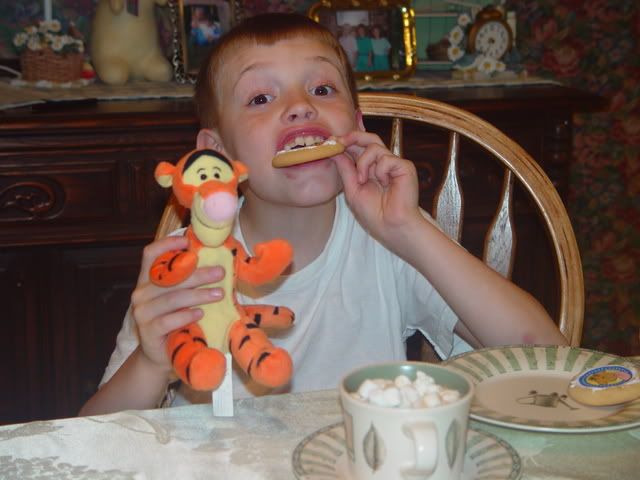
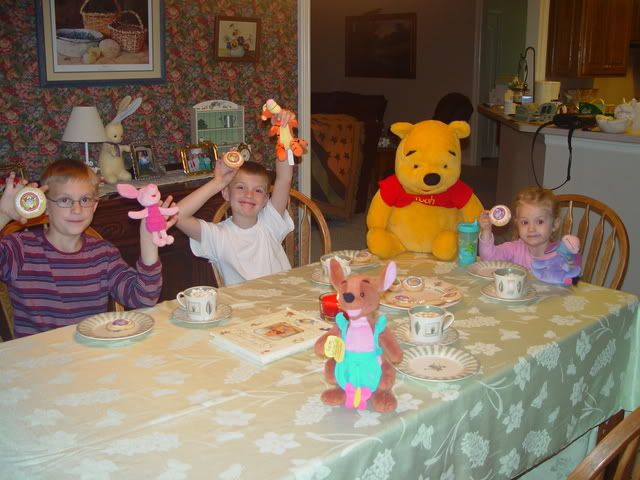
Here are the pictures from our Winnie the Pooh Tea. (Actually we drank hot chocolate.) We had seen the Heffelump movie a few weeks before and all of the kids loved it. They saw these cookies at Walmart and I actually let them buy them.

Image hosted by Photobucket.com

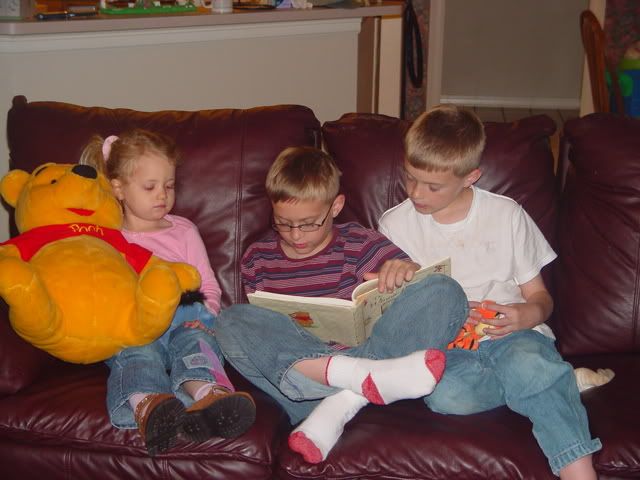
They made them and while they were out playing I made up the table complete with all of the stuffed animals. They each chose one to eat with. Then we took turns reading classic Winnie the Pooh!

Image hosted by Photobucket.com

What fun!

A Brave Writer Mom in Texas

Posted in General, Poetry Teatime | Comments Off on Tuesday Teatime: Winnie the Pooh!


Swinging to the Music

Do you feel out of touch with your teens? Want to generate some conversation to stimulate language and narration? Song lyrics are the poetry of our generation. Songwriters pack so much power into a three minute song. Don’t miss the chance to explore the world of language, theme and message in today’s popular music.

Listen to a favorite song(s) and examine the lyrics with your teens.
Song lyrics are one of the easiest ways to gain access to your teen’s worldview. Suggest listening to one of their favorite songs together with the lyrics.

If you have a particularly reluctant teen writer and communicator, you might not be able to come to your child head-on asking to listen to a song and then to talk about it. Instead, suggest he or she bring a favorite CD in the car the next time you drive together. Ask to listen to one of the tracks and then ask a few questions about the lyrics:

  • Do you know why the songwriter wrote this song?
  • How does this song fit in with other songs on the CD?
  • How does this song address the main topic (love, death, relationships, sex, making a difference, celebrity, pain, depression)? What does it have to say about the main topic?
  • Why does the chorus say what it does? (The chorus is the repeated refrain of the song and usually contains the primary message of the song.)
  • How does the music (instruments) support the message of the song? Does it contrast the message or does it underscore it? (Sometimes a song will have tragic lyrics with an upbeat tune. The writer, in that case, may be trying to strike an ironic note rather than telling you the message sincerely…)
  • Do the lyrics ryhme? Do they work (whether or not they rhyme)?
  • Do the lyrics tell a story or reveal a viewpoint or deal in nonsense or proselytize an agenda? What is it?
  • Is the song effective?
  • What words stand out in the lyrics? Why do they stand out? What’s special about them? (unusual, interesting sound, surprising use, perfect fit with music…)
  • Does the song generate feelings in you? (Elation, depression, anger, rage, peace, joy, inspiration, empowerment…)
  • Do you like it? Can you say why?

Remember, your opinion is not that important right now. You don’t want to turn this into a moralizing moment or a long-winded explanation as to why this song is or isn’t a good match for your family’s religious faith. Rather, use this as a wool-gathering time. Discover what makes your teen tick. If your teen is reluctant to express much, listen together in silence. Share one thing you liked about the song’s lyrics. Then leave it be.

Try again next week. You might even look up other songs on the Internet by the same band, do a bit of research about how the band formed or why they are currently popular, and send an article to your teen via email showing that you are thinking of his or her band.

Music is one of the most personal parts of teen life. If you find a way to enter their musical world, you will enrich both your relationship with each other and their writing lives.

Posted in General, Tips for Teen Writers | Comments Off on Swinging to the Music


Friday Freewrite: A Different View

Choose one of the following and freewrite for between 7 and 10 minutes (longer if you are in high school – 15 – 20 minutes).

  1. Stand on your head with your feet against a wall for balance. Look at your upside down world and then write. (Write whatever that view prompts. It doesn’t mean you have to write what you saw, though that is perfectly fine. Let the experience draw new writing out of you wherever it leads.)
  2. Sit under a table and write.
  3. Lay on the trampoline in the yard and write.
  4. Climb into a tree and write.
  5. Write right after you wake up (put your notebook and pen next to your bed at bedtime and write the moment you awaken).
  6. Stay up late and write by candlelight.
  7. Go to a coffee shop, the mall or a zoo and write.

Posted in Friday Freewrite, General | Comments Off on Friday Freewrite: A Different View


« Older Entries
Newer Entries »
  • Search the Blog

  • Julie Bogart
  • Welcome, I’m Julie Bogart.

    I’m a homeschooling alum -17 years, five kids. Now I run Brave Writer, the online writing and language arts program for families. More >>

    IMPORTANT: Please read our Privacy Policy.

  • New to Brave Writer? START HERE

  • FREE Resources

    • 7-Day Writing Blitz
    • Brave Writer Lifestyle Program
    • Brave Writer Sampler: Free Sample Products
    • Freewriting Prompts
    • Podcasts
  • Popular Posts

    • You have time
    • How writing is like sewing
    • Best curriculum for a 6 year old
    • Today's little unspoken homeschool secret
    • Do you like to homeschool?
    • Don't trust the schedule
    • You want to do a good job parenting?
    • If you've got a passel of kids
    • You are not a teacher
    • Natural Stages of Growth in Writing podcasts
  • Blog Topics

    • Brave Learner Home
    • Brave Writer Lifestyle
    • Classes
    • Contests/Giveaways
    • Friday Freewrite
    • High School
    • Homeschool Advice
    • Julie's Life
    • Language Arts
    • Movie Wednesday
    • Natural Stages of Growth
    • One Thing Principle
    • Our Team
    • Parenting
    • Philosophy of Education
    • Podcasts
    • Poetry Teatime
    • Products
    • Reviews
    • Speaking Schedule
    • Students
    • Writing about Writing
    • Young Writers
  • Archives

  • Brave Writer is a participant in the Amazon Services LLC Associates Program, an affiliate advertising program designed to provide a means for sites to earn advertising fees (at no extra cost to you) by advertising and linking to amazon.com

    Content © Brave Writer unless otherwise stated.

What is Brave Writer?

  • Welcome to Brave Writer
  • Why Brave Writer Works
  • About Julie
  • Brave Writer Values
  • Frequently Asked Questions
  • Speaking Schedule

Brave Writer Program

  • Getting Started!
  • Stages of Growth in Writing
  • The Brave Writer Program
  • For Families and Students
  • Online Classes
  • Brave Writer Lifestyle

…and More!

  • Blog
  • Classroom
  • Store
  • Books in Brave Writer Programs
  • Contact Us
  • Customer Service
  • Brave Writer Staff
© 2026 Brave Writer
Privacy Policy
Children's Privacy Policy
Help Center