
A Brave Writer's Life in Brief - Page 616 of 781 - Thoughts from my home to yours A Brave Writer's Life in Brief
  • Start Here
    • For Families
      Multiple Ages
    • Ages 5-7
      Beginning Writers
    • Ages 8-10
      Emerging Writers
    • Ages 11-12
      Middle School Writers
    • Ages 13-14
      High School Writers
    • Ages 15-18
      College Prep Writers
  • Shop
    • Product Collections
    • Bundles
    • Writing Instruction Manuals
    • Literature & Grammar/Punctuation
    • Composition Formats
    • Literature Singles
    • Homeschool Help
    • Book Shop
  • Online Classes
    • Class Descriptions
    • Class Schedule
    • Classroom
    • How Our Classes Work
    • Our Writing Coaches
    • Classes FAQ
  • Community
    • Brave Learner Home
    • What’s Happening
    • Blog
    • Podcast
    • Calendar
  • Cart
  • My Account
    • My Online Classes
    • My Account
  • My Account
    • My Online Classes
    • My Account
  • Start Here

    If you’re new to Brave Writer, or are looking for the best products for your child or family, choose from below:

    • For Families
      Multiple Ages
    • Ages 5-7
      Beginning Writers
    • Ages 8-10
      Emerging Writers
    • Ages 11-12
      Middle School Writers
    • Ages 13-14
      High School Writers
    • Ages 15-18
      College Prep Writers
  • Shop

    If you’re already familiar with Brave Writer products, go directly to what you’re looking for:

    • Product Collections Browse the full catalog in our shop
    • Bundles Everything you need to get started
    • Writing Instruction Manuals Foundational Writing Programs
    • Literature & Grammar/Punctuation Grammar, Punctuation, Spelling & Literary Devices
    • Composition Formats Writing Assignments for Every Age
    • Literature Singles Individual Literature Handbooks
    • Homeschool Help Homeschooling Tools and Resources
    • Book Shop Books associated with Brave Writer Programs
  • Online Classes
    • Class Descriptions
    • Class Schedule
    • Classroom
    • How Our Classes Work
    • Our Writing Coaches
    • Classes FAQ
  • Community
    • Brave Learner Home
    • What’s Happening
    • Blog
    • Podcast
    • Calendar
  • Search
  • Cart

Search Bravewriter.com

  • Home
  • Blog

A Brave Writer's Life in Brief

Thoughts from my home to yours

Tweaking the assignment to the student

Tweaking the assignment to the student
Received a great question from Brave Writer mom, Kellie:

Hi Julie,

In your FAQ section of The Writer’s Jungle you mention how kids can write about anything and do it well if they can find something about the topic that hooks their fascination. I’m wondering what this looks like in real life.

Can you tell me how the following 5th & 6th grade students would attack this assignment?

Write a Report on Christopher Columbus

Student A: This girl is a natural talker, loves to write in great detail, is very fashion conscious, and is able to find a number of ways to earn money.

Student B: A very analytical boy — math is his strong suit. He doesn’t enjoy flowery detail and wants to get to the facts and get the job done.

Student C: This child is very art oriented and enjoys science and animals.

Student D: This child does great at writing fictional stories — very into dramatic writing not factual.

Maybe these scenarios are not enough to go on and if not — what kinds of questions can I ask the kids to find out what their natural bent is? How can I help them when they are given a generic assignment to find their own groove and write from within?

Thanks!
Kellie

Let’s go one student at a time. Remember: these are ideas that may or may not work with individual kids. The idea is to shift your focus to the student’s natural bent and inclinations, away from strictures of an assignment. One thing to know: the most successful writers do this all the time instinctively. They hardly know they are doing it! So it’s not cheating. It’s smart writing.

Student A: This girl is a natural talker, loves to write in great detail, is very fashion conscious, and is able to find a number of ways to earn money.

Perhaps her interest in Columbus will be to choose an aspect of his character (personality? his attempts to get funding for his trip? his fashion sense?) to describe in detail. Let her hone in on one aspect (rather than generalizing) and see if she can get intimately acquainted with the most interesting part of who Columbus is. Start there. You can always add less interesting detail (biographical information or the timeline of his trip, etc.) once she’s given her full attention to the part that interests her most.

Student B: A very analytical boy — math is his strong suit. He doesn’t enjoy flowery detail and wants to get to the facts and get the job done.

This kind of kid does well with making a list to start. Let him itemize the factual details of the life of Columbus. Choose the most interesting, surprising fact to open the report. Let him organize the facts into categories and use sub-heads for each section. He can freewrite and then revise each group of facts one at a time. Then organize chronologically using sub-headings to provide natural structure and transitions.

Student C: This child is very art oriented and enjoys science and animals.

Columbus may be a hard sell for this kid. Perhaps write on something else! (smile) Also, could do pictorial narration with artwork and captions.

Student D: This child does great at writing fictional stories — very into dramatic writing not factual.

Put the report into a narrative style, telling it from Columbus’s perspective or alternatively this student could write from the perspective of a crew member on the ship. In The Writer’s Jungle, Gabrielle Linnell wrote a piece called “An Adventuring Maid.” She did research to have all her historical details accurately represented in her work, but she wrote her piece as a fictional narrative. This kind of work is a wonderful way to make writing spring to life. I like to use Jean Fritz’s books as an example of how history can be written in an engaging manner all while conveying the important historical information.

I hope that helps you get an idea of what you might be able to accomplish if you widen your expectations and apply some creativity.

As a side note. I graduated with my Master’s in theology in 2007. I had finals that included writing my own contemporary epistle, writing a translation, putting my theological thoughts into poetry, freewriting and personal experience as well as your standard academic formats. I thought I’d throw that out because there is a perception that all the writing anyone will ever do in the future is essays and research papers. Not necessarily!

Images by MapHobbit,  Scott Markowitz, anthony kelly (cc cropped, tinted)
Posted in Email, Homeschool Advice, Young Writers | 8 Comments »


Friday Freewrite: Secret Code

You work for the CIA and have intercepted and decoded a secret message that threatens our national security. What is the message?

Posted in Friday Freewrite | Comments Off on Friday Freewrite: Secret Code


Fall Class Schedule

It’s almost done. I’ve got the following classes lined up for fall (am just now confimring the dates). We’ll post asap. Thanks for your patience.

We’ll be offering:

New! MLA Research Paper: This class will teach your high schoolers how to write a 5-7 page, MLA format based argumentative paper using a version of the notecard system.

Expository Essay (5 paragraph)

Kidswrite Basic

Kidswrite Intermediate

Just So Stories: Kids learn to write stories that use Kipling’s literary elements.

Copywork/Dictation: Especially suited to families with kids who struggle with language arts. Revolutionary class!

Nature Journaling

Hand Holders: For moms wanting the extra support/accountability.

Posted in General | Comments Off on Fall Class Schedule


Losing Control

Losing Control

Letting go of control feels like not caring. Part of what motivates you to control your kids is the deep heartfelt love you have for their well-being. You care, therefore you control.

The experience of being controlled, however, feels 180 degrees opposite. When someone controls you, you don’t feel loved. You feel invisible. You feel discounted. You feel used or abused or undermined. The primary feeling is that you must escape control to get back to feeling like yourself again.

The danger of being a strong-willed mother is that you mistakenly convey love through control leaving your child paradoxically feeling unloved! It’s an awful conundrum and one that no mother intentionally creates in her child. If you find it hard to believe that this is your child’s experience, flip it around for a second. Don’t you feel unloved when you perceive your child to be strong-willed? When he or she resists forcibly the great meal you made, or the lesson you prepared, isn’t there a little twinge of rejection you experience?

Yet the desire to manage the external world competes with our hunger to meet the needs of our child’s interior life. How do we do that? How do we manage what our kids “do” while attending to their emotional well-being? So often it feels like you can only do one or the other.

I submit to you that there is a third way.

The idea in a family is that everyone can be their best selves when they are at home. It means they can let their hair down, be exactly who they are and still be loved. It also means that no one person gets to have the say-so over all other members. Families are cooperatives with wiser more experienced people in charge and younger, less experienced people learning the ropes. The idea isn’t to run a dictatorship (I’ve never, for a “New York minute,” bought the whole “this is a benevolent dictatorship” – really, who wants THAT?!). The idea is to set up a context where wiser, mature people can be resources to the less experienced, more emotionally volatile wunderkind (your kiddos!).

The third way puts relationship ahead of achievement. The idea is to create a context where conversation (communication) and negotiation enable all parties to participate at the level they are best able. So let’s cut to the chase. How does that look in homeschool?

One of the biggest mistakes we make as mothers is to assume that our kids know what is going on in our heads. We tend to share conclusions with them, rather than the process. So for instance, you may spend hours diligently debating a particular philosophy of math instruction online with your homeschool buddies. You may research the materials and shop around and peruse the books at a friend’s house. Then one day, decision made, you buy it and schedule the lessons. Your child looks at the cover, thinks it looks “boring” (code for: I’m unrelated to this book choice and feel put upon) and you feel devastated. After all, you just know this is the right program and you are certain once he gets into it, he’s going to love it. It fits him so well! If only he could see!

Now the stage is set for classic power grabs.

The mom feels cheated of the thrill of seeing this curriculum work (after all her labor to finally pick it and pay for it) and the student feels run over (he liked his old book well enough, he thinks this one is ugly and he doesn’t feel like learning how to do a new system – or whatever his reasons are!). Tears and/or punishment follow.

In the third way model, the choices about math books would be aired. Even with young kids (first and second graders), you can have conversations that let them hear what you are thinking. You don’t need to have a big talk every time you want to make a decision. On the other hand, simply narrating the process you’re in so that they can overhear it or participate in it goes a long way toward easing these kinds of tensions. Perhaps as you collect up the math book, you might say, “You know, I was reading about this other kind of math book today on the homeschool board. It’s called _______. And it reminded me of you because….. I’m thinking of purchasing it, to look it over. Would you be interested in looking at it with me online and then deciding if we want to try it?”

Kids love to be involved in decision-making, they love having their viewpoint valued. So much can be achieved through a little open discussion. You have to be prepared for, “Yeah, Mom, that looks awful to me.” But think about that. If that is really true, wouldn’t you rather know that before you plunked down your cold cash and then felt obligated to drag your child through the mud of unhappy math work?

With writing, the same principles need to apply. In Brave Writer, we give editorial control to the writer. As moms, we act as sources of input. We share what we see, love, want more of. We tell our kids what they do right and we point out areas for growth. We leave final decisions in the hands of the kids. We give up control (an illusion anyway since we didn’t write the papers) and allow for our voices to participate in the process rather than to control it. A strange thing happens when you “lose control” and validate the competence of your kids to make wise decisions (within the protected space of your love, input and oversight): trust. Your kids come to trust you… when you trust them to be truthful with you, when you honor their truth with support and kindness.

When a child says, “I hate this. This is too hard” trust is built when your response is, “I hate that you are having that experience. I want you to not feel that you are working too hard. Let’s see how we can solve this problem.” Trust is undermined when you say, “It’s not too hard. You can do it. You just don’t want to because you would rather watch TV.”

What is striking is that moms who give up control yet sustain relationship (through communication), have more power to ask for what they need from their kids. They can say what they need too! “I’m your mom and I feel responsible for your education. I want you to be happy in it too. How can we work together so that you don’t feel tortured by ________ but so that I’m reassured that you are learning too? I am willing to put things on hold until we can solve it.”

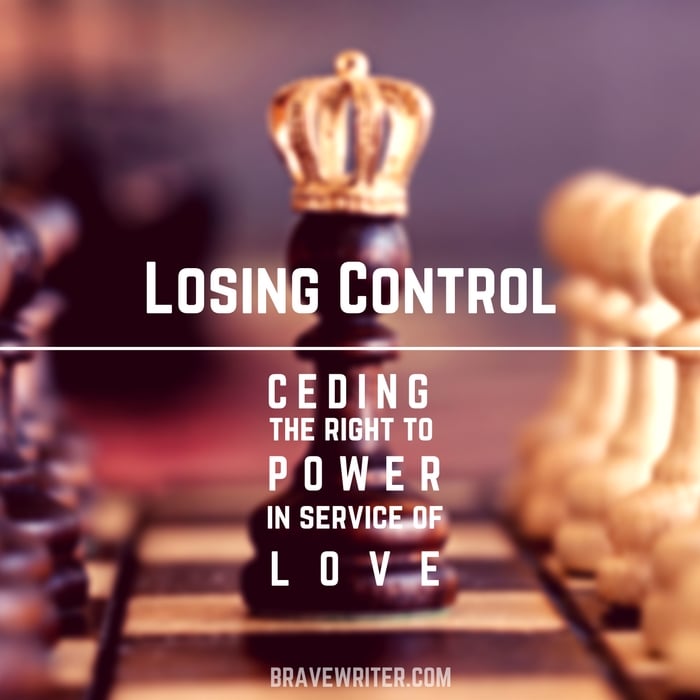
The happiest homes are not those where Mom gives up what she needs so that the kids don’t feel any pain. They aren’t the homes where it’s Mom’s way or the highway. The safest places to live are those homes where each person has a right to their feelings and needs (including mom, including kids) and together, they talk about how to meet those needs and feelings in a loving, non-judgmental, creative way. It’s not really losing control, actually. It’s ceding the right to power in service of love.

The Homeschool Alliance

Posted in Brave Writer Philosophy, General, Homeschool Advice | 17 Comments »


New post coming; Friday Freewrite

Hi everyone.

I’ve got the new post in drafts, but it’s not finished. July is high season at Brave Writer and I’ve been swamped this week. Thanks for all your feedback both in comments and via email. Our next entry is titled “Losing Control” and I’ll do my best to get it up for you soon.

For now, here’s your Friday Freewrite topic for this week:

Open a book nearby. Turn to page 12. Take the first line of the third paragraph and write it at the top of your page. Read it to yourself and then freewrite. Go!

Posted in Friday Freewrite | Comments Off on New post coming; Friday Freewrite


« Older Entries
Newer Entries »
  • Search the Blog

  • Julie Bogart
  • Welcome, I’m Julie Bogart.

    I’m a homeschooling alum -17 years, five kids. Now I run Brave Writer, the online writing and language arts program for families. More >>

    IMPORTANT: Please read our Privacy Policy.

  • New to Brave Writer? START HERE

  • FREE Resources

    • 7-Day Writing Blitz
    • Brave Writer Lifestyle Program
    • Brave Writer Sampler: Free Sample Products
    • Freewriting Prompts
    • Podcasts
  • Popular Posts

    • You have time
    • How writing is like sewing
    • Best curriculum for a 6 year old
    • Today's little unspoken homeschool secret
    • Do you like to homeschool?
    • Don't trust the schedule
    • You want to do a good job parenting?
    • If you've got a passel of kids
    • You are not a teacher
    • Natural Stages of Growth in Writing podcasts
  • Blog Topics

    • Brave Learner Home
    • Brave Writer Lifestyle
    • Classes
    • Contests/Giveaways
    • Friday Freewrite
    • High School
    • Homeschool Advice
    • Julie's Life
    • Language Arts
    • Movie Wednesday
    • Natural Stages of Growth
    • One Thing Principle
    • Our Team
    • Parenting
    • Philosophy of Education
    • Podcasts
    • Poetry Teatime
    • Products
    • Reviews
    • Speaking Schedule
    • Students
    • Writing about Writing
    • Young Writers
  • Archives

  • Brave Writer is a participant in the Amazon Services LLC Associates Program, an affiliate advertising program designed to provide a means for sites to earn advertising fees (at no extra cost to you) by advertising and linking to amazon.com

    Content © Brave Writer unless otherwise stated.

What is Brave Writer?

  • Welcome to Brave Writer
  • Why Brave Writer Works
  • About Julie
  • Brave Writer Values
  • Frequently Asked Questions
  • Speaking Schedule

Brave Writer Program

  • Getting Started!
  • Stages of Growth in Writing
  • The Brave Writer Program
  • For Families and Students
  • Online Classes
  • Brave Writer Lifestyle

…and More!

  • Blog
  • Classroom
  • Store
  • Books in Brave Writer Programs
  • Contact Us
  • Customer Service
  • Brave Writer Staff
© 2026 Brave Writer
Privacy Policy
Children's Privacy Policy
Help Center