A Brave Writer's Life in Brief - Page 612 of 781 - Thoughts from my home to yours A Brave Writer's Life in Brief
  • Start Here
    • For Families
      Multiple Ages
    • Ages 5-7
      Beginning Writers
    • Ages 8-10
      Emerging Writers
    • Ages 11-12
      Middle School Writers
    • Ages 13-14
      High School Writers
    • Ages 15-18
      College Prep Writers
  • Shop
    • Product Collections
    • Bundles
    • Writing Instruction Manuals
    • Literature & Grammar/Punctuation
    • Composition Formats
    • Literature Singles
    • Homeschool Help
    • Book Shop
  • Online Classes
    • Class Descriptions
    • Class Schedule
    • Classroom
    • How Our Classes Work
    • Our Writing Coaches
    • Classes FAQ
  • Community
    • Brave Learner Home
    • What’s Happening
    • Blog
    • Podcast
    • Calendar
  • Cart
  • My Account
    • My Online Classes
    • My Account
  • My Account
    • My Online Classes
    • My Account
  • Start Here

    If you’re new to Brave Writer, or are looking for the best products for your child or family, choose from below:

    • For Families
      Multiple Ages
    • Ages 5-7
      Beginning Writers
    • Ages 8-10
      Emerging Writers
    • Ages 11-12
      Middle School Writers
    • Ages 13-14
      High School Writers
    • Ages 15-18
      College Prep Writers
  • Shop

    If you’re already familiar with Brave Writer products, go directly to what you’re looking for:

    • Product Collections Browse the full catalog in our shop
    • Bundles Everything you need to get started
    • Writing Instruction Manuals Foundational Writing Programs
    • Literature & Grammar/Punctuation Grammar, Punctuation, Spelling & Literary Devices
    • Composition Formats Writing Assignments for Every Age
    • Literature Singles Individual Literature Handbooks
    • Homeschool Help Homeschooling Tools and Resources
    • Book Shop Books associated with Brave Writer Programs
  • Online Classes
    • Class Descriptions
    • Class Schedule
    • Classroom
    • How Our Classes Work
    • Our Writing Coaches
    • Classes FAQ
  • Community
    • Brave Learner Home
    • What’s Happening
    • Blog
    • Podcast
    • Calendar
  • Search
  • Cart

Search Bravewriter.com

  • Home
  • Blog

A Brave Writer's Life in Brief

Thoughts from my home to yours

It’s Autumn! Time to do fall stuff.

25 Homeschool Ideas for Fall

We made a list of things to do in the summer and one of our BW moms asked me to make one for fall.

  1. Of course buy pumpkins and carve/decorate them. You can use those big quilting pins to pierce the pumpkins so that you can cut colored paper and pin ears, eyes, mouths, if you prefer (a Mr. Pumpkin Head ala Mr. Potato Head).
  2. Make a chart that tracks the color changes of leaves on one of your trees. Sharpie mark several leaves with numerals. Then each day, record how the colors change for each one. Do you see speckles? Streaks? Shading shifts from left to right or top to bottom? Bring your colored pencils and compare colors to the leaves and then name the colors (goldenrod, chartreuse, ruby).
  3. Serve hot apple cider during your teatime/poetry for the months of October and November.
  4. Rake leaves for a neighbor while that neighbor is at work. Leave pumpkin muffins and an anonymous note. Don’t ever say who raked the yard.
  5. Jump on the trampoline and take flying photos.
  6. Hike to a creek with your dog.
  7. Stay out late and look at the moon once per week. Draw it and notice how the shape changes over the course of a month.
  8. Borrow a telescope and find Saturn.
  9. Create a nature’s table where you collect and display fall-ish items: acorns, acorn hats, moss on bark, dried colored leaves, scented candles, little pumpkins or gourds, blond hay stalks, dried corn, pebbles. We like to add little figurines like Half Penny Dolls. Lego figures work too.
  10. Read and write poems about the fall.
  11. Use sidewalk chalk to create hopscotch (look up various versions on the Internet and try them all).
  12. Volunteer at a homeless shelter and serve.
  13. Roast marshmallows in the fireplace.
  14. Peel an apple in one long peel using a pocket knife.
  15. Bake pies (try new ones like rhubarb, or old ones in a new way – pumpkin using a real pie pumpkin, not canned).
  16. Shake whipping cream in a glass jar with a marble until it become butter. Take turns shaking during read aloud time.
  17. Dye fabric with natural foods: beets to make purples, red onions for reds, tumeric for yellows. Muslin works great. You can make bean bags or little quilted pot holders with the resulting fabrics.
  18. Find out how to play cornhole. (Cincinnati specialty!) Then make one and try it.
  19. Take a bird watching hike (bring binoculars and a field guide). You can sometimes sign up at local nature preserves or parks too.
  20. Toss the old pigskin around!
  21. Buy a candle making kit and make the candles (or paper making or soap making).
  22. Clean the messiest space in your house, then scent the room with lavender.
  23. Spend an evening eating popcorn, drinking cider, and reading silently as a family in front of the fire. Turn the TV off.
  24. Go to a local festival.
  25. Invite college students or adults living alone to an evening of soup, bread and games (like Apples to Apples). Fall is a great time to care for shut ins or kids who have moved away from home.

Posted in Activities, Brave Writer Philosophy, Homeschool Advice | 1 Comment »


Friday Freewrite: Courage

What do you think courage means?

Posted in Friday Freewrite | 2 Comments »


That Absurd Little Bird: The Topic Sentence

The Topic Sentence

If you want to see my dyed gray hair stand on end, talk to me about the importance of the initial topic sentence.

“My left earlobe is very attractive for three reasons.”

“I like anchovy ice cream more than pizza.”

“Captain Diaperpants is an entertaining book and I highly recommend it.”

Need I go on? ::yawn::

Truth is: The topic sentence is to the paragraph what support hose are to varicose veins. We don’t really want to be aware of the work they’re doing. They offer support, yes, but why announce that fact to the world? The best ones are hidden in the compelling-to-read prose.

I was lurking on the Internet and read a whole bunch of sample paragraphs on a writing site for homeschooled students. The curriculum writer stressed the importance of both the topic sentence and structured, orderly writing as hallmarks of correct writing. She then conceded that this kind of writing would be “stiff and stilted and even boring in most cases,” but it didn’t matter. Didn’t matter? In what universe? The point was to learn to write these orderly, cardboard, stiff, spiritless, uninspired, i-n-s-i-p-i-d paragraphs (::grinding teeth::) with duty and diligence no matter how painful to the reader.

Oh break my writerly heart!

Reverse the curse of the initial topic sentence.

Here’s how:

  • Start in the middle.
    Don’t tell me all I need to know in the first sentence. Once I find out that you are a black belt in karate, what interest do I have in reading how you earned the belt? Start with the struggle, facing the board as you prepare to sever it in half as with a cleaver. Leave me hanging out there, flapping in the breeze, worried and curious.
  • Get me involved.
    Use sensory detail to suck me into the scene without revealing your point until I’m hooked: “I sneezed when I leaned over the basket of cumin to examine it for bugs. The spicy fragrance reminded me of kasbahs and Moroccan stews. Unfortunately, I found myself in a modern Farmer’s Market in downtown Cincinnati instead. I miss North Africa.”
  • Put the main idea at the end of the paragraph.
    Most freewriting will start with a typical topic sentence that generalizes about the subject for writing. That’s fine when getting your thoughts together. To help hide the know-it-all sentence when you revise, move it to the end and see what happens. Like in the sample above—the topic sentence is last to appear. It’s so much happier modestly revealing itself at the end.

I know, I know. I didn’t even talk about the all important topic sentence in academic writing or in subsequent paragraphs. We’ll get to that another day.

For now, hook me, seduce me, scare me, move me, grab me by the collar, and don’t let me go. Lure me into your writing by concealing the point. That’s the point! (And that second-to-last sentence you just read, the one pretending not to be a topic sentence, is the topic sentence for this piece, artfully concealed until the end, incidentally…)

Groovy Grammar Workshop

Posted in Language Arts, Writing about Writing, Young Writers | 6 Comments »


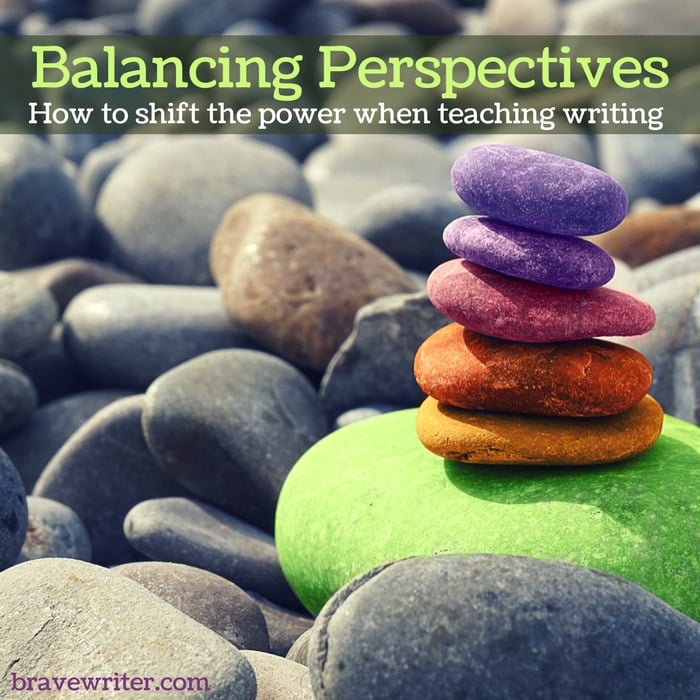
Shift the Power

Balancing perspectives

Remember: the best educational environment is one where everyone is moving in the same direction, with similar levels of enthusiasm. Not everyone has to “love” writing, but it helps if resistance is lowered. So let’s work on that!

Power Dynamics in Home Education

Let’s talk about the power dynamics in families. There’s no question “who’s in charge” in a family. Kids know. Parents know. Adults carry the responsibility so they have the power.

Knowing we are in charge, we often use that power to run our families and homeschools. We set out the expectations of what is to be done and then we expect respectful cooperation. When our kids don’t share the same goals and don’t have the same instincts, many parents assume the child is in rebellion or is willful. (Books have been written to illustrate this point.)

Kids who don’t share the same goals or perspective, instead, will assume their parents are mean and don’t understand kids. (Kids wish they had written books to illustrate this point.)

There is an imbalance between the perspectives of parents and children (one has books with studies to support its viewpoint and the other doesn’t—all kids have is whining, crying, ignoring and acts of passive aggression). This imbalance can create havoc for the homeschooling parent who hopes her child will write one day. Kids might believe that the parent’s insistence that they write is another one of those power-plays designed to meet adult needs while ignoring the viewpoints of children.

When one group experiences itself as marginalized (not able to express its views in a way that makes contact with the powers-that-be and causes change) and the other group experiences itself as in power with the ability to coerce compliance, crankiness has the chance to fester and develop into full-blown rage or disinterested passivity (the “I surrender” stance).

For some reason, working on writing causes the power struggle to show its full colors. Kids have a knack for resisting parental input when it’s related to the writing they do. Their writing is the one space that children try to protect from parental control—writing equals “who I am” and as a result, they want their writing to be accepted as is, punctuation mistakes and spelling errors included.

If we want to see crankiness replaced by joy (since it is my contention that joy is the best teacher there is), we have to shift the power dynamics. We need to hear our marginalized poor, our “oh-so-powerless” kids. We have to “divest” ourselves of our power and serve our kids.

Here are some sure fire ways to move from first to last so your kids can move from last to first:

1) Apologize.

I remember at one seminar encouraging the parents to rub their kids’ shoulders before a freewrite. A mom’s hand shot into the air. She couldn’t believe it! Just that morning, her son had asked her to rub his shoulders, before he started writing. She told him, “This is school. This is not play time. I’m not rubbing your shoulders. You should get to work and stop dilly-dallying.” Lightbulb! She suddenly saw. Unwittingly, she had undermined his success in writing that morning. Say you’re sorry. Then start over, together.

2) Take the same risks your kids take.

When they write, you write. Freewrite once in awhile when they do. Risk sharing your writing so that they can hear and read it. Respect and honor the process you are asking them to engage in. You will sympathize with their efforts if you have experienced the same kinds of blocks and blanks that they experience with writing from time to time. And the biggest bonus of all: you’ll learn how you break through stuck places so you can share those insights with your kids.

3) Ask permission.

Your child is not just a writer, but an author. Authors deserve final control over their writing. Let your child know that the input you offer is optional and that you won’t give unwanted input. Discuss artistic choices. Then let the writer decide which of these artistic choices she prefers to make. If you take this approach with all writing (personal, academic, assigned), over time your child will come to value and ask for your input. Trust me.

4) Ask for your child’s writing goals.

Your child may tell you up front that he has no goals for writing. If that is the case, you can share the goals you have for your writing… and then pursue them, right in front of your child. “Wait honey. I’m working on that piece about gardening for my online community, remember? I’ll be right with you. Hey can you listen a minute—how does this sound?” I know you have goals for your children’s writing. We’ll discuss that at another time. Right now we are working toward unhooking the power struggle.

If your child has goals (such as, wanting to start a live journal or wants to write a short story or is interested in learning how to write poetry in calligraphy), talk about ways that you can support your child in reaching those goals. Do they need more time on the computer? Do they need a book about story writing? Can you purchase a set of pens and offer a book of poems with which to practice their calligraphy?

5) Make writing opportunities interesting.

If writing has become a curse instead of a joy, take a break from writing. Read, talk, read, talk, watch movies, read, talk. Then pick a surprising writing activity. Of course a new freewriting prompt left on an empty kitchen table with brand new colored pens and pretty paper sometimes jump starts the reluctant writer as well. Don’t say anything. Just leave it all out and see what happens. Jump in the car and bring journals along. Write at a coffee shop, all of you, together. Change the setting and you’ll change the attitude.

If you shift the power dynamic in your home—giving up some of your power so that those without power get some—you’ll see a shift in the level of joy in your home. It may take some time before they trust that you are truly divesting (not just manipulating them). You have to let go of outcomes and not see this as a strategy. But once they believe you—that you are unequivocally on their side and they know it—they will trust you to give input into their writing and to even make some suggestions of what kinds of writing they may want to attempt or learn.

What an honor to be the one to foster that kind of home environment!

The Homeschool Alliance

Posted in Brave Writer Philosophy | 2 Comments »


Friday Freewrite: Make History!

If you could have been someone in history, who would you have been?

Posted in Friday Freewrite | Comments Off on Friday Freewrite: Make History!


« Older Entries
Newer Entries »
  • Search the Blog

  • Julie Bogart
  • Welcome, I’m Julie Bogart.

    I’m a homeschooling alum -17 years, five kids. Now I run Brave Writer, the online writing and language arts program for families. More >>

    IMPORTANT: Please read our Privacy Policy.

  • New to Brave Writer? START HERE

  • FREE Resources

    • 7-Day Writing Blitz
    • Brave Writer Lifestyle Program
    • Brave Writer Sampler: Free Sample Products
    • Freewriting Prompts
    • Podcasts
  • Popular Posts

    • You have time
    • How writing is like sewing
    • Best curriculum for a 6 year old
    • Today's little unspoken homeschool secret
    • Do you like to homeschool?
    • Don't trust the schedule
    • You want to do a good job parenting?
    • If you've got a passel of kids
    • You are not a teacher
    • Natural Stages of Growth in Writing podcasts
  • Blog Topics

    • Brave Learner Home
    • Brave Writer Lifestyle
    • Classes
    • Contests/Giveaways
    • Friday Freewrite
    • High School
    • Homeschool Advice
    • Julie's Life
    • Language Arts
    • Movie Wednesday
    • Natural Stages of Growth
    • One Thing Principle
    • Our Team
    • Parenting
    • Philosophy of Education
    • Podcasts
    • Poetry Teatime
    • Products
    • Reviews
    • Speaking Schedule
    • Students
    • Writing about Writing
    • Young Writers
  • Archives

  • Brave Writer is a participant in the Amazon Services LLC Associates Program, an affiliate advertising program designed to provide a means for sites to earn advertising fees (at no extra cost to you) by advertising and linking to amazon.com

    Content © Brave Writer unless otherwise stated.

What is Brave Writer?

  • Welcome to Brave Writer
  • Why Brave Writer Works
  • About Julie
  • Brave Writer Values
  • Frequently Asked Questions
  • Speaking Schedule

Brave Writer Program

  • Getting Started!
  • Stages of Growth in Writing
  • The Brave Writer Program
  • For Families and Students
  • Online Classes
  • Brave Writer Lifestyle

…and More!

  • Blog
  • Classroom
  • Store
  • Books in Brave Writer Programs
  • Contact Us
  • Customer Service
  • Brave Writer Staff
© 2026 Brave Writer
Privacy Policy
Children's Privacy Policy
Help Center