A Brave Writer's Life in Brief - Page 457 of 781 - Thoughts from my home to yours A Brave Writer's Life in Brief
  • Start Here
    • For Families
      Multiple Ages
    • Ages 5-7
      Beginning Writers
    • Ages 8-10
      Emerging Writers
    • Ages 11-12
      Middle School Writers
    • Ages 13-14
      High School Writers
    • Ages 15-18
      College Prep Writers
  • Shop
    • Product Collections
    • Bundles
    • Writing Instruction Manuals
    • Literature & Grammar/Punctuation
    • Composition Formats
    • Literature Singles
    • Homeschool Help
    • Book Shop
  • Online Classes
    • Class Descriptions
    • Class Schedule
    • Classroom
    • How Our Classes Work
    • Our Writing Coaches
    • Classes FAQ
  • Community
    • Brave Learner Home
    • What’s Happening
    • Blog
    • Podcast
    • Calendar
  • Cart
  • My Account
    • My Online Classes
    • My Account
  • My Account
    • My Online Classes
    • My Account
  • Start Here

    If you’re new to Brave Writer, or are looking for the best products for your child or family, choose from below:

    • For Families
      Multiple Ages
    • Ages 5-7
      Beginning Writers
    • Ages 8-10
      Emerging Writers
    • Ages 11-12
      Middle School Writers
    • Ages 13-14
      High School Writers
    • Ages 15-18
      College Prep Writers
  • Shop

    If you’re already familiar with Brave Writer products, go directly to what you’re looking for:

    • Product Collections Browse the full catalog in our shop
    • Bundles Everything you need to get started
    • Writing Instruction Manuals Foundational Writing Programs
    • Literature & Grammar/Punctuation Grammar, Punctuation, Spelling & Literary Devices
    • Composition Formats Writing Assignments for Every Age
    • Literature Singles Individual Literature Handbooks
    • Homeschool Help Homeschooling Tools and Resources
    • Book Shop Books associated with Brave Writer Programs
  • Online Classes
    • Class Descriptions
    • Class Schedule
    • Classroom
    • How Our Classes Work
    • Our Writing Coaches
    • Classes FAQ
  • Community
    • Brave Learner Home
    • What’s Happening
    • Blog
    • Podcast
    • Calendar
  • Search
  • Cart

Search Bravewriter.com

  • Home
  • Blog

A Brave Writer's Life in Brief

Thoughts from my home to yours

Keeping it real at home

Keeping it real at home

I’m about to make a bold statement.

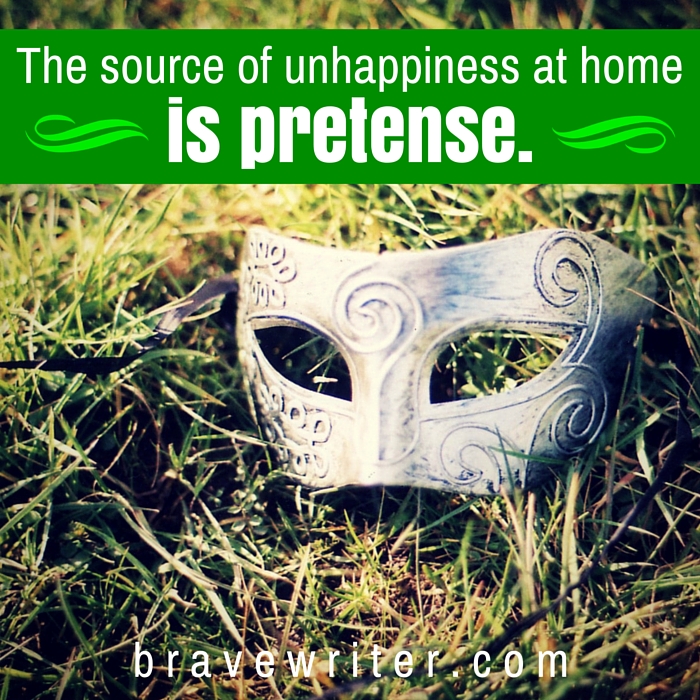
The source of unhappiness at home is pretense.

Pretending in homeschool looks like this:

  • Defending your homeschool to others when you secretly doubt your effectiveness.
  • Showing off the good parts, while hiding the parts that embarrass you.
  • Continuing to use the textbook even though you know it causes pain, just because you paid for it.
  • Endorsing a philosophy of education you don’t actually use (you say you believe in studying the classics, but never read them; you want to believe unschooling is the best way to educate, but you undermine your child’s self-directed learning when it doesn’t match what you thought it would look like).
  • Ignoring a child’s struggles because you don’t want to have to pay for specialists or tutors.
  • Telling yourself that the schools are really really bad so that you can justify your “very bad, no good” year, instead of facing it.
  • Letting your relationship with your kids wither instead of putting in the effort to hear what’s going on for them and making adjustments.
  • Slavish devotion to a method over caring about real learning.
  • Acting as though you are okay with a practice when you really really are not.
  • Ignoring abuse, conflict, disrespect, or volatility in the home, and assuming that those things don’t impact your homeschool.
  • Refusing to consider all options (including the ones you say you don’t believe in) when what you are doing is clearly not working any more.
  • Being more interested in the politics of homeschool (common core, legislation, rights) than in homeschooling.
  • Tweaking your vocabulary to fit the homeschool community’s approved language rather than being true to your own way of thinking.
  • Hiding your child’s behavior or educational failures from others (kids who are dangerous to themselves or others, kids who refuse to cooperate, kids who act out in embarrassing ways—drinking, theft, cyber bullying).
  • Withdrawing from “society” to avoid accountability.

I have often quoted a saying by Iris Murdoch (The Severed Head) without even knowing the source. A Brave Writer mom (Gail) helped me track it down. Let me post it here:

“You can’t cheat the dark gods.”

The truth will out!

Whatever is going on with you is going on with you. No amount of cover-up or smooth-over will fix the problems you face. Moreover, who you are is an essential part of your homeschool. If you hate the classics (no matter how much you persuade yourself that they are essential to education), you will sabotage your homeschool to avoid reading them.

If you do distrust gaming as a way to learn, you will never be happy when your child is on the computer. You will look for ways to manipulate the system to stop your child from doing the very thing you secretly hate and distrust. Which leads to tension and stress in the relationship—inevitably, absolutely, take that to the bank.

If the context of your family is “walking on eggshells” to keep the volatile member from exploding, the energy for learning will be used up by an attempt to control the out of control member—and then you’ll wonder why homeschool is not peaceful or happy or working.

You are not responsible for the reputation of homeschool.

Let me repeat that.

You, sincere-trying-really-hard homeschooler, are not responsible for how other people see you or homeschooling.

You have one responsibility: to create and hold the space for a peaceful environment in which your family can grow and learn.

Create and hold space for a peaceful environment
in which your family can grow and learn.

Click to Tweet

That’s it.

There are scads of ways to get there and as many as there are families. It is right and good to tell your public school mom friend that sometimes you worry that the work you’re doing with your kids is not on par with the local schools. If that’s a real fear, it’s absolutely humanizing and truthful to say it out loud. It doesn’t mean you will change course or decide to put your kids on the big yellow bus. It means you are facing the depth of your own anxiety—just like the public school mom who wonders if the second grade teacher is any good this year.

It is right and good to admit that one child’s ADD or behavior problems is impacting the health of the whole family. Once you admit it, you can begin to seek help for everyone. You are not blaming anyone. You are protecting everyone’s well being.

It is right and good to ditch the program that makes YOU unhappy no matter how many people say it’s the best thing since frosted cake!

Ditch the program that makes YOU unhappy no matter how many say it’s the best thing since frosted cake!

Click to Tweet

It is right and good to admit that it’s easier to fight for the right to homeschool than to homeschool. Start there.

Be real. Everyone wants to support a person who tells the truth. Everyone hates the person who pretends her way into perfection (right?).

You have a universe of choices—keep them all on the table. Be attentive to the muscles in your body. If you feel yourself tighten, you know something is not right. Find out what it is, say it out loud, do something about it.

Keep it real.

Image by Elliot Bennett (cc cropped)

Posted in Homeschool Advice, Parenting | 3 Comments »


Friday Freewrite: Chores

http://www.dreamstime.com/stock-photography-young-girl-dishwasher-image16823722
Should all family members have to do chores? Why or why not?

New to freewriting? Check out our online guide.

Image © Gemenacom | Dreamstime.com

Posted in Friday Freewrite | Comments Off on Friday Freewrite: Chores


Mother Tongue

Mother Tongue

I want to live in a world where the content of written communication is more important than spelling and punctuation.

I want to live in a world where people are generous about typos and the accidental homonym-switcheroo.

I want to write in a world where readers value the risk of self-disclosure that goes into all writing, even blog comments, even Facebook status updates, more than grammatical accuracy.

I want to read in a world where voices very different from mine have access to being published, in their natural writing voices—whether or not they use “prestige English.”

I wish for a world where communication of all forms is regarded as self-expression, and the vibrant ever-changing shape of language is appreciated, not judged as good or bad or in need of protection or preservation.

I like language and people and varieties of spellings and deliberate and accidental misuses of grammar and creative punctuation.

I love seeing the explosion of self-expression that is the Internet—the spontaneous need to share and express and be heard. I love that that hunger overcomes the endless drum beat for perfectly edited copy.

I am less fond of the pride that stems from “being a grammar snob.” But I’m trying to love and understand that impulse, too. After all, I know it takes quite a bit of work to master the prestige form of English, and most people who do so are passionate about language, and have been rewarded for that effort.

If there is one soapbox that I still mount occasionally, it is the one that says, “There’s no officially right way to say or write anything. There is only custom and convention—and these evolve all the time. In the meantime, please—hear the content before you eviscerate the copy.”

Image by Quinn Anya (cc  polka dots added)

Posted in Brave Writer Philosophy, Writing about Writing | 3 Comments »


Have You Been Avoiding Writing?

http://www.dreamstime.com/stock-image-not-knowing-what-to-do-person-hands-folded-staring-question-mark-indicates-doubt-image39672031

An email I received:

What do you do if you’ve been avoiding writing for a long long time? The child in question is 14. He is male.

My reply:

First, congratulations! Thank you for not damaging your writer. It is far better to ignore and avoid writing than to require it and create writer’s block due to applying methods that harm the child’s natural ease of self-expression.

Any child who has simply “not written” can be taught/encouraged to find his or her writing voice no matter how old. The older the child, the more swiftly this process can happen. Why? Because older children (12, 15, 17!) have been speaking fluent English for many more years than their younger siblings. They have read more words than new readers. They’ve handwritten or keyboarded to the point of near fluency (spelling, punctuation, how to make that weird cursive ‘r’, where the question mark is on the laptop). They have thought about ideas and have mastered facts that were unfamiliar to them at ages 6, 8, and 10.

When we turn our attention to writing with a child who is already a teen, we are greeted with a person who is truly ready to write! So if your way of avoiding all that trauma that attends most writing programs was to ignore it—well done! You’ve waited for the key moment to make real progress. I’ll help you with that in a minute.

If you are the parent of a teen who won’t write because the programs you used have created writing paralysis (a block that is bigger than “I don’t know what to write,” but is more like “I hate writing and will never use it therefore I will not do it now or ever, forever more”), you have a slightly different issue but no less solvable.

Here are the two strategies.

1. For the writer you neglected to cultivate: Start from scratch! You can. Start by listening to him, having great conversations, jotting down some of the great stuff he says in words out loud to you. Read back what he says to his dad or siblings or to him later in the day, talking about the content of what he said.

Begin with copywork—song lyrics, humor, his favorite quotes from books. Do it at the same time with him, copying your favorite quotes. Read your quotes to each other. Pick quotes for each other as a surprise. Light a candle or eat brownies or use fountain pens or create an entire passage by snipping the words from magazines and gluing them in order on a page. Make a collage of favorite quotes! Make up your own quotes!

Freewrite—about anything, about everything. We have prompts on our blog, but you can get them anywhere. With teens, you want the topics to be interesting to the teen. Provocative positions are often best: What makes X band better than Y band? If you could change one law, which one would it be and why? If 18 year olds can be asked to fight for our country, does it make sense to say they aren’t old enough to drink alcohol? What’s one part of your education you’d like to take control of and how would you do it?

Get into fan fiction or NaNoWriMo (National Novel Writing Month) or blogging about gaming or online discussion with kids who have similar hobbies or texting or Facebook or whatever drives a kid to write without thinking about “school.”

Play with words—use them, write big ones on a white board to stump each other, recite Shakespeare or poetry or quotes from Seinfeld.

Then, over the course of a year of this kind of practice, talk about moving into some preparation for college. Look at the Brave Writer online classes or local classes in a co-op or junior college. Move one bit at a time, but first, focus on reading, copying, freewriting, and language play. Like you would at any age.

2. For the damaged writer, the same process applies, but you have to rebuild trust and that happens through this little conversation that you need to have.

“Son, gulp. I’m just realizing that the writing programs we’ve used have been really unhelpful to you in becoming a competent, comfortable writer. I feel awful about it! Can we start over? I promise to pay attention when you say something is boring or isn’t working for you. I want us to start with writing that has meaning for you. Here’s a brownie. Let’s talk.”

Some version of this with more or less apology depending on how much damage is there will work. Brownies or going out for Cokes helps.

The goal with any child or teen is to recognize that the writing voice is already alive and well within. It may be hidden from view or afraid to come out, but some attentiveness to your child’s speaking voice and some humility about how difficult writing is for many kids will lead to breakthroughs. Start where your child is. Kids can go from not writing to college level comp between 16-18.

Promise.

Brave Writer Online Classes

Image © Richair | Dreamstime.com

Posted in Email, Homeschool Advice, Writing about Writing | Comments Off on Have You Been Avoiding Writing?


Poetry Teatime: Helping a neighbor

Poetry Teatime

I wanted to share what we did today anyway so maybe others will be encouraged to reach out.

Our widow neighbor has been battling loneliness and depression lately. The kids and i picked up donut holes, brought a picnic blanket and invited ourselves next door. With books and donuts in hand, we set up teatime on the floor of our neighbor’s living room.

She relaxed in her comfy chair while we read poetry and sang songs to her. She was soooo thankful! (I found out later that she called her daughter to tell her we were coming. Then her daughter made her promise to call her back when we left because she was so intrigued by this “teatime” we were doing!)

We were able to bless each other using teatime today! I wonder- how have others used teatime to reach out to neighbors, friends, etc.? Think of it – using language arts to make someone’s day!! It was fun!

Jen

Image (cc)

Visit our Poetry Teatime website!

Posted in Poetry Teatime | 1 Comment »


« Older Entries
Newer Entries »
  • Search the Blog

  • Julie Bogart
  • Welcome, I’m Julie Bogart.

    I’m a homeschooling alum -17 years, five kids. Now I run Brave Writer, the online writing and language arts program for families. More >>

    IMPORTANT: Please read our Privacy Policy.

  • New to Brave Writer? START HERE

  • FREE Resources

    • 7-Day Writing Blitz
    • Brave Writer Lifestyle Program
    • Brave Writer Sampler: Free Sample Products
    • Freewriting Prompts
    • Podcasts
  • Popular Posts

    • You have time
    • How writing is like sewing
    • Best curriculum for a 6 year old
    • Today's little unspoken homeschool secret
    • Do you like to homeschool?
    • Don't trust the schedule
    • You want to do a good job parenting?
    • If you've got a passel of kids
    • You are not a teacher
    • Natural Stages of Growth in Writing podcasts
  • Blog Topics

    • Brave Learner Home
    • Brave Writer Lifestyle
    • Classes
    • Contests/Giveaways
    • Friday Freewrite
    • High School
    • Homeschool Advice
    • Julie's Life
    • Language Arts
    • Movie Wednesday
    • Natural Stages of Growth
    • One Thing Principle
    • Our Team
    • Parenting
    • Philosophy of Education
    • Podcasts
    • Poetry Teatime
    • Products
    • Reviews
    • Speaking Schedule
    • Students
    • Writing about Writing
    • Young Writers
  • Archives

  • Brave Writer is a participant in the Amazon Services LLC Associates Program, an affiliate advertising program designed to provide a means for sites to earn advertising fees (at no extra cost to you) by advertising and linking to amazon.com

    Content © Brave Writer unless otherwise stated.

What is Brave Writer?

  • Welcome to Brave Writer
  • Why Brave Writer Works
  • About Julie
  • Brave Writer Values
  • Frequently Asked Questions
  • Speaking Schedule

Brave Writer Program

  • Getting Started!
  • Stages of Growth in Writing
  • The Brave Writer Program
  • For Families and Students
  • Online Classes
  • Brave Writer Lifestyle

…and More!

  • Blog
  • Classroom
  • Store
  • Books in Brave Writer Programs
  • Contact Us
  • Customer Service
  • Brave Writer Staff
© 2026 Brave Writer
Privacy Policy
Children's Privacy Policy
Help Center