What if academic standards didn’t have to threaten your homeschool rhythm?
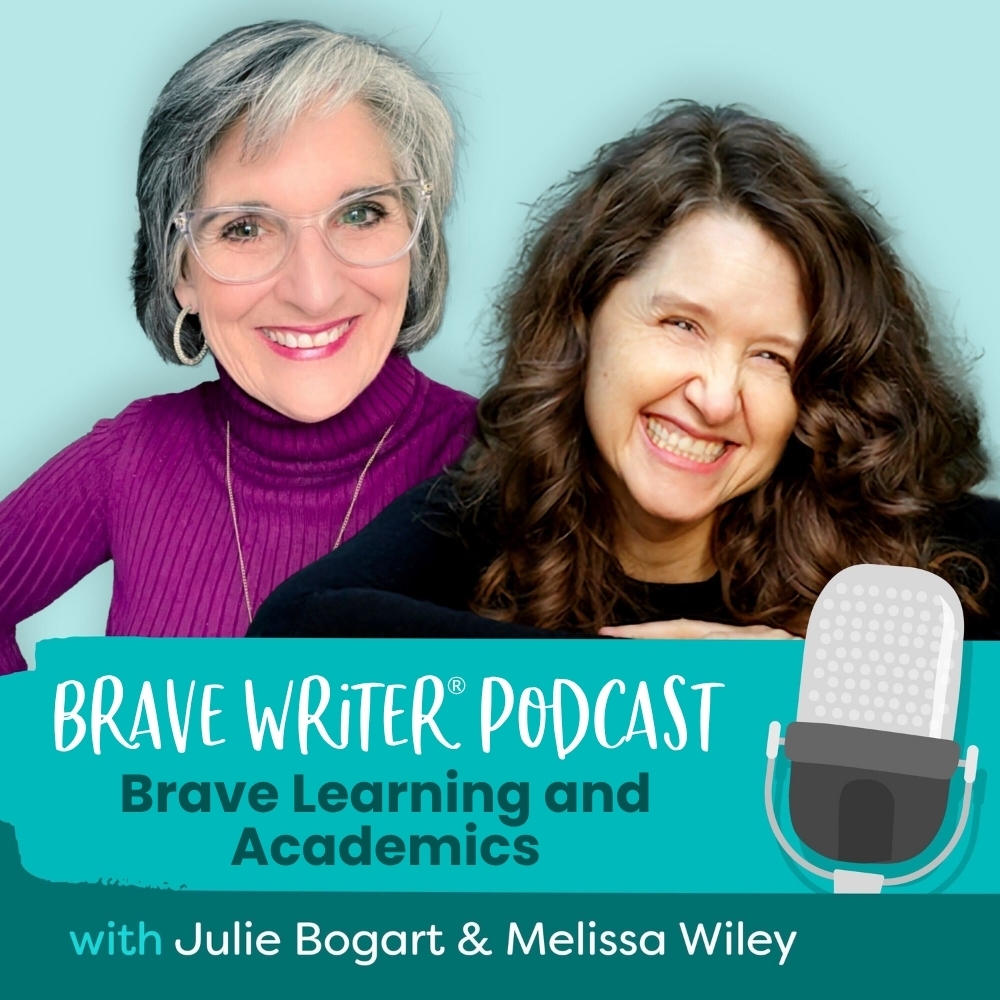
In this Brave Writer podcast episode, we explore how to translate grade-level expectations into the rich, lived learning already happening in your home. From Poetry Teatime to bird watching, baking, narration, read-alouds, and everyday conversations, we look at how whole experiences often contain the very skills listed in scope-and-sequence documents. Rather than turning homeschool into school-at-home, we can use standards as information, not intimidation.
Join us as we make peace with checklists, protect our children’s investment in learning, and celebrate the evidence already unfolding in daily life.
Show Notes
When Academic Standards Make You Panic
Have you ever looked at a list of grade-level standards and felt your shoulders climb toward your ears?
There they are: the skills your child is supposed to master, the content they are supposed to know, the sequence they are supposed to follow. The language sounds official. The list looks long. Suddenly, the cozy read-alouds, the nature walks, the poetry, the baking, the big conversations in the car all seem suspiciously unmeasurable.
We know that feeling.
Academic standards can be useful. They can remind us of topics we may not have touched yet. They can help us translate our homeschool life for charter schools, portfolio reviews, or state requirements. They can even offer reassurance.
But standards are not the same thing as learning.
Learning Is Not a Checklist
A checklist can be helpful when we are cleaning a bathroom. Wipe the sink. Scrub the tub. Empty the trash. Done.
Children do not learn like bathrooms get cleaned.
A child’s mind is not a collection of unfinished chores. Learning grows through curiosity, connection, repetition, surprise, appetite, and investment. A child who cares about measuring the distance from the front door to the mailbox may absorb measurement more deeply than a child forced through a worksheet before breakfast.
That does not mean we ignore standards. It means we refuse to let them become the boss of the homeschool.
Start with the Whole
Many academic standards are written as parts: identify punctuation, answer who/what/where questions, compare units of measurement, explain historical groups, recognize spelling patterns.
But homeschool life often begins with the whole.
A child who listens to read-alouds, narrates stories, laughs over poems, writes notes, plays games, bakes muffins, tracks birds, builds with Legos, and asks questions about history is already living inside a web of academic skills.
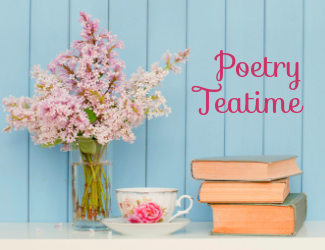
Poetry Teatime may include rhythm, vocabulary, punctuation, oral reading, interpretation, and literary language. A bird-watching habit may include observation, classification, migration, habitat, animal behavior, geography, data collection, and narration. Baking may include fractions, sequencing, measurement, chemistry, and patience.
The parts are there. We simply learn to notice them.
Plan from Behind
This is where documentation becomes our friend.
Instead of beginning every week with a fear-based list of what must be forced into the day, we can observe what actually happens and give it credit. Write it down. Save the dated freewrite. Take a photo of the Lego measurement experiment. Jot a note about the conversation in the car where your child compared snow and hail.
A simple binder can become a record of a rich learning life. Divide it by subject. Add dated work samples, notes, drawings, narrations, lists, maps, and projects. Over time, you will see evidence accumulate.
Not because you manufactured school.
Because you honored learning.
Use Standards as Information
Sometimes a standards list will reveal a gap. Maybe you realize you have spent years delighting in nature study and have barely touched electricity. Wonderful. That is not failure. That is information.
Visit the library. Pull books from the children’s nonfiction shelves. Watch a documentary. Try an experiment. Follow curiosity until the topic has a little life in it.
The goal is not to force-feed a child a meal they did not ask for. The goal is to create appetite.
Investment Changes Everything
Children learn more readily when they have a reason to care. The reluctant writer may suddenly produce a persuasive essay when a video game system is on the line. The child uninterested in French may become curious through maps of Paris, French films, music, podcasts, or a beloved character who speaks the language.
Standards get hit when children are invested.
That is the heart of Brave Writer-style learning. We do not have to choose between academic growth and a meaningful homeschool life. We can understand the standards, translate the language, document the learning, and still protect the wonder.
Homeschooling does not have to become school-at-home.
We can begin with life, then notice all the learning already there.
Resources
- Catch the replays of our free Brave Writer training webinars
- Shop our June sale!
- Visit the Brave Learner website at thebravelearner.com
- Order your copy of The Brave Learner from the Brave Writer Book Shop
- Brave Writer class registration is open!
- Visit Julie’s Substack to find her special podcast for kids (and a lot more!)
- Purchase Julie’s new book, Help! My Kid Hates Writing
- Find community at the Brave Learner Home
- Learn more about the Brave Writer Literature & Mechanics programs
- Start a free trial of CTCmath.com to try the math program that’s sure to grab and keep your child’s attention
- Subscribe to Julie’s Substack newsletters, Brave Learning with Julie Bogart and Julie Off Topic, and Melissa’s Catalog of Enthusiasms
- Sign up for our Text Message Pod Ring to get podcast updates and more!
- Send us podcast topic ideas by texting us: +1 (833) 947-3684
- Interested in advertising with us? Reach out to media@bravewriter.com
Connect with Julie
- Instagram: @juliebogartwriter
- Threads: @juliebogartwriter
- Bluesky: @bravewriter.com
- Facebook: facebook.com/bravewriter
Connect with Melissa
- Website: melissawiley.com
- Substack: melissawiley.substack.com
- Instagram: @melissawileybooks
- Bluesky: @melissawiley.bsky.social
Produced by NOVA