Writing about Writing Archives - Page 19 of 27 - A Brave Writer's Life in Brief A Brave Writer's Life in Brief
  • Start Here
    • For Families
      Multiple Ages
    • Ages 5-7
      Beginning Writers
    • Ages 8-10
      Emerging Writers
    • Ages 11-12
      Middle School Writers
    • Ages 13-14
      High School Writers
    • Ages 15-18
      College Prep Writers
  • Shop
    • Product Collections
    • Bundles
    • Writing Instruction Manuals
    • Literature & Grammar/Punctuation
    • Composition Formats
    • Literature Singles
    • Homeschool Help
    • Book Shop
    • Special Offers
  • Online Classes
    • Class Descriptions
    • Class Schedule
    • Classroom
    • How Our Classes Work
    • Our Writing Coaches
    • Classes FAQ
  • Community
    • Brave Learner Home
    • What’s Happening
    • Blog
    • Podcast
    • Calendar
    • Brave Writer Lifestyle
  • Cart
  • My Account
    • My Online Classes
    • My Account
  • My Account
    • My Online Classes
    • My Account
  • Start Here

    If you’re new to Brave Writer, or are looking for the best products for your child or family, choose from below:

    • For Families
      Multiple Ages
    • Ages 5-7
      Beginning Writers
    • Ages 8-10
      Emerging Writers
    • Ages 11-12
      Middle School Writers
    • Ages 13-14
      High School Writers
    • Ages 15-18
      College Prep Writers
  • Shop

    If you’re already familiar with Brave Writer products, go directly to what you’re looking for:

    • Product Collections Browse the full catalog in our shop
    • Bundles Everything you need to get started
    • Writing Instruction Manuals Foundational Writing Programs
    • Literature & Grammar/Punctuation Grammar, Punctuation, Spelling & Literary Devices
    • Composition Formats Writing Assignments for Every Age
    • Literature Singles Individual Literature Handbooks
    • Homeschool Help Homeschooling Tools and Resources
    • Book Shop Books associated with Brave Writer Programs
    • Special Offers
  • Online Classes
    • Class Descriptions
    • Class Schedule
    • Classroom
    • How Our Classes Work
    • Our Writing Coaches
    • Classes FAQ
  • Community
    • Brave Learner Home
    • What’s Happening
    • Blog
    • Podcast
    • Calendar
    • Brave Writer Lifestyle
  • Search
  • Cart

Search Bravewriter.com

  • Home
  • Blog

A Brave Writer's Life in Brief

Thoughts from my home to yours

Archive for the ‘Writing about Writing’ Category

« Older Entries
Newer Entries »

When the Tears Come

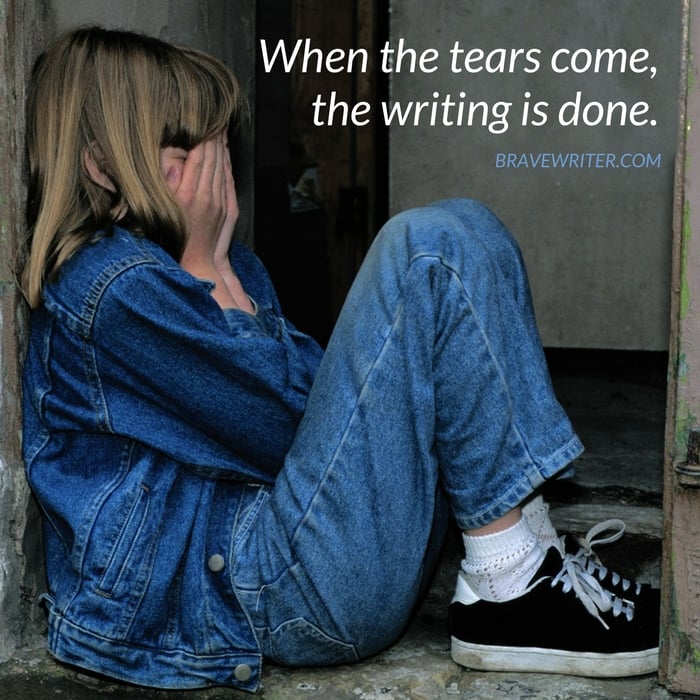
When the tears come, the writing is done

Who can do anything well while crying?

Can you type while crying? Cook dinner? Play board games? Not well.

Tears are an indication that something is wrong. Really wrong. They signal pain: emotional or physical. In writing, emotional pain may be writer’s block or fear of making a mistake. Physical pain may be that the hand hurts from squeezing the pencil too tightly, or eye strain, or physical exhaustion from a poor night’s sleep.

Crying is not a sign of laziness or lack of character. Crying is the last release, the final “giving up” and admission of failure.

Crying signals: I need comfort.

When the tears come, the writing’s done.

Take a break.

Acknowledge your child’s feelings. “I see that you’re unhappy. Let’s talk about this project later.”

Offer a hug.

When the Tears Come the Writing is Done

Later, when your child has regained equilibrium, come back to find out what went wrong.

Ask:

  • Are you afraid of making a mistake?
  • Is it too hard to grip the pencil for ten minutes straight?
  • Are you having a hard time spelling?
  • Do you wish you could play outside in the sunshine rather than sit at a table?
  • Does it feel like you have nothing to say?
  • Are you sleepy? Hungry?
  • Do you feel pressured by me?

Be an investigator and a comforter. A cup of tea and eye contact will go a long way toward soothing the hurting writer. Remember, writer’s block is the usual reason for writing paralysis (not strong wills).

Writer’s block means the child doesn’t have access to the words inside. The words are hidden behind anxiety, fear of failure, or a vague sense of the topic (not enough depth in the subject area to be able to write about it meaningfully).

Writer’s block is experienced by everyone (pros, professors, and prodigies) and at its most acute, produces tears.

Give oodles of empathy and hugs. Offer a snack (with protein in it). Talk about how to make writing less painful. Take some time to remind yourself of the goal – a free, brave writer who is at ease when writing, not gripped with anxiety and fear.

Take a look at Growing Brave Writers, if you need strategies for unblocking your chronically blocked writers.
Growing Brave Writers

Posted in Brave Writer Philosophy, Homeschool Advice, Writing about Writing | 1 Comment »

Flip the Script!

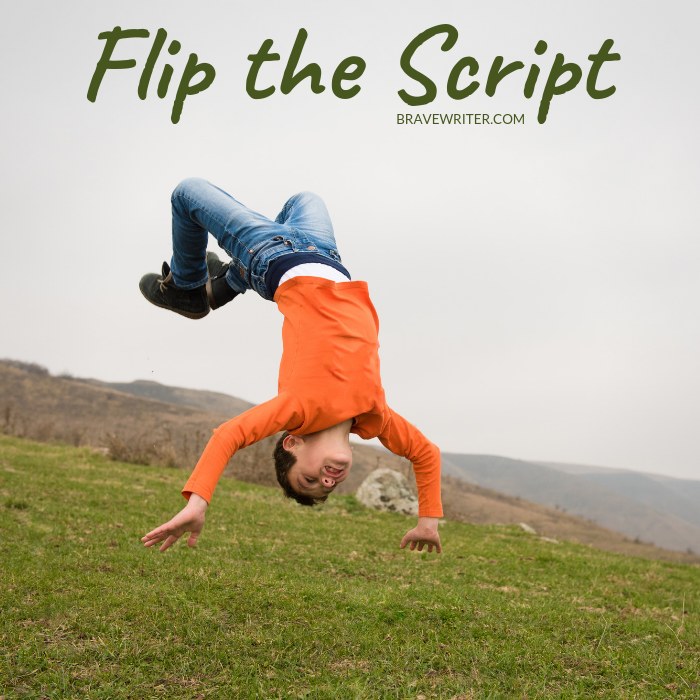
Flip the Script

A mother of ten called me to ask about writing. She had never heard of Brave Writer until a friend of hers shared about it enthusiastically. She wondered how it compared to her favorite writing program and why she should consider switching.

We had a great conversation. One of the issues that emerged in the phone call struck me as worth sharing here.

I want to say it to everyone.

It’s okay to use more than one writing program.

As you gain confidence in your home education abilities, what you’ll find is that it is your philosophy of learning and education that governs how you use any material you bring to your children. The curriculum will no longer be in charge. You will be.

So this mom shared how she used to be a slave to the rubric of the writing program she loved. Then one day her college-aged son told her that he had discovered in college that there was more to writing than formats or structure.

It was a moment for her. It changed how she saw writing. The next thing you know, she felt less worried about the rubric. When her next child wrote, she was okay with a few flaws in the final product and was more interested in the process that produced the paragraph.

As we chatted more, it became apparent that she had evolved a lot as a home educator in all these years. She is comfortable in her own skin, she feels free to switch things up for a change of pace to keep her own interest in homeschooling burning, she feels curious to try Brave Writer because she’s excited to have another set of tools to play with.

This is how it ought to be for all of us. It takes time to get there. You cling to the books and programs you trust at the front end of home education. But as it goes along, you evolve, you discover that you have opinions, you have children reporting their opinions, and you realize that YOU are in charge of how your kids move forward (not a book, not a theory, not a program).

Feel free to add other voices to your writing instruction. I’m one. But there are so many good ones out there! I recommend many of them in The Writer’s Jungle—the ones who’ve completely changed my life and my writing.

I always recommend reading published writers who write about writing. They’re usually hilarious and smart, cynical in all those delicious ways, and uniquely sympathetic to the struggle to confront a blank screen. You might also:

  • Join a writing support group.
  • Take a poetry class at the local community college.
  • Put your kids in the library poetry slam group!
  • Act out a scene of Shakespeare as a family, to ingest the language and amazing number of metaphors.
  • Buy a book of writing prompts and use those for your freewrites.
  • Learn to draw instead of write. Those processes are so similar in how they work with your brain, you’ll find that one informs the other and vice versa.
  • Read fan fiction. Write it!

Writing is so big. It’s much bigger than a book that tells you how to write an essay.

And remember: essay writing lasts for 8 years of your child’s life (9th grade through senior in college). If your kids go on to get an MA in the social science or humanities, it will go on a little longer. If he or she goes on to be a Ph.D., that means they like writing.

But for the rest of us, the shelf life of an essay in anyone’s life is two terms of a presidency. That’s it!

But writing—all the kinds we do all our lives—goes on for good! Get into it. Add new colors to your homeschool instruction. Don’t worry about “purity” of philosophy. Try stuff, see how it feels, keep what works, chuck what doesn’t.

Flip the script—see what’s on the back of the page.


Write for Fun: Fly High

Posted in Homeschool Advice, Writing about Writing | Comments Off on Flip the Script!

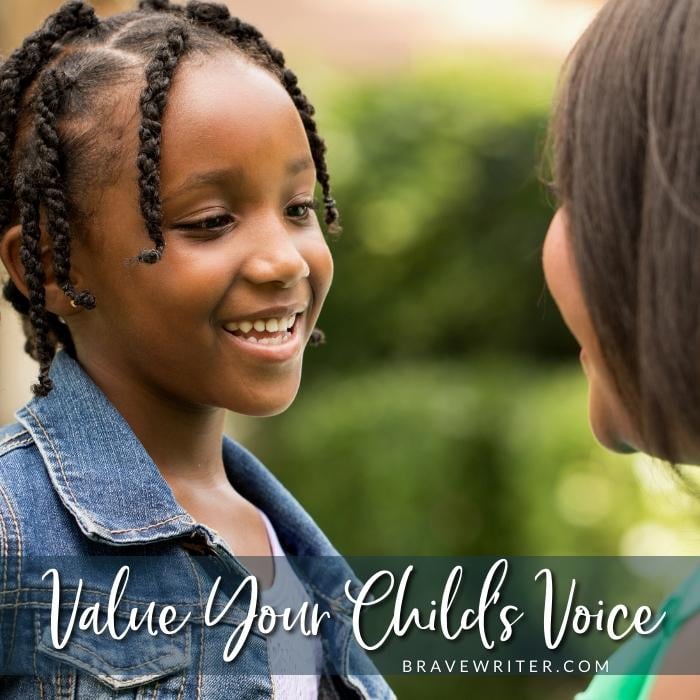
Value Your Child’s Voice

Value Your Child's Voice

We talk about writing voice in the writing process quite a bit in Brave Writer. We want the writing your kids do to sound like them—to have their vocabulary, inflection, quirky personality, and sense of humor. We don’t want them to sound like a copy of Aesop or the writer of X, Y, Z curriculum. We don’t want them to produce rote writing where no one can tell who wrote it, so devoid of voice it is.

So we start with freewriting.

But what happens when we give freedom to express and little shows up? What if what we find on the page is lifeless and dull, the utter opposite of what shows up in the bathtub or at an amusement park?

Even worse: what if what shows up really does in fact sound like your child, but it’s lifeless and dull (according to you) and feels like the barest beginnings of original thought?

So let’s back up a step.

“Writing voice” is two words. The real word we want to explore is “voice” all by itself.

Peter Elbow (my writing mentor) describes it this way:

“Most children have real voice but then lose it. It is often just plain loud: like screeching or banging a drum. It can be annoying or wearing for others. ‘Shhh’ is the response we get to the power of real voice.

“But, in addition, much of what we say with real voice is difficult for those around us to deal with: anger, grief, self-pity, even love for the wrong people. When we are hushed up from those expressions, we lose real voice.”

Here’s where we sometimes go wrong as parents. We are busy, our children are young and inexperienced. When they risk saying what they really think in the ways they want to really say what they think, we sometimes move into what I call “civilize the savages” mode. We are more worried about the appearance of what they say than what it is, in fact, they are saying.

If your children develop the habit of shutting down their real ideas, thoughts, preferences, wishes, and dreams around you, they will also turn off “real voice.” Then when you go to writing with them, they will turn to you and expect you to tell them what words ought to fill the page, just like they now wait for you to show them what thoughts are acceptable to say out loud.

Writing is a risk, but so is speaking. We must create space for both the prudent, acceptable, “makes Mama proud” words and the “Oh I hope she doesn’t really feel that way” words. We need to pause and let the rumble of language flow through our kids verbally and they must know that you are interested, receptive, and open-minded enough to hear it (without freaking out) in order for them to find their written voice.

You can start today:

Eye contact and a focused minute of conversation where you really hear what one of your kids is saying is the beginning of fostering an environment where what your child means to say becomes the norm for what is written.

You may have to change your own perceptions of what writing is too. It may be that you use an artificial voice when you write—the one the teacher told you sounded more grown up, or the one that keeps you from being perceived as impolite, or the one you use to project a cheery disposition.

Maybe you don’t even write because the risk feels too great and you avoid it.

Take some time to explore how much space there is in your self, in your children, and in your home to express authentic voice (verbally first, in writing second). See what you can do to expand that space…

Baby steps:

“You look angry—want to tell me about it? Want to yell about it?”

“Your giggly, silliness is cracking me up! I want to be as silly as you!”

“It’s okay to be really sad right now. Tell me about it.”

“I hate that too, sometimes.”

“You are so smart using all those big words!”

“I would love to hear you tell me more about that story! Go for it. I want every tiny detail.” (Instead of insisting on summary)

See what happens… I know for me, I have to put my phone down and walk away from the computer. I also find that it’s easy to tune out my kids when the topic doesn’t interest me or they are struggling to find the words. I have to remind myself to pay attention and to care. You can’t do it every time, but you can do it some of the time, for each child in a rotating way. Be mindful and conscious.


Brave Learner Home

Posted in Brave Writer Philosophy, Homeschool Advice, Writing about Writing | Comments Off on Value Your Child’s Voice

« Older Entries
Newer Entries »
  • Search the Blog

  • Julie Bogart
  • Welcome, I’m Julie Bogart.

    I’m a homeschooling alum -17 years, five kids. Now I run Brave Writer, the online writing and language arts program for families. More >>

    IMPORTANT: Please read our Privacy Policy.

  • New to Brave Writer? START HERE

  • FREE Resources

    • 7-Day Writing Blitz
    • Brave Writer Lifestyle Program
    • Brave Writer Sampler: Free Sample Products
    • Freewriting Prompts
    • Podcasts
  • Popular Posts

    • You have time
    • How writing is like sewing
    • Best curriculum for a 6 year old
    • Today's little unspoken homeschool secret
    • Do you like to homeschool?
    • Don't trust the schedule
    • You want to do a good job parenting?
    • If you've got a passel of kids
    • You are not a teacher
    • Natural Stages of Growth in Writing podcasts
  • Blog Topics

    • Brave Learner Home
    • Brave Writer Lifestyle
    • Classes
    • Contests/Giveaways
    • Friday Freewrite
    • High School
    • Homeschool Advice
    • Julie's Life
    • Language Arts
    • Movie Wednesday
    • Natural Stages of Growth
    • One Thing Principle
    • Our Team
    • Parenting
    • Philosophy of Education
    • Podcasts
    • Poetry Teatime
    • Products
    • Reviews
    • Speaking Schedule
    • Students
    • Writing about Writing
    • Young Writers
  • Archives

  • Brave Writer is a participant in the Amazon Services LLC Associates Program, an affiliate advertising program designed to provide a means for sites to earn advertising fees (at no extra cost to you) by advertising and linking to amazon.com

    Content © Brave Writer unless otherwise stated.

What is Brave Writer?

  • Welcome to Brave Writer
  • Why Brave Writer Works
  • About Julie
  • Brave Writer Values
  • Frequently Asked Questions
  • Speaking Schedule

Brave Writer Program

  • Getting Started!
  • Stages of Growth in Writing
  • The Brave Writer Program
  • For Families and Students
  • Online Classes
  • Brave Writer Lifestyle

…and More!

  • Blog
  • Classroom
  • Store
  • Books in Brave Writer Programs
  • Contact Us
  • Customer Service
  • Brave Writer Staff
© 2026 Brave Writer
Privacy Policy
Children's Privacy Policy
Help Center