Writing about Writing Archives - Page 18 of 27 - A Brave Writer's Life in Brief A Brave Writer's Life in Brief
  • Start Here
    • For Families
      Multiple Ages
    • Ages 5-7
      Beginning Writers
    • Ages 8-10
      Emerging Writers
    • Ages 11-12
      Middle School Writers
    • Ages 13-14
      High School Writers
    • Ages 15-18
      College Prep Writers
  • Shop
    • Product Collections
    • Bundles
    • Writing Instruction Manuals
    • Literature & Grammar/Punctuation
    • Composition Formats
    • Literature Singles
    • Homeschool Help
    • Book Shop
    • Special Offers
  • Online Classes
    • Class Descriptions
    • Class Schedule
    • Classroom
    • How Our Classes Work
    • Our Writing Coaches
    • Classes FAQ
  • Community
    • Brave Learner Home
    • What’s Happening
    • Blog
    • Podcast
    • Calendar
    • Brave Writer Lifestyle
  • Cart
  • My Account
    • My Online Classes
    • My Account
  • My Account
    • My Online Classes
    • My Account
  • Start Here

    If you’re new to Brave Writer, or are looking for the best products for your child or family, choose from below:

    • For Families
      Multiple Ages
    • Ages 5-7
      Beginning Writers
    • Ages 8-10
      Emerging Writers
    • Ages 11-12
      Middle School Writers
    • Ages 13-14
      High School Writers
    • Ages 15-18
      College Prep Writers
  • Shop

    If you’re already familiar with Brave Writer products, go directly to what you’re looking for:

    • Product Collections Browse the full catalog in our shop
    • Bundles Everything you need to get started
    • Writing Instruction Manuals Foundational Writing Programs
    • Literature & Grammar/Punctuation Grammar, Punctuation, Spelling & Literary Devices
    • Composition Formats Writing Assignments for Every Age
    • Literature Singles Individual Literature Handbooks
    • Homeschool Help Homeschooling Tools and Resources
    • Book Shop Books associated with Brave Writer Programs
    • Special Offers
  • Online Classes
    • Class Descriptions
    • Class Schedule
    • Classroom
    • How Our Classes Work
    • Our Writing Coaches
    • Classes FAQ
  • Community
    • Brave Learner Home
    • What’s Happening
    • Blog
    • Podcast
    • Calendar
    • Brave Writer Lifestyle
  • Search
  • Cart

Search Bravewriter.com

  • Home
  • Blog

A Brave Writer's Life in Brief

Thoughts from my home to yours

Archive for the ‘Writing about Writing’ Category

« Older Entries
Newer Entries »

Are We Having Fun Yet?

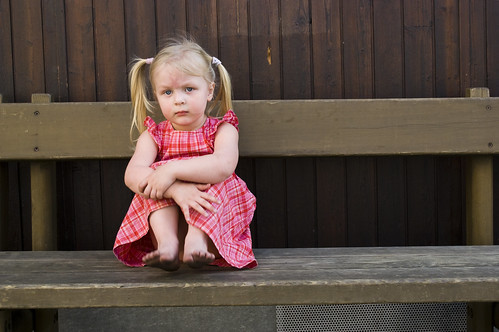
What is she thinking?

When leading new teacher training, the topic of “fun” surfaced which made me think about that word and how I feel about it. Everyone wants to have “fun”—”fun” is the word we use to describe our happy experiences. Fun is free, happy, includes laughter, involves increased heart rates, lightheadedness, and the belief that life is good, right now.

But what happens when we say to our kids or friends:

“This experience is going to be fun”?

I know for me, when someone tells me to expect that an outing or event will be fun, a little part of me tightens. I wonder if I’m being tricked into an experience I don’t really want to have, or if I’ll be required to say I had fun because I wouldn’t want to hurt anyone’s feelings. I wonder what happens if the event isn’t fun for me. Do I have a way to stop being a part of it?

There are times when the promise of fun is wholly justified. If a friend calls and says, “Let’s go surfing! It will be so much fun!” I’m likely to agree happily. But if right before spring cleaning, my spouse says to me: “You know we’ll have fun washing the windows,” part of me feels, well, manipulated. What if I really hate window-washing? Just white-washing it (ha!) with the word “fun” isn’t going to change that. I want it understood that I have a genuine feeling about it and I don’t want someone to require me to feel what they assert.

“This is going to be fun” is a coercive statement. Therefore, I avoid making it.

The thing about children is this. We’re told that they are responsive to joy, laughter, and the experience of fun. That means, adults attempt to win cooperation from childish children for tasks that are often associated with “not fun” by promising “fun.” Corporations have figured this out. Daily vitamins, as one example, are shaped like cartoon characters and soaked in sugar to make vitamin-popping a “fun” experience.

The promise of “fun” though, can be a promise of diminishing returns. If you tell a child that the visit to the dentist will be “fun” because there will be a toy at the end of it, and instead, the visit includes painful tooth-drilling, the fun no longer stands out as the key experience of the appointment. The child learns to be cautious when the word “fun” is batted about. It starts to sound like, “This experience is not going to be fun, but we’re going to pretend it is so you won’t get mad or cry or run the other way.”

And so begin the dubious associations with the word “fun.”

With homeschool, as in life, there are tasks that are “fun” and tasks that are not. Not every task has to be “fun” in the true sense of that word, in order to be satisfying or productive or even practiced. Each person needs to have the freedom to form his or her own opinion of the subject area or how we teach it.

“Fun” needs to be experienced as a wonderful by-product when observed in hindsight: “That was a lot of fun learning about dependent clauses.” It is not likely that forecasting “fun” for dependent clause study will be met with anything but suspicion.

Rather than looking for “fun ways” to learn any subject, focus instead on teaching a subject area in a way that involves the child’s whole personality and sense of self. No one wants a subject “done to them.” No one wants to be required to enjoy a subject area.

The best learning experiences are those where the child is engaged/immersed—with his or her full powers of evaluation and capability available. Your job is to provide a stress-free, nurturing, attentive, clear environment in which that activity can take place. Fun is not essential, but when a child is fully involved, fun is a frequently cited result.

And that’s when fun is, well, fun.

Image by Clemens v. Vogelsang
Posted in Homeschool Advice, Writing about Writing | 3 Comments »

Safe Space for Living = Safe Space for Writing

Create a safe space for writing by creating a safe space for living

It’s not enough to tell your kids they can take writing risks and you’ll be there to support them, no matter what. You can promise that you won’t criticize their mechanical errors or that you are “okay” with whatever they write as long as they move the pencil. These are good practices that help to make the act of writing less daunting.

Yet a child who is used to being managed, directed, and revised in daily life will carry that feeling into the writing life; those words will not carry the message you hope to convey.

Writing is a risk. There are styles of parenting that make risk-taking more difficult for the child. To facilitate freedom in risk, children need to have lots of experiences with you, the parent, that let them know they can make mistakes, or offer you something different than you envisioned for them, or that they need time to not write for a bit.

Emotional connection creates emotional safety.

For example, if your child descends the stairs after dressing herself in mismatched top and bottoms, do you comment? Do you send her back for the “right” shirt? Do you feel disappointment? Does it show?

When there’s a mess on the floor, do you find yourself focused on cleaning it up rather than seeing what it represents?

Think back to your parents or your spouse or a school teacher. What types of comments made you nervous or left you feeling blank or closed? When did you blossom and venture to some new space for thought or activity?

When a mother tells me her daughter is a perfectionist, I often ask: “Are you, too?”

When a father tells me, “I don’t want to live through my boy, but he is capable of so much!” and then proceeds to tell me his ambitions for his son, it’s not all that surprising to me when I discover that this same child seizes up in writing, afraid to disappoint this powerful man in his life that he admires.

A habit of commenting (even in a positive tone of voice) can become a second-voice in the child’s head. Your evaluations (even when positive) can rob the child of forming his or her own. Your child starts to measure him or herself by what he or she imagines you might say, rather than feeling free to explore.

Sometimes the best way to create emotional safety for a child is to be quiet (to say nothing, to not have an opinion ar all), and at other times, it’s helpful to point the child back to his or her own experience.

For instance, you might say nothing about the outfit of choice, but you might make a comment about a child’s big mess on the living room floor: “What a lot of creativity and fun we have here!”

How you say what you say is the most important feature of this dynamic. Your tone of voice creates or thwarts your relationship of trust with your child.

I want to repeat that.

The tone of voice you take with your child,
even more than the content of what you say,
will determine how open your child is with you.

A child’s felt experience of space and safety will translate into taking risks (of various kinds) throughout childhood. Some of those risks will show up in writing.

If you find that your child is not responding to the space-creating language you use for freewriting, ask yourself if a shadow hides in your communications. Do you convey through tone or words that you have expectations for the child that feel like pressure (not like support for growth)?

How can you free up space for calm, creative, patient progress and risk-taking instead of conveying the hidden expectation of a performance that reassures you?

There are lots of reasons for writer’s block, but I wanted to point out this dynamic today. It doesn’t show up in writing manuals, but in many cases is the primary struggle. Writing is not like math pages where you can assign them and measure the number of problems completed. Writing requires an unearthing of language from within. Any time a child goes within (to create), the child unconsciously checks the space to see if “that’s allowed.”

It’s your job to allow, allow, allow in lots of areas, with genuine interest, trust, and care. As you do, lots of good stuff will show up (and some stuff you don’t want too). But that’s all part of it! You get to show your kids that it’s okay to make mistakes, to take risks that don’t pan out, and to create their own way.

You do it together. Like writing. Life life.

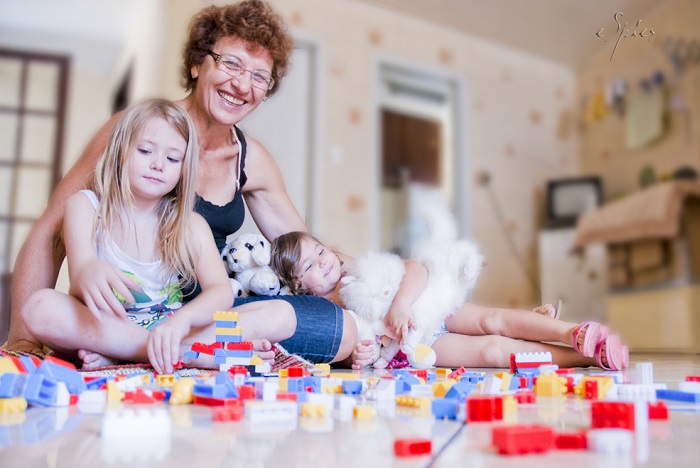
The Homeschool AllianceHeader Image by Emanuele Spies (cc)

Posted in Homeschool Advice, Writing about Writing | Comments Off on Safe Space for Living = Safe Space for Writing

Writing Advice: The Spiraling Approach

The Writing Spiral

I’m about to lay on you some high quality, free-of-charge writing advice. Take it. Apply it. Share it.

I wish I could get this message out to everyone who teaches writing. It would change the landscape of how many gifted, competent, satisfied, brave writers there are in the world. You are on the front lines and can make all the difference for your kids.

Apply a spiraling strategy to writing growth.

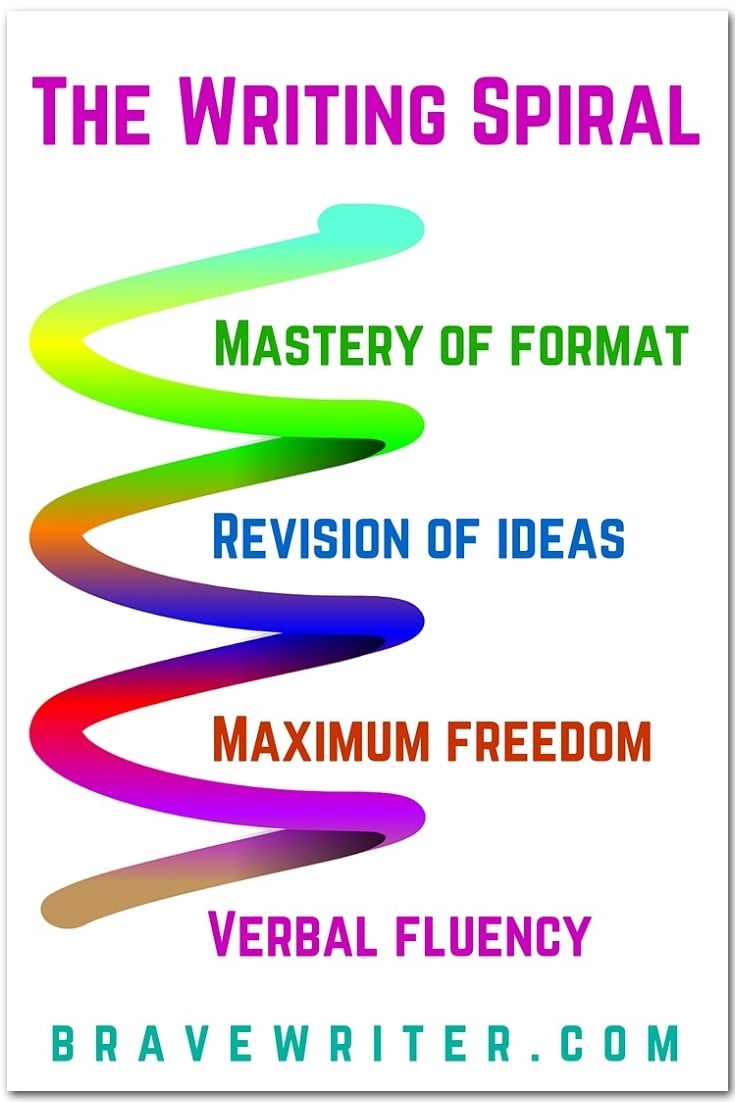
The strategy for growth in writing needs to go like this:

  • Verbal fluency in the vocabulary of that level
  • Maximum freedom to explore that topic/subject area in writing (no structure, no rules, no disapproval for spelling errors, grammar inaccuracies, missing punctuation, and disorganization)
  • Revision of ideas and the introduction of structure
  • Mastery of format for that developmental stage of growth

KEY INSIGHT: This sequence starts again when your child goes up a level.

So for the beginning writer, we start with speech, jotting down the child’s thoughts, and then reading them back. We may ask a child to copy their own thoughts in their own hand from a model we make for them. But mostly, they talk, we write.

For the growing writer, we introduce freewriting. A child takes the unedited scrap language in his or her mind and transfers it to a page without worry about spelling, grammar, handwriting, or punctuation. Once comfortable with freewriting, we introduce some of the strategies of revision. We revise content for ideas, insights, better vocabulary, higher quality images and comparisons, without attention to specific formats. Conversation, freewriting, revision, polishing all happen on a regular basis but no one is expecting an argumentative essay out of the process.

The proficient writer will still use conversation and freewriting to express new ideas onto the page, but the vocabulary deepens. Now the formats are more structured: a report, or lapbook. A poem, or narration. Each of these will begin with freewriting, but then the forms are easily taught to this writer.

The Writing SpiralWhen you move to the academic writing of high school, it almost feels like a regression. While the child develops a literary, rhetorical vocabulary, it helps to go back to freedom for risk taking. In Brave Writer, for instance, we offer the Boomerang Book Club as a way to write about literature without attention to form. In these written responses to discussion questions, students learn to put their thoughts about novels into writing without the added pressure of writing a literary analysis essay…yet.

After many months of this practice, students are finally ready to add the format called the essay. They find it easy to access the language within because they’ve been doing it freely for many months. They find that they are “fluent” in the material that goes into the format and aren’t having to fire on both cylinders from the get go. They have this wonderful head start: written vocabulary in the field for the format.

You can’t expect your student to jump from writing little reports to a literary response or expository essay just because the student can type or handwrite. Until the student has developed a vocabulary in writing for that level of reflection, the writer won’t be comfortable transferring the thoughts in his mind down through his arm into his keyboard. Each advance in intellectual development requires a period of free, written exploration before introducing formats. That written exploration has to be over a period of time (not just one freewrite) so that the child/teen becomes comfortable with accessing this new category of vocabulary in writing.

Do not see it as “going backwards” to give a student a chance to write with no agenda whatsoever about the topic at hand, whatever that new topic may be.

Our Help for High School manual and Essay Prep online courses are designed for this kind of written exploration that precedes the essay. The Boomerang Book Club does the same thing for literature.

Remember this progression:

  1. Oral development
  2. Written free exploration
  3. Revision techniques (for ideas and content generation)
  4. Formats

Follow these four steps each time your child moves up one rung of the natural stages of growth in writing ladder. If you take seriously the period of written exploration, teaching the format that follows will be a breeze. Skip it, and you risk introducing writer’s block at that new developmental stage.

UPDATED: Here’s a talk I did about The Writing Spiral!

Second image by Johannes Ahlmann (cc text added)

Posted in Homeschool Advice, Writing about Writing | Comments Off on Writing Advice: The Spiraling Approach

« Older Entries
Newer Entries »
  • Search the Blog

  • Julie Bogart
  • Welcome, I’m Julie Bogart.

    I’m a homeschooling alum -17 years, five kids. Now I run Brave Writer, the online writing and language arts program for families. More >>

    IMPORTANT: Please read our Privacy Policy.

  • New to Brave Writer? START HERE

  • FREE Resources

    • 7-Day Writing Blitz
    • Brave Writer Lifestyle Program
    • Brave Writer Sampler: Free Sample Products
    • Freewriting Prompts
    • Podcasts
  • Popular Posts

    • You have time
    • How writing is like sewing
    • Best curriculum for a 6 year old
    • Today's little unspoken homeschool secret
    • Do you like to homeschool?
    • Don't trust the schedule
    • You want to do a good job parenting?
    • If you've got a passel of kids
    • You are not a teacher
    • Natural Stages of Growth in Writing podcasts
  • Blog Topics

    • Brave Learner Home
    • Brave Writer Lifestyle
    • Classes
    • Contests/Giveaways
    • Friday Freewrite
    • High School
    • Homeschool Advice
    • Julie's Life
    • Language Arts
    • Movie Wednesday
    • Natural Stages of Growth
    • One Thing Principle
    • Our Team
    • Parenting
    • Philosophy of Education
    • Podcasts
    • Poetry Teatime
    • Products
    • Reviews
    • Speaking Schedule
    • Students
    • Writing about Writing
    • Young Writers
  • Archives

  • Brave Writer is a participant in the Amazon Services LLC Associates Program, an affiliate advertising program designed to provide a means for sites to earn advertising fees (at no extra cost to you) by advertising and linking to amazon.com

    Content © Brave Writer unless otherwise stated.

What is Brave Writer?

  • Welcome to Brave Writer
  • Why Brave Writer Works
  • About Julie
  • Brave Writer Values
  • Frequently Asked Questions
  • Speaking Schedule

Brave Writer Program

  • Getting Started!
  • Stages of Growth in Writing
  • The Brave Writer Program
  • For Families and Students
  • Online Classes
  • Brave Writer Lifestyle

…and More!

  • Blog
  • Classroom
  • Store
  • Books in Brave Writer Programs
  • Contact Us
  • Customer Service
  • Brave Writer Staff
© 2026 Brave Writer
Privacy Policy
Children's Privacy Policy
Help Center