Format writing teaches kids to solve the “puzzle” of the assignment rather than teaching kids to tap into their writing voices. #homeschool
— Julie Bogart (@BraveWriter) September 29, 2013
Archive for the ‘Writing about Writing’ Category
Not puzzle-solving, but voice-finding
When Your Child Writes Hurtful Words
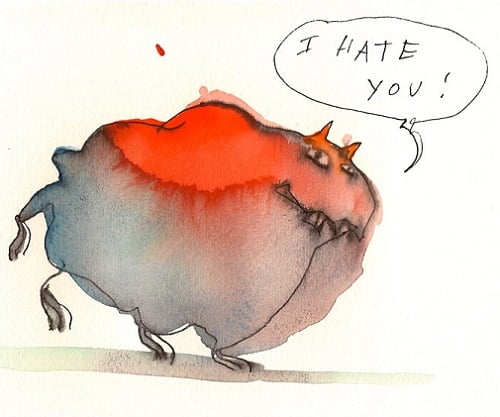
Sometimes freewriting yields an emotional catharsis in your child. You find out that she is angry at her father for teasing her about her table manners. You discover that your son is mad at you for “making him do math.” You read that your child thinks your mother is mean or that another child calls her brother “stupid.”
It takes a big person to withstand criticism in almost any setting. But when it comes from a beloved child, it’s like running a tractor over your heart. Freewriting sometimes calls forth buried emotions, but it can also yield truths that you might not want to face.
For instance, maybe your mother was mean the last time she visited, or perhaps your spouse did cross the line from teasing to mocking and humiliated the daughter.
It’s important to stand up for reality in your family. So if your child detected misbehavior by an adult and it showed up in writing, validate it. You don’t need to pretend it away or minimize it. Simply acknowledge it:
- “You’re right. Grandma was pretty harsh. I don’t like it when she shouts either.”
- “Let’s talk to Dad. I wonder if he knows he hurt your feelings.”
- “Thanks for sharing this with me. Let’s see what can be done to repair the damage.”
If the freewriting is slanderous: “Joey is stupid” or “Mom is the worst mother in the world,” you can talk about it from a writing point of view.
Powerful writing “shows” it doesn’t “tell.”
Suggest your child lay off of the “slams” and focus instead on revealing the character of the one being accused. What can happen in those moments is powerful. Now your child is being required to find support for the assertion. As he or she does that, sometimes perspective has a way of creeping in. Maybe she discovers that Joey isn’t actually stupid, he just plays too hard sometimes and your daughter gets overwhelmed. Maybe your son discovers that what is bugging him is that he wants to play his computer game longer and you stop him for dinner. Now you have a real problem that can be addressed and solved, rather than name-calling.
Use this kind of writing to heal pain and damaged relationships. Honor it. Don’t judge it. Never require anyone to write only edifying depictions of others. Some of the best writing is the accurate recognition of another person’s flaws. Learning how to depict those with care is the challenge. If the writing is a veiled plea for support and love, take care of that too.
Image by waltercolor (cc cropped)
Remembering the Lock ‘n Key Diary

In 1970, I turned 9 years old and entered 4th grade. My November birthday brought a brown paper package from Chicago to Los Angeles from my Grandmother. I ripped it open.
A red diary with gold leafing! A golden metal lock clasped it shut, and a tiny matching key on a red string was Scotch taped to the cover.
Magic.
I knew one thing about diaries. They held secrets. With a lock and key to protect them, there was no limit to the private thoughts a 9 year old could scribble onto its pages!
I tested the key. It worked! The stiff edges crackled as I thumbed them looking for November 7. I cloistered myself in the corner of my bedroom, door closed, and picked up my pen to write…nothing.
Nothing.
I had no secrets. It stunned me to discover that I had been on the planet nine whole years and I had not a single thought or private wish that needed safe-keeping. I closed the diary in defeat.
I stared blankly at a sky blue wall.
Then a thought dawned—maybe inspired by the color red, the gold leafing, or the desperate internal search.
Love.
Diaries are records of secret crushes!
I broke open the seal again, and enthusiastically began my first entry:
“I love Scott Halstead.”
Whether I did actually “love” Scott or not was entirely beside the point. I could now write about emotions that I didn’t want my brother to read. Victory!
The following pages mused whether or not to give Scott my baseball cards (I had two), how to show him I loved him (I never mustered that courage), and what he might say to me if we ever exchanged syllables.
The first month of entries is a torrid private fantasy of benign interactions between two kids—with a surprising number of misspellings for being an A student speller in school. My handwriting is slope-y and jumbled, and I believe I thought it was beautiful at the time.
I kept up the daily entries for a few impressive months and then the crush wore off with none to replace it, and my thoughts became mundane.
There’s quite a drought of entries after Christmas. Then, on February 9, 1971, an earthquake struck Northridge, CA, not 8 miles from my home. We felt the full force of that quake. Walls split in our neighbor’s house, dishes burst from cabinets and crashed to the ground, beds slid across floors, and our little Boston Terrier leapt over her gate to tear into our bedrooms.
My brother, 7 years old at the time, felt the rocking house under him as he woke up and we could hear him (standing) on his bed shouting “Ahoy Matey!” I made the uncertain, slingshot, stumbling journey from my room to my parents’ bed, while the house creaked and groaned and threw me against the walls.
I wrote about it the next day, in my diary.
Not too many words, but enough to see my perspective at nine, of this big event that I’ve never forgotten.
It’s funny how I thought my secret crush was the point of the diary back then, when today I see it as this “witness to history” moment, afforded me by the seduction of gold leafing, and a lock and key, and the wonderful way writing is and has always been there for me.
I smile when I see it now. My grandmother wrote poems in an era when women didn’t work or publish much, but she assumed I’d write. My mother became a successful author. I teach writing. My daughter writes poems and teaches writing. We all journal.
The beat goes on…
Just felt like thanking the genius who put gold edges and locks and keys on red diaries. I don’t know what kind of writer I might have become without mine.
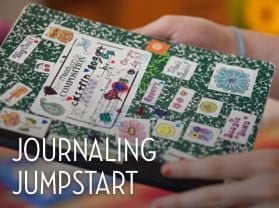 Journaling Jumpstart guides students to explore various methods of journaling, all while challenging them to build a pattern of regular journal-keeping, no matter what the style.
“The best time to begin keeping a journal is whenever you decide to.” (Hannah Hinchman, A Life in Hand)
This class is perfect for middle school, junior high, high school, and beyond! It would make a great first independent online class for middle schoolers or a great family project (parents included!) to start the new year journaling together!
Header image by Hannah G