Writing about Writing Archives - Page 13 of 17 - A Brave Writer's Life in Brief A Brave Writer's Life in Brief
  • Start Here
    • For Families
      Multiple Ages
    • Ages 5-7
      Beginning Writers
    • Ages 8-10
      Emerging Writers
    • Ages 11-12
      Middle School Writers
    • Ages 13-14
      High School Writers
    • Ages 15-18
      College Prep Writers
  • Shop
    • Product Collections
    • Bundles
    • Writing Instruction Manuals
    • Literature & Grammar/Punctuation
    • Composition Formats
    • Literature Singles
    • Homeschool Help
    • Book Shop
  • Online Classes
    • Class Descriptions
    • Class Schedule
    • Classroom
    • How Our Classes Work
    • Our Writing Coaches
    • Classes FAQ
  • Community
    • Brave Learner Home
    • What’s Happening
    • Blog
    • Podcast
    • Calendar
  • Cart
  • My Account
    • My Online Classes
    • My Account
  • My Account
    • My Online Classes
    • My Account
  • Start Here

    If you’re new to Brave Writer, or are looking for the best products for your child or family, choose from below:

    • For Families
      Multiple Ages
    • Ages 5-7
      Beginning Writers
    • Ages 8-10
      Emerging Writers
    • Ages 11-12
      Middle School Writers
    • Ages 13-14
      High School Writers
    • Ages 15-18
      College Prep Writers
  • Shop

    If you’re already familiar with Brave Writer products, go directly to what you’re looking for:

    • Product Collections Browse the full catalog in our shop
    • Bundles Everything you need to get started
    • Writing Instruction Manuals Foundational Writing Programs
    • Literature & Grammar/Punctuation Grammar, Punctuation, Spelling & Literary Devices
    • Composition Formats Writing Assignments for Every Age
    • Literature Singles Individual Literature Handbooks
    • Homeschool Help Homeschooling Tools and Resources
    • Book Shop Books associated with Brave Writer Programs
  • Online Classes
    • Class Descriptions
    • Class Schedule
    • Classroom
    • How Our Classes Work
    • Our Writing Coaches
    • Classes FAQ
  • Community
    • Brave Learner Home
    • What’s Happening
    • Blog
    • Podcast
    • Calendar
  • Search
  • Cart

Search Bravewriter.com

  • Home
  • Blog

A Brave Writer's Life in Brief

Thoughts from my home to yours

Archive for the ‘Writing about Writing’ Category

« Older Entries
Newer Entries »

The professor-archetype

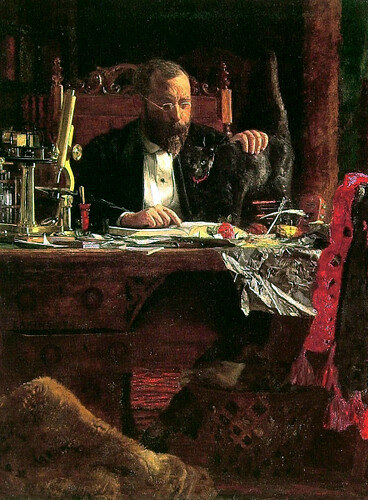
Portrait of Professor Benjamin H RandHave you ever noticed that in some children’s literature, a professorial type male character is often included as a father-like figure to a gaggle of kids? He might even be the father.

This man is usually interesting to the reader because he seems oblivious to typical parental worries—he doesn’t throw up red flags of caution when the children experiment with dangerous tools, contraptions, or potions. He is unworried by their retellings of journeys into magical worlds or forests. He is non-plussed by their cheeky philosophy or their impolitely expressed opinions. He often accepts their fantastical tales with aplomb, barely registering alarm when they return from adventures riddled with danger, and shows a surprising capacity to believe the stories at face value.

This man-character doesn’t lecture children and sometimes, infuriatingly, doesn’t even give advice or warnings when they seem most merited. He, himself, might be engaged in his own mysterious doings and ponderings, which leave the children bewildered and impressed.

I think of characters like Professor Dumbledore (Harry Potter), Professor Kirke (Chronicles of Narnia), Professor Martin Penderwick (professor of botany, The Penderwicks), Merlin (The Sword and the Stone), Wayne Szalinski (Honey, I Shrunk the Kids), Gandalf (Lord of the Rings series) and even the benign homesteading pioneer, Pa Ingalls (Little House series).

This archetype is an intriguing figure. Children gravitate to these men and I’ve been curious about why. I have a few hunches. It seems to me that children crave the experience of being taken seriously. They want their words to be weighed by adults and then found to be full of truth, sincerity, and importance. Even if children’s ideas or experiences could be explained away by an adult’s greater worldliness, children still hope to find in the adult they respect, an appreciation for the way they know the world so far.

These professor-like men uniformly respect a child’s grasp of the world they live in and they are appropriately engaged in their own battles and explorations so as not to be overly impressed by the children’s, either. These men’s lives are independent of whether or not the kids turn out, survive, or discover the same truths the professor-types take for granted.

Additionally, the professor-archetype believes he doesn’t know everything and is open to learning from any source, including the naive experiences of kids. This openness registers deeply with readers. It gives child-readers hope that the thoughts and feelings they have about the life they are living can find a kind, sympathetic, or at minimum, respectful audience in the adults they love and trust.

When I get worked up (wanting to cover all the bases, trying to protect my children from danger – even my adult children!, lecturing them from the vast-expanse of my more abundant failures and successes, disbelieving their reports because they don’t match what I’ve known to be true), I sometimes envision Professor Kirke and his wave-of-the-hand type attitude. He couldn’t be bothered explaining away Lucy’s experience of Narnia. If she reported it and she was trustworthy and we admit that there are things in the universe we do not yet know, there must be truth in Lucy’s report. End of story.

A profound respect for the truthfulness of children. Impressive.

When faced with my children’s inexperience and their youthful impulses, I have to resist the temptation to be a stodgy, know-it-all adult who fails to see magic and opportunity in a child’s point of view. I have to sometimes sit on my hands (which tend to do all the talking, lecturing, and waving) and let the perspective “ride”—let it run its course or express itself without restraint to hear the full-bodied nature of what it wants to say. I have to make room for what makes me uncomfortable.

I’m learning how to let risk be a part of a child’s (or young adult’s) exploration. I’m trying to hang back, talk less, and listen more. I want to be open, quieter, more curious, less case-closed.

I want to relate to my kids, believing that life is a better teacher than a lecture.

I want to respect their experiences without being a busybody about them.

It’s funny. This professor-archetype character is so popular with kids. They just love the surprise of an authority figure who would treat children as peers and invite them into real danger trusting them to their competencies, heart (valor), and goodwill—at least on the level of how they express their participation in the world around them, and how they understand their part in it.

These men (and women) make good role models for us. Don’t you think? Who are your favorite adults in children’s (or any) literature? What have you learned from them? I’m curious.

Cross-posted on facebook.

Image Portrait of Professor Benjamin H Rand by Thomas Eakins (1874)
Posted in Literary elements, Living Literature, Writing about Writing | 4 Comments »

It’s the Writer, Not the Writing

It's the Writer, Not the Writing

It’s tempting to see writing as something a person does, as assignments to complete, as skills to acquire for an academic or career purpose.

It’s tempting to evaluate the writing a person does as though it is a set of math problems—measurable, impersonal, external.

It’s tempting to push for completion, because the assignment or project has a due date or has to be done for the end-of-the-year evaluation.

The paradigm shift is this:

Writing is not like other subjects. Writing is closely related to the self, no matter what the content. Even mothers sending me email get nervous thinking I will read their questions, and wonder what I will make of them, because they are undressing their minds right in front of me. What will I see? How will I react?

How much more kids feel that way?

  • Take the “school definition” out of writing (beware of the ghost of public school past).
  • Focus on the “writer” more than the “writing.”
  • Tears mean the lesson is over for the day.
  • Partial work is valuable.
  • Progress happens through a series of attempts, not through wrestling a single project to the perfected finish.
  • Self-expression is a risk and needs you to treat it gently.
  • Support helps—and help is helpful (not damaging, not cheating, not short-cutting).

Academic formats require as much “soul investment” as fan fiction and diaries. You must be just as gentle and curious with an expository essay as you were with the story about your child’s pet gerbil.

Writers express what lives inside them. Writing is the form it is put in. Expression deserves respectful care. Mechanics deserve minimal care. Expression matters the most. Mechanics are marginally important.

Work on the two components (mechanics and expression) separately and teach your writer to take responsibility for editing mechanics and getting someone to help him or her see what he or she can’t see without a second set of eyes.

That’s it. That’s all the attention mechanics deserve. They do not make or break the essence of the writing. They merely punctuate it, so someone else can approximate the tone and meaning the writer intends.

Brave Writer not brave writing.

Learn More: The Difference Between Brave Writer and Other Programs

Posted in Brave Writer Philosophy, Homeschool Advice, Writing about Writing | Comments Off on It’s the Writer, Not the Writing

Be your child’s writing coach

Pencil Icon

One of the most important parts of being a writing coach in your children’s lives is finding a way to convey appreciation for the original writing while conveying important information that might grow or enhance the writing. This delicate balance can be achieved when you deliberately respect the original writing.

One way you show respect is to *not* write on it. You can read it as it is and when you do decide to put feedback or corrections on the paper, you do so on a photocopy of the original. You preserve the original, and comment on a copy.

Secondly, you can use pencil on that photocopy to convey changes or suggested enhancements rather than pen. Your child can erase comments that don’t feel helpful, and the pencil gives the impression of suggestion rather than demand.

Thirdly, write positive comments on the photocopy, not just corrections. Underline great phrases, circle good word choices, put an exclamation point next to an idea that impresses you. You can tell your child your code for conveying your approval. It’s also nice to jot positive notes, like, “Excellent use of dialog” or “This is a well-chosen fact” or “I like how you incorporate your personal experience…”

Lastly, remind your young writers that they don’t have to take your corrections—it’s their right as authors. They can pick and choose what to apply to their work. You might mention that picking one or two to apply is a good habit to get into, but try not to press your case. Give this point as information, not as parent-to-child command.

My comment to you about that last item: don’t worry if your kids don’t apply all of your suggestions. The mistakes they leave in their writing will magically reappear at a later date to be addressed again. And if they don’t, then you’ve spared yourself having to “argue” about a point they internalized and corrected independently in future pieces.

Respect the writer (preserve the original writing).

Respect the writing (use a photocopy and pencil for feedback).

Offer feedback (positive and corrective) in a spirit of support.

Allow the writer to determine how to apply the feedback.

Simple!

Cross-posted on facebook

Image by bennthewolfe

Posted in Brave Writer Lifestyle, Writing about Writing | Comments Off on Be your child’s writing coach

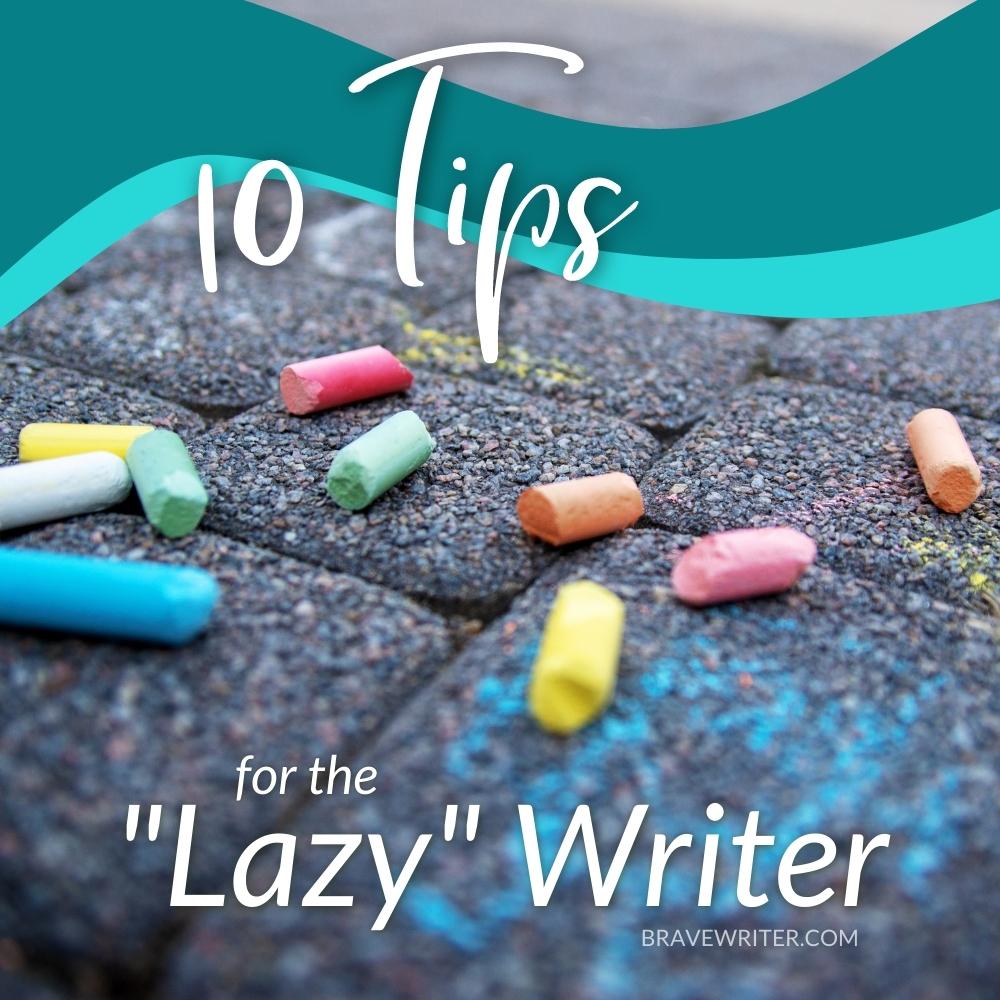
10 Tips for the “Lazy” Writer

10 Tips for "Lazy" Writer

There are tips, practices, tools, and helps that make writing easier. Don’t believe for a minute that your kids are lazy!

Ten ways to encourage writing today:

  1. Put out gel pens and black paper
  2. Instant Message or text with your child
  3. Light candles and listen to music while writing
  4. Write a sentence on a white board that is provocative yet unfinished, like: “If I could do whatever I wanted today, I would….”
  5. Write together (at the table, everyone at the same time)
  6. Write at the mall, jotting down fashion observations
  7. Give a shoulder massage before writing
  8. Comment on 3 status updates on social media
  9. Rewrite the ending to a favorite movie or book (make it melodramatic, sad, angry, happy, or include aliens!)
  10. Write on a clipboard, under a table, lying on a trampoline, up in a tree, with sidewalk chalk on the driveway

Writing is about freedom to express without the pressure that comes from straight jacket formats. Formats are only helpful once kids feel FREE to write.

Let me say it again: You can’t produce good writing that fits a format until you’ve spent hundreds of hours writing without caring one whit about format. Once you feel as easy writing as you do talking, formats are a snap of the fingers to teach and follow.

So play with words today.


Growing Brave Writers

Posted in Brave Writer Philosophy, Writing about Writing, Writing Exercises | 1 Comment »

What I hate about writing

DSCN8039.JPGI wrote in my journal this morning. Not a handwritten flower-covered lined paper book. No, I opened a Word doc and started typing. I find handwriting too slow and too painful, like many of your kids. Gosh, I can’t remember the last time I used handwriting for journaling.

Anyway, I was reading someone else’s blog this morning—a published someone, a someone with a book that’s popular right now, but who is also in my Facebook feed (I had to ask myself, “Are we friends? Have I met her?” I couldn’t remember). In any case, she’s clearly a writer. She has that “thing” that I associate with writerly writers—the cleverness, the snark, the sharing of personal experience in that candid, use-the-“f”-word-because-I’m-irreverent-and-it’s-2012 way. I do understand this.

I feel like I’ve been versions of that person. I remember taking breaks from journaling (I’ve kept a journal/diary since 4th grade). I would stop when my own writing nauseated me. I’d notice that I was more interested in the sound of my own voice than in the ideas. Or I’d notice that I was literally reading my writing back as I wrote, imagining how it would sound once I was dead and my fan-following had discovered this one unwritten journal and they were poring over my last insightful words. As those embarrassing images would slip into view, I’d clap the book closed and go on a journaling fast. It was a true fast—hard to stay with it, sneaking chances to write anyway (letters were always a great “diet cheat”).

This morning I felt fed up—with words, with thoughts, with being pushed to have new ideas or insights that pinged off someone else’s personal journey. So I wrote about it. Hypocrite. Here I am, doing the same danged thing. Writing about writing.

It’s like my number one pet peeve: song lyrics about songs. “I have to say I love you, in a song” or “This song’s for you,” or “So I wrote it down in a song.” Seriously. Sing a song… Don’t sing about singing a song.

Yet I’m writing about writing this morning.

And I just wanted to say that it’s okay with me if you’re not insightful when you write. I’d rather be bored than manipulated. I’d rather read about your day than about your cosmic revelation. In fact, I really really like reading about someone’s day and finding the take away for myself (you don’t need to tell me what I should take away). Sometimes it’s enough to sit next to someone else’s life around the Internet campfire and just be with it. Not every experience has to drip with meaning.

Sometimes there is no meaning. Sometimes one word in back of the other is all there is to write. Sometimes you don’t know what you mean until years later when you reread your old journals with horror and realize that you “knew” all along you were supposed to leave, but made excuses using contrived insight to make you stay.

What I hate about writing is that it teases you into believing your thoughts are important. They are. I say that to you every day here in Brave Writer. But they’re also astonishingly mundane… because we’re all the same essentially. Getting by on one word, one idea, one over-wrought insight at a time.

Have a good day. 🙂 (I included a photo with this post to cheer it up.)

Posted in Writing about Writing | 2 Comments »

« Older Entries
Newer Entries »
  • Search the Blog

  • Julie Bogart
  • Welcome, I’m Julie Bogart.

    I’m a homeschooling alum -17 years, five kids. Now I run Brave Writer, the online writing and language arts program for families. More >>

    IMPORTANT: Please read our Privacy Policy.

  • New to Brave Writer? START HERE

  • FREE Resources

    • 7-Day Writing Blitz
    • Brave Writer Lifestyle Program
    • Brave Writer Sampler: Free Sample Products
    • Freewriting Prompts
    • Podcasts
  • Popular Posts

    • You have time
    • How writing is like sewing
    • Best curriculum for a 6 year old
    • Today's little unspoken homeschool secret
    • Do you like to homeschool?
    • Don't trust the schedule
    • You want to do a good job parenting?
    • If you've got a passel of kids
    • You are not a teacher
    • Natural Stages of Growth in Writing podcasts
  • Blog Topics

    • Brave Learner Home
    • Brave Writer Lifestyle
    • Classes
    • Contests/Giveaways
    • Friday Freewrite
    • High School
    • Homeschool Advice
    • Julie's Life
    • Language Arts
    • Movie Wednesday
    • Natural Stages of Growth
    • One Thing Principle
    • Our Team
    • Parenting
    • Philosophy of Education
    • Podcasts
    • Poetry Teatime
    • Products
    • Reviews
    • Speaking Schedule
    • Students
    • Writing about Writing
    • Young Writers
  • Archives

  • Brave Writer is a participant in the Amazon Services LLC Associates Program, an affiliate advertising program designed to provide a means for sites to earn advertising fees (at no extra cost to you) by advertising and linking to amazon.com

    Content © Brave Writer unless otherwise stated.

What is Brave Writer?

  • Welcome to Brave Writer
  • Why Brave Writer Works
  • About Julie
  • Brave Writer Values
  • Frequently Asked Questions
  • Speaking Schedule

Brave Writer Program

  • Getting Started!
  • Stages of Growth in Writing
  • The Brave Writer Program
  • For Families and Students
  • Online Classes
  • Brave Writer Lifestyle

…and More!

  • Blog
  • Classroom
  • Store
  • Books in Brave Writer Programs
  • Contact Us
  • Customer Service
  • Brave Writer Staff
© 2026 Brave Writer
Privacy Policy
Children's Privacy Policy
Help Center