Podcasts Archives - Page 3 of 71 - A Brave Writer's Life in Brief A Brave Writer's Life in Brief
  • Start Here
    • For Families
      Multiple Ages
    • Ages 5-7
      Beginning Writers
    • Ages 8-10
      Emerging Writers
    • Ages 11-12
      Middle School Writers
    • Ages 13-14
      High School Writers
    • Ages 15-18
      College Prep Writers
  • Shop
    • Product Collections
    • Bundles
    • Writing Instruction Manuals
    • Literature & Grammar/Punctuation
    • Composition Formats
    • Literature Singles
    • Homeschool Help
    • Book Shop
  • Online Classes
    • Class Descriptions
    • Class Schedule
    • Classroom
    • How Our Classes Work
    • Our Writing Coaches
    • Classes FAQ
  • Community
    • Brave Learner Home
    • What’s Happening
    • Blog
    • Podcast
    • Calendar
  • Cart
  • My Account
    • My Online Classes
    • My Account
  • My Account
    • My Online Classes
    • My Account
  • Start Here

    If you’re new to Brave Writer, or are looking for the best products for your child or family, choose from below:

    • For Families
      Multiple Ages
    • Ages 5-7
      Beginning Writers
    • Ages 8-10
      Emerging Writers
    • Ages 11-12
      Middle School Writers
    • Ages 13-14
      High School Writers
    • Ages 15-18
      College Prep Writers
  • Shop

    If you’re already familiar with Brave Writer products, go directly to what you’re looking for:

    • Product Collections Browse the full catalog in our shop
    • Bundles Everything you need to get started
    • Writing Instruction Manuals Foundational Writing Programs
    • Literature & Grammar/Punctuation Grammar, Punctuation, Spelling & Literary Devices
    • Composition Formats Writing Assignments for Every Age
    • Literature Singles Individual Literature Handbooks
    • Homeschool Help Homeschooling Tools and Resources
    • Book Shop Books associated with Brave Writer Programs
  • Online Classes
    • Class Descriptions
    • Class Schedule
    • Classroom
    • How Our Classes Work
    • Our Writing Coaches
    • Classes FAQ
  • Community
    • Brave Learner Home
    • What’s Happening
    • Blog
    • Podcast
    • Calendar
  • Search
  • Cart

Search Bravewriter.com

  • Home
  • Blog

A Brave Writer's Life in Brief

Thoughts from my home to yours

Archive for the ‘Podcasts’ Category

« Older Entries
Newer Entries »

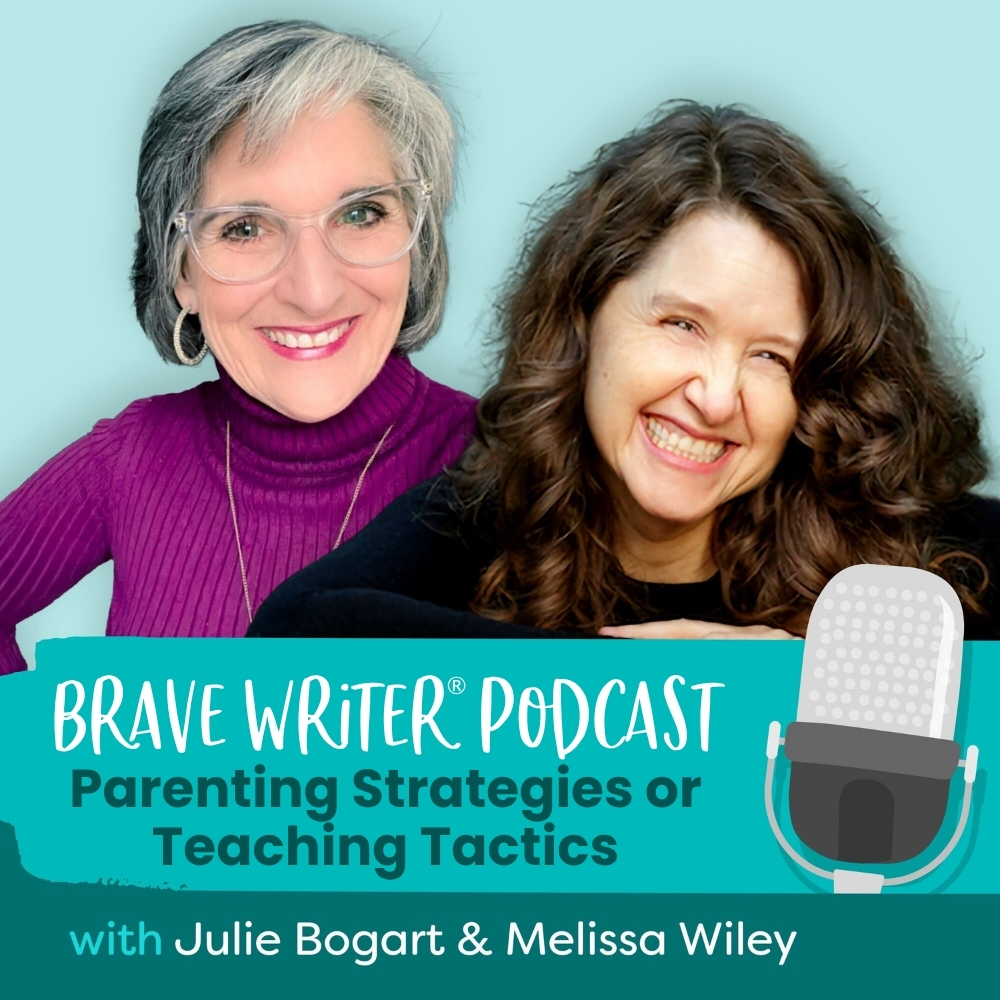
[Podcast #307] Italy, Literature, and Learning Connections

Brave Writer Podcast

Julie is back from her two-week trip to Italy (with a quick stop in Copenhagen!) and brings stories that weave together travel, literature, and layered learning. From visiting her aunt on the Mediterranean coast to finally stepping inside Florence’s Santa Croce—20 years after promising herself she would—Julie shares how books like A Room with a View transform sightseeing into soul-deep experiences.

She and Melissa explore how these kinds of connections—between story, place, and lived experience—are the essence of meaningful education. You’ll also hear about unexploded WWII bombs in a train station, the Leaning Tower of Pisa’s surprising wonder, naked bungee-jumping in Denmark, and a serendipitous plane conversation that led to the discovery of a century-old “living book.”

This Brave Writer podcast episode is a reminder to travel, talk to strangers, and create opportunities for our kids (and ourselves) to encounter the world twice: once through story, and once in real life.

Show Notes

Travel, Family, and Literature

This trip began as a chance to visit Julie’s aunt on the Mediterranean coast but soon became a deeply layered journey. Anchored in A Room with a View by E.M. Forster, Julie describes how reading about a place and then experiencing it firsthand adds dimension and delight—whether it’s stumbling upon Giotto’s frescoes, standing beneath Galileo’s tomb, or finally walking into Santa Croce. These encounters remind us that literature doesn’t just tell stories—it prepares us to live them.

Learning Twice: Experience + Story

Julie and Melissa explore the educational magic of encountering something more than once—first in books, films, or stories, and then in real life. From Sister Wendy’s art documentaries sparking awe in Florence’s Uffizi, to Melissa’s son recognizing dugouts from her novel The Prairie Thief, these layered connections create hooks for memory and deeper understanding. As Julie notes, “If you really want your kids to know something, they need it twice.”

Unexpected Encounters

The episode also celebrates the surprises of travel and conversation: unexploded WWII bombs unearthed in an Italian train station, Pisa’s leaning tower being more thrilling than expected, naked bungee-jumping in Denmark, and a chance plane-seat conversation that introduced Julie to Gordon MacQuarrie’s century-old Stories of the Old Duck Hunters and Other Drivel. These moments remind us that the world is full of unexpected teachers—if we’re willing to listen.

This episode is a joyful reflection on how travel, literature, and layered experiences enrich our lives and our children’s education. Whether through family stories, beloved books, or chance encounters with strangers, we are invited to step out of our comfort zones, connect deeply, and see the world with fresh eyes.

Resources

  • A Room with a View by E.M. Forster
  • Sister Wendy’s Story of Painting (BBC)
  • Bogart family trip to Italy
  • The Prairie Thief by Melissa Wiley
  • Brave Writer Dart: The Prairie Thief
  • Stories of the Old Duck Hunters and Other Drivel by Gordon MacQuarrie
  • Brave Writer Online Classes
  • Start a free trial of CTCmath.com to try the math program that’s sure to grab and keep your child’s attention
  • Sign up for our Text Message Pod Ring to get podcast updates and more!
  • Send us podcast topic ideas by texting us: +1 (833) 947-3684

Connect with Julie

  • Instagram: @juliebravewriter
  • Threads: @juliebravewriter
  • Bluesky: @bravewriter.com
  • Facebook: facebook.com/bravewriter

Connect with Melissa

  • Website: melissawiley.com
  • Substack: melissawiley.substack.com
  • Instagram: @melissawileybooks
  • Bluesky: @melissawiley.bsky.social

Produced by NOVA
Brave Writer Podcast

Posted in Podcasts | Comments Off on [Podcast #307] Italy, Literature, and Learning Connections

[Podcast #306] Challenge Accepted: An Interview with Chris Balme

Brave Writer Podcast

One of the major perks of homeschooling is that the middle-school years can be about adventure instead of awkwardness.

In this Brave Writer podcast episode, Melissa chats with author Chris Balme about his book, Challenge Accepted: 50 Adventures to Make Middle School Awesome. Balme’s book invites young readers to discover how trust, agency, and meaningful challenges transform “awkward years” into growth years.

Chris Balme
Chris Balme

Join us for a conversation about kid-driven adventures—stealth art, teaching what you know, citizen science, apprenticeships, and building from scratch.

Plus we talk about practical ways to:

  • close the gap between social perception and interpretation,
  • repair friendships,
  • and use side-by-side activities to spark conversation.

We also share why modeling a beginner’s mind (learning an instrument, sketching, coding) invites kids to try, fail, and try again.

Listen to the full episode to gather specific challenge ideas you can use this week and to reframe these years as the great adventure they are.

Show Notes

When we think of middle school, cultural messaging often paints it as the “awkward years,” something to simply survive. But what if we told a better story? That’s exactly what educator and author Chris Balme invites us to do in his new book Challenge Accepted: 50 Adventures to Make Middle School Awesome.

Chris has spent more than two decades working with adolescents, founding innovative schools and training parents and teachers. His mission is to reframe these years as one of the most magical and formative stages of human growth, rather than a gauntlet to endure. His perspective resonates with our Brave Writer philosophy: middle schoolers deserve trust, agency, and meaningful challenges that help them see themselves as capable and valued.

From “get through it” to “step into it”

Chris reminds us that middle schoolers are the “ultimate underdogs”—underestimated and often misunderstood. Their social awareness turns on almost overnight, leaving them flooded with new perceptions but little guidance on interpretation. This can make them vulnerable to overreacting, misjudging, or retreating. Yet, it’s also the perfect moment to equip them with the tools of resilience, relationship repair, and courage.

Instead of assuming they can’t handle responsibility, Chris urges us to give them challenges that matter. Whether it’s apprenticing with a neighbor, running a student café, or staging a protest march, kids light up when they realize adults trust them to contribute.

Adventures that build confidence

In Challenge Accepted, Chris offers 50 practical adventures that middle schoolers can take on their own or with friends. These aren’t worksheets—they’re invitations into real life.

  • Be a stealth artist. Create and secretly “install” art in your community in playful, respectful ways.
  • Share what you know. Teach others about your passion—whether it’s Greek mythology, coding, or skateboarding.
  • Become a citizen scientist. Contribute to real research by logging birds, weather, or online data.
  • Build something from scratch. A treehouse, a business, a Rube Goldberg machine—the process matters more than perfection.
  • Forgive someone. Practice repairing friendships, an essential life skill often overlooked in adolescence.

Each adventure signals trust: We believe you are capable. And that message is what middle schoolers most need to hear.

Parallel growth—for kids and parents

One of our favorite takeaways from Chris is the reminder that kids watch how we approach challenges ourselves. When we pick up a cello, a guitar, or a sketchbook and let them see us fumble forward, we normalize imperfection. We show them it’s safe to begin again.

At Brave Writer, we call this the Building Confidence stage. Chris’s adventures align beautifully with our writing projects and practices, which emphasize real-world expression and connection. Together, we can rewrite the cultural script from “just survive” to “make it an adventure.”

Middle school doesn’t have to be a time of dread. With the right guidance—and the right adventures—it can become a story worth remembering.

Resources

  • Learn more at Chris Balme’s website: www.chrisbalme.com
  • Chris’s Substack: Growing Wiser
  • Follow Chris Balme on Instagram: @chrisbalme 
  • Find CHALLENGE ACCEPTED: 50 ADVENTURES TO MAKE MIDDLE SCHOOL AWESOME in the Brave Writer Bookshop
  • Fall class registration is open! 
  • Visit Julie’s Substack to find her special podcast for kids (and a lot more!) 
  • Purchase Julie’s new book, Help! My Kid Hates Writing
  • Join us at the Brave Learner Home: https://bravewriter.com/brave-learner-home
  • Learn more about the Brave Writer Literature & Mechanics programs
  • Start a free trial of CTCmath.com to try the math program that’s sure to grab and keep your child’s attention
  • Subscribe to Julie’s Substack newsletters, Brave Learning with Julie Bogart and Julie Off Topic, and Melissa’s Catalog of Enthusiasms
  • Sign up for our Text Message Pod Ring to get podcast updates and more!
  • Send us podcast topic ideas by texting us: +1 (833) 947-3684

Connect with Julie

  • Instagram: @juliebravewriter
  • Threads: @juliebravewriter
  • Bluesky: @bravewriter.com
  • Facebook: facebook.com/bravewriter

Connect with Melissa

  • Website: melissawiley.com
  • Substack: melissawiley.substack.com
  • Instagram: @melissawileybooks
  • Bluesky: @melissawiley.bsky.social

Produced by NOVA
Brave Writer Podcast

Posted in Podcasts | Comments Off on [Podcast #306] Challenge Accepted: An Interview with Chris Balme

[Podcast #305] Can Screens Benefit the Whole Family? with Ash Brandin

Brave Writer Podcast

Do you ever catch yourself treating screens like contraband—tolerated in tiny doses, never to be openly celebrated?

Ash Brandin, author of Power On: Managing Screen Time for the Benefit of the Whole Family, urges us to view screens as morally neutral and to focus on how they can serve the whole family’s needs.

In this Brave Writer podcast episode, Ash shares their “Screen Time ABCs”:

  • Access that adapts to context rather than rigid caps
  • Behavior as neutral data rather than blame
  • Content choices that create better stopping points

They offer practical tactics like sticky-note reminders for Minecraft, reducing scarcity with predictable access and occasional “yes days,” using body doubling for schoolwork, and setting YouTube Kids to Approved Content Only to eliminate ads and algorithms. Ash also addresses AI, encouraging us to teach kids digital literacy and vetting skills rather than fear.

Their perspective replaces guilt with guidance, helping families connect through technology instead of fighting against it. Tune in to hear Ash’s thoughtful strategies and mindset-shifting advice.

Show Notes

Start with needs, not minutes

Ash points out that parents often ask, “Is there a right amount?” Instead of hunting for a magic number, they recommend evaluating needs and trade-offs. If an hour of Minecraft results in ninety minutes of meltdown, the exchange rate is poor. If a PBS show during a delayed dinner brings calm to the table, that’s a benefit worth naming. The goal isn’t austerity; it’s alignment—matching screen use to the people, the moment, and the mission.

Use the ABCs to guide decisions

One of Ash’s most practical tools is the “Screen Time ABCs”:

  • A is for Access: When, where, and how long? Access flexes with real life. The American Academy of Pediatrics now emphasizes a family media plan over rigid time caps, a shift Ash applauds.
  • B is for Behavior: Behavior is data, not judgment. A child’s outburst after gaming isn’t proof that “screens are bad”—it’s an opportunity to notice patterns, teach self-awareness, and practice regulation.
  • C is for Content: Different media have different exit ramps. A Mario Kart race ends naturally; Minecraft doesn’t. Ash suggests asking, “How will you know you’re done today?” and, “What’s the first thing you’ll do when you come back?” A sticky note reminder can turn a meltdown into a manageable pause.

Reduce scarcity; increase trust

Ash reminds us that scarcity breeds desperation. Predictable opportunities—plus the occasional “yes day”—can normalize screen use and build trust. Children who know their passions are honored are more likely to accept limits without resentment.

Sit closer to their digital life

Parents don’t have to love every game to love the child who plays it. Ash encourages curiosity: peek over a shoulder, help set up a console, or ask, “What was the best part of that session?” Sometimes, body doubling—working side by side—can ease online schoolwork struggles. Even offline drafts before typing into an online portal can help.

Smart safety without panic

Ash emphasizes principle over panic. On YouTube Kids, for example, the “Approved Content Only” setting eliminates ads and the algorithm while preserving real choice through trusted channels like PBS Kids. Free apps, on the other hand, often come at the hidden cost of data, attention, or intrusive ads.

About AI (and why tone matters)

Ash is clear: AI isn’t going back in the bottle. Their advice? Teach digital literacy and emotional safety. Help kids understand what AI is (a pattern-predicting tool, not a friend), and model curiosity and vetting skills. Invite children to run an “AI audit” by asking ChatGPT about a subject they know well, then evaluate what it got right and wrong.

Ash’s work shifts the conversation from guilt to guidance. When we adopt their neutral, practical approach, we empower our families to use technology wisely and sustainably—for connection, creativity, and calm.

Resources

  • Follow Ash Brandin on Instagram: @thegamereducator
  • Read Power On: Managing Screen Time for the Benefit of the Whole Family by Ash Brandin
  • Fall class registration is open! 
  • Visit Julie’s Substack to find her special podcast for kids (and a lot more!) 
  • Purchase Julie’s new book, Help! My Kid Hates Writing
  • Join us at the Brave Learner Home: https://bravewriter.com/brave-learner-home
  • Learn more about the Brave Writer Literature & Mechanics programs
  • Start a free trial of CTCmath.com to try the math program that’s sure to grab and keep your child’s attention
  • Subscribe to Julie’s Substack newsletters, Brave Learning with Julie Bogart and Julie Off Topic, and Melissa’s Catalog of Enthusiasms
  • Sign up for our Text Message Pod Ring to get podcast updates and more!
  • Send us podcast topic ideas by texting us: +1 (833) 947-3684

Connect with Julie

  • Instagram: @juliebravewriter
  • Threads: @juliebravewriter
  • Bluesky: @bravewriter.com
  • Facebook: facebook.com/bravewriter

Connect with Melissa

  • Website: melissawiley.com
  • Substack: melissawiley.substack.com
  • Instagram: @melissawileybooks
  • Bluesky: @melissawiley.bsky.social

Produced by NOVA
Brave Writer Podcast

Posted in Podcasts | Comments Off on [Podcast #305] Can Screens Benefit the Whole Family? with Ash Brandin

[Podcast #304] Teens and Books: A Deep Dive with Dawn Smith  

Brave Writer Podcast

Do you ever wonder how to keep teens reading—joyfully, deeply, and on their own terms?

In this conversation with Brave Writer Director of Publishing Dawn Smith, we explore practical ways to sustain a teen’s love of books:

  • continuing read-alouds,
  • using buddy-reading systems with sticky-note annotations,
  • deciding when a movie should come before (or after) the book,
  • and leveraging picture books, audiobooks, and graphic adaptations as scaffolds into harder texts.

We also share a simple framework for building teen book lists—evaluating a single title, the mix across a year, and the overall “reading diet”—so families preserve joy while expanding range and rigor.

Show Notes

When we treat reading as shared culture rather than mere curriculum, teens build stamina for hard texts, confidence with analysis, and—most importantly—a positive association with books that lasts.

Keep Reading Aloud (Yes, Even to Teens)

Reading aloud isn’t just for early years. Teen ears benefit from tone, cadence, and vocabulary they might skip in silent reading. Try a hybrid: launch a classic with an audiobook or a few read-aloud chapters to establish rhythm and pronunciation, then hand the book off. As teens race ahead, let them summarize to you—an effortless way to practice narration and reveal what’s resonating.

Buddy Reading Makes It a Book Club

Instead of “assigning,” read alongside. Share a copy with color-coded sticky tabs or keep a traveling notebook for quotes, questions, and connections. Schedule a weekly chat (chapters 1–3 by Friday), and let teens bring the passage starters. Ownership rises when they get to say, “Let’s look at this scene together.”

Book First or Movie First? It Depends

Old “rules” fall apart when we consider real kids. For some, a film (or even a spoiler-filled recap) lowers stress and provides visual hooks so they can relax into the language of the book. Others relish building their own mental movie first. Either path can spark richer compare/contrast conversations about adaptation choices, medium constraints, and theme.

Picture Books and Graphic Texts Are Powerful Scaffolds

Picture books are compact masterclasses in structure, imagery, and sophisticated vocabulary—perfect for teens learning a new era, idea, or genre. Graphic adaptations (think epics and Shakespeare) create onramps to complex works without diluting ideas. “Windows and mirrors” apply here too: choose texts that both reflect your teen’s world and open onto others.

Curate with Three Lenses: Book, Year, and Diet

When selecting titles, ask: Why this book? What voice or community does it represent? Does the author speak from within that experience, and how do reviews from that community respond? Then zoom out: Across the year, do we have variety in genre, era, and perspective? Finally, over the whole high-school “reading diet,” are we preserving a love of reading while nudging range and rigor? Every “yes” to one long book is a “no” to three medium ones—choose intentionally.

Prioritize Joy to Power Rigor

When teens associate reading with delight and agency, they can draw on that goodwill to tackle denser academic texts later. Let them choose plenty; then support the stretches with scaffolds (audio, film, excerpts, discussion questions). Our goal isn’t to check every “canon” box—it’s to raise readers who keep reading.

Lean on Tools That Invite Discussion

Rich guides (like our teen literature studies, Boomerang and Slingshot) offer think-piece questions, writer’s-craft insights, and historical context so you don’t have to carry it all alone. Use them to seed conversation, frame comparisons, or jumpstart a paper topic—while keeping the tone invitational, not interrogational.

When we lead with companionship, flexibility, and purpose, teens don’t just finish books—they become readers for life.

Resources

  • Find Jim Trelease’s The Read-Aloud Handbook in the Brave Writer Book Shop
  • Check out our Boomerang and Slingshot guides for teens.
  • Fall class registration is open! 
  • Visit Julie’s Substack to find her special podcast for kids (and a lot more!) 
  • Purchase Julie’s new book, Help! My Kid Hates Writing
  • Join us at the Brave Learner Home: https://bravewriter.com/brave-learner-home
  • Learn more about the Brave Writer Literature & Mechanics programs
  • Start a free trial of CTCmath.com to try the math program that’s sure to grab and keep your child’s attention
  • Give your child the gift of music! Sign up for a free month of private lessons with Maestro Music and let your child discover their own musical voice: www.maestromusic.online/brave
  • Subscribe to Julie’s Substack newsletters, Brave Learning with Julie Bogart and Julie Off Topic, and Melissa’s Catalog of Enthusiasms
  • Sign up for our Text Message Pod Ring to get podcast updates and more!
  • Send us podcast topic ideas by texting us: +1 (833) 947-3684

Connect with Julie

  • Instagram: @juliebravewriter
  • Threads: @juliebravewriter
  • Bluesky: @bravewriter.com
  • Facebook: facebook.com/bravewriter

Connect with Melissa

  • Website: melissawiley.com
  • Substack: melissawiley.substack.com
  • Instagram: @melissawileybooks
  • Bluesky: @melissawiley.bsky.social

Produced by NOVA
Brave Writer Podcast

Posted in Podcasts | Comments Off on [Podcast #304] Teens and Books: A Deep Dive with Dawn Smith  

[Podcast #303] Introducing Monday Morning Meetings: a Brave Writer Podcast for Kids

Brave Writer Podcast

Do you ever wish your homeschool week started with momentum instead of Monday drag?

We’ve found that small, doable invitations right at the start of the week prime kids for curiosity, competence, and follow-through. Think five minutes of inspiration that launches hours of self-directed learning—no elaborate prep required.

In our work with families, three tiny shifts consistently flip the “on” switch for kids: cozy learning spaces, gathering the world into the home, and playful comparison that sharpens thinking.

In this Brave Writer podcast episode, we share kid-friendly prompts you can use right away.

  • Build a “hidey hole” (a cozy, distraction-light nook) to make reading and copywork inviting.
  • Curate a rotating Nature Table to grow observation, vocabulary, and seasonal awareness.
  • Try “Movie Twins” to compare an original film with its remake, strengthening analytic thinking and family conversation.

We show how five-minute Monday cues, paired with simple tools like clipboards, lamps, and labels, generate ownership and momentum all week long.

Show Notes

Create a “Hidey Hole” for Focus

Environment shapes attention. When a child builds a small, cozy nook—behind a chair, under a card table, or in a closet—with a lamp, clipboard, pillows, and a blanket, the space itself signals, “This is where I do my thing.” A hidey hole reduces visual noise and invites immersion. Reading, copywork, or a short math set often feels easier when it happens someplace special. Pro tip: let kids assemble a “go bag” (clipboard, pencil, book light) so their setup is always ready. The win isn’t the fort; it’s the ownership kids feel over their learning.

Gather a Nature Table to Grow Observation

Kids love to collect. Channel that impulse into a rotating nature display: leaves, cones, bark, shells, driftwood, feathers, stones. Add index cards for handwritten labels and a magnifier for closer looks. Now you’ve built a mini-museum that evolves with the seasons and keeps curiosity alive between outings. The Nature Table is quiet science: sorting, classifying, noticing patterns, and building vocabulary. It also dignifies “treasures” by giving them a place of honor—an early lesson in curating ideas and evidence.

Try “Movie Twins” to Practice Compare & Contrast

Analytical thinking blossoms when kids hold two versions of the same story side by side (e.g., an original film and its remake). Invite them to list similarities and differences in plot beats, acting choices, costumes, or pacing. Rewatch one shared scene back-to-back and ask: Which performance convinces you? What choices change the meaning? This playful exercise builds core academic skills: identifying criteria, evaluating evidence, and articulating a point of view.

Keep It Five Minutes, Then Let Them Run

Kick off Monday with a five-minute prompt, then get out of the way. The secret isn’t length—it’s leverage. Short, vivid cues paired with concrete tools (clipboard, lamp, Ziplocs, index cards) create momentum kids can sustain on their own. If younger siblings hover, invite them into a parallel version (a mini hidey hole or a smaller collection tray) so everyone has a win.

From Micro-Invites to Macro-Growth

When we honor children’s agency—“Here’s an idea; make it yours”—we see stronger attention, better stamina, and more confident expression. A cozy nook births a reading streak. A labeled leaf becomes a paragraph. Two films turn into a lively family debate. Start small on Monday; watch the learning ripple through the week.

Resources

  • Visit Julie’s Substack to find her special podcast for kids (and a lot more!) 
  • Fall class registration is open! 
  • Purchase Julie’s new book, Help! My Kid Hates Writing
  • Brave Learner Home: https://bravewriter.com/brave-learner-home
  • Learn more about the Brave Writer Literature & Mechanics programs
  • Start a free trial of CTCmath.com to try the math program that’s sure to grab and keep your child’s attention
  • Give your child the gift of music! Sign up for a free month of private lessons with Maestro Music and let your child discover their own musical voice: www.maestromusic.online/brave
  • Subscribe to Julie’s Substack newsletters, Brave Learning with Julie Bogart and Julie Off Topic, and Melissa’s Catalog of Enthusiasms
  • Sign up for our Text Message Pod Ring to get podcast updates and more!
  • Send us podcast topic ideas by texting us: +1 (833) 947-3684

Connect with Julie

  • Instagram: @juliebravewriter
  • Threads: @juliebravewriter
  • Bluesky: @bravewriter.com
  • Facebook: facebook.com/bravewriter

Connect with Melissa

  • Website: melissawiley.com
  • Substack: melissawiley.substack.com
  • Instagram: @melissawileybooks
  • Bluesky: @melissawiley.bsky.social

Produced by NOVA
Brave Writer Podcast

Posted in Podcasts | Comments Off on [Podcast #303] Introducing Monday Morning Meetings: a Brave Writer Podcast for Kids

« Older Entries
Newer Entries »
  • Search the Blog

  • Julie Bogart
  • Welcome, I’m Julie Bogart.

    I’m a homeschooling alum -17 years, five kids. Now I run Brave Writer, the online writing and language arts program for families. More >>

    IMPORTANT: Please read our Privacy Policy.

  • New to Brave Writer? START HERE

  • FREE Resources

    • 7-Day Writing Blitz
    • Brave Writer Lifestyle Program
    • Brave Writer Sampler: Free Sample Products
    • Freewriting Prompts
    • Podcasts
  • Popular Posts

    • You have time
    • How writing is like sewing
    • Best curriculum for a 6 year old
    • Today's little unspoken homeschool secret
    • Do you like to homeschool?
    • Don't trust the schedule
    • You want to do a good job parenting?
    • If you've got a passel of kids
    • You are not a teacher
    • Natural Stages of Growth in Writing podcasts
  • Blog Topics

    • Brave Learner Home
    • Brave Writer Lifestyle
    • Classes
    • Contests/Giveaways
    • Friday Freewrite
    • High School
    • Homeschool Advice
    • Julie's Life
    • Language Arts
    • Movie Wednesday
    • Natural Stages of Growth
    • One Thing Principle
    • Our Team
    • Parenting
    • Philosophy of Education
    • Podcasts
    • Poetry Teatime
    • Products
    • Reviews
    • Speaking Schedule
    • Students
    • Writing about Writing
    • Young Writers
  • Archives

  • Brave Writer is a participant in the Amazon Services LLC Associates Program, an affiliate advertising program designed to provide a means for sites to earn advertising fees (at no extra cost to you) by advertising and linking to amazon.com

    Content © Brave Writer unless otherwise stated.

What is Brave Writer?

  • Welcome to Brave Writer
  • Why Brave Writer Works
  • About Julie
  • Brave Writer Values
  • Frequently Asked Questions
  • Speaking Schedule

Brave Writer Program

  • Getting Started!
  • Stages of Growth in Writing
  • The Brave Writer Program
  • For Families and Students
  • Online Classes
  • Brave Writer Lifestyle

…and More!

  • Blog
  • Classroom
  • Store
  • Books in Brave Writer Programs
  • Contact Us
  • Customer Service
© 2025 Brave Writer
Privacy Policy
Children's Privacy Policy
Help Center