Podcasts Archives - Page 18 of 75 - A Brave Writer's Life in Brief A Brave Writer's Life in Brief
  • Start Here
    • For Families
      Multiple Ages
    • Ages 5-7
      Beginning Writers
    • Ages 8-10
      Emerging Writers
    • Ages 11-12
      Middle School Writers
    • Ages 13-14
      High School Writers
    • Ages 15-18
      College Prep Writers
  • Shop
    • Product Collections
    • Bundles
    • Writing Instruction Manuals
    • Literature & Grammar/Punctuation
    • Composition Formats
    • Literature Singles
    • Homeschool Help
    • Book Shop
  • Online Classes
    • Class Descriptions
    • Class Schedule
    • Classroom
    • How Our Classes Work
    • Our Writing Coaches
    • Classes FAQ
  • Community
    • Brave Learner Home
    • What’s Happening
    • Blog
    • Podcast
    • Calendar
  • Cart
  • My Account
    • My Online Classes
    • My Account
  • My Account
    • My Online Classes
    • My Account
  • Start Here

    If you’re new to Brave Writer, or are looking for the best products for your child or family, choose from below:

    • For Families
      Multiple Ages
    • Ages 5-7
      Beginning Writers
    • Ages 8-10
      Emerging Writers
    • Ages 11-12
      Middle School Writers
    • Ages 13-14
      High School Writers
    • Ages 15-18
      College Prep Writers
  • Shop

    If you’re already familiar with Brave Writer products, go directly to what you’re looking for:

    • Product Collections Browse the full catalog in our shop
    • Bundles Everything you need to get started
    • Writing Instruction Manuals Foundational Writing Programs
    • Literature & Grammar/Punctuation Grammar, Punctuation, Spelling & Literary Devices
    • Composition Formats Writing Assignments for Every Age
    • Literature Singles Individual Literature Handbooks
    • Homeschool Help Homeschooling Tools and Resources
    • Book Shop Books associated with Brave Writer Programs
  • Online Classes
    • Class Descriptions
    • Class Schedule
    • Classroom
    • How Our Classes Work
    • Our Writing Coaches
    • Classes FAQ
  • Community
    • Brave Learner Home
    • What’s Happening
    • Blog
    • Podcast
    • Calendar
  • Search
  • Cart

Search Bravewriter.com

  • Home
  • Blog

A Brave Writer's Life in Brief

Thoughts from my home to yours

Archive for the ‘Podcasts’ Category

« Older Entries
Newer Entries »

[Podcast #253] Literary Analysis & Writer’s Craft

Brave Writer Podcast

Literary analysis shouldn’t be a cold dissection that increases the distance between the reader and the text, but rather a way for the reader to more deeply engage with the text.

Today’s podcast is a rebroadcast of a training webinar where we talk about Brave Writer’s approach to teaching literary analysis and writer’s craft to your kids.

Noticing a writer’s craft can start before your child even learns how to read! Daily read-aloud time, with pauses to notice feelings about the text and guess what comes next, builds your child’s critical thinking skills. Literary analysis doesn’t need to be bound to books either–using a remote while watching TV shows or movies can work in much the same way.

Also, if you find this episode helpful, be sure to check out our Brave Writer 101 training, where we coach you on giving kinder, more meaningful writing instruction to your child.

Show Notes

Noticing

The first step of literary analysis is to notice how a text makes you feel. You can start teaching your kids this before they can even read or write themselves. Read aloud to them every day and pause to ask them questions about how the text is making them feel—nervous, sad, happy, excited? You can do this with TV shows and movies too. Teach them how to notice how the material makes their body feel.

Naming

The next step in literary analysis is to recognize the author intended the reader to feel a certain way, and that they used literary devices to achieve their goal. You can teach literary devices by having your student identify them in text. Then you can have your student master them in their own writing. This stage of literary analysis education gives your child the vocabulary to more deeply discuss their interaction with the text and appreciate the writer’s craft.

Thinking Critically

The final step of literary analysis is critical thinking (all these steps are part of an ongoing cycle, of course). This is where you engage your student in questions like: Why did the author want to make the reader feel a certain way? Did they achieve their goal? How does a reader’s own context shape how they interpreted the text? Critical thinking is the ultimate goal in teaching your child about writing.

Resources

  • Start a free trial of CTCmath.com to try the math program that’s sure to grab and keep your child’s attention.
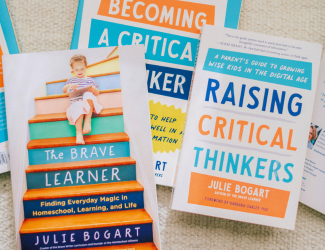
  • Find “Becoming a Critical Thinker” in the Brave Writer Book Shop.
  • Check out all class descriptions here. 
  • Take a look at the Braver Writer fall class schedule. 
  • Sign up for Brave Writer 101. 
  • Sign up for our Text Message Pod Ring to get podcast updates and more!
  • Send us podcast topic ideas by texting us: +1 (833) 947-3684

Connect with Julie

  • Instagram: @juliebogartwriter
  • Threads: @juliebogartwriter
  • Twitter: @bravewriter
  • Facebook: facebook.com/bravewriter

Connect with Melissa

  • Website: melissawiley.com
  • Substack: melissawiley.substack.com
  • Instagram: @melissawileybooks
  • Twitter: @melissawiley

Produced by NOVA Media

Brave Writer Podcast

Posted in Podcasts | Comments Off on [Podcast #253] Literary Analysis & Writer’s Craft

[Podcast #252] The GPS of Writing: Grammar, Punctuation, and Spelling

Brave Writer Podcast

Welcome to today’s Brave Writer podcast! Since Julie is taking a short break to focus on her newest book, we’re replacing our typical podcast with a broadcast of her webinar, The GPS of Writing: Grammar, Punctuation, and Spelling.

Throughout this episode, Julie weaves a metaphor for grammar, punctuation, and spelling.

  • Grammar is the rules of the word-party.
  • Punctuation is the decorator and bouncer.
  • Spelling is the personal stylist!

Most importantly, Julie reminds anxious parents that, at the end of the day, what children really need to learn is how grammar, punctuation, and spelling serve their self expression. It’s not about memorizing rules or being perfect. It’s about repeated exposure to meaningful experiences with living literature.

Show Notes

Grammar

Grammar is the rules of a word party. It sets the expectations. If the readers are schoolteachers and grandmothers, the rules of the party will be more straightlaced. If the readers are the general public, the rules of the party will be generic. If the readers are people who can deeply relate to you personally, the rules will be more lax.

Punctuation

Punctuation is the party decorator and bouncer. It adds an extra layer of meaning to the party and controls the ambiance. Periods say “let’s stay put together, people.” Commas say “take a breath.” Exclamation points are like clapping loudly.

Spelling

To wrap up the metaphor, spelling is the personal stylist. It makes sure all the words are looking their best. Misspellings are like spinach stuck in your teeth or a mascara smudge–they’re not the end of the world, but they can be a little distracting.

This kind of metaphor helps adults and kids embody grammar, punctuation, and spelling. Embodiment of these tools, rather than memorization of rules, is at the heart of the Brave Writer curriculum. Through repeated exposure to meaningful experiences with living literature, your kids can truly learn how to write well.

Resources

  • Start a free trial of CTCmath.com to try the math program that’s sure to grab and keep your child’s attention.
  • Don’t miss Fall Class Registration. Full class descriptions here.
  • Check out the 2024-2025 Brave Writer Mechanics and Literature Programs.
  • You can find “Charlotte’s Web” and other books in the Brave Writer Book Shop.
  • Get free samples of our Brave Writer products.
  • Want the digital Brave Writer products professionally printed and quickly shipped to your home? Order physical copies from The Homeschool Printing Company.
  • Sign up for our Text Message Pod Ring to get podcast updates and more!
  • Send us podcast topic ideas by texting us: +1 (833) 947-3684

Connect with Julie

  • Instagram: @juliebogartwriter
  • Threads: @juliebogartwriter
  • Twitter: @bravewriter
  • Facebook: facebook.com/bravewriter

Connect with Melissa

  • Website: melissawiley.com
  • Substack: melissawiley.substack.com
  • Instagram: @melissawileybooks
  • Twitter: @melissawiley

Produced by NOVA Media

Brave Writer Podcast

Posted in Podcasts | Comments Off on [Podcast #252] The GPS of Writing: Grammar, Punctuation, and Spelling

[Podcast #251] The Joy of Slow with Leslie Martino

Brave Writer Podcast Joy of Slow

Once you view time as a gift to be savored, you can start to naturally exchange agendas for rhythms and arbitrary expectations for deep learning. This is one of the takeaway messages from The Joy of Slow: Restoring Balance and Wonder to Homeschool Learning, a book by experienced homeschooling mom Leslie Martino.

Leslie is our guest on the Brave Writer podcast today. She earned bachelor and master’s degrees in education from Columbia University, taught as an elementary school teacher, and now homeschools her four kids, ages 10-14. Her book is a meditation on the joy of slow as well as a how-to guide for homeschooling families.

Leslie Martino
Leslie Martino

In our conversation today, we dive into:

  • creating time and space for critical reflection,
  • the importance of depth over breadth,
  • and savoring joyful connection with our loved ones.

If you’ve been feeling overwhelmed by the question, “Are my kids learning fast enough?” this episode will (hopefully) bring a little peace and calm to your soul.

Show Notes

Making Time for Critical Reflection

As homeschooling parents, often we’re good at guiding our kids through empathetic self-criticism and using mistakes as a positive impetus for growth, but we’re terrible at applying it to ourselves. The pressure to give our kids a good foundation for life can overtake us. In her book, Leslie reminds parents that slowing down is worth it. Mistakes and re-dos are invaluable for deep learning, if you take the time to reflect and adjust.

Depth over Breadth

Letting your kid become an obsessed little ornithologist or budding architect is okay, even if that means other subjects take a back seat from time to time. Leslie highlights the importance of letting your child have some say in what they are learning, because passion leads to curiosity and critical thinking. Plus, if the birder and builder are in the same family, they will end up learning about each others’ topics of interest because passionate kids are the most aggressive teachers (in a good way). 

Savoring Joyful Connections

One of Leslie’s points of emphasis is developing a meaningful relationship with your child. The connective tissue of relationships is sharing experiences, especially navigating mistakes and challenges together in a healthy way. It’s not that speed is evil, but taking your time can be more important when developing these lifelong connections. 

Resources

  • Start a free trial of CTCmath.com to try the math program that’s sure to grab and keep your child’s attention.
  • Don’t miss Fall Class Registration. Full class descriptions here.
  • Find “The Joy of Slow” in the Brave Writer Book Shop
  • Check out Leslie’s webinar at Brave Learner Home
  • Learn more at Leslie’s website: LeslieMartino.com/
  • Follow Leslie on Instagram: @lesliemmartino
  • Sign up for our Text Message Pod Ring to get podcast updates and more!
  • Send us podcast topic ideas by texting us: +1 (833) 947-3684

Connect with Julie

  • Instagram: @juliebogartwriter
  • Threads: @juliebogartwriter
  • Twitter: @bravewriter
  • Facebook: facebook.com/bravewriter

Connect with Melissa

  • Website: melissawiley.com
  • Substack: melissawiley.substack.com
  • Instagram: @melissawileybooks
  • Twitter: @melissawiley

Produced by NOVA Media

Brave Writer Podcast

Posted in Podcasts | Comments Off on [Podcast #251] The Joy of Slow with Leslie Martino

[Podcast #250] Reading Aloud: Why Teach Writing Mechanics with Living Literature?

Brave Writer Podcast Reading Aloud

What is living literature? What does it have to do with teaching your kids grammar and spelling?

Today’s podcast episode is a recording of Julie’s webinar where she explains the heart of Brave Writer’s approach to teaching writing.

Julie talks about how immersion in rich, powerful literature is the best way to teach your child writing mechanics. She outlines the Brave Writer process in six steps:

  1. Parents read aloud.
  2. Students read to themselves.
  3. Students keenly observe what they read and ask investigative questions.
  4. Students test what they know through copywork and dictation.
  5. Students correct their own work.
  6. Students freewrite.

With specific examples and colorful anecdotes, Julie dives into the details for each step. She also breaks them down by program level: The Quill (5-7 year olds), Dart (8-10), Arrow (11-12), Boomerang (13-14), and Slingshot (15-18).

If you’ve been looking for a distillation of what exactly Brave Writer is, this is the episode for you!

Show Notes

1. Reading Aloud

Just like your child learned how to speak from being immersed in your speech, they can learn to write by being immersed in your reading aloud to them. Reading aloud to your child is a way to tune their ear to good writing–that’s why using living literature is so important (and why we’re very picky about what books we use in our Brave Writer programs). Children need to hear high-quality, impactful writing as their own first step on their writing journey.

2. Read to Self

Just like reading aloud to your child tunes their ear, your child reading to themselves tunes their eyes. The next step is for your child to read to themselves. By immersing themselves in this way, they’re training their eyes to recognize what looks like good writing and noticing if something seems off.

3. Keen Observation

The next step is to activate your child more as they read to themselves. Here at Brave Writer we call it “keen observation” and support it in our program with lists of “investigative questions.” For example, students might highlight every question mark they see. Or they may note how the author describes one character versus another.

4. Copywork and Dictation

Now it’s time for the student to take the wheel… by that we mean the pen (or chalk, or marker, etc.). They work on the physical aspect of putting words to paper. When they are very young this might just mean tracing words. Then they may graduate to writing what’s dictated to them. Or reverse dictation exercises. Overall, they’re learning that they can translate thoughts into writing.

5. Self-Correction

Giving students the exercise of catching their own mistakes shows them that they do know writing mechanics even if they aren’t always perfect. It also shows them that editing is a natural part of writing and doesn’t need to feel threatening. Rather than approaching writing as an opportunity to make mistakes, they can approach editing as an opportunity to strengthen what they’re trying to express.

6. Freewriting

The final step in the cycle is freewriting. The goal is just for students to get their thoughts down on paper. This is to help your student become accustomed to writing, analyzing and opining about things around them. The more you can remove the feeling of peril about writing, the better and more joyful the learning process will be for your student.

Of course each of these six steps in the Brave Writer program is adjusted to age groups: The Quill (5-7 year olds), Dart (8-10), Arrow (11-12), Boomerang (13-14), and Slingshot (15-18). But the fundamental premise remains the same: Using living literature is the best way to teach writing mechanics.

Resources

  • Start a free trial of CTCmath.com to try the math program that’s sure to grab and keep your child’s attention.
  • Don’t miss Fall Class Registration. Full class descriptions here.
  • Check out the Brave Writer Mechanics and Literature Programs.
  • You can find “Braiding Sweetgrass” and other books in the Brave Writer Book Shop.
  • Get free samples of our Brave Writer products.
  • Want the digital Brave Writer products professionally printed and quickly shipped to your home? Order physical copies from The Homeschool Printing Company.
  • Sign up for our Text Message Pod Ring to get podcast updates and more!
  • Send us podcast topic ideas by texting us: +1 (833) 947-3684.

Connect with Julie

  • Instagram: @juliebogartwriter
  • Threads: @juliebogartwriter
  • Twitter: @bravewriter
  • Facebook: facebook.com/bravewriter

Connect with Melissa

  • Website: melissawiley.com
  • Substack: melissawiley.substack.com
  • Instagram: @melissawileybooks
  • Twitter: @melissawiley

Produced by NOVA Media

Brave Writer Podcast

Posted in Podcasts | Comments Off on [Podcast #250] Reading Aloud: Why Teach Writing Mechanics with Living Literature?

[Podcast #249] Escaping Fundamentalism with Tia Levings

Brave Writer Podcast Tia Levings

Tia Levings was trapped in a high-control religion, experiencing church-sanctioned domestic abuse at the hands of her husband. Her only relief was the Trapdoor Society online message boards where she could discuss big ideas about education and human development.

Years later, she barely escaped with her and her kids’ lives.

Tia Levings
Tia Levings

Tia joins us today on the Brave Writer podcast for an emotional, deeply meaningful episode where we discuss our intertwined stories and her new memoir, A Well-Trained Wife: My Escape from Christian Patriarchy.

Show Notes

Fundamentalism

In Tia’s words, “Fundamentalist thinking is anytime you have a promise that has a formula attached to it, that if you do these steps, you will definitely get this result.” In her particular fundamentalist group, the Quiverfull movement, the formula was complete authority of husbands and strict obedience by wives and children. The promised result was the happiness that comes from living the way God intended. 

Tia identifies this fundamentalism throughout the US government and culture, noting that its goal is to impose this formula on all Americans. 

She also cautions against fundamentalism of any kind. The lived experience is so diverse and nuanced that people must be able to experiment with what works best for them. She encourages parents and educational thought leaders to keep that front and center in their discussions.  

Healing

Upon escape, part of Tia’s healing journey was writing this book. What started out as a therapy journal became a draft of a novel, and then over a decade slowly became a memoir. By the time Tia recorded the audiobook version she finally felt the story was outside of her, that she didn’t have to carry it any more.

Today, Tia practices regulating her nervous system, particularly around feeling rushed. Abusers often pressure their victims to match a certain timeline, rushing them into doing things they aren’t ready or willing to do. That’s why Tia now prioritizes building a life that resists urgency– a new kind of commitment.

You can buy Tia’s memoir here. 

On the back cover, you’ll find praise from Julie:

“With unflinching honesty and relentless self-reflection, Levings’ debut memoir is a portrait in courage. Levings pulls back the curtain on the degraded, carefully lived spiritual life she chose for herself against her better interests. Anyone who has suffered from abuse or an attempt to fit into a spiritual community will recognize her self-abandonment in service of idealism. In the end, Levings saves herself through an equally dedicated commitment to her truth and well-being, at great risk to herself. A well-trained wife serves as the cautionary tale about the power of control and the harm inherent in authoritarian groups, particularly those who claim to speak for God.”

Resources

  • Start a free trial of CTCmath.com to try the math program that’s sure to grab and keep your child’s attention.
  • Don’t miss Fall Class Registration. Full class descriptions here.
  • Check out the Brave Writer Book Shop for Tia’s book and all other books mentioned on our podcast
  • Learn more at TiaLevings.com
  • Follow Tia on Instagram: @tialevings
  • Subscribe to Tia’s Substack, “The AntiFundamentalist” 
  • Watch “Shiny Happy People” on Amazon Prime
  • Sign up for our Text Message Pod Ring to get podcast updates and more!
  • Send us podcast topic ideas by texting us: +1 (833) 947-3684

Connect with Julie

  • Instagram: @juliebogartwriter
  • Threads: @juliebogartwriter
  • Twitter: @bravewriter
  • Facebook: facebook.com/bravewriter

Connect with Melissa

  • Website: melissawiley.com
  • Substack: melissawiley.substack.com
  • Instagram: @melissawileybooks
  • Twitter: @melissawiley

Produced by NOVA Media

Brave Writer Podcast

Posted in Podcasts | Comments Off on [Podcast #249] Escaping Fundamentalism with Tia Levings

« Older Entries
Newer Entries »
  • Search the Blog

  • Julie Bogart
  • Welcome, I’m Julie Bogart.

    I’m a homeschooling alum -17 years, five kids. Now I run Brave Writer, the online writing and language arts program for families. More >>

    IMPORTANT: Please read our Privacy Policy.

  • New to Brave Writer? START HERE

  • FREE Resources

    • 7-Day Writing Blitz
    • Brave Writer Lifestyle Program
    • Brave Writer Sampler: Free Sample Products
    • Freewriting Prompts
    • Podcasts
  • Popular Posts

    • You have time
    • How writing is like sewing
    • Best curriculum for a 6 year old
    • Today's little unspoken homeschool secret
    • Do you like to homeschool?
    • Don't trust the schedule
    • You want to do a good job parenting?
    • If you've got a passel of kids
    • You are not a teacher
    • Natural Stages of Growth in Writing podcasts
  • Blog Topics

    • Brave Learner Home
    • Brave Writer Lifestyle
    • Classes
    • Contests/Giveaways
    • Friday Freewrite
    • High School
    • Homeschool Advice
    • Julie's Life
    • Language Arts
    • Movie Wednesday
    • Natural Stages of Growth
    • One Thing Principle
    • Our Team
    • Parenting
    • Philosophy of Education
    • Podcasts
    • Poetry Teatime
    • Products
    • Reviews
    • Speaking Schedule
    • Students
    • Writing about Writing
    • Young Writers
  • Archives

  • Brave Writer is a participant in the Amazon Services LLC Associates Program, an affiliate advertising program designed to provide a means for sites to earn advertising fees (at no extra cost to you) by advertising and linking to amazon.com

    Content © Brave Writer unless otherwise stated.

What is Brave Writer?

  • Welcome to Brave Writer
  • Why Brave Writer Works
  • About Julie
  • Brave Writer Values
  • Frequently Asked Questions
  • Speaking Schedule

Brave Writer Program

  • Getting Started!
  • Stages of Growth in Writing
  • The Brave Writer Program
  • For Families and Students
  • Online Classes
  • Brave Writer Lifestyle

…and More!

  • Blog
  • Classroom
  • Store
  • Books in Brave Writer Programs
  • Contact Us
  • Customer Service
  • Brave Writer Staff
© 2026 Brave Writer
Privacy Policy
Children's Privacy Policy
Help Center