On Being a Mother Archives - Page 7 of 12 - A Brave Writer's Life in Brief A Brave Writer's Life in Brief
  • Start Here
    • For Families
      Multiple Ages
    • Ages 5-7
      Beginning Writers
    • Ages 8-10
      Emerging Writers
    • Ages 11-12
      Middle School Writers
    • Ages 13-14
      High School Writers
    • Ages 15-18
      College Prep Writers
  • Shop
    • Product Collections
    • Bundles
    • Writing Instruction Manuals
    • Literature & Grammar/Punctuation
    • Composition Formats
    • Literature Singles
    • Homeschool Help
    • Book Shop
    • Special Offers
  • Online Classes
    • Class Descriptions
    • Class Schedule
    • Classroom
    • How Our Classes Work
    • Our Writing Coaches
    • Classes FAQ
  • Community
    • Brave Learner Home
    • What’s Happening
    • Blog
    • Podcast
    • Calendar
    • Brave Writer Lifestyle
  • Cart
  • My Account
    • My Online Classes
    • My Account
  • My Account
    • My Online Classes
    • My Account
  • Start Here

    If you’re new to Brave Writer, or are looking for the best products for your child or family, choose from below:

    • For Families
      Multiple Ages
    • Ages 5-7
      Beginning Writers
    • Ages 8-10
      Emerging Writers
    • Ages 11-12
      Middle School Writers
    • Ages 13-14
      High School Writers
    • Ages 15-18
      College Prep Writers
  • Shop

    If you’re already familiar with Brave Writer products, go directly to what you’re looking for:

    • Product Collections Browse the full catalog in our shop
    • Bundles Everything you need to get started
    • Writing Instruction Manuals Foundational Writing Programs
    • Literature & Grammar/Punctuation Grammar, Punctuation, Spelling & Literary Devices
    • Composition Formats Writing Assignments for Every Age
    • Literature Singles Individual Literature Handbooks
    • Homeschool Help Homeschooling Tools and Resources
    • Book Shop Books associated with Brave Writer Programs
    • Special Offers
  • Online Classes
    • Class Descriptions
    • Class Schedule
    • Classroom
    • How Our Classes Work
    • Our Writing Coaches
    • Classes FAQ
  • Community
    • Brave Learner Home
    • What’s Happening
    • Blog
    • Podcast
    • Calendar
    • Brave Writer Lifestyle
  • Search
  • Cart

Search Bravewriter.com

  • Home
  • Blog

A Brave Writer's Life in Brief

Thoughts from my home to yours

Archive for the ‘On Being a Mother’ Category

« Older Entries
Newer Entries »

Are you a Type A mom?

People First

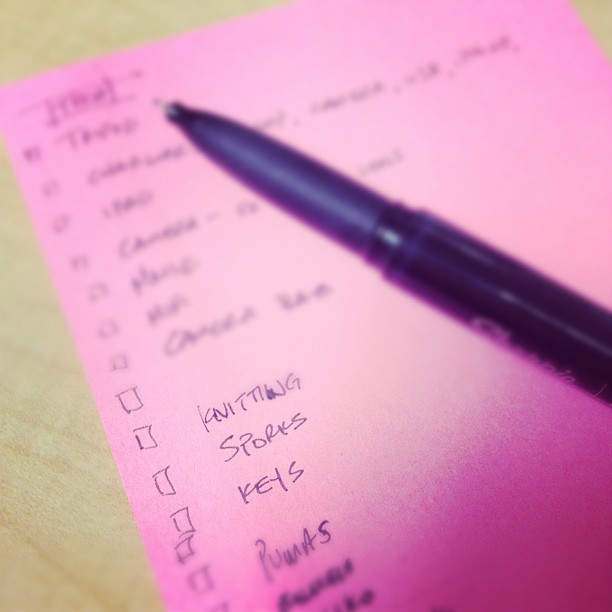
Do you find it difficult to operate without a checklist? Do you find yourself worried about getting it all done?

On the flip side, do you wish you could be more relaxed, but each time you try, the anxiety rises and you don’t quite relax?

It’s difficult to battle who you are—how you naturally interact with the world. Messy people buy the manuals of the naturally organized thinking they can change if they just have a system. Type A parents want to find a way to relax without feeling like they are lazy.

I say: Work with whatchu got! It’s too hard to do a personality-ectomy! Better to suit your aims to your style.

For instance, if you want to be a more relaxed mom—one who puts the warm fuzzies ahead of the workbooks, change the checklist. See if that helps.

Self-awareness is the first step. Each time you are tempted to push your kids toward what feels like work rather than delight, breathe. Feel your face. Are you smiling? Are your brows furrowing? Get back to connection with your children. Measure your day (checklist) with a new “Type A” criteria.

Check these off as you do them:

__ Hugged each kid

__ Made eye contact with one and had a conversation for 3 minutes

__ Asked questions of my quiet child to find out more about her process, not her work completed.

__ Played a game.

__ Took a walk.

__ Cultivated silliness (silly voice, body, jokes, puns, dance moves).

__ Put on music.

__ Smiled at my children, each one, at least once.

__ Gave 5 compliments.

__ Ate tasty foods and noticed the flavors.

__ Let everyone stop “working” sooner than they expected.

__ Did someone’s task for them.

__ Sat next to my child during her hardest subject until she finished it, offering encouragements.

__ Gave myself and kids permission to NOT do a boring chapter of the workbook.

__ Left a mess so my children could return to it later to finish the art project or the Lego build or the play fort.

What if you had a check list like that? Would that help you be a Type A mom who is also more fun?

Try that for a couple of days and see if you find a new groove for your careful personality—one that measures and values connection, over work completed. (You are likely to still get all the work done – that’s who you are! But now you’ll make room for the other stuff you wish you would do more spontaneously.)

Good luck!

A Gracious Space

Image by Betsy Weber (cc)

Posted in Homeschool Advice, On Being a Mother | 1 Comment »

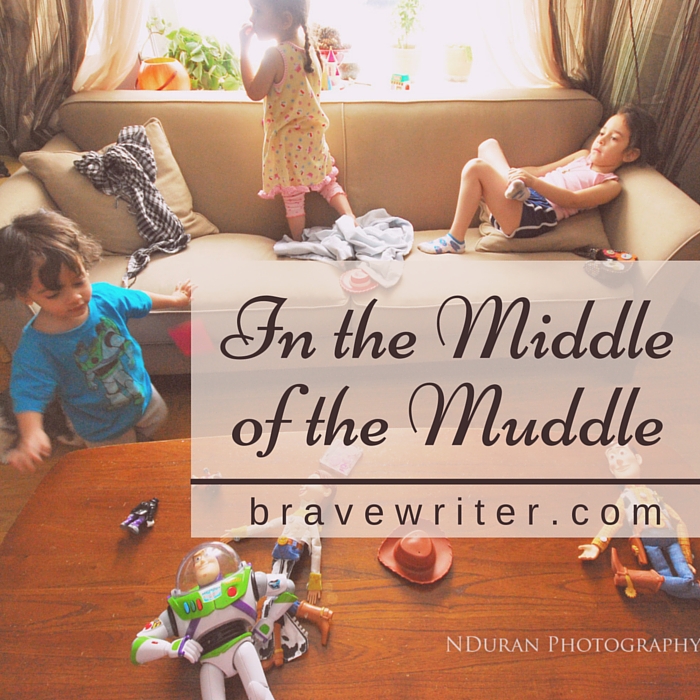
In the Middle of the Muddle

In the middle of the muddle

I had a conversation with Joanna in private message after I posted about my dislike of the word “obedience” in parenting. It was fruitful. I told her that I like hearing from mothers who are “in the middle of the muddle,” because it’s too easy for mothers with older kids (like me) removed from those toddler years to get a bit glassy-eyed about those struggles.

Here’s one of her comments:

“You’re right, I am in the “middle of the muddle” (I like that) — I have five kids, 3-14 (straddling preschool to 8th grade). I think you do an amazing job “remembering” motherhood, but yes… perhaps the earliest years are pleasantly fuzzy, those years when any mom will tell you that a battle of wills is just par for the course. It’s being patient and empathetic in the midst of it that makes the difference, I think. Tonight, in our house, it was “I want to go bed without brushing my teeth.” Well, it’s not a matter of impossibility, danger or hurting someone else… but the answer is still “no” and I didn’t feel badly about that. There was a short melt-down before he came around (this time the tactic was distraction… Blueberries for Sal awaits, hurry!).

“This is the thing… if I thought that his meltdown was evidence that I hadn’t adequately built a bridge of trust, I would feel condemned — just as condemned as if I felt it was due to my unfaithfulness with “the rod.” I think part of sensible little-kid parenting is just embracing that sometimes (lots of times, because preschoolers excel at making requests/demands) you have to say no, that sometimes your sweetheart will be angry/devastated as a result, that sometimes your wills will clash, but that at the end of the day, love can win and you can come out friends. I love the vision you communicate of coming alongside, of coaching, of understanding and empathizing and saying “yes.” I think it works with older kids and I think it works with schooling. I’m just concerned that it has the potential to create more condemnation when applied (without qualification) to little ones — and I know that’s the farthest thing from your heart.”

I responded to her and want to develop those thoughts.

The key is being mindful and attentive.

I don’t know what you’re like in your home, but what you share here is careful and kind. I agree about the love covering the “no’s.”

One of the things I had to learn (as a highly empathetic mother) was how to support a child in taking greater and greater responsibility. What happens for less empathetic parents is they have to learn how to let go of more and more control.

These are the two axes of mothering—either too much “control” or too much “understanding.”

One of the tricky parts of reading about parenting is the tendency of all the advocates of any one style to act as though a “pure” system will cover all personalities and family dynamics. That turns out not to be true.

What works is to be attentive, to be willing to be wrong, to trust your hunches, to at times let things go (after a day at Disneyland with a burnt out child, skipping the toothbrushing is not a big deal one night), to support consistent practice to develop a habit (expecting toothbrushing most every night and finding a way to help that happen)… Parents offer strength (the backbone of good practices) and tenderness (the compassion for childishness and the perspective of maturity).

That balance is one that gets tweaked throughout childhood.

I like to recommend that everyone start with compassion—getting behind the eyes of the child to see the world as that child is currently seeing it. This takes a pause – you have to stop your own racing thoughts to enter into that empty space of observation, without prejudgment.

Once you are there, it’s easier to see what the child needs and what your role should be. If your heart is pounding and you feel anger rising, you are not there yet.

But even when you are being the backbone on behalf of a child who is struggling to take ownership of his responsibilities (no matter how big or small these are), you can be kind.

“We’re going to register for the ACT test now. I’m standing here until you open the browser and I see you logging in.”

That’s different than anger shouted from another room:

“Hey I told you six times to register for the ACT. The deadline is today. I’m not paying for that late fee. It will come out of your paycheck. Now stop that darned game and register!”

Empathy helps you to keep your attitude in check—to realize that childishness (even in big kids!) runs against emerging personal responsibility. You can remember this feeling, if you tap into it. That helps you determine how you will support the growth necessary without caving (“Here, I’ll do it for you”) versus punishment (“You can’t have the car this weekend if you don’t do it”).

Even small children benefit from this kind of empathy + backbone strategy.

“Toothbrushing happens every night. Sometimes we’re going to go into the bathroom singing and laughing and sometimes I may have to carry you in. But I promise to be gentle with your teeth and as soon as you get the hang of it, you can do it all by yourself.”

These ideas all factor heavily into both homeschooling and the teaching of writing, by the way.


The Homeschool Alliance
Image by Nori (cc tinted, text added)

Posted in Homeschool Advice, Julie's Life, On Being a Mother | 1 Comment »

Love who you are

Love who you are

Have you noticed how easy it is to wish away your chief personality features? Do you think to yourself, “I’m the wrong personality for my temperament”? You might wish for a clean, orderly home in your heart, but your personality style is relaxed Bohemian. Or you are the sort who keeps a ship-shape house, but wish you could relax when your kids make big creative messes.

Layered on top of the structured versus unstructured selves we bring to homeschool are our memories of school. We compare what we do at home (even when we don’t want to) to what we experienced as children. We react against it (“I’m not doing that!) or we we suffer because of it (“I’m not teaching my kids anything”).

The temptation to overhaul our essential selves is powerful. Advertising everywhere tells us we are one tweak away from being the fantasy person in our heads. We may be able to resist Botox or Coach purses, but the seductress for home educators is any “method” that results in effortless, joyful learning where parents and kids get along all the time.

We hop from one program to the next like frogs on lily pads forgetting to consider which personality is implementing the philosophy!

Let me let you in on a little secret.

There’s no one personality type that is better for homeschooling than another.

Let me drill down further.

There’s no one personality type that is better for parenting, loving, nurturing than another.

Every type has its marvelous strengths, and (darn it all) each type has its blind spots and liabilities.

What you and I need to do is to become self aware people—able to recognize when our personalities are creating the hum of happiness and productivity, and when they are sapping the energy from the room and causing pain.

It isn’t always better to have a messy or a neat house.

Sometimes waking up to a clear kitchen table, fluffed pillows, books easy to access, and a freshly vacuumed carpet is the most nurturing way to start the day. If, however, the process of getting there ended an art project or removed a Robin Hood fort still lingering in the minds of your kids as they went to bed, the same cleared space in the morning may now feel like robbery:

“Where did you put my art project?”

“Do I really have to get out all the blankets again for my fort?”

The question to ask yourself as you move through the day isn’t “How can I be more relaxed?” or “How can I be more productive?”

You want to ask yourself a single question:

“How can I best serve this moment?”

I remember when I went to graduate school, I had just begun our unschooling experiment. It was a study in contrasts. I was being educated by highly trained academics with lectures, a syllabus, reading schedule, essay assignments, and tests. My kids were free to explore the world without any hindrance.

Or so I thought.

Love who you are

What became apparent to me after a semester surprised me. I loved graduate school. It felt nurturing to have someone care enough to create lessons, to show me what I should read to get a full view of the subject, to dialog with me from a position of investment and knowledge. I liked having a plan and a schedule. I felt relief. I had studied the subject area for five years on my own, and now I felt this surge of strength that came from guidance and support.

Meanwhile, the structures I had used in homeschool were on hold. I wanted my kids to feel free to learn what they wanted, to investigate any topic to their hearts’ content. A couple of them took off! But two floundered. They felt (strangely enough) unloved. They wouldn’t have used that language but in hindsight that’s what it was. They felt connected to me when I took the time to plan their lessons and guide their education. They lost that connection when I gave them “freedom.”

I spent hours on unschooling lists learning how to create the context, how to support an unschooling lifestyle, how to foster and nurture a rich learning environment. I didn’t “abandon” my kids to doing whatever they wanted unsupervised. Nevertheless, two of my children missed planned lessons and a structure for learning. I understood this because I was having a parallel experience in grad school.

What becomes so difficult to tease apart as a home educator is the idealized vision of learning that dances in our heads like sugar plums and the very real home and family we have. Our job isn’t to be more organized or more relaxed, more structured or completely free of structure.

Our job is to serve the moment—to serve the needs of our families from within the framework of our delightful personalities.

We can do that best when we lean into our strengths.

If you’re an orderly person, create happy order. Avoid the temptation to require everyone to be like you. Resist your tendency to nag or to have your feelings hurt when the rest of your gang is unenthusiastic for kitchen duty or keeping tables cleared. Straighten, file, assemble check lists, keep the sink empty, make the beds, plan the day. Enthusiastically offer your talent for creating a clean, peaceful, orderly, neat space to the family as a gift.

If you’re a relaxed, go-with-the-flow mom, stop pummeling your personality. Your home is cozy, it’s alive with activity, and it supports messes without stress. Keep big containers nearby for quick clean-ups, make a loose routine to follow each day (rather than a schedule), allow your kids who need order to create systems to support you and the family. Smile.

Do not worry that you aren’t getting enough done in either system or style. Focus on this moment. What is happening right now? How can I help it become a good moment? Shall I ease up and let the mess grow? Shall I hunker down and clear the space so something new can be born? Are we getting along and growing?

Above all: no system saves you. You will eventually go back to being who you are. Your job is to be the best you, you can be. Be the you that creates love and learning, not the you that worries and frets or ignores and pretends away.

You can even say to your kids in a moment of frazzledness:

“You know me! I need everything cleaned up before I can think straight. Anyone willing to help me so we get the day off to a good start? My brain is about to fall out of my head when I see shoes scattered everywhere. Cookies to the helpers!”

Or

“You know me! I can’t put a week-long system together for the life of me. Let’s make a quick list for today of things we want to study and do, and then put them in an order. Who wants to make the list with me? If today feels good, we can do it again tomorrow. Let’s eat cookies while we discuss.”

See? The goal isn’t to “reform” who you are and how you are. The goal is to be the best of yourself that you can be, acknowledging that within your strengths and weaknesses is a real human being doing the best she can. Your kids want to help you and they want to be themselves too.

They’ll learn to love who they are in direct proportion

to how well you love who you are.

Go forth and love yourself.

Posted in Brave Writer Philosophy, Homeschool Advice, Julie's Life, On Being a Mother, Unschooling | 16 Comments »

« Older Entries
Newer Entries »
  • Search the Blog

  • Julie Bogart
  • Welcome, I’m Julie Bogart.

    I’m a homeschooling alum -17 years, five kids. Now I run Brave Writer, the online writing and language arts program for families. More >>

    IMPORTANT: Please read our Privacy Policy.

  • New to Brave Writer? START HERE

  • FREE Resources

    • 7-Day Writing Blitz
    • Brave Writer Lifestyle Program
    • Brave Writer Sampler: Free Sample Products
    • Freewriting Prompts
    • Podcasts
  • Popular Posts

    • You have time
    • How writing is like sewing
    • Best curriculum for a 6 year old
    • Today's little unspoken homeschool secret
    • Do you like to homeschool?
    • Don't trust the schedule
    • You want to do a good job parenting?
    • If you've got a passel of kids
    • You are not a teacher
    • Natural Stages of Growth in Writing podcasts
  • Blog Topics

    • Brave Learner Home
    • Brave Writer Lifestyle
    • Classes
    • Contests/Giveaways
    • Friday Freewrite
    • High School
    • Homeschool Advice
    • Julie's Life
    • Language Arts
    • Movie Wednesday
    • Natural Stages of Growth
    • One Thing Principle
    • Our Team
    • Parenting
    • Philosophy of Education
    • Podcasts
    • Poetry Teatime
    • Products
    • Reviews
    • Speaking Schedule
    • Students
    • Writing about Writing
    • Young Writers
  • Archives

  • Brave Writer is a participant in the Amazon Services LLC Associates Program, an affiliate advertising program designed to provide a means for sites to earn advertising fees (at no extra cost to you) by advertising and linking to amazon.com

    Content © Brave Writer unless otherwise stated.

What is Brave Writer?

  • Welcome to Brave Writer
  • Why Brave Writer Works
  • About Julie
  • Brave Writer Values
  • Frequently Asked Questions
  • Speaking Schedule

Brave Writer Program

  • Getting Started!
  • Stages of Growth in Writing
  • The Brave Writer Program
  • For Families and Students
  • Online Classes
  • Brave Writer Lifestyle

…and More!

  • Blog
  • Classroom
  • Store
  • Books in Brave Writer Programs
  • Contact Us
  • Customer Service
  • Brave Writer Staff
© 2026 Brave Writer
Privacy Policy
Children's Privacy Policy
Help Center