
On Being a Mother Archives - Page 5 of 8 - A Brave Writer's Life in Brief A Brave Writer's Life in Brief
  • Start Here
    • For Families
      Multiple Ages
    • Ages 5-7
      Beginning Writers
    • Ages 8-10
      Emerging Writers
    • Ages 11-12
      Middle School Writers
    • Ages 13-14
      High School Writers
    • Ages 15-18
      College Prep Writers
  • Shop
    • Product Collections
    • Bundles
    • Writing Instruction Manuals
    • Literature & Grammar/Punctuation
    • Composition Formats
    • Literature Singles
    • Homeschool Help
    • Book Shop
  • Online Classes
    • Class Descriptions
    • Class Schedule
    • Classroom
    • How Our Classes Work
    • Our Writing Coaches
    • Classes FAQ
  • Community
    • Brave Learner Home
    • What’s Happening
    • Blog
    • Podcast
    • Calendar
  • Cart
  • My Account
    • My Online Classes
    • My Account
  • My Account
    • My Online Classes
    • My Account
  • Start Here

    If you’re new to Brave Writer, or are looking for the best products for your child or family, choose from below:

    • For Families
      Multiple Ages
    • Ages 5-7
      Beginning Writers
    • Ages 8-10
      Emerging Writers
    • Ages 11-12
      Middle School Writers
    • Ages 13-14
      High School Writers
    • Ages 15-18
      College Prep Writers
  • Shop

    If you’re already familiar with Brave Writer products, go directly to what you’re looking for:

    • Product Collections Browse the full catalog in our shop
    • Bundles Everything you need to get started
    • Writing Instruction Manuals Foundational Writing Programs
    • Literature & Grammar/Punctuation Grammar, Punctuation, Spelling & Literary Devices
    • Composition Formats Writing Assignments for Every Age
    • Literature Singles Individual Literature Handbooks
    • Homeschool Help Homeschooling Tools and Resources
    • Book Shop Books associated with Brave Writer Programs
  • Online Classes
    • Class Descriptions
    • Class Schedule
    • Classroom
    • How Our Classes Work
    • Our Writing Coaches
    • Classes FAQ
  • Community
    • Brave Learner Home
    • What’s Happening
    • Blog
    • Podcast
    • Calendar
  • Search
  • Cart

Search Bravewriter.com

  • Home
  • Blog

A Brave Writer's Life in Brief

Thoughts from my home to yours

Archive for the ‘On Being a Mother’ Category

« Older Entries
Newer Entries »

Love who you are

Love who you are

Have you noticed how easy it is to wish away your chief personality features? Do you think to yourself, “I’m the wrong personality for my temperament”? You might wish for a clean, orderly home in your heart, but your personality style is relaxed Bohemian. Or you are the sort who keeps a ship-shape house, but wish you could relax when your kids make big creative messes.

Layered on top of the structured versus unstructured selves we bring to homeschool are our memories of school. We compare what we do at home (even when we don’t want to) to what we experienced as children. We react against it (“I’m not doing that!) or we we suffer because of it (“I’m not teaching my kids anything”).

The temptation to overhaul our essential selves is powerful. Advertising everywhere tells us we are one tweak away from being the fantasy person in our heads. We may be able to resist Botox or Coach purses, but the seductress for home educators is any “method” that results in effortless, joyful learning where parents and kids get along all the time.

We hop from one program to the next like frogs on lily pads forgetting to consider which personality is implementing the philosophy!

Let me let you in on a little secret.

There’s no one personality type that is better for homeschooling than another.

Let me drill down further.

There’s no one personality type that is better for parenting, loving, nurturing than another.

Every type has its marvelous strengths, and (darn it all) each type has its blind spots and liabilities.

What you and I need to do is to become self aware people—able to recognize when our personalities are creating the hum of happiness and productivity, and when they are sapping the energy from the room and causing pain.

It isn’t always better to have a messy or a neat house.

Sometimes waking up to a clear kitchen table, fluffed pillows, books easy to access, and a freshly vacuumed carpet is the most nurturing way to start the day. If, however, the process of getting there ended an art project or removed a Robin Hood fort still lingering in the minds of your kids as they went to bed, the same cleared space in the morning may now feel like robbery:

“Where did you put my art project?”

“Do I really have to get out all the blankets again for my fort?”

The question to ask yourself as you move through the day isn’t “How can I be more relaxed?” or “How can I be more productive?”

You want to ask yourself a single question:

“How can I best serve this moment?”

I remember when I went to graduate school, I had just begun our unschooling experiment. It was a study in contrasts. I was being educated by highly trained academics with lectures, a syllabus, reading schedule, essay assignments, and tests. My kids were free to explore the world without any hindrance.

Or so I thought.
Love who you are

What became apparent to me after a semester surprised me. I loved graduate school. It felt nurturing to have someone care enough to create lessons, to show me what I should read to get a full view of the subject, to dialog with me from a position of investment and knowledge. I liked having a plan and a schedule. I felt relief. I had studied the subject area for five years on my own, and now I felt this surge of strength that came from guidance and support.

Meanwhile, the structures I had used in homeschool were on hold. I wanted my kids to feel free to learn what they wanted, to investigate any topic to their hearts’ content. A couple of them took off! But two floundered. They felt (strangely enough) unloved. They wouldn’t have used that language but in hindsight that’s what it was. They felt connected to me when I took the time to plan their lessons and guide their education. They lost that connection when I gave them “freedom.”

I spent hours on unschooling lists learning how to create the context, how to support an unschooling lifestyle, how to foster and nurture a rich learning environment. I didn’t “abandon” my kids to doing whatever they wanted unsupervised. Nevertheless, two of my children missed planned lessons and a structure for learning. I understood this because I was having a parallel experience in grad school.

What becomes so difficult to tease apart as a home educator is the idealized vision of learning that dances in our heads like sugar plums and the very real home and family we have. Our job isn’t to be more organized or more relaxed, more structured or completely free of structure.

Our job is to serve the moment—to serve the needs of our families from within the framework of our delightful personalities.

We can do that best when we lean into our strengths.

If you’re an orderly person, create happy order. Avoid the temptation to require everyone to be like you. Resist your tendency to nag or to have your feelings hurt when the rest of your gang is unenthusiastic for kitchen duty or keeping tables cleared. Straighten, file, assemble check lists, keep the sink empty, make the beds, plan the day. Enthusiastically offer your talent for creating a clean, peaceful, orderly, neat space to the family as a gift.

If you’re a relaxed, go-with-the-flow mom, stop pummeling your personality. Your home is cozy, it’s alive with activity, and it supports messes without stress. Keep big containers nearby for quick clean-ups, make a loose routine to follow each day (rather than a schedule), allow your kids who need order to create systems to support you and the family. Smile.

Do not worry that you aren’t getting enough done in either system or style. Focus on this moment. What is happening right now? How can I help it become a good moment? Shall I ease up and let the mess grow? Shall I hunker down and clear the space so something new can be born? Are we getting along and growing?

Above all: no system saves you. You will eventually go back to being who you are. Your job is to be the best you, you can be. Be the you that creates love and learning, not the you that worries and frets or ignores and pretends away.

You can even say to your kids in a moment of frazzledness:

“You know me! I need everything cleaned up before I can think straight. Anyone willing to help me so we get the day off to a good start? My brain is about to fall out of my head when I see shoes scattered everywhere. Cookies to the helpers!”

Or

“You know me! I can’t put a week-long system together for the life of me. Let’s make a quick list for today of things we want to study and do, and then put them in an order. Who wants to make the list with me? If today feels good, we can do it again tomorrow. Let’s eat cookies while we discuss.”

See? The goal isn’t to “reform” who you are and how you are. The goal is to be the best of yourself that you can be, acknowledging that within your strengths and weaknesses is a real human being doing the best she can. Your kids want to help you and they want to be themselves too.

They’ll learn to love who they are in direct proportion

to how well you love who you are.

Go forth and love yourself.
Posted in Brave Writer Philosophy, Homeschool Advice, Julie's Life, On Being a Mother, Unschooling | 16 Comments »

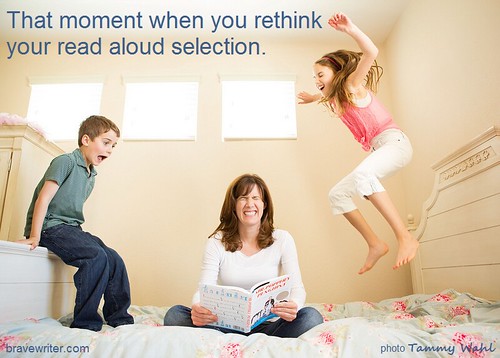
Read aloud time!

Read Aloud Time

Image by Tammy Wahl. Used with permission.

Posted in On Being a Mother, Reading | Comments Off on Read aloud time!

Mother’s Day is around the corner

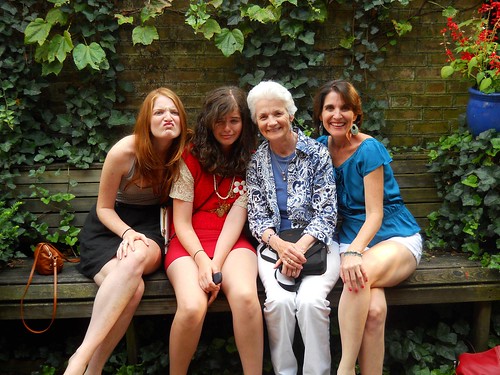
Three GenerationsLeft to right: my daughters Johannah and Caitrin, my mom, and me

So I’m thinking about mothers.

I remember sitting at United Dairy Farmers eating mint chip ice cream with a bunch of my homeschooling friends after support group one night. Someone made a comment about her mother. A derisive one. A “we all know this is true” kind of off-the-cuff critique. It was made with warmth and humor, though the sentiment of frustration was real.

What followed was a cascade of “knowing” remarks about our mothers.

“She’s so controlling.”

“She never did approve of homeschooling so I just try not to talk about it.”

“My mother—she still doesn’t get it.”

“My mom treats me like I’m fifteen! It’s like I never grew up.”

On and on the comments went. Most of the time there was laughter, but behind the laughs I knew there was pain. These daughters had memories of not being heard or understood. They had ongoing evidence that the choices they were making today didn’t meet with their mother’s approval. Ouch. Even if the daughters loved their moms (and they did, absolutely!), they still felt that sting that comes from parental disapproval.

I listened along. The conversation shifted at one point to kids. Now we were griping good-naturedly about how our kids were making ridiculous choices or were resisting our better ideas or couldn’t fulfill their responsibilities and we were put upon to do things for them.

In one of those “Matrix-style” moments, I saw reality split.

We were mothers, resenting our mothers, for not allowing us to make our own choices, for not respecting our skill to live our own lives, for thinking they knew better than we did all the time, and for conveying it in a way that caused pain.

On the flip side, our kids were behaving in ways that we didn’t like and had plans for the future we found unnerving and they didn’t like our advice. We were belittling our kids among ourselves… which made me wonder if that belittlement wasn’t also felt by those same kids, like these adults felt about their own childhoods.

After some time went by, I finally spoke up.

“You know, I hope our kids don’t talk about us the way we just talked about our moms. And I hope we don’t behave to our kids in the ways we resent in our moms.”

Of course, I have a really awesome mom. I don’t spend much time resenting or talking negatively about her. She modeled for me what it means to be supportive and to trust me, and she gives space for me to be who I need to be. I feel like an adult around her. Consequently, I try to be that for my kids because I want them saying good stuff about me to their friends.

So as Mother’s Day approaches, maybe ask yourself: “How do I want my kids to talk about me behind my back?” And then adjust how you mother and love accordingly.

Cross-posted on facebook.

Posted in Julie's Life, On Being a Mother | 1 Comment »

Self-care: Part Two

Laying on Grass

Image by RelaxingMusic

Self-care is essential to the happy functioning of your family.

Self-care is not, however, ensuring that everyone in your family is behaving according to your plans and standards so that you can finally have a rest.

Self-care happens in the middle of the muddle, when things are at their most stressful, when you feel the least capable of meeting your own expectations and hopes. That frazzled feeling? A flashing red warning light that you need to take a self-appointed time out.

Check your body:

  • your jaw,
  • your neck,
  • your shoulders,
  • your brow,
  • your temples.

Tense?

Check your energy level:

  • ordinary tasks sound overwhelming,
  • resentment toward those around you for not cooperating with your plan for their lives,
  • bored,
  • frustrated,
  • listless.

Spent?

A few principles will help you get what you need:

1) Stop requiring others to meet your expectations for them. It’s hard to do, but it helps once you get the hang of it. This looks like letting go of your idealized vision of your child or partner, and accepting the person in front of you as that person is.

Today, you can practice by withholding suggestions. Make no behavior suggestions for the whole day. If a toddler or too young child needs some guidance to avoid certain death or vandalism, step in wordlessly and help. Take judgment, nudging, guilting, and shaming out of today’s vocabulary.

2) Stop matching your home to a picture in your head. Focus on the home in front of your eyes. Make one or two adjustments to what you see that bring you pleasure when you see them. Move a sofa, vacuum behind it, change the pillows, add a vase of flowers. In the midst of the mess, make one or two positive changes to the home rather than wishing you had time to overhaul the whole space.

3) Call a spade a spade. Don’t forgive so easily. If you are wounded by words (from a child, from a spouse), say so. Show your hurt or pain, don’t swallow it. Say it with feeling words, “I feel unimportant to you when you say…” or “I feel sad, bad, mad when you say…” or “I feel taken for granted when…”

There are even times when a shout as response is perfectly appropriate: “Hey! Stop that! That hurts!” or “I don’t like that! I feel used/mistreated/taken advantage of when you do/say/yell that!”

The biggest source of “energy drain” in anyone’s life is pretending that things are okay when they really really really are not. Stop pretending.

4) Ask for help. People love to be valuable. Ask for help sincerely, not to guilt anyone. Ask a family member that drives to go get you your favorite drink or to pick up bath salts. Ask your oldest child to run herd on the rest of the kids while you take 15 minutes to read a book in a different room. Ask the youngest children to set the table any way they want so you don’t have to. Ask a spouse to give you 20 minutes so you can take a walk or go for a run.

Don’t steal time—you know you should be with the children but you just want to read one more blog, or one more response to the forum post… We do this when we are bored, stressed, or not attending to our selves. We sneak what we need and then feel badly about it later.

Use that blog or that forum thread as a time out for yourself, deliberately taken, at a time in the day when you can give yourself to it without guilt or the vague sense of shame that you are not quite taking care of the kids, but you are also, darn it, so tired and you deserve a break….

Self-care is intentional. It’s also a great model for your children (and your spouse). When they see that you choose to go out with friends once in a while, or take up a new course of study, or need ten minutes to regroup, or that you are more interested in your own life than in regulating theirs, they become aware that they can live that way too. When you let them know when they hurt you, when you speak up for what you need, when you ask for help, you are teaching the whole family how to care for one another.

You are not the sole designated need-meeter, nor are you responsible to fashion a vision for this family that you single-handedly foist upon or require from everyone.

Your true vocation in the home, in your family, is to be a source of care—for others, but also for self. The symbiosis of these two will create the momentum you need to sustain all kinds of wonderful activities and intimacies for a long time to come.

See Part One here.


Be Good to You: Self Care Practices for the Homeschooling Parent

Posted in Brave Writer Lifestyle, Homeschool Advice, On Being a Mother | 2 Comments »

Self-care: Part One

Meditate

Image by RelaxingMusic

Try not to defend your life to others. It’s tempting to explain your choices, to provide evidence that you did the best you could or that your convictions are pure and your motives are selfless.

We’re all a bundle of needs, making decisions that are both selfless and self-interested. The only criteria that matters in evaluating how you spent today is the one you’ve chosen to live by… today.

That criteria shifts and changes—some years you have more energy for self-sacrifice and understanding; and others, you find you need someone to give you a break, to make up for what you lack, to be the strength you lack. Some years you find resources and help, and others, it seems no one “gets” what you’re going through and it’s entirely up to you to figure out the way forward.

Some years you’re blindsided by facts you never imagined would be the substance of your life, of your family.

We have our ideals (they matter) and we have our limits (they matter too). One person (you, me) can change the entire dynamic in a home by making better, more emotionally supportive, empathetic choices; but it’s also true that one person can wreck the peace, by not cooperating, asserting a will that is unresponsive to the best care and kindness you can give.

A family is an interdependent system—no one person can carry it alone. There must be give and take, support and nurture for each person, even if in uneven doses at times.

All you can do is become the healthiest version of you that you can be—taking care of your welfare so that you don’t wake up one day and “flip out.”

You’ll be given good advice: Be generous. Give. Share. Listen. Pay attention. Make adjustments. Become a partner to your kids, to your spouse. Forgive. Find the good, the true, the pure. Let go of petty resentments and high expectations.

But you also need to take care of you. Be sure that you, the care-giver, are being given care too—by someone, somehow, somewhere. It’s how you keep going.

When you hit your limits, you’ll get advice to give more. You’ll be told what the ideals are. You’ll be reminded of your original goals. You’ll try harder. We women are especially likely to take this advice to heart.

Just remember: in the trying (which is right and noble and good), stand up for you too. You matter as much to the whole system as all the people you love and serve freely every day.

Be good to you, no matter what that looks like. You get one life, too. It needs to be a good, peace-filled, lovely one. No Joan of Abeccas here. No Teresa of Calculadders allowed.

Stay connected to your well-being while you give to the ones you love. That’s it.

See Part Two here.


Be Good to You: Self Care Practices for the Homeschooling Parent

Posted in Brave Writer Lifestyle, Homeschool Advice, On Being a Mother | 1 Comment »

« Older Entries
Newer Entries »
  • Search the Blog

  • Julie Bogart
  • Welcome, I’m Julie Bogart.

    I’m a homeschooling alum -17 years, five kids. Now I run Brave Writer, the online writing and language arts program for families. More >>

    IMPORTANT: Please read our Privacy Policy.

  • New to Brave Writer? START HERE

  • FREE Resources

    • 7-Day Writing Blitz
    • Brave Writer Lifestyle Program
    • Brave Writer Sampler: Free Sample Products
    • Freewriting Prompts
    • Podcasts
  • Popular Posts

    • You have time
    • How writing is like sewing
    • Best curriculum for a 6 year old
    • Today's little unspoken homeschool secret
    • Do you like to homeschool?
    • Don't trust the schedule
    • You want to do a good job parenting?
    • If you've got a passel of kids
    • You are not a teacher
    • Natural Stages of Growth in Writing podcasts
  • Blog Topics

    • Brave Learner Home
    • Brave Writer Lifestyle
    • Classes
    • Contests/Giveaways
    • Friday Freewrite
    • High School
    • Homeschool Advice
    • Julie's Life
    • Language Arts
    • Movie Wednesday
    • Natural Stages of Growth
    • One Thing Principle
    • Our Team
    • Parenting
    • Philosophy of Education
    • Podcasts
    • Poetry Teatime
    • Products
    • Reviews
    • Speaking Schedule
    • Students
    • Writing about Writing
    • Young Writers
  • Archives

  • Brave Writer is a participant in the Amazon Services LLC Associates Program, an affiliate advertising program designed to provide a means for sites to earn advertising fees (at no extra cost to you) by advertising and linking to amazon.com

    Content © Brave Writer unless otherwise stated.

What is Brave Writer?

  • Welcome to Brave Writer
  • Why Brave Writer Works
  • About Julie
  • Brave Writer Values
  • Frequently Asked Questions
  • Speaking Schedule

Brave Writer Program

  • Getting Started!
  • Stages of Growth in Writing
  • The Brave Writer Program
  • For Families and Students
  • Online Classes
  • Brave Writer Lifestyle

…and More!

  • Blog
  • Classroom
  • Store
  • Books in Brave Writer Programs
  • Contact Us
  • Customer Service
  • Brave Writer Staff
© 2026 Brave Writer
Privacy Policy
Children's Privacy Policy
Help Center