Activities Archives - Page 7 of 8 - A Brave Writer's Life in Brief A Brave Writer's Life in Brief
  • Start Here
    • For Families
      Multiple Ages
    • Ages 5-7
      Beginning Writers
    • Ages 8-10
      Emerging Writers
    • Ages 11-12
      Middle School Writers
    • Ages 13-14
      High School Writers
    • Ages 15-18
      College Prep Writers
  • Shop
    • Product Collections
    • Bundles
    • Writing Instruction Manuals
    • Literature & Grammar/Punctuation
    • Composition Formats
    • Literature Singles
    • Homeschool Help
    • Book Shop
  • Online Classes
    • Class Descriptions
    • Class Schedule
    • Classroom
    • How Our Classes Work
    • Our Writing Coaches
    • Classes FAQ
  • Community
    • Brave Learner Home
    • What’s Happening
    • Blog
    • Podcast
    • Calendar
  • Cart
  • My Account
    • My Online Classes
    • My Account
  • My Account
    • My Online Classes
    • My Account
  • Start Here

    If you’re new to Brave Writer, or are looking for the best products for your child or family, choose from below:

    • For Families
      Multiple Ages
    • Ages 5-7
      Beginning Writers
    • Ages 8-10
      Emerging Writers
    • Ages 11-12
      Middle School Writers
    • Ages 13-14
      High School Writers
    • Ages 15-18
      College Prep Writers
  • Shop

    If you’re already familiar with Brave Writer products, go directly to what you’re looking for:

    • Product Collections Browse the full catalog in our shop
    • Bundles Everything you need to get started
    • Writing Instruction Manuals Foundational Writing Programs
    • Literature & Grammar/Punctuation Grammar, Punctuation, Spelling & Literary Devices
    • Composition Formats Writing Assignments for Every Age
    • Literature Singles Individual Literature Handbooks
    • Homeschool Help Homeschooling Tools and Resources
    • Book Shop Books associated with Brave Writer Programs
  • Online Classes
    • Class Descriptions
    • Class Schedule
    • Classroom
    • How Our Classes Work
    • Our Writing Coaches
    • Classes FAQ
  • Community
    • Brave Learner Home
    • What’s Happening
    • Blog
    • Podcast
    • Calendar
  • Search
  • Cart

Search Bravewriter.com

  • Home
  • Blog

A Brave Writer's Life in Brief

Thoughts from my home to yours

Archive for the ‘Activities’ Category

« Older Entries
Newer Entries »

Lapbook Success!

Want to see how a lapbook can be used as a way to foster writing?

Thanks to Teresa and Joshua (10) for your permission to share your wonderful work!

Joshua’s lapbook below features what he learned about sharks, a passion of his. Teresa and I had discussed what to do about spelling errors, etc., via email. The basic idea is to slowly develop the skill of self-editing (kids edit their own work) and I gave her strategies for how to nurture that practice successfully. Enjoy!


Hi Julie,

This is for Joshua’s (10) September assignment – a mini report on Sharks.

I have attached 3 photos and retyped his text below.  This is completely his design and content.  What is interesting is that he wrote more about sharks in his freewrite, but he did not want to include it all in the report.  He knows SO much more than he was willing to put in there.   I am typing the text exactly as on the report, errors and all…

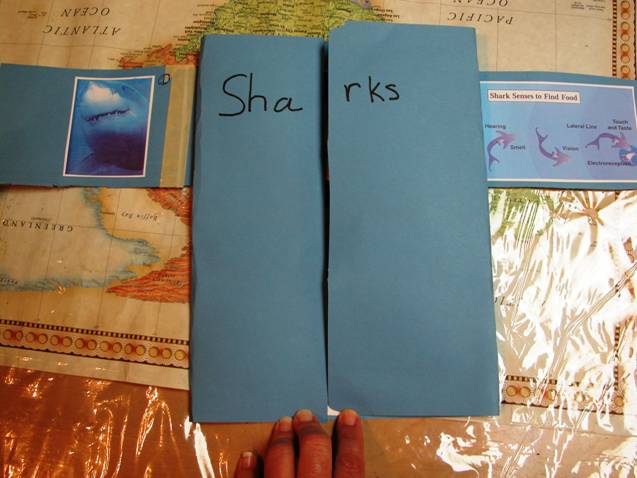
Photo “Sharks1”

He designed it so that the photos are numbered and on a slide.  When you open the book, the center writing area has the corresponding number for that photo with a blurb about it.
Youngblood

Photo “Sharks2”

Center text:

News flash, this just came in about sharks

1) One of the five most dangeres sharks the Great white.

2) Sharks have a sixth sence of sencing energy, this shark is sencing the fishes moovment or energy.

3) This picture is about how sharks find there food.

Right flap text (fictional story):

The dog and the shark
by Joshua Youngblood

There once was a dog and shark and this is the story of how they became friends.
One day John went on is boat whith Jack his dog. They went out into the ocean, but John forgot to poot the boat tale gate up so when he made a sharp turn and Jack slipped and fell into the ocean. When John got home he realised that Jack wasn’t there, meanwhile Jack was swimming around when he saw a shark coming at him Jack thought he was going to be eatten but he was not eatten, Jack asked the shark if he could bring him home and the shark said yes and they becaum friends. The shark took Jack to John and they lived happely ever after. THE END!
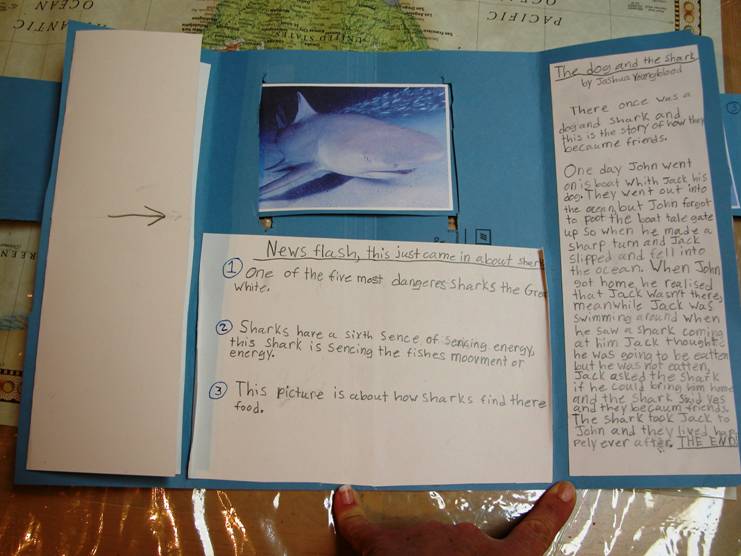
image008

Photo “Sharks3”

Left flap text (Prelutsky poem copywork):

In the middle of the ocean,
In the deep deep dark,
Dwells a monstrous apparition,
The detested RADISHARK.
It’s an underwater nightmare
That you hope you never meet,
For it eats what it wants,
And it always wants to eat.

Its appalling, bulbous body
Is astonishingly red,
And its fangs are sharp and gleaming
In its huge and horrid head,
And the only thought it harbors
In its small but frightful mind,
Is to catch you and to bite you
On your belly and behind.

It is ruthless, it is brutal,
It swims swiftly, it swims far,
So it’s guaranteed to find you
Almost anywhere you are.
If the RADISHARK is near you,
Pray the beast is fast asleep
In the middle of the ocean
In the dark dark deep.
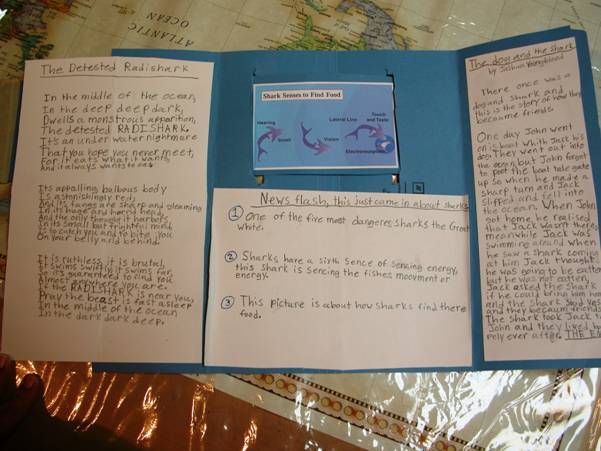
image009

Tags: lapbooks
Posted in Activities, Poetry, Spelling, Young Writers | 5 Comments »

It’s Autumn! Time to do fall stuff.

25 Homeschool Ideas for Fall

We made a list of things to do in the summer and one of our BW moms asked me to make one for fall.

  1. Of course buy pumpkins and carve/decorate them. You can use those big quilting pins to pierce the pumpkins so that you can cut colored paper and pin ears, eyes, mouths, if you prefer (a Mr. Pumpkin Head ala Mr. Potato Head).
  2. Make a chart that tracks the color changes of leaves on one of your trees. Sharpie mark several leaves with numerals. Then each day, record how the colors change for each one. Do you see speckles? Streaks? Shading shifts from left to right or top to bottom? Bring your colored pencils and compare colors to the leaves and then name the colors (goldenrod, chartreuse, ruby).
  3. Serve hot apple cider during your teatime/poetry for the months of October and November.
  4. Rake leaves for a neighbor while that neighbor is at work. Leave pumpkin muffins and an anonymous note. Don’t ever say who raked the yard.
  5. Jump on the trampoline and take flying photos.
  6. Hike to a creek with your dog.
  7. Stay out late and look at the moon once per week. Draw it and notice how the shape changes over the course of a month.
  8. Borrow a telescope and find Saturn.
  9. Create a nature’s table where you collect and display fall-ish items: acorns, acorn hats, moss on bark, dried colored leaves, scented candles, little pumpkins or gourds, blond hay stalks, dried corn, pebbles. We like to add little figurines like Half Penny Dolls. Lego figures work too.
  10. Read and write poems about the fall.
  11. Use sidewalk chalk to create hopscotch (look up various versions on the Internet and try them all).
  12. Volunteer at a homeless shelter and serve.
  13. Roast marshmallows in the fireplace.
  14. Peel an apple in one long peel using a pocket knife.
  15. Bake pies (try new ones like rhubarb, or old ones in a new way – pumpkin using a real pie pumpkin, not canned).
  16. Shake whipping cream in a glass jar with a marble until it become butter. Take turns shaking during read aloud time.
  17. Dye fabric with natural foods: beets to make purples, red onions for reds, tumeric for yellows. Muslin works great. You can make bean bags or little quilted pot holders with the resulting fabrics.
  18. Find out how to play cornhole. (Cincinnati specialty!) Then make one and try it.
  19. Take a bird watching hike (bring binoculars and a field guide). You can sometimes sign up at local nature preserves or parks too.
  20. Toss the old pigskin around!
  21. Buy a candle making kit and make the candles (or paper making or soap making).
  22. Clean the messiest space in your house, then scent the room with lavender.
  23. Spend an evening eating popcorn, drinking cider, and reading silently as a family in front of the fire. Turn the TV off.
  24. Go to a local festival.
  25. Invite college students or adults living alone to an evening of soup, bread and games (like Apples to Apples). Fall is a great time to care for shut ins or kids who have moved away from home.

Posted in Activities, Brave Writer Philosophy, Homeschool Advice | 1 Comment »

How to break old stuff!

Yesterday, Liam and I sat together in the living room while I worked and he read Living Bird (a magazine put out by the Cornell Lab of Ornithology). He started giggling. Then he chuckled. Next thing you know, his body shook while he laughed out loud. Now it’s nearly impossible to get any work done when someone is enjoying a good joke in a piece of writing that is only feet from where you sit! So I had to know the source of such good humor.

Pete Dunne: How to Destroy Your Binoculars

Nobody could have anticipated this problem. Only a few decades ago birders took pains to keep their binoculars in good working order so they would provide years of service.

No longer. Now, with new-and-improved, super-whiz-bang binoculars appearing every other week, birders who already own quality instruments that don’t have the latest technological innovations—coatings that deflect images of European Starlings and House Sparrows; squishy gel-packed bodies as squeezable as toilet paper—are crying for an excuse to ditch their built-to-last-a-lifetime glass so they have an excuse to buy the latest and greatest.

But they can’t. Their current binoculars work just fine. Replacing them will mean hours of negotiation with their conscience, their spouse, or both.

So here, for the benefit of birders suffering new binocular envy, are several proven ways to destroy the binoculars you are using now. I have personally tried every one and will attest to their success.

With that introduction, Dunne then reels off six detailed methods for deep-sixing your aging binoculars. And they are hilarious! Here are two:

1. The ol’ bioncular left on the roof of your car trick. Although this used to be the binocular abuser’s default setting (the equivalent of the dog eating your homework), unfortunately this is not the fail-safe technique it used to be. There are instruments out there now that can take a standard tumble onto tarmac and survive. In order to achieve maximum damage levels as defined by the new, enhanced, bino-destructo scale, you must place your instrument with barrels parallel to the car roof (i.e. not standing upright) so that you can achieve freeway speeds before the instrument goes airborne. If possible, when backing up to retrieve the wreckage, (for insurance purposes) run the instrument over with tires of your car…

(snip)

5. While scanning for hawks, consume a New-York-deli-sized roast beef sandwich (making sure that half the mayo lands on the glass), then introduce the binoculars to a six-month old Labrador retriever with the counsel, “Now be a good dog, Armageddon, and leave those binoculars alone.” Leave the room. Make sure the instruments are within reach and remove all doggy toys from the vicinity.

And if all else fails:

6. Loan them to me. I guarantee you’ll need new instruments by the time you get them back.

We laughed so much reading about the destructive methods of cleaning the lenses using the equivalent of a brillo pad and packing the binocs in a backpack, on a hot day, with a loosened jar of honey to ooze and lubricate the working parts of the instrument.

It occurred to me that this format would make an ideal writing exercise. How many of us have kids who want the latest X Box or Wii or the best saddle for a horse or the newest bicycle or the most recent iPod (the iTouch!) even while the stuff they have works perfectly and used to entertain them for hours? I see that show of hands. Everyone!

So turn them loose. Let them write about how to destroy that old stuff in order to justify the expense of the new stuff.

Hmm. Am I’m unleashing criminal activity against otherwise still-in-good-condition stuff? For the record: I said write about it. Don’t actually do it. 🙂

Posted in Activities, Brave Writer Philosophy, Writing Exercises, Young Writers | 2 Comments »

Thank you notes

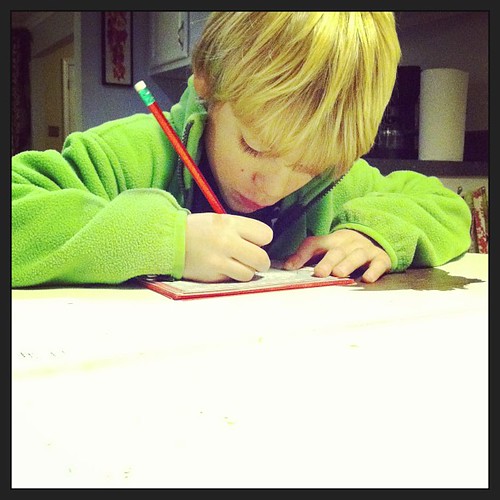
Writing thank you notesImage by eren {sea+prairie}

Hi Julie,

I’ve only just started reading my Writer’s Jungle so perhaps this question is already addressed somewhere in there.

How do I help my 10yo son improve his vocabulary choices while writing? He is a voracious reader and can comprehend vocabulary words way above grade level. However, pulling descriptive words out of him during writing is another story.

Here is how a recent session writing thank you notes went:

(Proofreading) “The (gift) is fun. You are very nice.”

Me: Hmmm…I think you can select words that pack a more descriptive punch. Let’s think of another word other than “fun”.

Him: Uhhh…okay, how about “good”?

Me: Well, “good” is also a bland word. Let’s think of the (gift). What words can you use to describe it?

Him: Fun. Good. Nice.

Me: Let’s do this…get the Synonym Finder and we will look up a new word.

Him: (Big Sigh, rolling eyes) NOOOOO! I want to use the word “fun”!

Me: Okay, let’s move on. How about finding a replacement for the word “nice”. (In my mind, I am thinking of words like “generous”, “thoughtful”, “kind”, etc.)

Him: Uhhhh….I can’t think of anything.

Me: You can’t think of anything?

Him: Okay, how about “good”?

And so on…

Help! Do you have any tips for me?

Thanks,
Linda

—

Hi Linda!

Your request likely feels like a very big challenge to your son as he is not thinking in specifics but vague generalities.

The best thank you notes tell a little anecdote. So rather than asking him for a summary word, ask him about playing with the gift. What did he do the first time he played or did he have a big win or did he beat the computer or whatever?

Help him to remember the thing as it is used, not as it is described in terms of adjectives.

Fun is a great place to start. Now help him to show the fun he had (rather than summarizing it).

How about:

Thanks for the really fun gift! My brother and I played with it for four hours. I ________ until my brother tried to _________ and then right when I thought I would lose I __________ and whipped his butt.

Something like that.

The point is, don’t write about the gift in general. Try to put it in a specific context and the words will more likely come forth.

Also, words like generous, thoughtful, kind are parent words. Nice is a meaningless word. So perhaps you can help him to say what he really means:

I love that you knew to get me that gift because….

Or:

It’s so cool that you would buy me the thing I’ve been wanting forever…

That kind of thing rather than generalizations.

I hope that helps a bit!
Julie

—

Hi Julie,

Your tips helped!

Here is his latest thank you:

Thank you for the Key Card Door Alarm. I rigged it to my drawer. I put my favorite Christmas presents in the drawer. Now they are safe from sneaky monkeys!

I love you very much!

What I love about it is that it captures a bit of his personality, which is what Brave Writer is all about!

Thanks, again!
Linda

Posted in Activities, Brave Writer Philosophy, Email, Young Writers | 2 Comments »

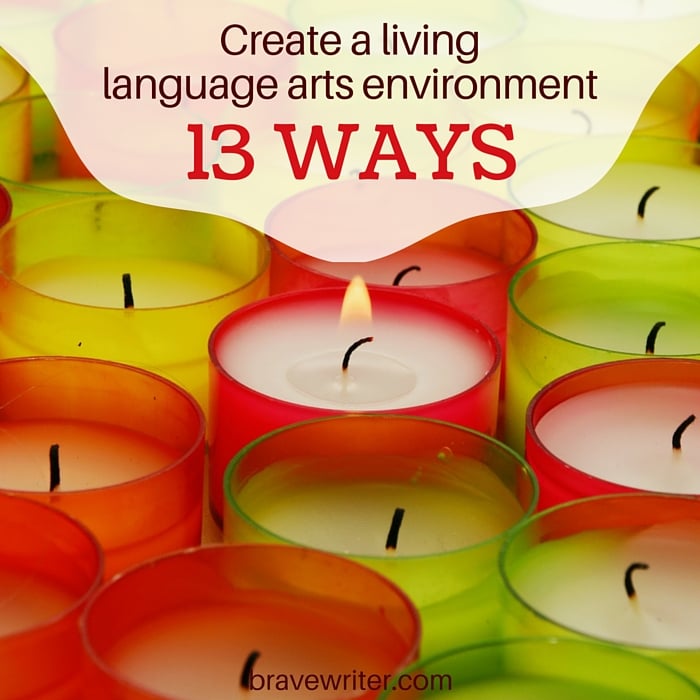
Living Language Arts

13 Ways to create a living language arts environment

Here are thirteen tips to try at home to cultivate a living language arts environment. You don’t have to do all of them today, but pick one and go for it! Rotate the others in.

13. Read Aloud.

Don’t worry that you are behind or haven’t in a long time. Start again today. You can pick out a well-loved classic, a book of poetry, or a magazine with a great article (sometimes reading an article from Zoobooks or Children’s National Geographic or even American Girl can be a wonderful change of pace, and the benefit is that you can complete an article in one sitting).

12. Talk.

Make eye contact and have a conversation with at least one child today. The conversation must not contain admonitions, corrections, or explanations of how to perform a task. Focus on the child’s interests and ask questions.

11. Tell a joke.

Playing with words and meanings is one of the most enjoyable ways to cultivate an expanding vocabulary.

10. Write notes.

Use email to send a note to dad. Cut out photos, glue them to card stock and write notes to grandparents. Leave love notes on the mirror using lipstick for mom or dad or an older sister. Create a treasure hunt writing notes as clues. Notes are short and don’t require a lot of preparatory writing so they make a great way to keep writing alive when the fires are dim.

Be creative. Ask a ten-year-old to write you a list of groceries as you dictate what’s missing from your cupboard or refrigerator.

9. Play a game.

Clue, Cranium, Settlers of Catan, Cadoo, Imagine If… Any game encourages discussion, following directions, explanations of strategy. Remember – the more your kids talk and explain themselves, the better their writing will be.

8. Take a walk.

If you can get one child alone for a walk, even better. Somehow, walking forward with eyes on the horizon, talking often comes more easily. You can turn the walk into a writing opportunity by taking a color walk. Instead of talking, focus on one color for the whole walk and silently observe it. When you return home, freewrite for ten minutes about the color (or its absence!) on the walk. Let your mind go.

7. Visit an art museum.

Writers need things to write about. To stimulate the creative part of the brain, supply visual material. Art museums offer kids a chance to look at visual expression. They can then, in turn, put what they observe into words.

6. Light a candle; read a chapter.

In busy households, it’s easy for noise to dominate the atmosphere making silent reading a challenge. Pick a day one week to light a candle for thirty minutes. Let the kids know that during that 30 minute period, no one may talk. They must read quietly, or play quietly, or sit and think quietly. Allow silence to give your kids a chance to read or think without interruption. The candle marks when silence begins and when it ends.

5. Copy a favorite passage.

Keep a notebook and fill it with favorite quotes from books, poetry, the Bible, the Qu’ran… even favorite jokes! Jot down whatever book you find inspirational.

4. Teatime.

Brave Writer families love to have Tuesday teatimes where they combine good treats with hot tea and poetry. See the poetry teatime website for lots of ideas.

3. Find a new word.

Make it everyone’s aim to find a new word to share at the end of the day (at dinner or bedtime). Everyone reads signs, books, websites, etc. with a view to noticing an unfamiliar word. Even finding a word on TV or in a movie counts. Look up its meaning and attempt to use it during the day. Share your words with each other at the end of the day.

2. Reward the finding of typos.

Pay a quarter for every typo in print found by one of your kids.

1. Love words.

Exclaim over a wonderful sentence, word pair or choice term. Get silly with words, creating new ones out of combining old ones. Find new ways to compliment each other. Write them with markers, cut them out of magazines, pin them on bulletin boards, tape them to items around the house.

Make word appreciation a regular part of your life. Give credit to the authors, particularly if the great set of words is uttered by one of your kids. Don’t let them get away. Trap them and write them down.

Party School!

Posted in Activities, Brave Writer Lifestyle | 2 Comments »

« Older Entries
Newer Entries »
  • Search the Blog

  • Julie Bogart
  • Welcome, I’m Julie Bogart.

    I’m a homeschooling alum -17 years, five kids. Now I run Brave Writer, the online writing and language arts program for families. More >>

    IMPORTANT: Please read our Privacy Policy.

  • New to Brave Writer? START HERE

  • FREE Resources

    • 7-Day Writing Blitz
    • Brave Writer Lifestyle Program
    • Brave Writer Sampler: Free Sample Products
    • Freewriting Prompts
    • Podcasts
  • Popular Posts

    • You have time
    • How writing is like sewing
    • Best curriculum for a 6 year old
    • Today's little unspoken homeschool secret
    • Do you like to homeschool?
    • Don't trust the schedule
    • You want to do a good job parenting?
    • If you've got a passel of kids
    • You are not a teacher
    • Natural Stages of Growth in Writing podcasts
  • Blog Topics

    • Brave Learner Home
    • Brave Writer Lifestyle
    • Classes
    • Contests/Giveaways
    • Friday Freewrite
    • High School
    • Homeschool Advice
    • Julie's Life
    • Language Arts
    • Movie Wednesday
    • Natural Stages of Growth
    • One Thing Principle
    • Our Team
    • Parenting
    • Philosophy of Education
    • Podcasts
    • Poetry Teatime
    • Products
    • Reviews
    • Speaking Schedule
    • Students
    • Writing about Writing
    • Young Writers
  • Archives

  • Brave Writer is a participant in the Amazon Services LLC Associates Program, an affiliate advertising program designed to provide a means for sites to earn advertising fees (at no extra cost to you) by advertising and linking to amazon.com

    Content © Brave Writer unless otherwise stated.

What is Brave Writer?

  • Welcome to Brave Writer
  • Why Brave Writer Works
  • About Julie
  • Brave Writer Values
  • Frequently Asked Questions
  • Speaking Schedule

Brave Writer Program

  • Getting Started!
  • Stages of Growth in Writing
  • The Brave Writer Program
  • For Families and Students
  • Online Classes
  • Brave Writer Lifestyle

…and More!

  • Blog
  • Classroom
  • Store
  • Books in Brave Writer Programs
  • Contact Us
  • Customer Service
  • Brave Writer Staff
© 2026 Brave Writer
Privacy Policy
Children's Privacy Policy
Help Center