
Julie Bogart, Author at A Brave Writer's Life in Brief - Page 245 of 481 A Brave Writer's Life in Brief
  • Start Here
    • For Families
      Multiple Ages
    • Ages 5-7
      Beginning Writers
    • Ages 8-10
      Emerging Writers
    • Ages 11-12
      Middle School Writers
    • Ages 13-14
      High School Writers
    • Ages 15-18
      College Prep Writers
  • Shop
    • Product Collections
    • Bundles
    • Writing Instruction Manuals
    • Literature & Grammar/Punctuation
    • Composition Formats
    • Literature Singles
    • Homeschool Help
    • Book Shop
  • Online Classes
    • Class Descriptions
    • Class Schedule
    • Classroom
    • How Our Classes Work
    • Our Writing Coaches
    • Classes FAQ
  • Community
    • Brave Learner Home
    • What’s Happening
    • Blog
    • Podcast
    • Calendar
  • Cart
  • My Account
    • My Online Classes
    • My Account
  • My Account
    • My Online Classes
    • My Account
  • Start Here

    If you’re new to Brave Writer, or are looking for the best products for your child or family, choose from below:

    • For Families
      Multiple Ages
    • Ages 5-7
      Beginning Writers
    • Ages 8-10
      Emerging Writers
    • Ages 11-12
      Middle School Writers
    • Ages 13-14
      High School Writers
    • Ages 15-18
      College Prep Writers
  • Shop

    If you’re already familiar with Brave Writer products, go directly to what you’re looking for:

    • Product Collections Browse the full catalog in our shop
    • Bundles Everything you need to get started
    • Writing Instruction Manuals Foundational Writing Programs
    • Literature & Grammar/Punctuation Grammar, Punctuation, Spelling & Literary Devices
    • Composition Formats Writing Assignments for Every Age
    • Literature Singles Individual Literature Handbooks
    • Homeschool Help Homeschooling Tools and Resources
    • Book Shop Books associated with Brave Writer Programs
  • Online Classes
    • Class Descriptions
    • Class Schedule
    • Classroom
    • How Our Classes Work
    • Our Writing Coaches
    • Classes FAQ
  • Community
    • Brave Learner Home
    • What’s Happening
    • Blog
    • Podcast
    • Calendar
  • Search
  • Cart

Search Bravewriter.com

  • Home
  • Blog

A Brave Writer's Life in Brief

Thoughts from my home to yours

Author Archive

« Older Entries
Newer Entries »

Have You Been Avoiding Writing?

http://www.dreamstime.com/stock-image-not-knowing-what-to-do-person-hands-folded-staring-question-mark-indicates-doubt-image39672031

An email I received:

What do you do if you’ve been avoiding writing for a long long time? The child in question is 14. He is male.

My reply:

First, congratulations! Thank you for not damaging your writer. It is far better to ignore and avoid writing than to require it and create writer’s block due to applying methods that harm the child’s natural ease of self-expression.

Any child who has simply “not written” can be taught/encouraged to find his or her writing voice no matter how old. The older the child, the more swiftly this process can happen. Why? Because older children (12, 15, 17!) have been speaking fluent English for many more years than their younger siblings. They have read more words than new readers. They’ve handwritten or keyboarded to the point of near fluency (spelling, punctuation, how to make that weird cursive ‘r’, where the question mark is on the laptop). They have thought about ideas and have mastered facts that were unfamiliar to them at ages 6, 8, and 10.

When we turn our attention to writing with a child who is already a teen, we are greeted with a person who is truly ready to write! So if your way of avoiding all that trauma that attends most writing programs was to ignore it—well done! You’ve waited for the key moment to make real progress. I’ll help you with that in a minute.

If you are the parent of a teen who won’t write because the programs you used have created writing paralysis (a block that is bigger than “I don’t know what to write,” but is more like “I hate writing and will never use it therefore I will not do it now or ever, forever more”), you have a slightly different issue but no less solvable.

Here are the two strategies.

1. For the writer you neglected to cultivate: Start from scratch! You can. Start by listening to him, having great conversations, jotting down some of the great stuff he says in words out loud to you. Read back what he says to his dad or siblings or to him later in the day, talking about the content of what he said.

Begin with copywork—song lyrics, humor, his favorite quotes from books. Do it at the same time with him, copying your favorite quotes. Read your quotes to each other. Pick quotes for each other as a surprise. Light a candle or eat brownies or use fountain pens or create an entire passage by snipping the words from magazines and gluing them in order on a page. Make a collage of favorite quotes! Make up your own quotes!

Freewrite—about anything, about everything. We have prompts on our blog, but you can get them anywhere. With teens, you want the topics to be interesting to the teen. Provocative positions are often best: What makes X band better than Y band? If you could change one law, which one would it be and why? If 18 year olds can be asked to fight for our country, does it make sense to say they aren’t old enough to drink alcohol? What’s one part of your education you’d like to take control of and how would you do it?

Get into fan fiction or NaNoWriMo (National Novel Writing Month) or blogging about gaming or online discussion with kids who have similar hobbies or texting or Facebook or whatever drives a kid to write without thinking about “school.”

Play with words—use them, write big ones on a white board to stump each other, recite Shakespeare or poetry or quotes from Seinfeld.

Then, over the course of a year of this kind of practice, talk about moving into some preparation for college. Look at the Brave Writer online classes or local classes in a co-op or junior college. Move one bit at a time, but first, focus on reading, copying, freewriting, and language play. Like you would at any age.

2. For the damaged writer, the same process applies, but you have to rebuild trust and that happens through this little conversation that you need to have.

“Son, gulp. I’m just realizing that the writing programs we’ve used have been really unhelpful to you in becoming a competent, comfortable writer. I feel awful about it! Can we start over? I promise to pay attention when you say something is boring or isn’t working for you. I want us to start with writing that has meaning for you. Here’s a brownie. Let’s talk.”

Some version of this with more or less apology depending on how much damage is there will work. Brownies or going out for Cokes helps.

The goal with any child or teen is to recognize that the writing voice is already alive and well within. It may be hidden from view or afraid to come out, but some attentiveness to your child’s speaking voice and some humility about how difficult writing is for many kids will lead to breakthroughs. Start where your child is. Kids can go from not writing to college level comp between 16-18.

Promise.

Brave Writer Online Classes

Image © Richair | Dreamstime.com

Posted in Email, Homeschool Advice, Writing about Writing | Comments Off on Have You Been Avoiding Writing?

It’s a trap!

http://www.dreamstime.com/stock-photography-happy-family-image18946842

Don’t stumble into it! Surely you can see it coming a mile away. As you watch the smudgy shape on the horizon become bigger and more real, you have two choices:

To stand there and let that perfectly coiffed, smart, capable homeschooler with the engaged happy learners and the bright smile dim your shine with the enormous shadow she casts…

OR

…you can step aside, into your own pool of light, and lift your eyes to the sky—its boundless open expanse of reassuring space to grow and evolve and become.

You have that choice every day.

The perennially eager learners are a fantasy—children are like us.

Some days they are engaged and enthusiastic.

Some days they are bored and whiny.

Some days they are content to simply follow the program, too distracted or tired to commit energy to creativity or imagination.

Some days you have so much fun—then you tuck in your darling dear to hear him declare that he never has any fun.

You can’t control how your children respond to your best efforts and conscientiousness.

You can’t manage your children into “model unschoolers.”

You can’t keep up with your best friend or the fantasy homeschooler you think lives in another state, doing it more skillfully and with ease.

What you can do—what you can do right now today—is to be present to the children, home, and life you have. The small moments that accumulate to create the feel and memories of your family are happening all day today.

You can help establish some of the mood of your family simply through paying attention to:

  • a smile directed at you
  • a clutter-free space on a table for lunch or copywork
  • the spontaneous sharing between siblings
  • diligence even if displayed for only 5 minutes at a time
  • humor and little jokes
  • completion of one subject’s demands today (even if all the others fall through the cracks)
  • one line of quality writing in a read aloud
  • picking a flower from the back yard and putting it in a glass of water
  • eating something yummy
  • snuggling a child
  • explaining a concept and seeing the light go on this time!

More goes right than you appreciate.

Keep a record of what goes right today and side-step the visage of model homeschooling. It takes self-will and discipline.

I know for me, I get caught into the snare of comparison when I spend too much time looking at photos of other families. I project my biggest fantasies onto the happy smiles. As my mom says, “Facebook shows us faces, not lives.”

We can’t know the lives behind the images. If the stories we make up in our heads make us feel worse about our own lives, we are literally stepping into the trap and are immediately whipped upside down, hanging by a snared foot, from a tree branch.

Instead, get off the well-trimmed path.

Make your own way through the forest and notice what you notice. It’s quite possible that if you move away from examining what other people do, and pay more attention to the amazing tenacity of effort you give to your family, you will discover much to be proud of.

I dare you!

Cross-posted on facebook. Image © Yuyuyi | Dreamstime.com

Posted in Homeschool Advice | 1 Comment »

You are the right person for the job

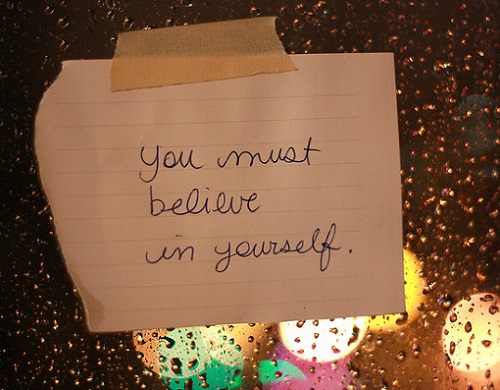
Rainy Day Inspiration :: You Must Believe In Yourself!

 A mom wrote:

We never feel like we are doing enough, yet at the end of each day, we are exhausted from doing too much.

Do you know that feeling?

That is a crazy-making feeling right there. We are perennially worried that we are not accomplishing enough toward our children’s educations, yet each day is overpowering in its demands on our emotions, time, and mental energy.

This is where you have to rally on behalf of your self.

If you are exhausted and spent, it is because you have used an extraordinary amount of energy toward managing your home and your children with an intention to educate all day!

You can’t do more than that!

Can you channel your energies toward more productive uses? Perhaps. Some days, for sure. Some days, NO WAY.

Trust that…

that output is working secretly, invisibly, on behalf of your children.

your worry is evidence of your profound love and devotion to your children.

your neuroses will drive you to bettering your homeschool little by little, year by year, and that will be enough.

one day, you will be at the end, you will know that it is right to be finished, and it will be time to do something else.

For now, lean into home education and trust yourself. You are the right person for the job. Your kids are lucky that you are their mother. You bring unique gifts to them. Identify them. Celebrate them. Stop looking at your deficiencies. Blaze a different path—the one that is right for your family.

Your homeschool should look like you and your family…and no one else’s.

Trust.

Cross-posted on facebook. Image by Jennifer (cc)

Posted in Brave Writer Philosophy, Homeschool Advice | 2 Comments »

Pay day!

Go Doughboy

Whenever I share about a great moment in one of my kids’ lives, my friend says, “Pay day!” We were homeschoolers together for years. She has 8 kids, I have 5. We have had our share of challenges and doubts, like any parent. Home education is unique in how it puts pressure on us, though. We feel every set back more deeply—after all, no one blames the “school system” when our kids are behind.

We home educators have a hard time not blaming ourselves. When our kids struggle, we assume that it is up to us to figure it out and handle any challenge. We worry—can’t remember that some years are years of struggle for a child who, with a little time and maturity, will figure it out just fine (whatever “it” is)!

Home education doesn’t always show the fruit we want to see in a single year or handful of years. Some kids who say they don’t like home education discover as adults that, in fact, they appreciate having been homeschooled.

Not only that, we don’t get paid. Not in money. Not in credible experience for a resume. Not in vacation days or bonuses. We provide this service to our families out of sheer conviction that this form of education—this method—has a shot at providing our children with a preferred environment for learning and family bonding.

Chutzpah out the wazoo!

So, on those days when a child suddenly surprises you with an achievement or a good report out in the world, THAT’S when we get paid.

Your child tests well on the Iowas? Pay day!

Your child gets into college? Pay day!

Your daughter is chosen to be the lead in a play? Pay day!

Your son builds his own computer from scratch? Pay day!

Your mother finally reports that she is amazed by your 10 year old’s vocabulary? Pay day!

The library selects your child’s poem to display on their wall? Pay day!

Your son’s soccer coach selects him to be team captain because of his maturity? Pay day!

The child who would not learn times tables with the math book suddenly knows how to calculate percentages because of online gaming? Pay day!

You’ve worked for three years to help your poor child to read, who has begged to read every day since she turned 5, and is now going on 9 and finally read her first book aloud to you? PAY DAY!!!!

Your adult child tells you that his scholarship interview went well in part because he shared about poetry teatimes? Pay day!

Your adult daughter uses your methods for appreciating art in a museum with under privileged kids as a social worker? Pay day!

Your kids know how to study when they get to college because they know how to teach themselves anything? Pay day!

Your children are bonded to each other and look out for each as adults because they are close? Pay day!

There are dozens of pay days happening all the time. What are yours? How can we help each other to call them out when we see them?

You do get paid. Pay attention. Then, take it to the bank—your emotional bank—and make a big deposit.

You’re doing it!

Well done.

Cross-posted on facebook. Image by Bradley P. Johnson (cc)

Posted in Homeschool Advice | 3 Comments »

What if you ditched the pen and paper?

NaaD 39 Cheryl blog

The temptation when faced with learning challenges is to set up a system to address the problems—a structure that will take the issues seriously and will create benchmarks for measurable progress. This kind of approach feels quite “teacherly” and valid. We (worried parents) trust a system that is incrementally organized with practices that we can use that promise us good results. We cling to it, sometimes, and follow it to the letter.

What happens, though, when a child balks? Your son or daughter won’t do the practices, hates them, cries or whines that the work is boring or too difficult?

Tension escalates and the relationship between you and your child is at risk.

Certainly professional help for kids with diagnosed learning disorders can be quite useful to language-impaired kids. Some materials built from these methodologies may target issues that you didn’t even realize were constitutive to the disorder or challenge your child faces. Naturally, incorporating these tactics and practices is loving and right!

Still, I want to caution you here. The temptation to get very serious about problems and to follow the protocols to the letter is powerful for parents. We want to believe that if we “do it right,” our child will overcome their disorders or learn to cope with their challenges. Once we “get serious,” the space for risk-taking, joy, play, and imagination sometimes go right out the window! We tend to “clamp down” rather than to loosen up!

The most effective way to make progress with struggling learners is to enhance the parent-child bond, not just turn to systems and structure. With trust and affection between you, any process you use can contribute to growth.

That nurturing bond is created between parents and children when the parent understands the child’s need for a couple of things:

Play. Children need to know that you value play, humor, happiness, freedom to explore, jokes, kinesthetic activity.

Breaks. Kids will try almost anything, but they need to know that if it is too stressful, they get to quit, take a break, move away from the process or activity.

Create playful ways to address the issues that are not systematic at all! Perhaps for handwriting, you will use paintbrushes and buckets of water to write messages on the driveway.

What if your child stood behind you, put his arms through to the front as though he is your hands, and you had him open a jar of pickles or try writing your name from that blind position? What if you get him in touch with his body and hands and uses for hands in new ways?

Can he trace words? Can he trace them better if the two of you hold the same pencil and you move gracefully together over the letters—first you controlling his hand, and then he controls your hand?

We are so quick to think all learning happens on paper, with pen, following a set of assignments.

See if you can get outside of this frame of reference—play, take breaks, build trust.

Good luck!

Cross-posted on facebook. Image by Brave Writer mom, Cheryl (cc).

Posted in Homeschool Advice | 2 Comments »

« Older Entries
Newer Entries »
  • Search the Blog

  • Julie Bogart
  • Welcome, I’m Julie Bogart.

    I’m a homeschooling alum -17 years, five kids. Now I run Brave Writer, the online writing and language arts program for families. More >>

    IMPORTANT: Please read our Privacy Policy.

  • New to Brave Writer? START HERE

  • FREE Resources

    • 7-Day Writing Blitz
    • Brave Writer Lifestyle Program
    • Brave Writer Sampler: Free Sample Products
    • Freewriting Prompts
    • Podcasts
  • Popular Posts

    • You have time
    • How writing is like sewing
    • Best curriculum for a 6 year old
    • Today's little unspoken homeschool secret
    • Do you like to homeschool?
    • Don't trust the schedule
    • You want to do a good job parenting?
    • If you've got a passel of kids
    • You are not a teacher
    • Natural Stages of Growth in Writing podcasts
  • Blog Topics

    • Brave Learner Home
    • Brave Writer Lifestyle
    • Classes
    • Contests/Giveaways
    • Friday Freewrite
    • High School
    • Homeschool Advice
    • Julie's Life
    • Language Arts
    • Movie Wednesday
    • Natural Stages of Growth
    • One Thing Principle
    • Our Team
    • Parenting
    • Philosophy of Education
    • Podcasts
    • Poetry Teatime
    • Products
    • Reviews
    • Speaking Schedule
    • Students
    • Writing about Writing
    • Young Writers
  • Archives

  • Brave Writer is a participant in the Amazon Services LLC Associates Program, an affiliate advertising program designed to provide a means for sites to earn advertising fees (at no extra cost to you) by advertising and linking to amazon.com

    Content © Brave Writer unless otherwise stated.

What is Brave Writer?

  • Welcome to Brave Writer
  • Why Brave Writer Works
  • About Julie
  • Brave Writer Values
  • Frequently Asked Questions
  • Speaking Schedule

Brave Writer Program

  • Getting Started!
  • Stages of Growth in Writing
  • The Brave Writer Program
  • For Families and Students
  • Online Classes
  • Brave Writer Lifestyle

…and More!

  • Blog
  • Classroom
  • Store
  • Books in Brave Writer Programs
  • Contact Us
  • Customer Service
  • Brave Writer Staff
© 2026 Brave Writer
Privacy Policy
Children's Privacy Policy
Help Center