Julie Bogart, Author at A Brave Writer's Life in Brief - Page 238 of 481 A Brave Writer's Life in Brief
  • Start Here
    • For Families
      Multiple Ages
    • Ages 5-7
      Beginning Writers
    • Ages 8-10
      Emerging Writers
    • Ages 11-12
      Middle School Writers
    • Ages 13-14
      High School Writers
    • Ages 15-18
      College Prep Writers
  • Shop
    • Product Collections
    • Bundles
    • Writing Instruction Manuals
    • Literature & Grammar/Punctuation
    • Composition Formats
    • Literature Singles
    • Homeschool Help
    • Book Shop
  • Online Classes
    • Class Descriptions
    • Class Schedule
    • Classroom
    • How Our Classes Work
    • Our Writing Coaches
    • Classes FAQ
  • Community
    • Brave Learner Home
    • What’s Happening
    • Blog
    • Podcast
    • Calendar
  • Cart
  • My Account
    • My Online Classes
    • My Account
  • My Account
    • My Online Classes
    • My Account
  • Start Here

    If you’re new to Brave Writer, or are looking for the best products for your child or family, choose from below:

    • For Families
      Multiple Ages
    • Ages 5-7
      Beginning Writers
    • Ages 8-10
      Emerging Writers
    • Ages 11-12
      Middle School Writers
    • Ages 13-14
      High School Writers
    • Ages 15-18
      College Prep Writers
  • Shop

    If you’re already familiar with Brave Writer products, go directly to what you’re looking for:

    • Product Collections Browse the full catalog in our shop
    • Bundles Everything you need to get started
    • Writing Instruction Manuals Foundational Writing Programs
    • Literature & Grammar/Punctuation Grammar, Punctuation, Spelling & Literary Devices
    • Composition Formats Writing Assignments for Every Age
    • Literature Singles Individual Literature Handbooks
    • Homeschool Help Homeschooling Tools and Resources
    • Book Shop Books associated with Brave Writer Programs
  • Online Classes
    • Class Descriptions
    • Class Schedule
    • Classroom
    • How Our Classes Work
    • Our Writing Coaches
    • Classes FAQ
  • Community
    • Brave Learner Home
    • What’s Happening
    • Blog
    • Podcast
    • Calendar
  • Search
  • Cart

Search Bravewriter.com

  • Home
  • Blog

A Brave Writer's Life in Brief

Thoughts from my home to yours

Author Archive

« Older Entries
Newer Entries »

Focus on Content then Meaning

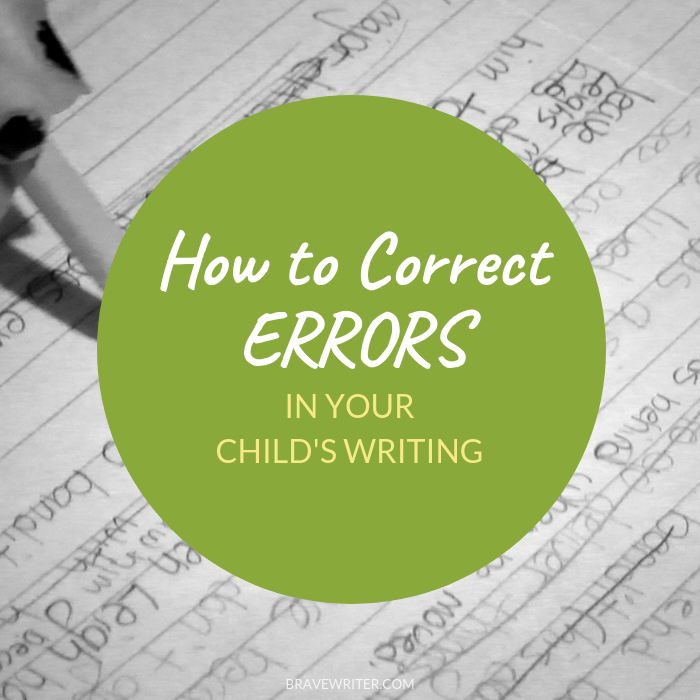
How to Correct Errors in Your Child's Writing

Writing Tip:
The Trick is to Focus on Content First

How do you correct errors without provoking tears?

The trick is to focus on content first. As we say in the biz, “Content is King!” Someone asked me what was “Queen” and I said, “Meaning.” So do it like this:

1. Start with content.

Focus on the topic, the insight, the great ideas or explanations or details that deliver the idea to the reader. You want to say words like:

“You know so much about roller coasters! It was surprising to read that the Raptor was so tall! I had no idea that the speeds got up to ___ mph. I could feel like I was on the coaster when you talked about the ‘wind whipping’ your hair. Great use of the ‘w’ sound.”

Notice that every comment is on the content – finding what is good in it, noticing it, remarking on it.

2. Now focus on meaning.

Notice if the writing makes sense, if it is conveying what it hopes to convey. So, make comments more like these in the “meaning” portion:

“I’m reading along here, and I notice that I got a little lost when I moved from this idea to the next one. Did you want it to read like this (read the run-on sentence all together with no stopping or pausing) or more like this (pause where a period should go to make it make sense)?”

When your writer chooses the second, you comment like this:

“To help the reader really get what you’re saying, a period here will make all the difference. Let’s put one in.”

How to Correct Errors in Your Child's Writing

This is how you work through the whole text. Punctuation is not just marks on a page, but a way to ensure that the reader gets the right, accurate understanding of ideas that the writer wants conveyed.

For weak language, you can say,

“I can tell that you think the ride was ‘awesome.’ The reader might want to feel what that is like. Can you think of more to say to unpack that word?”

And so on.

If a step in a process is missing, you want to note it conversationally:

“Oops! I got a little lost. Is there a step missing here? I don’t want to miss what you really want me to know.”

So start with content – be prolific in praise.

Then move to meaning – be conversational, friendly, and helpful.

Daily Writing TipsWish you had a bunch of Writing Tips in one place so that you could easily refer back to them whenever you wanted?

DONE!

We put 100 of our emailed Daily Writing Tips into a single document so you don’t lose them. It’s a digital product, so you can print the tips, put them on your iPad or tablet, or read them from a phone or laptop. Get your copy today! 


Top photo: woodleywonderworks (cc cropped, text added)
Posted in Writing about Writing | Comments Off on Focus on Content then Meaning

Why Journaling Helps People

Journaling Helps

When I lived in France as an exchange student, I wrote over 1000 pages in my journal. When I lived in Morocco, I wrote dozens of journals. I’ve kept some semblance of a journal since 4th grade—writing more some years than others. I always know when I’m “going through something.” Journaling pops back to the forefront of my life.

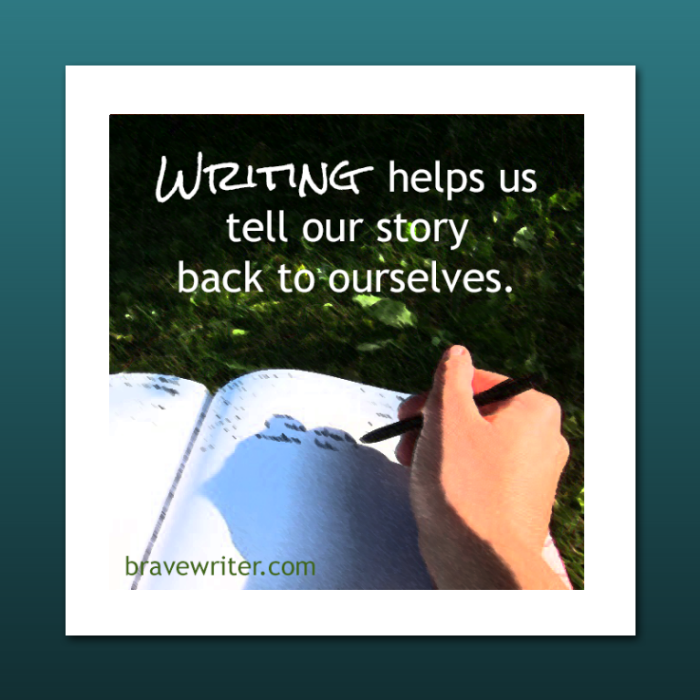
This study is fascinating to me. It clarifies why journaling helps people. Writing helps us tell our story back to ourselves. It helps us put the emotions and experiences into a meaningful context.

You might try this with your own children. I remember how Noah struggled with big emotions after particularly meaningful experiences in his life (sleep away camp, performing in a play, a great vacation). He’d get swamped by the feelings and didn’t know what to do with them.

I suggested he keep a “special occasions” journal. He could write his memories while they were fresh and then reread them any time he wanted to revisit those precious experiences. It worked…and he still has that journal to this day.

Image by Emma Larkins (cc cropped, smudged, text added)

Posted in Homeschool Advice, Julie's Life, Writing about Writing | Comments Off on Why Journaling Helps People

Challenge for the Week!

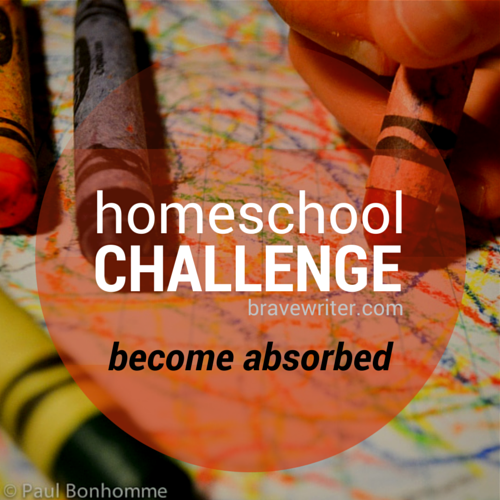
Homeschool Challenge

“We’re most happy when we forget the time.” Pico Iyer

Think about your best homeschooling moments. Aren’t they like this? When you become absorbed in the moment and forget what you haven’t gotten to, or what the state standards are, or where you are supposed to be at 2:00 p.m.—aren’t those your best moments?

A challenge for this week:

Allow yourself to become absorbed—once, this week. Allow one experience (of reading or talking or tea timing or crafting or chasing a question through Google or playing soccer in the backyard…) to take over the clock—to induce you to forget the clock. See how that feels and what its contours and properties are.

Then report back either on our facebook page (and the post is pinned to the top) or here on the blog and let us know how it went!

Image by Paul B. (cc cropped, tinted, text added)

Posted in Brave Writer Lifestyle | Comments Off on Challenge for the Week!

You Have Time to Prepare

You have time to prepare

Do you remember how to divide fractions? I didn’t. I had a 4th grade math book whose page I turned and discovered, “Oops! We are up to division of fractions. I can’t remember how to do that.”

I whisked myself away to the garage to teach myself. My kids made messes in the living room.

I returned ready to show Noah how to divide fractions. He performed the task easily. At the end of the page, he commented, “So I don’t have to really remember this? I won’t need fractions as an adult? I only need to know them for today, right?”

Ha! He took a different lesson than the one I meant to impart. My inability to remember how to divide fractions stood out, naked and then ashamed. I countered that my handicaps in math were just that—skills I didn’t get to use when I needed them. I hoped for better for him, and I told him that I would do a better job of preparing to be his teacher in the future.

It’s with this experience in mind that I make the following recommendation. It is wise to prepare. In fact, it is essential to learn how to home educate your kids. It is entirely on task to read blogs, Facebook groups, books, and the directions that precede any lesson you expect your kids to complete.

In fact, it is so on task, may I make a bold statement? I know you don’t have time to study “learning” by yourself, in some ideal context of private, quiet, peaceful hours in the day. I know this.

Just Do It

My advice: just do it—right in the middle of the day with kids all around you, “off-task” in dress up clothes, acting out Frozen one more time. Tuck your feet under you, snuggle up to the corner of the sectional, and read, scroll, page. Use headphones if you need to. Highlighter in hand, read. Take notes. Absorb.

It is so much better to let go of today’s and tomorrow’s lessons in order to drill down to the essential ingredients of math or writing, or to understand a period in history, or to get a glimpse of how the science experiment should go and what its objective is, than to muddle forward with doubt and your child’s resistance.

Prepare quoteIt is not better to just “get it done” and hope for the best. There is no “automatic” method for any learning. It just doesn’t happen that way. Depth, immersion, exploration, and guidance are the core values of education.

We are concerned with completion of pages or curricula, and then we worry that our kids aren’t making progress, and we hope for a quick fix—some solution that won’t require us to take valuable time to understand before implementation.

But this approach is backwards. You didn’t go to college (most of you) to get a teaching credential. You’re becoming educators on the fly (even unschoolers are embarking on a huge new project of how to be that parent who facilitates learning or invests deeply in a child’s passions). These choices necessitate information that informs how you spend time with your kids, and what you impart.

You will feel so much better if you have a handle on the contours of a subject area, than if you plod through a book hoping for magic (that the lesson leaps from the page without you knowing why or how it works).

You Have Time

For all the hours you don’t spend in preparation, you will find yourself frustrated with basic problems. Why isn’t my child of 10 spelling well? This is answered quickly in a book that explains the natural stages of growth in writing. 10 year olds don’t spell well. Here’s why, here’s how to foster the continued growth.

Without that bit of knowledge, you will be tempted to push your child or to shame him for not spelling well. I know. I’ve done all of that. I’ve pushed, I’ve shamed, I’ve blamed, I’ve plowed forward in a curriculum expecting it to teach and finding out it did not.

Then a new day dawned. I saw that my home life was fluid—we didn’t have set school hours, we didn’t have a teacher’s lounge for me. We had the mixed up mess of living and learning and all my insecurities about parenting and educating—together in one living room, at one kitchen table. It finally occurred to me: If I was unsure about how to impart a specific skill set for them or share about an area of passion for me, I could spend daytime looking into it. Right when I wanted to.

I wanted my kids to have an art education, but had no idea how to go about it. We spent time in the library where they read books they wanted, and I checked out books about art. I read them. I bought some. I started hanging prints on the wall. Finally, I ordered the 6 video set of Sister Wendy’s Story of Painting. I put them on every day for a couple of weeks, right after breakfast. My kids were free to come and go, but I took notes. They remember this period of our homeschool.

The foundation from that season was laid in me. I couldn’t wait to go to museums with the kids. They were excited to see paintings we’d already viewed in the video series.

I didn’t set out to make this a lesson for them. It was a lesson for me. I didn’t “go to another room” to understand it and then come back with the pretense of “Aha! Here’s the lesson you have to learn now.” Rather, I learned, in front of them.

Did our Sister Wendy odyssey take time away from math? Yes, yes it did.

It also showed me the value of taking time to prepare the feast of ideas I hoped would be my children’s education.

The benefits were life-changing:

  •  To understand—to be prepared.
  • To get behind the lessons to why the lessons.
  • To discover the germ of value in the material.
  • To grow as an educator.
  • To fuel my creativity.
  • To spark my enthusiasm.
  • To feel competent.
  • To hold realistic expectations for each age and subject area.

These are the benefits of preparation. You deserve these benefits. Take the time to get them.

Top image by Pedro Ribeiro Simões (cc cropped)


Brave Learner Home

Posted in Homeschool Advice | Comments Off on You Have Time to Prepare

Five Magic Words

Brave Writer

Get a dose of at least one of these per day and see if your home environment doesn’t improve.

I’ve provided two possible examples of each one to get your creative juices going. Build from these!

1. Surprise

  • A margin note in the math book
  • Cake for breakfast

2. Chance

  • Roll of the dice—numbers represent “how many” of whatever work for the day (number of math problems, number of letters traced, number of pages or sentences or words read…)
  • Flip a coin—heads means working independently for ten minutes; tails means working with a partner for ten minutes (child chooses which subject for independence or partnership)

3. Mystery

  • Handwritten clues leading to a new board game or snack or treat
  • Invisible ink to reveal a new copywork or dictation passage

4. Secret

  • Provide a lock n key diary for secret entries
  • Tell a child a secret plan to spend time with them (that day, later in the week…)

5. Discovery

  • Walk, bike, kayak somewhere new
  • Explore little known works of authors or poets you love

Good luck!


Need ongoing coaching and support?
Check out Brave Learner Home!


Brave Learner Home

Posted in Homeschool Advice, Parenting | Comments Off on Five Magic Words

« Older Entries
Newer Entries »
  • Search the Blog

  • Julie Bogart
  • Welcome, I’m Julie Bogart.

    I’m a homeschooling alum -17 years, five kids. Now I run Brave Writer, the online writing and language arts program for families. More >>

    IMPORTANT: Please read our Privacy Policy.

  • New to Brave Writer? START HERE

  • FREE Resources

    • 7-Day Writing Blitz
    • Brave Writer Lifestyle Program
    • Brave Writer Sampler: Free Sample Products
    • Freewriting Prompts
    • Podcasts
  • Popular Posts

    • You have time
    • How writing is like sewing
    • Best curriculum for a 6 year old
    • Today's little unspoken homeschool secret
    • Do you like to homeschool?
    • Don't trust the schedule
    • You want to do a good job parenting?
    • If you've got a passel of kids
    • You are not a teacher
    • Natural Stages of Growth in Writing podcasts
  • Blog Topics

    • Brave Learner Home
    • Brave Writer Lifestyle
    • Classes
    • Contests/Giveaways
    • Friday Freewrite
    • High School
    • Homeschool Advice
    • Julie's Life
    • Language Arts
    • Movie Wednesday
    • Natural Stages of Growth
    • One Thing Principle
    • Our Team
    • Parenting
    • Philosophy of Education
    • Podcasts
    • Poetry Teatime
    • Products
    • Reviews
    • Speaking Schedule
    • Students
    • Writing about Writing
    • Young Writers
  • Archives

  • Brave Writer is a participant in the Amazon Services LLC Associates Program, an affiliate advertising program designed to provide a means for sites to earn advertising fees (at no extra cost to you) by advertising and linking to amazon.com

    Content © Brave Writer unless otherwise stated.

What is Brave Writer?

  • Welcome to Brave Writer
  • Why Brave Writer Works
  • About Julie
  • Brave Writer Values
  • Frequently Asked Questions
  • Speaking Schedule

Brave Writer Program

  • Getting Started!
  • Stages of Growth in Writing
  • The Brave Writer Program
  • For Families and Students
  • Online Classes
  • Brave Writer Lifestyle

…and More!

  • Blog
  • Classroom
  • Store
  • Books in Brave Writer Programs
  • Contact Us
  • Customer Service
  • Brave Writer Staff
© 2026 Brave Writer
Privacy Policy
Children's Privacy Policy
Help Center