
Julie Bogart, Author at A Brave Writer's Life in Brief - Page 237 of 480 A Brave Writer's Life in Brief
  • Start Here
    • For Families
      Multiple Ages
    • Ages 5-7
      Beginning Writers
    • Ages 8-10
      Emerging Writers
    • Ages 11-12
      Middle School Writers
    • Ages 13-14
      High School Writers
    • Ages 15-18
      College Prep Writers
  • Shop
    • Product Collections
    • Bundles
    • Writing Instruction Manuals
    • Literature & Grammar/Punctuation
    • Composition Formats
    • Literature Singles
    • Homeschool Help
    • Book Shop
  • Online Classes
    • Class Descriptions
    • Class Schedule
    • Classroom
    • How Our Classes Work
    • Our Writing Coaches
    • Classes FAQ
  • Community
    • Brave Learner Home
    • What’s Happening
    • Blog
    • Podcast
    • Calendar
  • Cart
  • My Account
    • My Online Classes
    • My Account
  • My Account
    • My Online Classes
    • My Account
  • Start Here

    If you’re new to Brave Writer, or are looking for the best products for your child or family, choose from below:

    • For Families
      Multiple Ages
    • Ages 5-7
      Beginning Writers
    • Ages 8-10
      Emerging Writers
    • Ages 11-12
      Middle School Writers
    • Ages 13-14
      High School Writers
    • Ages 15-18
      College Prep Writers
  • Shop

    If you’re already familiar with Brave Writer products, go directly to what you’re looking for:

    • Product Collections Browse the full catalog in our shop
    • Bundles Everything you need to get started
    • Writing Instruction Manuals Foundational Writing Programs
    • Literature & Grammar/Punctuation Grammar, Punctuation, Spelling & Literary Devices
    • Composition Formats Writing Assignments for Every Age
    • Literature Singles Individual Literature Handbooks
    • Homeschool Help Homeschooling Tools and Resources
    • Book Shop Books associated with Brave Writer Programs
  • Online Classes
    • Class Descriptions
    • Class Schedule
    • Classroom
    • How Our Classes Work
    • Our Writing Coaches
    • Classes FAQ
  • Community
    • Brave Learner Home
    • What’s Happening
    • Blog
    • Podcast
    • Calendar
  • Search
  • Cart

Search Bravewriter.com

  • Home
  • Blog

A Brave Writer's Life in Brief

Thoughts from my home to yours

Author Archive

« Older Entries
Newer Entries »

Startle Your Kids!

Startle Your Kids

One way to bring energy into your family life is for you, the homeschooling parent, to embark on your own adventure. Pick an adventure that is yours alone (not bound to your kids in any way). That adventure can be grand (like planning a trip to Europe by yourself—I mean it!) or it can be homespun (like refurbishing dolls or growing organic vegetables in your front yard).

We want our kids to pursue their interests with commitment and heart. We certainly homeschool them with that energy (after all, home education is our grand adventure—truly). Yet because the homeschool adventure is bound up in them, it is somewhat invisible to them (they don’t realize it is an adventure for you), unlike, say, learning to surf, or painting with oils, or writing a novel in a month, or going back to grad school, or running a half marathon, or horse-back riding in Montana, or getting your real estate license.

Take it in baby steps. Perhaps you will simply take yourself to an art museum sans children for the sake of pure pleasure. I did that once. I met a friend from the Internet (we had not yet met in person) in Chicago to go to the Art Institute together over a weekend. It was a rare escape and it took me some time to save the money for the flight. That commitment to art, though, carried me and my kids a long ways in our homeschool. It was a natural part of our lives because it had become a passion of mine—one I nurtured without them around all the time.

You might start running each day—short half mile lengths, alternating with walks, until you build up to a 10K or a half marathon. Your kids will then say about you, “Yeah, my mom’s a runner.” It will mean something to them—the commitment, the willingness to make time for it, the sheer joy at having achieved your goal. It’s a meta-lesson in learning and passion, determination and practice. They get to root for you and celebrate your achievements—a lesson in valuing you, the way you value them.

I have a friend who has a dream book. In it, she puts pictures of her aspirations for different years of her life. As we paged through it together one time, I noticed that she had a photo of a trip to learn to surf in Mexico. She had taken that trip in time for her 50th birthday. I looked at that beautiful blue image. I grew up next to the ocean yet had never learned to surf. I made that my goal for my 50th birthday…and went! She surprised me and met me there. It was a magical week, one I’ll never forget.

Of course, when my kids were younger, my adventures were of a smaller, less expensive, scale. I learned to quilt, I wrote articles for magazines, I got interested in birding, I became passionate about Shakespeare, poetry, and art, and I took guitar lessons.

Each time you branch out for yourself, you are investing in your family. It sounds counter-intuitive, but it’s the truth. Because you are such a zealot for home-everythingness, I trust you to not overdo it (you won’t let yourself!). Rather, what I’m suggesting is that you not let your own adult life—these healthy years—scroll by in service exclusively of your children, thinking that a later date will come when you can go to grad school or visit a full service spa in the Red Rocks of Arizona.

You grew up to this age so that you could use your full adult powers for good—for your family, for your community, and also, just as importantly, for yourself. When you take that time and initiative to create a good happy life for yourself, as much as you do for your kids, you give your family energy—energy that rebounds into home education. The world becomes alive with possibility for all of you.

Most importantly, your kids can look ahead to adulthood and SEE that it is worth growing up and learning all kinds of things because that’s when you get to DO COOL STUFF! Like Mom! Like Dad!

Startle your children! Be the model of adulthood to which you hope they aspire.

Last thing: If you find yourself frustrated that your kids aren’t into learning as much as you are, forget them for a bit. Dive deep. Learn all you want. The more you indulge your cravings, rather than foisting them on your kids, the more likely it is they will want to “get involved” eventually, in some aspect of your current passion because passion is contagious.

Surprise your family; surprise yourself! Set a goal today and go after it, right in the middle of all the muddle.


The Homeschool Alliance

Posted in Homeschool Advice | Comments Off on Startle Your Kids!

6 Ways to Start Your Day Over

6 Ways to Start Your Homeschool Day Over

It doesn’t matter if it is 10:00 in the morning, or 2:00 in the afternoon, or five minutes before bedtime. You can start a day over at any point in the day.

When it’s all going wrong—from sibling pokes to spilled orange juice to “Where is the math book?” to the dog peeing on the carpet AGAIN—you don’t have to wave the white flag and collapse into a quivering heap (though you TOTALLY have my permission to do that now and then—it’s cathartic!).

You can declare that the day is in reboot and begin again. Here are six ways to reset the temperature in your home.

Let’s count down to the most effective reboot practice.

6. Change rooms.
Move homeschool to your bedroom and do everything on the big bed. Toss pillows and blankets to everyone and put workbooks on clipboards. Cuddle the baby.

5. Get outside.
Bundle up and go for a walk with everyone. Or send the most rambunctious kiddos outside to find a pine cone or gather a bucket of snow to bring home to boil (for no good reason except to have a task) or to run six laps around the backyard.

4. Brownies.
They fix everything. (Keep a mix on hand for those days and resort to it.)

3. Have a shouting fest.
Everyone gets to scream for 2 whole minutes (set a timer) at the top of his or her lungs while jumping up and down and punching the air. Repeat. Until exhaustion.

2. Play music.
Dance. Sing. Wiggle. Involve stuffed animals. FaceTime mom/dad at work so s/he can see you.

And the number one reboot:

1. Poetry Teatime.
Any time of day. Stop the math books, wipe up the orange juice, throw a few mugs on the table, grab the poetry books, and settle down. It changes everything. Promise! Every time. And you will feel like you did school, which counts for something.

Good luck!
Julie


Images by wooleywonderworks, Jason Walsh, Ben Francis, Beth Rankin, Cristiano Betta, Philippe Put (cc cropped, darkened, text added)

Posted in Homeschool Advice | 1 Comment »

Is It Confusing? Is It Difficult? Are You Worried?

Find it hard to homeschool?

Good. Means you’re doing it right. Means you want to do it right. Means you’re evaluating and considering, caring, and revising.

  • How can you possibly find the right program and not ever reconsider?
  • How can you teach high school math when you found it impossible yourself?
  • Why wouldn’t you worry about your socially awkward tween or your dyslexic 2nd grader or your moody 16 year old?

Of course you’re tired—anxious, weary, feeling alone.

You have assigned yourself an enormous task—the complete education of your precious children, without any certainty that you can do it. You live in a petri dish of your own making—hoping that if you bring together the right ingredients with your children then educated persons will emerge and contribute to the world.

Even more—there are no guarantees your children will thank you for the herculean effort you are making on their behalf. They may grow up, go to college, marry, and say, “Heck no! I’m putting my own kids in school.” What then? Will that feel like you somehow failed them?

So, yes. You worry. Some days you feel overwhelmed and sad—wondering if this is how homeschool is supposed to feel. You want joy, natural learning, enthusiasm to explore the wide open world. You hope to see ties form between bickering children, and you want to feel close to your teens as they move away from you into their inevitable independence.

Will you do a good enough job? Will your kids agree?

Yes, this is how it is supposed to feel. Lean into it. As long as you homeschool, some doubt will ride sidecar to all the good you do every day. Not every decision will pan out, not every day will show fruit, not every effort will be worthwhile.

Yet if you stick with it, if you make adjustments that are considerate of your children as they are (as they show themselves to you), over time (cumulatively), your children will receive an education that suits them to adult life.

Doubt, worry, confusion, anxiety—as long as these are not swamping you (preventing you from doing the work of home education), they are simply conditions that go with the territory.

Keep going.

Keep trying.

Keep expanding your options.

Once in a while pause—admire how far you’ve come, how many things you’ve learned, how much you know now about education that you didn’t know when you started. Remind yourself that you are still learning and will know even more in another year! How grand is that!?

You’re okay now. Just as you are. Breathe.


The Homeschool Alliance

Posted in Brave Writer Philosophy, Homeschool Advice | 3 Comments »

Single Efforts can Teach Profound Skills

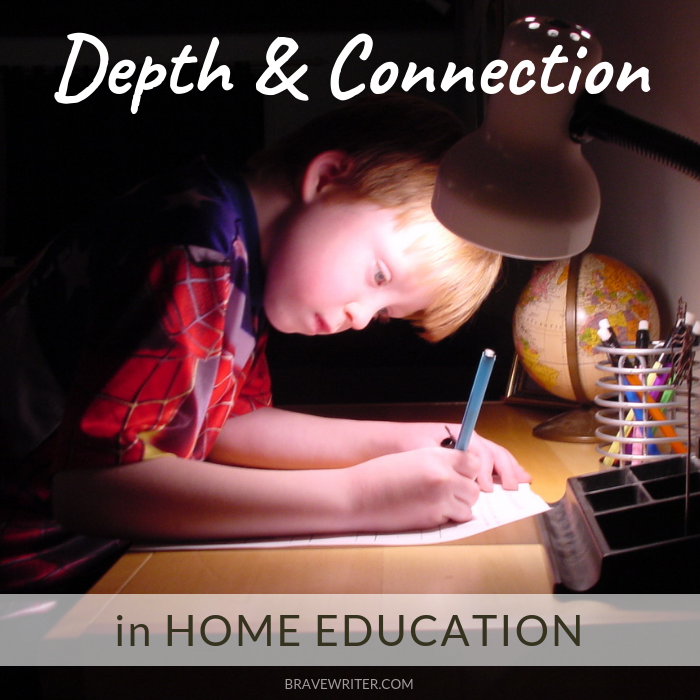
Depth and Connection in Home Education

Because we focus on depth and connection when we teach, we don’t need repetition of activities to the degree that schools need it. We aren’t pushing kids through material to ensure we don’t “miss anything.” On the contrary, we have the opportunity to patiently focus on an individual moment in time, looking at a specific skill, working with that child until it is understood.

It may be that you will revise a single piece of writing with one child this year. If you do a thorough, caring, patient job with your child, ensuring that the child feels connected to you and open to the teaching (through kindness, consideration, and helpfulness), that single editing/revision experience may be enough for the entire year! It is possible to learn it all in that one paper—enough for this year’s effort. When a child is well taught—when you care to give full commitment once in a while to a specific skill—your student will “get it” and not need repeated pushes and nudges and practice over and over again to the point of irritation and tedium.

Instead, your child will be able to take what you imparted and then practice as needed using the skills acquired in that one event.

Likewise, you might find that your child produced one fabulous session of copywork where the handwriting looked elegant, and the proportions on the page were spot on, and the care to copy punctuation and indentation succeeded. That experience teaches so much more than dozens of pages of half-hearted effort.

We focus too much on what isn’t getting done instead of recognizing the power of specific, intentional, well-executed moments in time. Do your kids need to love every lesson? No. They don’t have to fall in love with writing to become good writers. They need the skills—they can get them with far less pain if you change your expectations. Quality instruction, affection and closeness over quantity of products.

Trust these single efforts. They are working better for you than you know.

Top image by Tim Pierce (cc cropped, text added)

Stages of Growth in Writing

Posted in Brave Writer Philosophy | Comments Off on Single Efforts can Teach Profound Skills

Focus on Content then Meaning

How to Correct Errors in Your Child's Writing

Writing Tip:
The Trick is to Focus on Content First

How do you correct errors without provoking tears?

The trick is to focus on content first. As we say in the biz, “Content is King!” Someone asked me what was “Queen” and I said, “Meaning.” So do it like this:

1. Start with content.

Focus on the topic, the insight, the great ideas or explanations or details that deliver the idea to the reader. You want to say words like:

“You know so much about roller coasters! It was surprising to read that the Raptor was so tall! I had no idea that the speeds got up to ___ mph. I could feel like I was on the coaster when you talked about the ‘wind whipping’ your hair. Great use of the ‘w’ sound.”

Notice that every comment is on the content – finding what is good in it, noticing it, remarking on it.

2. Now focus on meaning.

Notice if the writing makes sense, if it is conveying what it hopes to convey. So, make comments more like these in the “meaning” portion:

“I’m reading along here, and I notice that I got a little lost when I moved from this idea to the next one. Did you want it to read like this (read the run-on sentence all together with no stopping or pausing) or more like this (pause where a period should go to make it make sense)?”

When your writer chooses the second, you comment like this:

“To help the reader really get what you’re saying, a period here will make all the difference. Let’s put one in.”

How to Correct Errors in Your Child's Writing

This is how you work through the whole text. Punctuation is not just marks on a page, but a way to ensure that the reader gets the right, accurate understanding of ideas that the writer wants conveyed.

For weak language, you can say,

“I can tell that you think the ride was ‘awesome.’ The reader might want to feel what that is like. Can you think of more to say to unpack that word?”

And so on.

If a step in a process is missing, you want to note it conversationally:

“Oops! I got a little lost. Is there a step missing here? I don’t want to miss what you really want me to know.”

So start with content – be prolific in praise.

Then move to meaning – be conversational, friendly, and helpful.


Daily Writing TipsWish you had a bunch of Writing Tips in one place so that you could easily refer back to them whenever you wanted?

DONE!

We put 100 of our emailed Daily Writing Tips into a single document so you don’t lose them. It’s a digital product, so you can print the tips, put them on your iPad or tablet, or read them from a phone or laptop. Get your copy today! 


Top photo: woodleywonderworks (cc cropped, text added)

Posted in Writing about Writing | Comments Off on Focus on Content then Meaning

« Older Entries
Newer Entries »
  • Search the Blog

  • Julie Bogart
  • Welcome, I’m Julie Bogart.

    I’m a homeschooling alum -17 years, five kids. Now I run Brave Writer, the online writing and language arts program for families. More >>

    IMPORTANT: Please read our Privacy Policy.

  • New to Brave Writer? START HERE

  • FREE Resources

    • 7-Day Writing Blitz
    • Brave Writer Lifestyle Program
    • Brave Writer Sampler: Free Sample Products
    • Freewriting Prompts
    • Podcasts
  • Popular Posts

    • You have time
    • How writing is like sewing
    • Best curriculum for a 6 year old
    • Today's little unspoken homeschool secret
    • Do you like to homeschool?
    • Don't trust the schedule
    • You want to do a good job parenting?
    • If you've got a passel of kids
    • You are not a teacher
    • Natural Stages of Growth in Writing podcasts
  • Blog Topics

    • Brave Learner Home
    • Brave Writer Lifestyle
    • Classes
    • Contests/Giveaways
    • Friday Freewrite
    • High School
    • Homeschool Advice
    • Julie's Life
    • Language Arts
    • Movie Wednesday
    • Natural Stages of Growth
    • One Thing Principle
    • Our Team
    • Parenting
    • Philosophy of Education
    • Podcasts
    • Poetry Teatime
    • Products
    • Reviews
    • Speaking Schedule
    • Students
    • Writing about Writing
    • Young Writers
  • Archives

  • Brave Writer is a participant in the Amazon Services LLC Associates Program, an affiliate advertising program designed to provide a means for sites to earn advertising fees (at no extra cost to you) by advertising and linking to amazon.com

    Content © Brave Writer unless otherwise stated.

What is Brave Writer?

  • Welcome to Brave Writer
  • Why Brave Writer Works
  • About Julie
  • Brave Writer Values
  • Frequently Asked Questions
  • Speaking Schedule

Brave Writer Program

  • Getting Started!
  • Stages of Growth in Writing
  • The Brave Writer Program
  • For Families and Students
  • Online Classes
  • Brave Writer Lifestyle

…and More!

  • Blog
  • Classroom
  • Store
  • Books in Brave Writer Programs
  • Contact Us
  • Customer Service
  • Brave Writer Staff
© 2026 Brave Writer
Privacy Policy
Children's Privacy Policy
Help Center