The split between structured and unstructured learning.
Should you unschool?
Use curriculum?
Structure the learning or unstructure it?
Watch the broadcast below where I offer insight and answer questions.

The split between structured and unstructured learning.
Should you unschool?
Use curriculum?
Structure the learning or unstructure it?
Watch the broadcast below where I offer insight and answer questions.
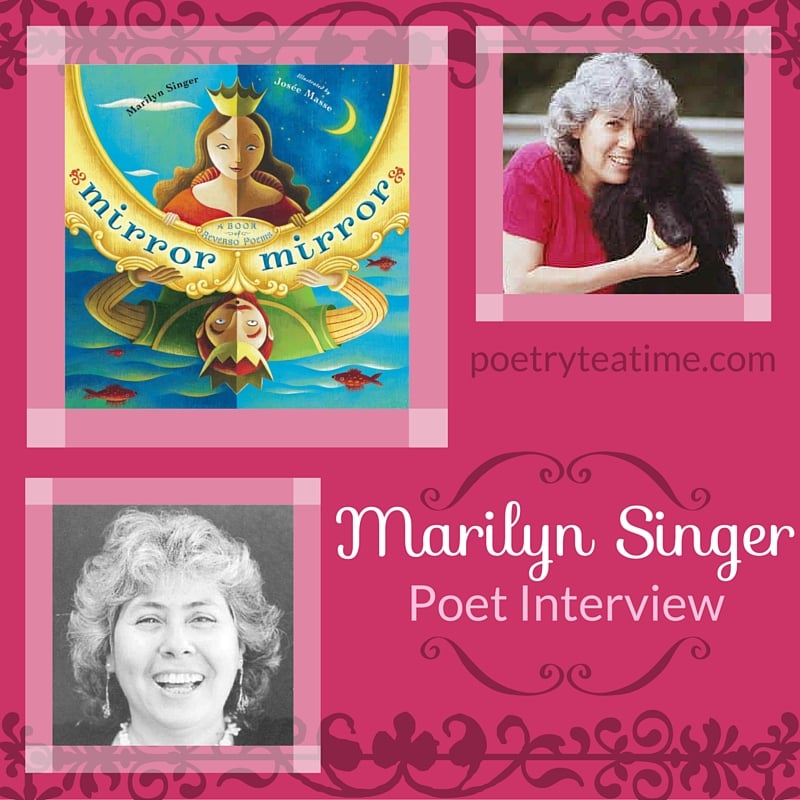
Welcome to our first Poetry Teatime Podcast!
I was honored to interview Marilyn Singer, award-winning poet and author. Marilyn and I met for the interview long distance—she, in her home in Brooklyn, and me, Julie, in a library in Cincinnati.
Unfortunately the library failed us, a bit. The Internet connection was variable throughout and you will notice that in the recording. Stay with it, though. The content is fabulous (delightful) and the sound improves. You will hear the cooing of her doves in the background at times, too. Enjoy!
Also, be sure to explore Marilyn’s wonderful books of poetry, including Mirror Mirror and its sequel Follow Follow! (affiliate links)
Shared on Facebook last night:
As I crawl into bed exhausted tonight, all of you will be on my mind. Today was an extraordinary day for me and our team, and I hope for all of you. As Jeannette and I discussed moments ago, the Poetry Teatime website is a labor of love. We have been captivated by a vision and it is extraordinary to see it come to life!
My heart is full. I feel a shift coming to the way homeschooling can be known and experienced. Homeschooling has, for too long, been about “doing it right” whether the “right doing” came from a rigid schoolish application of text books, or the totally radical version of unschooling.
For decades, homeschooling has been a defensive movement—trying to prove to nay-sayers that it has value, that it is not only as good as, but better than, the public and private school alternatives. That worry/anxiety was necessary in some ways. It caused home educators to take the educations of their children seriously and it gave them the courage to stare down the traditional educational establishment.
Today, though, it feels like we can move on. As homeschooling finds its footing in the mainstream, we can let go of the need to wear sandwich boards and ring bells. Instead, perhaps we can turn our attention to the heart of our homeschool hopes and trust them. And what are those?
When these two experiences are natural to the family, learning flourishes. When either is absent, no amount of “right doing” fixes the stress and sadness that are beneath the daily drudgery.
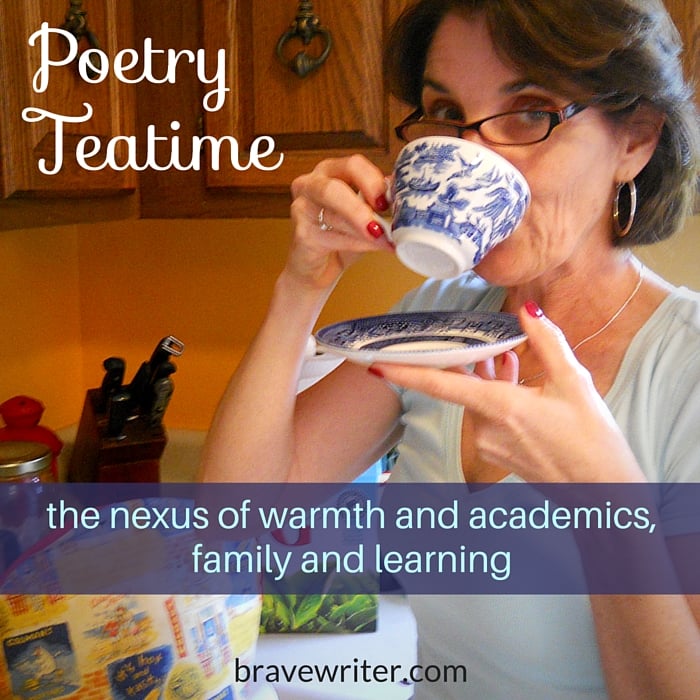
Poetry Teatime is that sweet spot—the nexus of warmth and academics, family and learning.
It’s a model of sorts—a felt sense that can be remembered in the body (not just wished for in the mind). When you’ve experienced that deep dive into poetry and shared learning, you will want to find ways to bring that same spirit to other subjects. Your own idea of what it means to homeschool shifts—it’s not about hitting markers or filling in workbooks or passing tests.
It’s this other thing—the thing we thought we were signed up to do only didn’t know how.
Today—it feels like we fully opened the door to “The Enchanted Education.” Your first blush with enchantment may just be poetry teatime.
Enchantment is not the result of mom working hard to throw a party that the kids will like. Rather, enchantment shows up spontaneously—when we “set the table” and enter fully into the joy of whatever topic is before us.
It’s my wish that homeschooling families would know happiness in all aspects of their lives together. Seems like poetry teatimes are a good place to start.
Thank you, again, for all the love today! It was a bit like a holiday for our team, because you made it so.
xo Julie

We’ve talked about what an Enchanted Education is.
Let’s look at what it is not.
Enchantment is not about Pinterest-worthy projects or crafts. The point is this: Academics are better received by children when the properties of surprise, mystery, risk, and adventure attend them. They are better mastered with some level of routine and measurable progress. The nexus of these elements is what creates and sustains momentum in the homeschool.
You can’t be all parties and you can’t be all workbooks. There needs to be some kind of mixture where the routine provides the sustained practice of academic growth, but the surprises and adventures lead to enthusiastic bursts and deeper dives.
The aim isn’t to create an arts and crafts homeschool, or even an elaborate series of spectacular events! (Remember: I’ve said I could only pull off one or two “parties” in a year, if that!)
The goal is to remember that for kids and teens, rote learning using pen and paper (abstraction) and receptive learning through reading text books is rarely enough to keep the enthusiasm high and the learning applied. Anyone can “enchant” learning because you have heart, connection to resources, and a home filled with space for exploration and coziness.
Take advantage of home (and for teens, take advantage of outside the home)! That’s your best way to think about enchantment.

Do your kids offer big resistance to handwriting, freewriting, or copywork? What do you do when your assurances that “This will be fun” are met with suspicion? Drop the rope! Here’s how:
Use writing around them—catch them in the act of thinking (when they aren’t expecting it) and jot down what they say to you (when they are really excited about what they are saying, not when you ask them to tell you something). It will be inconvenient. Just know that. Grab a scratch sheet of paper and jot it down. If met with suspicion, say, “No worries. I just want to save this to share with Dad later—it’s so good!”
Then do just that—share it with Dad at dinner, say, and do it in front of them.
What’s it about? Get curious in an interested way (not a “once I figure it out, I can get you to write” way). Let them know you are interested in whatever the block is. Then when you do know (if it’s boring or their hand hurts or they think they have nothing to say or copywork is not interesting), you can start there.
One suggestion from Charlotte Mason is to let students determine how many words (or letters!) they can attempt with full concentration and the habit of excellence. Then that’s all they have to do for that day. They get to say: “My attention is flagging” or “I lost interest” and stop right there. Tell them that if all they can sustain is a single well drawn letter, that will be enough for you. Then the next day they pick up where they left off. They may find that they will naturally increase when they are in charge of how much they write. The key, though, is to remind them of the importance of doing their prettiest work for that letter or word.
You might try doing your own copywork at the same time so that it is a group experience. Put on some wordless music.
Finally, if the passages are boring to them, you might look for jokes or puns where they get the next word each day without seeing the whole at once.