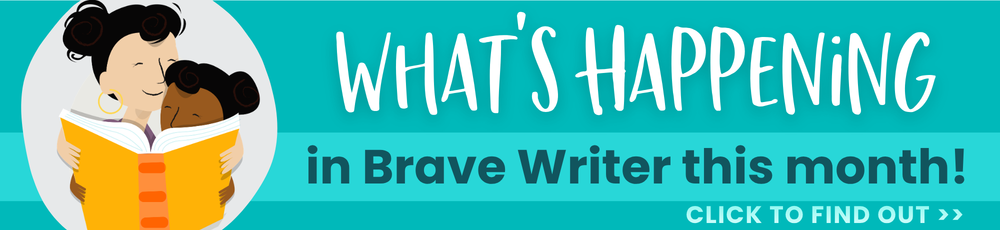
How Homeschooling Feels
Are you sick of trying to do a better job of homeschooling? Good!
That means you are closer to trusting yourself instead of comparing yourself to everyone else.
The biggest missing ingredient in today’s homeschools is confidence. Confidence comes from risk—try something! Put joy or curiosity at the center. If you don’t see those happening, pivot! You deserve to have a good life! That matters the most—way more than “hitting a bunch of standards.”
Experience Ahead of Image
Evaluate your homeschool by how it feels, rather than how it looks. Put your energy into creating an experience rather than an image. Every day we are shown pictures of smiling children, learning effortlessly in clean, trauma-free homes. Yet homeschooling thrives in lived-in homes, with caring adults who are growing and adapting.
You’re doing better than you realize every time you put experience ahead of image.
Need more support?
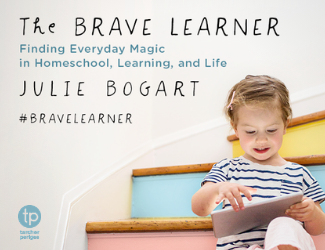
If that sounds impossible, read my book The Brave Learner. I spell it out for you. It provides handholds to make life a learning adventure rather than a carefully curated “school at home” that looks beautiful but feels rigid.
Get Ready to FLEX!
Summer is a great time to:
- Wander down a learning rabbit trail
- Sharpen skills ahead of fall
- Learn at a leisurely pace with our FLEX classes. (Keep reading!)
FLEX Online Writing Classes!
Back by popular demand: our Brave Writer FLEX classes, which help you flex your schedule around the rest of life …or just let you slow down the pace of our regular courses.
The details:
- Take five weeks to complete your four-week class, scheduling around vacations, camps, and other summer fun.
- Or just go “slo-mo,” giving your student more time with the material.
- Decide on the due dates that work best for you and your family. Your coach is ready when you are.
- Grab this option while you can: FLEX classes are only offered in summer!
Our students have been enthusiastic about this!
“I liked this course better than the classes that I’ve taken in the past because of the amount of freedom I had. The way I was able to submit my work in my own time was great for me.” – Justin
Grab that free and easy feeling for yourself and make your schooling work for you.
We’ve got four FLEX options:
- Essay Prep: Reading the Essay
- Essay Prep: Dynamic Thinking
- Essay Prep: Research and Citation
- Essay Writing 101: Analytic Essay
[Podcast #337] Life Skills
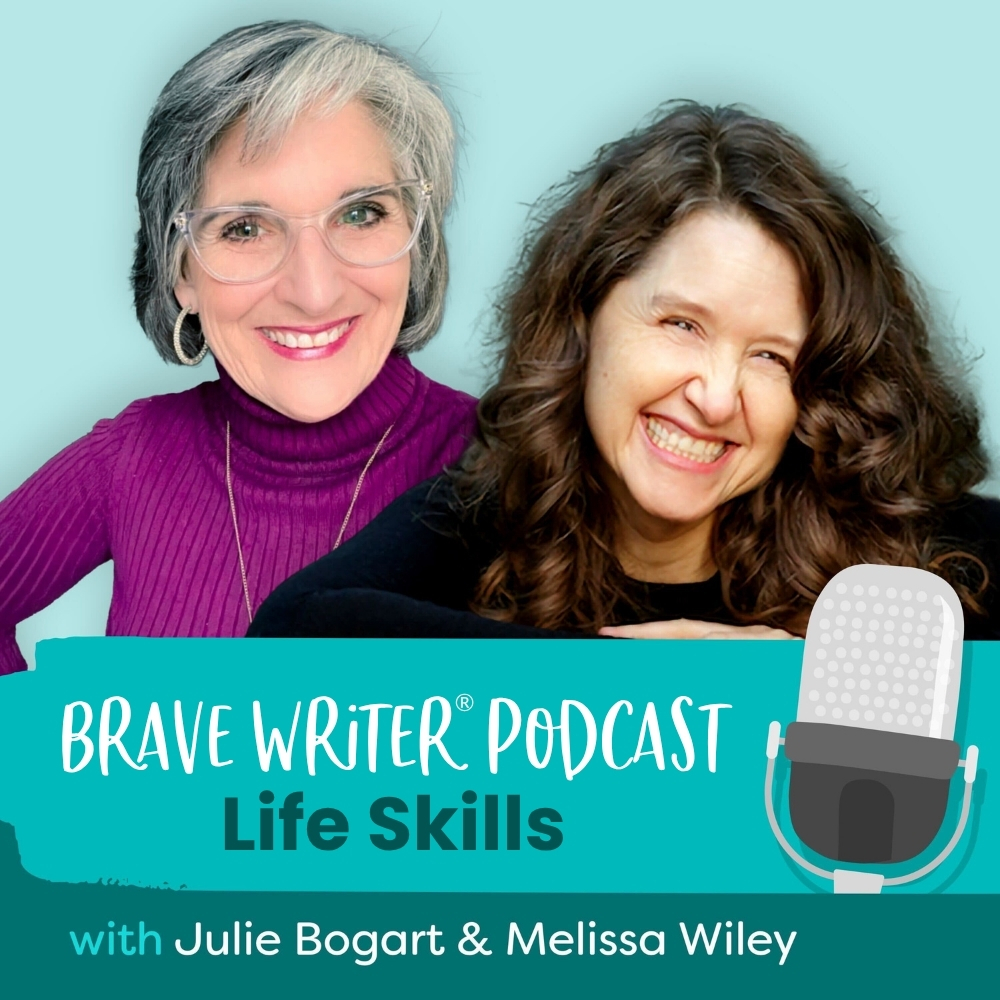
What do our kids actually need to know before they leave home?
In this Brave Writer podcast episode, we explore the everyday life skills that often get overlooked, from tying shoes and folding laundry to handling money, filling out forms, speaking with customer service, hosting guests, managing time, and learning how to do what life requires next.
We talk about why practical competence is part of education, not separate from it, and why homeschooling gives us a beautiful chance to teach these skills in real life, at the right moment.
Join us for a conversation about raising capable, confident kids who know how to participate fully in the world.
Show Notes
Why Life Skills Matter in Homeschooling
For many of us, education was shaped by categories: academic subjects belonged in school, while the practical parts of life were picked up somewhere else, somehow, later. We learned to think of reading, writing, and math as the real work, and everything else as secondary.
But that division has never made much sense.
Children do not live in separate compartments. They live one whole life. They need to know how to read, yes, but also how to button a shirt, fold a towel, speak to a receptionist, make a snack, write a thank-you note, and solve the small daily problems that make up ordinary human life.
That kind of competence matters more than we sometimes realize.
Life skills are already part of learning
One of the gifts of homeschooling is that we are not limited to a narrow definition of education. Learning can happen while sorting socks, setting the table, addressing an envelope, measuring flour, filling out a form, or checking the air in a tire.
A child learning to zip a coat is learning. A child folding laundry is learning. A child comparing prices at the grocery store, helping cancel a subscription, or practicing how to order food in a restaurant is learning too.
These moments may not look like formal lessons, but they are full of attention, memory, coordination, and judgment. They build familiarity with the world. They help children feel less intimidated by daily life because they have already had a chance to participate in it.
When we notice that, we begin to see practical competence not as a distraction from education, but as one of the ways education becomes real.
Start with what children can actually do
Life skills do not have to wait until children are older. In fact, many of them are easiest to teach when children are young and eager to imitate the grown-ups around them.
A young child can learn to tie bows, use scissors, snap buttons, sort clothing, fold napkins, wipe a table, or help set out plates and cups. These are small tasks, but they carry real weight. They strengthen dexterity, coordination, and confidence. They let a child feel useful.
As children grow, the skills can grow with them. Typing, baking, laundry, handling tools, filling out forms, learning phone etiquette, managing money, reading a calendar, and breaking large assignments into smaller pieces all become part of that wider education.
The point is not to hand children adult responsibility all at once. It is to let them grow into capability, one meaningful task at a time.
Practical competence builds confidence
Children feel more secure when they know how to do things.
That does not mean they need to do everything perfectly. It means they need experience. They need chances to try, to fumble, to ask questions, and to try again. They need to see that mistakes are part of learning, not proof that they are incapable.
This is one reason life skills matter so deeply. A child who knows how to speak to a cashier, write a check, use a screwdriver, make toast, or organize a school deadline begins to trust that unfamiliar tasks can be learned too.
That trust is the deeper lesson.
We are not only teaching children how to complete household tasks. We are teaching them that they are able to meet life as it comes.
The goal is not just knowledge, but participation
It is easy to let modern life become too abstract. We can watch videos about how to do something, save ideas for later, admire the finished result, and still never actually begin. Children can drift into the same pattern, especially when so much of life now happens on screens.
Homeschooling gives us a chance to move in a different direction.
We can invite children to participate. To stir the batter, make the call, address the envelope, greet the guest, clean the table, plant the flower, read the instructions, and solve the problem in front of them. We can let them experience learning as something lived, not merely observed.
What we want is bigger than independence for its own sake. We want children who feel at home in the world. Children who know that learning is not only about mastering subjects, but also about becoming capable, generous, attentive human beings.
Homeschooling does not only prepare children for life later.
It lets them begin living it now.
Resources
- Find our favorite read alouds and nonfiction in the Brave Writer Book Shop
- Brave Writer class registration is open!
- Visit Julie’s Substack to find her special podcast for kids (and a lot more!)
- Purchase Julie’s new book, Help! My Kid Hates Writing
- Find community at the Brave Learner Home
- Learn more about the Brave Writer Literature & Mechanics programs
- Start a free trial of CTCmath.com to try the math program that’s sure to grab and keep your child’s attention
- Subscribe to Julie’s Substack newsletters, Brave Learning with Julie Bogart and Julie Off Topic, and Melissa’s Catalog of Enthusiasms
- Sign up for our Text Message Pod Ring to get podcast updates and more!
- Send us podcast topic ideas by texting us: +1 (833) 947-3684
- Interested in advertising with us? Reach out to media@bravewriter.com
Connect with Julie
- Instagram: @juliebogartwriter
- Threads: @juliebogartwriter
- Bluesky: @bravewriter.com
- Facebook: facebook.com/bravewriter
Connect with Melissa
- Website: melissawiley.com
- Substack: melissawiley.substack.com
- Instagram: @melissawileybooks
- Bluesky: @melissawiley.bsky.social
Produced by NOVA
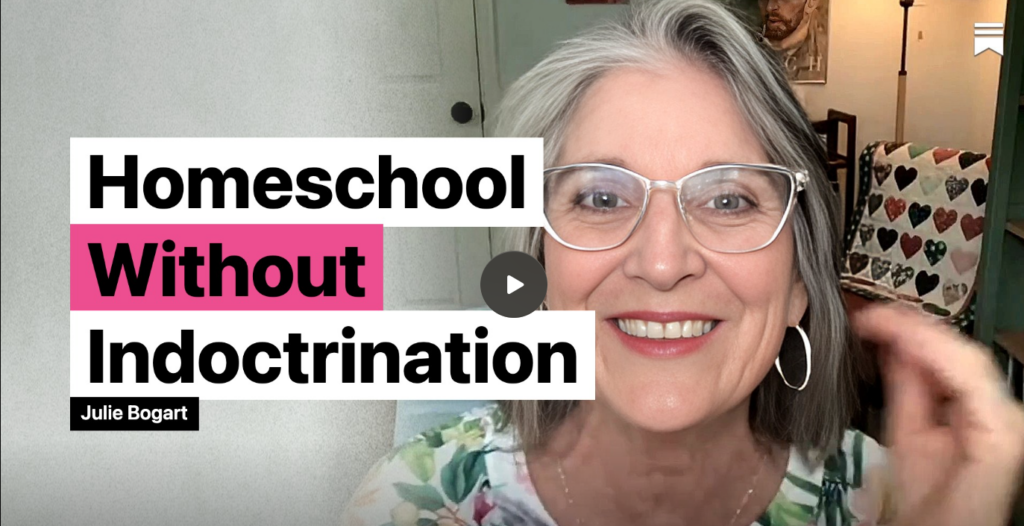
Homeschool Without Indoctrination
One of the topics I want to talk about is the current stream that I keep running across of antipathy toward homeschooling in general.
People who are pronouncing loudly on social media that there should never be any homeschooling, homeschooling is all indoctrination, homeschooling is always by unqualified adults and they are doing a disservice to children by pretending they can educate them.
But there is a way to home educate without indoctrinating. Watch this replay of a recent Brave Learning Substack live to find out how.
Subscribe to Brave Learning on Substack where we chat, discuss, problem-solve, and create together. Here’s what you can expect: weekly themed content, freewriting prompts, and a podcast for kiddos called Monday Morning Meeting (first 6 are free)!
Teaching Punctuation the Brave Writer Way: Commas
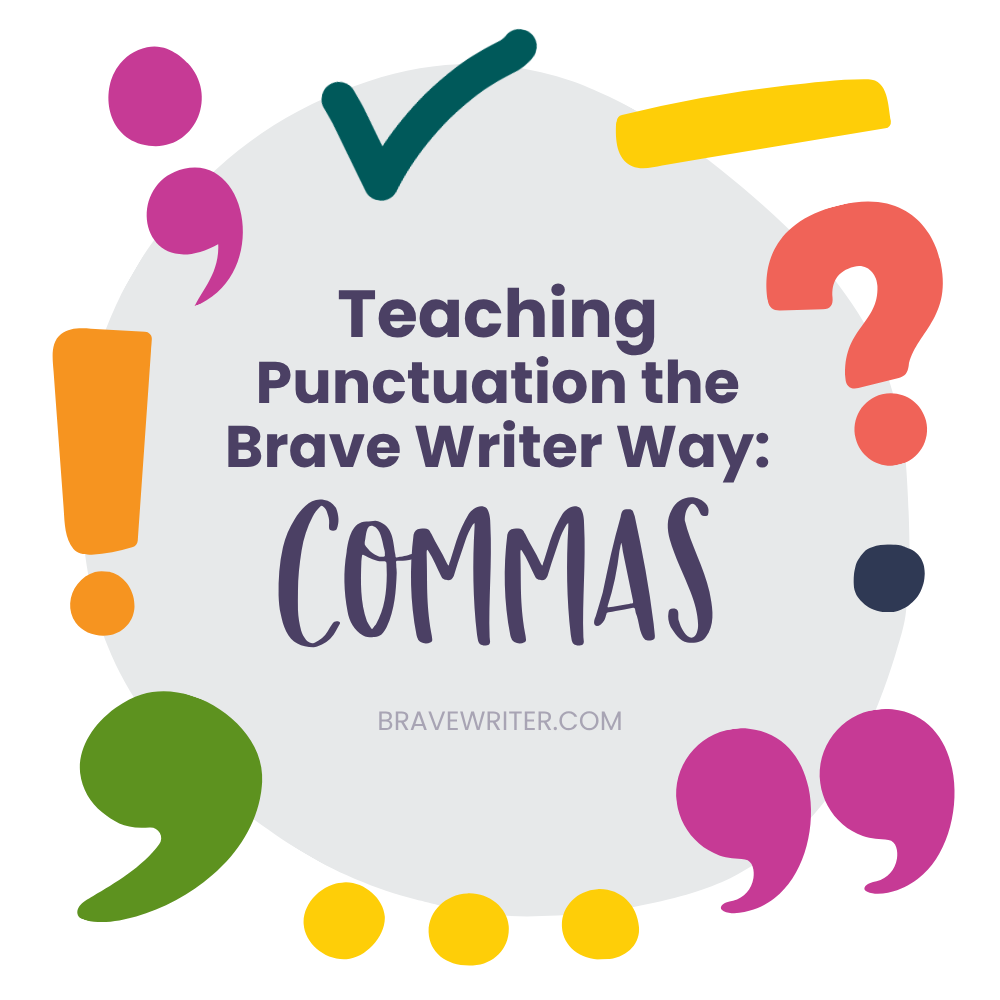
Want a look at how Brave Writer teaches punctuation? Below is one example.
For commas, we start by making a passage make no sense so that when a child goes to make corrections, it is to improve the meaning and intelligibility of that passage.
Teaching Tip
Want to teach about commas?
- Pick a short passage from a favorite book.
- Do a little violence to it by putting a bunch of commas in lots of WRONG places.
- Read aloud the passage, pausing for each comma.
- Notice how that harms the writing (interrupts the natural flow, makes the meaning difficult, etc.)
- Now, remove all of the commas.
- Read aloud the passage again, not pausing at all.
- Notice what that does to the writing (makes it hard to understand, sounds monotonous, etc.)
- Finally, hand a copy of the passage with no commas to your child and ask them to add commas in the places where “it feels right.”
- Talk how that helps the writing (sounds more natural, makes the meaning clearer, etc.)
Remember, teaching the “right” way by showing the “wrong” way first can help! It’s one of the strategies that makes grammar, punctuation, and spelling instruction stick.