August 2005 - A Brave Writer's Life in Brief A Brave Writer's Life in Brief
  • Start Here
    • For Families
      Multiple Ages
    • Ages 5-7
      Beginning Writers
    • Ages 8-10
      Emerging Writers
    • Ages 11-12
      Middle School Writers
    • Ages 13-14
      High School Writers
    • Ages 15-18
      College Prep Writers
  • Shop
    • Product Collections
    • Bundles
    • Writing Instruction Manuals
    • Literature & Grammar/Punctuation
    • Composition Formats
    • Literature Singles
    • Homeschool Help
    • Book Shop
  • Online Classes
    • Class Descriptions
    • Class Schedule
    • Classroom
    • How Our Classes Work
    • Our Writing Coaches
    • Classes FAQ
  • Community
    • Brave Learner Home
    • What’s Happening
    • Blog
    • Podcast
    • Calendar
  • Cart
  • My Account
    • My Online Classes
    • My Account
  • My Account
    • My Online Classes
    • My Account
  • Start Here

    If you’re new to Brave Writer, or are looking for the best products for your child or family, choose from below:

    • For Families
      Multiple Ages
    • Ages 5-7
      Beginning Writers
    • Ages 8-10
      Emerging Writers
    • Ages 11-12
      Middle School Writers
    • Ages 13-14
      High School Writers
    • Ages 15-18
      College Prep Writers
  • Shop

    If you’re already familiar with Brave Writer products, go directly to what you’re looking for:

    • Product Collections Browse the full catalog in our shop
    • Bundles Everything you need to get started
    • Writing Instruction Manuals Foundational Writing Programs
    • Literature & Grammar/Punctuation Grammar, Punctuation, Spelling & Literary Devices
    • Composition Formats Writing Assignments for Every Age
    • Literature Singles Individual Literature Handbooks
    • Homeschool Help Homeschooling Tools and Resources
    • Book Shop Books associated with Brave Writer Programs
  • Online Classes
    • Class Descriptions
    • Class Schedule
    • Classroom
    • How Our Classes Work
    • Our Writing Coaches
    • Classes FAQ
  • Community
    • Brave Learner Home
    • What’s Happening
    • Blog
    • Podcast
    • Calendar
  • Search
  • Cart

Search Bravewriter.com

  • Home
  • Blog

A Brave Writer's Life in Brief

Thoughts from my home to yours

Archive for August, 2005

« Older Entries

Finishing writing goals

When I was in second grade, my mother gave me a book called All About Me and consequently, I loved that book (my favorite topic, naturally). It included riveting details such as whether or not I had hazel eyes, how humiliatingly short I was for my age, and how many steps from my house to the nearest dry cleaner. Important, must-know kinds of stuff, obviously.

The end of the book had a section where you could write a story. I launched into that page with a pencil and second grade handwriting. My epic drama was about puppies and kitties, and don’t worry, they all lived happily ever after. Actually, they lived happily all the way through. Plot was not my strong point—zero story arc, no climax or conflict… but they sure cuddled and played alot.

My writing career continued in this vein for years. I wrote in diaries (about boys) and in notebooks (long winded unfinished stories about St. Bernards rescuing skiiers in Switzerland because I grew up next to Malibu beach with smog and surfers). Write what you know!

I sat on the corner of a busy intersection looking at roses in the median divider and realized for the first time in the universe: a rose is a metaphor for beauty and pain – look at those soft petals! Look at those thorns! Oh the depth! Oh the insight! Oh the cliche!

My personal writing has this unfinished, play in the mud quality to it. It’s not interesting to read unless you’re me, and then you love to read it. I like the sound of my own words, the themes and insights (Dali Julie Lama), the way one word can devastate a sentence, bringing the reader (that would be me) cheap thrills.

My “real world” writing (for grades or publishing) does get finished. I can wrestle the beast to the ground when I must. And there is nothing like having other readers besides this audience of one. Still, there lurks inside me a wild writer. I want to send plagues or overheat cars.

So yesterday was a HUGE day for me.

I completed my first novel. It is 51, 172 words and 180 pages long.

I wrote it while I was working on the high school book. Yes, I’m nuts.

It’s a freewheeling, wretched, sparkly piece of work. I won’t even let Jon read it. But after so many years of playing at the edges of writing a full length piece of fiction, and bringing it to completion, it is just fabulous to have done it. I had to share! (Note: I’m 43 years old… if your kids are under 43, you don’t have to make them finish their fiction until then.)

The book responsible for this transformation in me is a part of a national novel writing movement: No Plot? No Problem (Perfect for this puppy and kitty cat writer). The typical month for noveling is November, but that’s a bad month for me. So I picked August.

If you have a novel lurking behind your navel, this book will drag it out of you. Try it, you’ll like it (teens and adults welcome).

The book is written for adults. He uses adult scenarios such as business meetings, after work drinks and so on. I don’t recall any language issues, but just wanted to clarify for moms who want to know what they’re handing their kids. Flip through the pages and check out the website yourself first.
Posted in Brave Writer Philosophy, General | Comments Off on Finishing writing goals

Susan Schaeffer Macaulay on children as persons

“When we begin studying the person, the real child, we must serve who he is, not fit him into our schedules or plans. Part of this is allowing him play.”

(For the Children’s Sake 25)

Posted in Advice from the pros, Brave Writer Philosophy, Copywork Quotations, General | Comments Off on Susan Schaeffer Macaulay on children as persons

Friday Freewrite: What is the subject you’re avoiding?

Write about it.

Posted in Friday Freewrite, General | Comments Off on Friday Freewrite: What is the subject you’re avoiding?

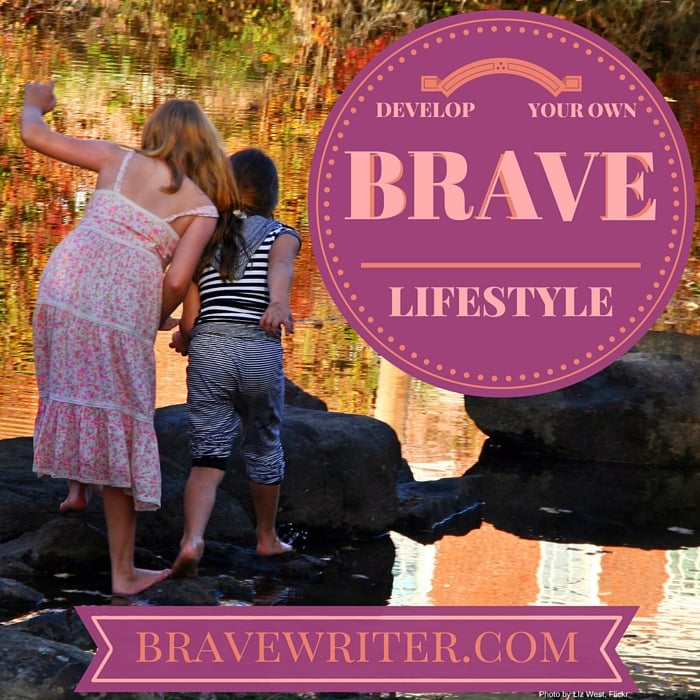
Planning Your Own Brave Writer Lifestyle

Develop your own Brave Writer Lifestyle in your Homeschool

Every summer I get a few emails essentially asking the same thing…

How do you plan your school year? Do you require your kids to accomplish and certain amount of work daily or weekly?

I’ve been at this home education thing for seventeen years. I don’t like to set up a schedule that focuses on specific subjects. What I try to do is to make sure that the things we say we want to do, get done. So if a child wants to go to the zoo, I make sure it’s on the calendar somewhere or we’ll never go. If someone wants to be sure not to miss a Discovery channel program or a movie, we get the DVR set to record it. If a child expresses an interest in cake decorating, we find a class. I see my primary role as that of facilitator. I make things happen for my kids (the things they can’t do because they don’t drive, don’t have money or don’t have the awareness of the opportunities).

Do I schedule copywork or dictation? Are my kids required to work through a math text? Do we follow a history program? Are we setting academic goals?

My simple answer. No.

Now for my more complicated answer.

Live your joy in the presence of your children.

Click to Tweet

The Brave Writer Lifestyle is a snapshot of the way we live. Copywork and dictation are done by those kids that enjoy them or see benefit in them. Those who don’t like them, don’t do them. Simple as that. I see these tools the way someone might look at a drawing program. You can learn to draw using a course and following the steps that the instructor suggests so that you draw a face with accuracy, for instance. But that isn’t the only way to learn to draw a face. It’s just that those exercises, measurements and techniques are effective, so why not use them? Artists have cultivated habits that help non-artists learn to draw.

Same with learning to play the piano. You can try to learn on your own (my son has done this), but it’s often easier if you have a book and an instructor who gives you exercises (my daughter is doing this).

I see writing the same way. There are methods and techniques, habits and practices that encourage and foster writing skills. Kids (and parents!) who want to write well will do them because they want to write well.

Kids who haven’t yet discovered the power of writing or the desire to write or the value of written communication may not get the point of copying a poem or quote the way E.M. Forster did every day. If a child slogs through the practice that is meant to enliven his writing, will it still work? It may (or may not) but he won’t be a happier, more enthusiastic writer at the end of it. Likely, he’ll be grumpy and become a resistant writer.

The first step, then, has to be that writing comes to life for the child! (And I’ve devoted a lot of space to that concept so I won’t do that again here.)

When I looked, really looked, at history, math, science and so on, I applied a similar principle. What tools get the job done for kids who’ve discovered that these are subjects they’d like to know more about?

I bring into the home that which the kids wouldn’t think to study or enjoy on their own (Sister Wendy Art videos, rock examination kits complete with cool magnifying glasses, books about the Civil Rights Movement, strategy games, math puzzles, Shakespeare films and plays, painting supplies, binoculars and bird feeders…). I offer these with genuine enthusiasm because even if not a single kid in the family cares about them, I do!

Planning Your Own Brave Writer Lifestyle

I live my joy in the presence of my children.

And then we talk… we talk lots.

I share what I know that they don’t – for instance, how to get into college, what kinds of skills will help them succeed as adults, how we can tackle the subject they don’t like so well but that seems important to their futures (and I wait for the child to “catch” the vision… I don’t impose) and so on. My 11 year old discovered recently that handwriting mattered to him… for the first time in his life. He is now handwriting each day on his own to improve. I supply tools: notebook, pencil, poetry book, stand to hold book open, clean table, and so on.

My daughter wants to read fluently so we read together every other day. She sets the pace and we spend the time it takes. I check out books from the library that she can read.

I have two teens (16 and 13) who are preparing for college. They follow math programs because that works best for them. My daughter (16) said to me once that when I stopped requiring math, she suddenly realized she needed it. She woke up one day and realized that if she didn’t keep up with her program, she would limit her options for her future. So she stopped trying to “get out of it” each day and started working hard. She took off an entire year from doing math in 9th grade and is now in 11th and is almost done with Algebra II on her own with a tutor. She made up for her “lost time” with motivation.

My oldest (18) has not finished enough science to get into college. Last night, he shared with me that he wishes he’d gone ahead and completed the science last year, but that he didn’t have the vision yet. Did he blame me? No. I had laid out for him a possible plan that would work, but he didn’t choose my plan. So he is now evaluating the choices still open to him. In the meantime, we have a great relationship because it hasn’t been about my pushing him to see what he didn’t see himself.

And he’s taking a college course anyway, of his own choosing, on his own path.

So when I plan the school year, I do think about where they are and where their skills could go. I imagine writing we can do together (similar to what I shared in the June and July issues of the Arrow and Slingshot) and pencil those ideas in. The ideas I shared in those issues come from my own experience of sorting out how I can work with my kids intentionally, but without coercion. Then I offer and suggest and create as inviting an environment as I can and see what clicks. I help kids who want help and I back off of kids who are engaged elsewhere.

Then I trust. I trust the process and I stay involved. Those two principles under gird everything we do.

So do I plan?

Yes. I spend time planning games, outings, outside lessons for playing piano or painting, tutorials for math or science that they want but I can’t teach, writing ideas that will stimulate them, movies to watch, field trips to take, nature hikes to go on, and all the fun snacks we can bake for our poetry tea times. Those take a lot of planning.

Julie

P.S. This philosophy of home education has taken years to evolve. Don’t worry if you are living a different reality currently. This is how we do it. It fits us. I offer it as a window of insight into our home. You will develop a lifestyle that is your own.

Top image by Liz West (cc Modified to Add Graphics)

Tags: Brave Writer Lifestyle, braveschooling
Posted in Brave Writer Lifestyle, Brave Writer Philosophy, Homeschool Advice | Comments Off on Planning Your Own Brave Writer Lifestyle

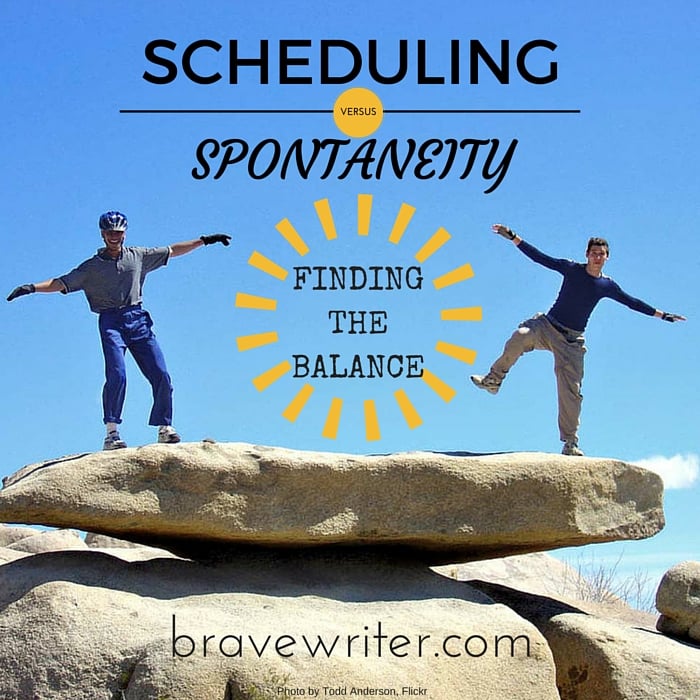
Homeschool Planning: Finding the Balance Between Scheduling & Spontaneity

Home school planning tips

Do you wish you were more spontaneous? Or do you think you need to “stick to a schedule”?

Because I’ve been a writing fiend this summer, I haven’t taken the time I usually take to anticipate the start of our fall routine. I like fall because it gets cooler again and we can spend more time outside. One year we worked through a book on how to draw with charcoals and sat outside every day for a couple of weeks drawing!

We also tend to take nature walks in the fall because there is less rain and Ohio has the best trees in the world.

Yesterday my daughter asked me and one of our boys to take the dog for a walk with her. I hopped up from the computer and out the door we went. As we walked, we had this conversation. I offer it as a sample of how to include your kids in your plans. (Sometimes we forget to do that.)

Caitrin hands me the leash so she can climb a tree. Liam walks along with me as Rocky (dog) drags me forward.

Me: So would you prefer a routine this fall, you know, a calendar with activities planned on it, or do you like it better when we are more spontaneous?

We’ve done both in the past and I try to get a feel for what the kids want.

Liam: I like being spontaneous best, but then sometimes we don’t do the things I like as often. But I don’t like schedules.

Me: That makes sense. What if we make a big calendar and add some activities to it sort of like place holders? Then we can decide that morning if we still want to. But at least we won’t forget what we wanted to do at one time when we were planning.

Liam: That sounds good.

Me: What would you put on our calendar?

Our calendar helps us create windows of time for spontaneity.

Liam: I like it when we take nature walks.

Me: How often? Once a week? Once a month?

Liam: Let’s go every other week.

Me: Okay. What about teatimes and reading aloud?

Liam: Every day!

Me: How about we definitely do teatimes once a week and then if other days feel right, we’ll do those spontaneously? And we will always read aloud every day.

Caitrin swung down from the tree and rejoined us.

Caitrin: I want to go to museums but NOT art museums.

This made me sad. She got tired of art museums in Italy and now she’s forgetting how much she loved our Cincinnati art museum.

Me: Good idea. We’ll check out some other kinds. If anyone wants to come with me to the Cincinnati or Dayton art museum, I’ll be going. I love them.

Liam: I will! I still love them.

Caitrin: Well, I’ll probably come too. Can we go to the library every week?

Me: Yes. We need to do that again.

With bigger kids in the house, we’ve gotten out of the habit of going to the library as a family and she misses that. So I want to make sure the younger ones and I go again each week.

Then we discussed copywork and reading to me and freewriting… for each one, we looked at how they could participate in ways that fit their personalities, skills and desires. Liam wants to improve his handwriting (his idea) but he finds it a struggle to handwrite. He has been working on this alone now for a week. He asked me to put it on the calendar so that he will remember to at least consider doing it each day. 🙂 Nice solution. He wants to remind himself.

Caitrin likes to work on reading but only every other day.

This is how we figured out the fall. It was so nice to walk and chat and let the dog sniff every mailbox in the neighborhood. They are looking forward to the routine and the spontaneity, both.

Image by Todd Anderson (cc Changed to add graphics.)

Brave Writer Online Writing Class Nature Journaling

Write, hike, and draw together!

Our Nature Journaling class turns your aspiration to study nature into a “dream come true”! Fun for all ages!

Click on the flower to learn more about using Nature Journaling in your homeschool!

Tags: bravewriter lifestyle, planning tips
Posted in Brave Writer Philosophy, Homeschool Advice | Comments Off on Homeschool Planning: Finding the Balance Between Scheduling & Spontaneity

« Older Entries
  • Search the Blog

  • Julie Bogart
  • Welcome, I’m Julie Bogart.

    I’m a homeschooling alum -17 years, five kids. Now I run Brave Writer, the online writing and language arts program for families. More >>

    IMPORTANT: Please read our Privacy Policy.

  • New to Brave Writer? START HERE

  • FREE Resources

    • 7-Day Writing Blitz
    • Brave Writer Lifestyle Program
    • Brave Writer Sampler: Free Sample Products
    • Freewriting Prompts
    • Podcasts
  • Popular Posts

    • You have time
    • How writing is like sewing
    • Best curriculum for a 6 year old
    • Today's little unspoken homeschool secret
    • Do you like to homeschool?
    • Don't trust the schedule
    • You want to do a good job parenting?
    • If you've got a passel of kids
    • You are not a teacher
    • Natural Stages of Growth in Writing podcasts
  • Blog Topics

    • Brave Learner Home
    • Brave Writer Lifestyle
    • Classes
    • Contests/Giveaways
    • Friday Freewrite
    • High School
    • Homeschool Advice
    • Julie's Life
    • Language Arts
    • Movie Wednesday
    • Natural Stages of Growth
    • One Thing Principle
    • Our Team
    • Parenting
    • Philosophy of Education
    • Podcasts
    • Poetry Teatime
    • Products
    • Reviews
    • Speaking Schedule
    • Students
    • Writing about Writing
    • Young Writers
  • Archives

  • Brave Writer is a participant in the Amazon Services LLC Associates Program, an affiliate advertising program designed to provide a means for sites to earn advertising fees (at no extra cost to you) by advertising and linking to amazon.com

    Content © Brave Writer unless otherwise stated.

What is Brave Writer?

  • Welcome to Brave Writer
  • Why Brave Writer Works
  • About Julie
  • Brave Writer Values
  • Frequently Asked Questions
  • Speaking Schedule

Brave Writer Program

  • Getting Started!
  • Stages of Growth in Writing
  • The Brave Writer Program
  • For Families and Students
  • Online Classes
  • Brave Writer Lifestyle

…and More!

  • Blog
  • Classroom
  • Store
  • Books in Brave Writer Programs
  • Contact Us
  • Customer Service
  • Brave Writer Staff
© 2026 Brave Writer
Privacy Policy
Children's Privacy Policy
Help Center