Young Writers Archives - Page 9 of 34 - A Brave Writer's Life in Brief A Brave Writer's Life in Brief
  • Start Here
    • For Families
      Multiple Ages
    • Ages 5-7
      Beginning Writers
    • Ages 8-10
      Emerging Writers
    • Ages 11-12
      Middle School Writers
    • Ages 13-14
      High School Writers
    • Ages 15-18
      College Prep Writers
  • Shop
    • Product Collections
    • Bundles
    • Writing Instruction Manuals
    • Literature & Grammar/Punctuation
    • Composition Formats
    • Literature Singles
    • Homeschool Help
    • Book Shop
    • Special Offers
  • Online Classes
    • Class Descriptions
    • Class Schedule
    • Classroom
    • How Our Classes Work
    • Our Writing Coaches
    • Classes FAQ
  • Community
    • Brave Learner Home
    • What’s Happening
    • Blog
    • Podcast
    • Calendar
  • Cart
  • My Account
    • My Online Classes
    • My Account
  • My Account
    • My Online Classes
    • My Account
  • Start Here

    If you’re new to Brave Writer, or are looking for the best products for your child or family, choose from below:

    • For Families
      Multiple Ages
    • Ages 5-7
      Beginning Writers
    • Ages 8-10
      Emerging Writers
    • Ages 11-12
      Middle School Writers
    • Ages 13-14
      High School Writers
    • Ages 15-18
      College Prep Writers
  • Shop

    If you’re already familiar with Brave Writer products, go directly to what you’re looking for:

    • Product Collections Browse the full catalog in our shop
    • Bundles Everything you need to get started
    • Writing Instruction Manuals Foundational Writing Programs
    • Literature & Grammar/Punctuation Grammar, Punctuation, Spelling & Literary Devices
    • Composition Formats Writing Assignments for Every Age
    • Literature Singles Individual Literature Handbooks
    • Homeschool Help Homeschooling Tools and Resources
    • Book Shop Books associated with Brave Writer Programs
    • Special Offers
  • Online Classes
    • Class Descriptions
    • Class Schedule
    • Classroom
    • How Our Classes Work
    • Our Writing Coaches
    • Classes FAQ
  • Community
    • Brave Learner Home
    • What’s Happening
    • Blog
    • Podcast
    • Calendar
  • Search
  • Cart

Search Bravewriter.com

  • Home
  • Blog

A Brave Writer's Life in Brief

Thoughts from my home to yours

Archive for the ‘Young Writers’ Category

« Older Entries
Newer Entries »

Take back our power in language

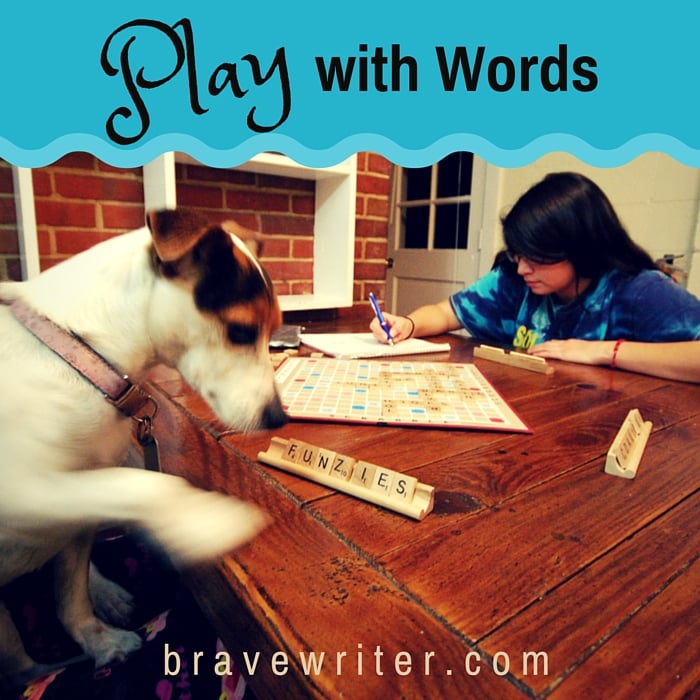
Play with words

It’s about time we take back our power in language. We are not controlled by Mrs. Cox, the ghost of public school past sitting on our left shoulders. We are free. We are at home. Let’s figure out how to make writing a freeing, liberating, sparkly experience, shall we?

You know how we let our kids take apart an old phone or toaster to see how it’s made, to learn how to use a screw driver, and to have the satisfaction of working on a “real” household item? That’s a great thing, isn’t it? Little screws lying on the ground, bits of wire, the metal tray, the coils that heat… It’s amazing to see it in pieces and to marvel at the fact that someone knew how to put these bits of metal and wire together to make a tool that burns our toast! Taking the toaster apart is more effective to teach us about the toaster than studying it in a book or even making toast, right?

Some of us have rooms dedicated to art exploration—a similar freedom to discover. We might keep an easel, paints and brushes available any time, a tray of pastels or colored pencils, and stacks of scratch paper.

Still others of us will collect musical instruments—percussion and piano, recorders and flutes, and two kinds of guitars! Or maybe we’re the kind of family who has a whole slew of balls, frisbees, hockey sticks, hoops, and goals available to practice a favorite sport or to learn a new one.

We know that play and exploration produce learning.

By contrast, we’re reluctant to play with, take apart, explore, and mess with language. Why? I don’t know. Perhaps it’s the grammar hangover from school where teachers are more about accuracy than inspiration.
Flip the script.

What if your house had an accuracy-free play-zone for words? What would be in it? How about a variety of writing utensils (gel pens, fountain pens, markers, sidewalk chalk, calligraphy quills, crayons, lipstick)? How about some unique writing surfaces (butcher paper taped in a big sheet to a wall, dry erase board, chalkboard, clipboard, various sizes of lined paper, cards, notecards, postcards, an iPad, a mirror, colored paper)?

How about making a stack of notecards with all the words you like—a whole big mixture of words you collect for a week, one per card?

How about putting individual punctuation marks on notecards (a comma card, a period card, an exclamation point card, a quotation marks card, a question marks card – or several of each!)? Then use your word notecards to make a sentence and lay the punctuation marks where you want them to go. Walk around the room and lay them out on the floor. If you want, you can use big poster boards rather than tiny notecards.

Begin by punctuating it all wrong, first. See what happens when you start a sentence with a period or an exclamation point? What if you put one in the middle of the sentence?

What new uses of these marks can you think of?

Are you getting the idea? Language is not meant to be treated like an antiseptic vaccine. It’s a toy! Play with it! See what happens. Discover how the pieces of language and writing work together to create meaning and joy, communication and inspiration.

Brave Writer Online Classes
Top Image by Virginia State Parks (cc cropped, tinted, text added)

Posted in Homeschool Advice, Language Arts, Words!, Writing Exercises, Young Writers | 4 Comments »

Pat Schneider on honoring geniuses

My goodness. How can I not share this today?

“Genius often emerges where there is intimate support for it. Shakespeare worked in the intimate supportive community of a strong theater that wanted his next play. Dickinson worked within the intimate community of a family that loved her and protected her time and privacy. Neither of them were seen by their contemporaries as being greatly gifted. It seems truly important that there be a community of support around the artist that protects the making of art” (Pat Schneider *Writing Alone and With Others* xxi).

This quote struck me this morning as I work on the Partnership Writing product. What I know about homeschooling families is that they are uniquely intimate. That’s not to say there isn’t intimacy in families with kids in public or private schools. Rather, home education creates a context where genius can thrive. Why? Because there are no other people on the planet who are as predisposed to recognize the particular genius of children as the parents of those same little people.

Every time I speak, I’m inundated with mothers who share with me the brilliance of their kids—the breadth of imagination, the depth of vocabulary, the surprising accumulation of facts that the parent never saw the child amassing. Over and over again, parents marvel at who lives inside the skin of their children.

It’s from that appreciation, that “what a miracle is my child” posture that writing growth can occur! We are not fighting for success in grammar and punctuation. Our mission is not the proper execution of essays. We are not charged with critiquing and down-dressing our children for what appears to be lethargy or ineptitude.

Our chief mission at home with our children is to discover and articulate their particular brilliances, and then to fiercely protect the space into which they cast their risky thoughts so that they may take the tentative steps toward refining that genius, knowing they are emotionally supported and respected.

You get to do that work! Not a school. Not a theater company. But like Emily Dickinson’s family, you may provide for your children the emotionally safe, enthusiastically prepared environment that allows for risk-taking, failure, exaggeration, and blossoming—all in one.

Geniuses. That’s who you’re raising. Make sure you remember that today.

Posted in Brave Writer Philosophy, On Being a Mother, Young Writers | Comments Off on Pat Schneider on honoring geniuses

Zippy tips for kids

2 zippy tips to get those rascals of yours on board

I promised that before the school year started, I’d give you a couple of pointers for how to get those kids of yours to buy into their homeschool experience. Here they are, in the nick of time!


1. Psst: They can’t read your mind. Let them in on your plans!

You know what I hate? I hate being super-duper excited about an idea I have that is sure to change the world, or at least tomorrow morning, only to have a kid—my kid!—roll her eyes at me and scowl.

I hate putting in endless hours reading, discussing, pondering, imagining, and preparing for this most-holy-and-awesome project only to meet sarcastic rejoinders, bored stares, and dawdling.

I hate being convinced by my posse of homeschool mom friends that the curricula I used last year blows and this new one is perfect, only to discover that I hate the first five paragraphs of explanation and now feel obligated to use it because of all the money I spent. I hate that my kids can tell I’m not excited and they make it worse by complaining…. OUTLOUD SO I CAN HEAR THEM.

Homeschooling is hard enough.

It’s intolerable when your kids DON’T WANT TO DO WHAT YOU WANT THEM TO DO.

To help your little rascals get into that same head space you’re in, you want to use a skill you’re famous for teaching your children: narration. Narrate aloud in a kind of Shakespearean soliloquy the process you are going through/went through that led you to this particular moment in time.

For instance, you might wake up one morning and move through the kitchen-family room talking aloud like this (while clearing shoes from the floor and empty dirty cups from horizontal surfaces):

You know, yesterday during nap time, I paged through our Incan chapter in the history text. Did you know they made these interesting patterns on clay pottery? I thought to myself, ‘I would love to paint pottery like that.’ Then I wondered how difficult it would be to get some clay to make the pots first. Easy! We have that Michael’s coupon.

Then I imagined what it must have been like for the archaeologists to have found those broken pots in the ground so many hundreds of years after they’d been made. You know?

So I got to thinking. What if I made a pot, painted it with cool Incan designs, smashed it with a hammer, and buried it in the backyard between layers of cardboard to show what century it came from? Then you guys could dig up the broken pots!

Or, even better, I wondered if you’d want to paint, smash, and bury the pots for me to dig up? Or we could do it for each other. Do you think you’d like to do something like that? Look at these pictures!

You model your process by narrating it to the kids. You invite them to move with you through the thoughts and ideas you generated so they have time to “catch up” to you and imagine it with you.

Sure, most kids would love to paint designs, hammer pots, and dig holes in the ground. But sometimes even your best ideas feel overwhelming to kids when they get dumped on their heads while they’re still wiping sleep from their eyes.

What do you do if the idea you have is
less immediately exciting?

When you want to move into a new set of workbooks, or you have decided to change how you teach math, or perhaps you have a child who will need to work harder than usual to learn to handwrite, you want to narrate your thinking process there too. But add brownies and some cuddle time.

(While on the couch, snuggled close together)

Sweetie, you know how we’re not enjoying ________ (math, writing, cursive, reading) right now? I have some friends who have shared some new ideas with me about how we might make it a little easier. It might take some effort to catch on and I know it will feel really weird at first to change what we’ve been doing, but how does this sound to you?

Here’s what it’s like. Here’s how it works. Here’s what you would be doing. How does that sound? (Listen.)

(Ask and mean it) Can we try it together for a week and then discuss how it feels? What time of day do you want to try it? Does it help if you have a plate of cookies by your side? Or iPod headphones in your ears? Or alone on your bed in your room, away from the chaos of the family?

Tell me how it really is for you and I will help you along the way. Here’s the philosophy behind this new way (state it in simple terms—more active, more concentration, more repetition, less tedium, more creativity, more predictability, slower, faster…). Then we’ll evaluate. Can you do it with me for a week (month, semester)?

This is how you narrate to your child what it is you might want to try, might want to do. You involve them, getting feedback. You’re still the parent. You can expect the child to cooperate or to try it, but you want to do so with a gentle, open mind. Allow for tweaks and feedback (even negative responses need to be heard).

If all else fails, you can try the new program yourself first. Sit at the table and start painting, or do copywork, or try the new math game. Talk about it as you do it. Let your kids watch you. Be upbeat and engaged. See who joins you. Laugh – that almost always pulls kids into what you are up to.

2. Psst: You can’t read their minds either! Ask them what they want.

On the flip side, your kids have been pondering, thinking, and imagining their lives too. Some of them spend time envisioning the next level they’ll beat on a video game. Others wish they could sew costumes or paint with watercolors. You might have a child who wants to be in a play or who wants to play an instrument. Maybe your daughter wants to become the next soccer star of her local team and your son hopes he can take a cake decorating class. A teen might want to spend hours a day watching the top 100 films listed by Criterion in order.

How will you know they have these dreams if you don’t ask? Where will those hours of the day come from if they’re already filled with your agenda or your wishes?

Even more, what if your kids have some thoughts about how to learn the hard subject area that they struggle with? It’s surprising the amount of insight some children have about their struggles if you know how to ask them the right kinds of questions. You might ask things like:

I know times tables feel hard to do. Does anything help? Do you prefer to hold things in your hand or draw on a chalk board? Does it help to talk to me as you work on them? What’s the hard part for you? Is it the book? Too busy and colorful? Too plain and tedious? Do the Cuisinaire rods hurt or help?

Don’t punch the questions at your child like a nail gun. Take them slowly, show curiosity. Sometimes a child will say one thing that unlocks the whole thing: 

I don’t get the point of the rods.

Suddenly you can see that your child is going through the motions without true understanding! More modeling and support, conversation and suggestions can follow. So pay attention and use your maturity and compassion to help you hear where the frustration comes from.

Usually lectures about the value of a specific subject area for their eventual adulthood doesn’t work with kids. What works is breaking down each task to its smallest part and relating it to their immediate world.

If there is no immediate connection, perhaps the work should fall to you to discover one before requiring a child to work that hard on the subject. After all, these are children. They don’t have the same level of fortitude to “do what they should” as you do as an adult. So take time (since you are the grown-up) to find the connection, to uncover the meaning, and to share it with love and support before requiring follow through and effort.

When your child shares what I like to call a B-HAG (Big Hairy Audacious Goal), you want to support the dream. For instance, our middle son, Jacob, wanted to go to NASA’S space camp. We didn’t earn enough at the time to afford it. So Jacob’s dad suggested that Jacob start a cookie business in our neighborhood to raise the money. And Jake did—he raised over $1000 between the ages of 10-12 to pay his entire way (including airfare).

We bought the ingredients, we taught him how to knock on doors to get customers, we supported him when he spoke to managers at grocery stores to see if he could sell cookies out front, we helped him open a bank account. We didn’t shut him down or make science experiments more important. We made time for him to achieve his goal with support and creativity. This choice took time away from other studies or activities. But it’s what he wanted to do.

Even to this day, Jacob (20) loves astronomy despite the fact that he isn’t planning to work in the space industry. He has this marker in childhood, though, of having set his mind to a Big Hairy Audacious Goal and fulfilling it. That attitude has continued right into his adulthood.

If you take the time to narrate what you imagine in your family and you take the time to listen to your children narrate what they imagine would make them happy, you will discover lots of things you could be doing together right now that would expand the joy and power of your homeschool immediately.

Isn’t that what you want?

I’d love to hear how it goes and what you find out from your kids. We can discuss in comments below.

Registration for fall classes opens on Monday, August 6, at noon eastern.

Remember: fall is our busiest time so if you are wanting a class, be sure to sign up early!

The new season of the Arrow and Boomerang are happening right now too! Not too late to sign up.

Rooting for you,


Posted in Brave Writer Philosophy, Homeschool Advice, On Being a Mother, Young Writers | 4 Comments »

« Older Entries
Newer Entries »
  • Search the Blog

  • Julie Bogart
  • Welcome, I’m Julie Bogart.

    I’m a homeschooling alum -17 years, five kids. Now I run Brave Writer, the online writing and language arts program for families. More >>

    IMPORTANT: Please read our Privacy Policy.

  • New to Brave Writer? START HERE

  • FREE Resources

    • 7-Day Writing Blitz
    • Brave Writer Lifestyle Program
    • Brave Writer Sampler: Free Sample Products
    • Freewriting Prompts
    • Podcasts
  • Popular Posts

    • You have time
    • How writing is like sewing
    • Best curriculum for a 6 year old
    • Today's little unspoken homeschool secret
    • Do you like to homeschool?
    • Don't trust the schedule
    • You want to do a good job parenting?
    • If you've got a passel of kids
    • You are not a teacher
    • Natural Stages of Growth in Writing podcasts
  • Blog Topics

    • Brave Learner Home
    • Brave Writer Lifestyle
    • Classes
    • Contests/Giveaways
    • Friday Freewrite
    • High School
    • Homeschool Advice
    • Julie's Life
    • Language Arts
    • Movie Wednesday
    • Natural Stages of Growth
    • One Thing Principle
    • Our Team
    • Parenting
    • Philosophy of Education
    • Podcasts
    • Poetry Teatime
    • Products
    • Reviews
    • Speaking Schedule
    • Students
    • Writing about Writing
    • Young Writers
  • Archives

  • Brave Writer is a participant in the Amazon Services LLC Associates Program, an affiliate advertising program designed to provide a means for sites to earn advertising fees (at no extra cost to you) by advertising and linking to amazon.com

    Content © Brave Writer unless otherwise stated.

What is Brave Writer?

  • Welcome to Brave Writer
  • Why Brave Writer Works
  • About Julie
  • Brave Writer Values
  • Frequently Asked Questions
  • Speaking Schedule

Brave Writer Program

  • Getting Started!
  • Stages of Growth in Writing
  • The Brave Writer Program
  • For Families and Students
  • Online Classes
  • Brave Writer Lifestyle

…and More!

  • Blog
  • Classroom
  • Store
  • Books in Brave Writer Programs
  • Contact Us
  • Customer Service
  • Brave Writer Staff
© 2026 Brave Writer
Privacy Policy
Children's Privacy Policy
Help Center