Wednesday Movies Archives - Page 8 of 34 - A Brave Writer's Life in Brief A Brave Writer's Life in Brief
  • Start Here
    • For Families
      Multiple Ages
    • Ages 5-7
      Beginning Writers
    • Ages 8-10
      Emerging Writers
    • Ages 11-12
      Middle School Writers
    • Ages 13-14
      High School Writers
    • Ages 15-18
      College Prep Writers
  • Shop
    • Product Collections
    • Bundles
    • Writing Instruction Manuals
    • Literature & Grammar/Punctuation
    • Composition Formats
    • Literature Singles
    • Homeschool Help
    • Book Shop
    • Special Offers
  • Online Classes
    • Class Descriptions
    • Class Schedule
    • Classroom
    • How Our Classes Work
    • Our Writing Coaches
    • Classes FAQ
  • Community
    • Brave Learner Home
    • What’s Happening
    • Blog
    • Podcast
    • Calendar
  • Cart
  • My Account
    • My Online Classes
    • My Account
  • My Account
    • My Online Classes
    • My Account
  • Start Here

    If you’re new to Brave Writer, or are looking for the best products for your child or family, choose from below:

    • For Families
      Multiple Ages
    • Ages 5-7
      Beginning Writers
    • Ages 8-10
      Emerging Writers
    • Ages 11-12
      Middle School Writers
    • Ages 13-14
      High School Writers
    • Ages 15-18
      College Prep Writers
  • Shop

    If you’re already familiar with Brave Writer products, go directly to what you’re looking for:

    • Product Collections Browse the full catalog in our shop
    • Bundles Everything you need to get started
    • Writing Instruction Manuals Foundational Writing Programs
    • Literature & Grammar/Punctuation Grammar, Punctuation, Spelling & Literary Devices
    • Composition Formats Writing Assignments for Every Age
    • Literature Singles Individual Literature Handbooks
    • Homeschool Help Homeschooling Tools and Resources
    • Book Shop Books associated with Brave Writer Programs
    • Special Offers
  • Online Classes
    • Class Descriptions
    • Class Schedule
    • Classroom
    • How Our Classes Work
    • Our Writing Coaches
    • Classes FAQ
  • Community
    • Brave Learner Home
    • What’s Happening
    • Blog
    • Podcast
    • Calendar
  • Search
  • Cart

Search Bravewriter.com

  • Home
  • Blog

A Brave Writer's Life in Brief

Thoughts from my home to yours

Archive for the ‘Wednesday Movies’ Category

« Older Entries
Newer Entries »

Introducing the Classics…Or Maybe Not

Introducing the Classics

by Amy Frantz, Brave Writer alum

I am passionate about classic literature, but as an adult I’m also a little resistant to reading it.


[This post contains Amazon affiliate links. When you click on those links to make purchases,
Brave Writer receives compensation at no extra cost to you. Thank you!]


I can trace this resistance to my teens when the idea that classics were superior to modern genre fiction began to pervade my social interactions. As a teenager, genre fiction was my bread and butter, but a constant parade of sneers at my chosen reading matter ignited my stubborn streak, and so I flat refused to read classics for all of my teen years (except for Shakespeare. You would pry Romeo and Juliet from my cold dead fingers). To this day, I still have not quite shaken off my resentment of the classics, which is honestly a tragedy.

My childhood, however, was a different matter. It was filled with Charles Dickens books (read aloud by my wonderful homeschooling mother), every Jane Austen adaptation available (especially Pride & Prejudice), and multiple film versions of Jane Eyre. In fact, my primary introduction and contact with the classics as a child came through screen.

There is a pervasive line of thought that holds to the notion that movies and television are inferior forms of storytelling and that “the book is always better.” Although the limitations of screen adaptation can certainly result in a film with less detail than, or noticeable plot deviations from, the source material, I do think we should be cautious in throwing the whole lot of them out entirely in favor of making kids and teens “read the classics.”

I am dyslexic and as a child experienced significant reading delays, so in many instances I either watched the movies or I didn’t experience the stories at all. I met Jane Austen’s heroines exclusively through screen and what a sadness it would be if I had never met them at all due to insistence that I read the books. And when I did start finally reading? I fed myself on a steady diet of Star Wars novels and Harry Potter; definitely not Homer. But my mother was simply thrilled that I was reading; what I was reading seemed to matter less than the act of reading itself.

I didn’t actually get around to reading Jane Eyre until my mid-20s, but my passion for the story is rooted in countless childhood hours comparing films. In fact, I probably would have never sat down to read Jane Eyre if it hadn’t been for those movies. I still have not as of yet completed reading a Jane Austen novel, I blush to admit, but Pride & Prejudice is still one of my favorite stories. I became passionate about the stage musical of Les Misérables in my early 20s and not only did I read Victor Hugo’s 1,400+ page masterpiece, I own five different English translations of it.

If the goal is to nurture a love of stories and a desire for literacy in kids,
I think it’s okay to take a backdoor approach.

That’s what worked the best for me growing up, anyway. I was allowed to consume the easiest versions of classic literature, which enabled me to sidestep my dyslexia and dive right into these stories which are considered important by so many people. Loving the stories first made me more willing to pick up a heavy book filled with tiny print that would otherwise send my dyslexia running and screaming.

When I was told as a teen that I was reading the wrong stuff and that my reading matter was inferior, it certainly didn’t make me want to go home and reach for the Tolstoy. It made me all the more stubborn in my reading choices and closed me off to things I genuinely would have enjoyed. In other words, it made me resistant. The exact opposite of the intentions of the people who were trying to get me to read classics.

Full disclosure: I am not a parent. But I do know what fostered a love of literature in me as a child and what didn’t. Shaming and blaming from peers and well-meaning adults was ineffective. Being allowed to compare different versions of Jane Eyre without the expectation that I had to read it was what eventually lead me to read it.

For me, the most important thing was loving the stories in whatever medium I could best handle them at the time. And to this day, my bookshelves are filled with Shakespeare’s works, Harry Potter, Les Mis, and Star Wars (a lot of Star Wars) all jammed in together.

Encouraging a love of classic literature might not look like a child reading Austen contentedly on the coach. It might look like movies, popcorn, and a whole bunch of science fiction books, but if there’s a love of stories plus a desire for literacy the classics will follow.

Brave Writer Lifestyle

Posted in Alumni, Wednesday Movies | Comments Off on Introducing the Classics…Or Maybe Not

Movie Wednesday: Comparative Analysis with Star Trek

Movie Wednesday Comparative Analysis with Star Trek

by Amy Frantz, Brave Writer alum

After returning from what was meant to be a simple mission, in which he saved his friend but violated the Prime Directive of Starfleet, hotshot Captain James T. “Jim” Kirk is stripped of his command of the star ship USS Enterprise. Kirk is not allowed to brood for long, however. A Starfleet agent named John Harrison has gone rogue and attacked Starfleet facilities.

Kirk is reinstated to his command and he, along with the Enterprise crew, are tasked with finding Harrison and bringing him to justice, a mission which takes them into the dangerous Neutral Zone. But when Kirk catches Harrison, he is confronted with Harrison’s true identity. His real name is Khan, a genetically engineered being from centuries past, who has been awakened from stasis and forced to use his superior intellect to build weapons for Starfleet with the lives of his crew used against him as blackmail.

With these revelations, suddenly the lines between enemies and allies become blurred, and Kirk finds himself thrust into a maelstrom of chaotic events.


[This post contains Amazon affiliate links. When you click on those links to make purchases,
Brave Writer receives compensation at no extra cost to you. Thank you!]


2013’s Star Trek Into Darkness is the standalone sequel to 2009’s Star Trek, but it can also serve as a reimagining of a much earlier film in the franchise, the 1982 film The Wrath of Khan.

Long before the 21st century reboot films, Star Trek came to the big screen in the 1970s and ’80s starring the cast of the original television series.

In 1982’s The Wrath of Khan, Jim Kirk has given up his command of the Enterprise because he has been promoted to Admiral. While he oversees cadets training to take over the crewing of the Enterprise, another Federation vessel encounters a planet where Khan, a genetically engineered being, along with his crew, were stranded some years earlier by Kirk. Khan, bent on vengeance, will stop at nothing in his pursuit of Kirk, who must resume command of the Enterprise and her young crew if there is any hope of stopping Khan’s bloody rampage.

The Wrath of Khan pulls heavily from classic literature for its thematic richness, but perhaps most noticeably from Moby Dick, the famous story of Captain Ahab’s obsession with vengeance upon the white whale who maimed him. This is paralleled by Khan’s fixation with avenging himself on Kirk, eventually leading to Khan’s own ruin. To emphasize this connection, Khan even directly quotes Ahab towards the end of the film: “To the last I grapple with thee…” And for the really observant viewer, you can even find a copy of Moby Dick inside the dwelling of Khan and his crew at the beginning of the movie.

In a similar way to how The Wrath of Khan borrows thematically from the classics, Into Darkness borrows heavily from The Wrath of Khan. But Into Darkness doesn’t simply recycle elements verbatim; in many cases, it inverts them.

Some examples include:

  • Kirk loses command of the Enterprise by being promoted in Khan and demoted in Darkness.
  • Kirk’s characterization is inverted. In Khan, he is “old and wise” but experiences rebirth through facing death. In Darkness, Kirk is “young and dumb” but gains maturity through taking on self-sacrifice.
  • In Khan, Kirk encounters his nemesis for the last time. In Darkness, Kirk encounters him for the first time.
  • A similar reversal is used with Kirk and Carol Marcus. In Khan, they are reunited after years apart. In Darkness, they’ve just met.
  • In the climactic scenes of each film, a main character sacrifices himself to save the ship because “the needs of the many outweigh the needs of the few.” But which character actually commits the act is reversed.

Those changes impact everything from character development to plot. Being able to note these differences and see how they alter each film is a form of comparative analysis.

Comparing and contrasting, either two texts or in this case two films, is a useful academic skill, but it’s also a lot of fun! So, bust out some popcorn and maybe a notepad and pen, and settle in for a day of comparing and contrasting Star Trek movies!


A note to parents: The Wrath of Khan and Into Darkness are rated PG and PG-13. We recommend looking up the films on sites like Common Sense Media before deciding if they are right for your family.


Discussion Questions

  • Do you think Into Darkness misses one of The Wrath of Khan‘s main thematic points about facing death by bringing Kirk back at the end? Or do you think it’s enough that Kirk intended to sacrifice himself? Explain your answer.
  • Other than the ones listed above, have you found any other instances of Into Darkness reversing or inverting something from The Wrath of Khan? List your answers.
  • The two films were released in 1982 and 2013. That’s roughly a 30 year gap! Audience demographics and expectations surrounding science fiction films have changed a lot in that time. Do you notice any differences in the way each film is made that reflect that? Explain your answer.

Additional Resources

DIY Star Trek badges

The Star Trek TV shows (Original Series, The Next Generation, Deep Space Nine, Voyager, and Enterprise) are all available currently on Netflix.

Movie Discussion Club

Posted in Wednesday Movies | Comments Off on Movie Wednesday: Comparative Analysis with Star Trek

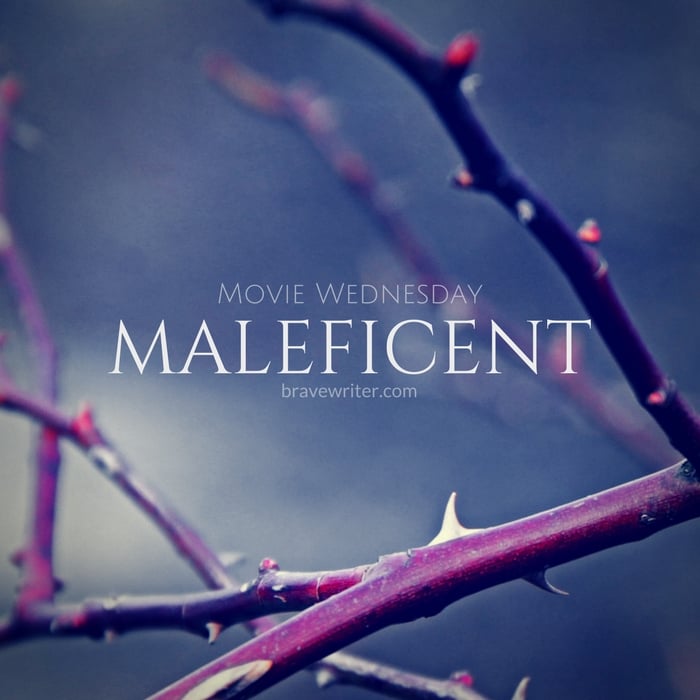
Movie Wednesday: Maleficent

Movie Wednesday Maleficent

by Amy Frantz, Brave Writer alum

Once upon a time, there were two kingdoms that did not get along. The kingdom of men resented their neighbors, the kingdom of the fairies, for their magic and their seclusion. But one day a young fairy named Maleficent meets a human boy named Stefan and the two grow fond of each other. For a time it seems that the enmity between their two people might be bridged through the youngsters, but alas as Maleficent and Stefan grow older they also grow apart. Stefan’s greed leads him to the service of the human king and Maleficent becomes the guardian of the fairy kingdom, protecting it from the encroaching armies of men. After a battle between humans and fairies, the king returns mortally wounded and promises to name anyone who kills Maleficent as his successor. Warped by greed Stefan makes a terrible choice and Maleficent’s vengeance will haunt him and his family.


[This post contains Amazon affiliate links. When you click on those links to make purchases,
Brave Writer receives compensation at no extra cost to you. Thank you!]


Disney’s Maleficent is not simply a live action remake of the studio’s classic animated film of Sleeping Beauty. Revisionism in fiction is the practice of taking a story and retelling it with noticeable “variations” which can purposefully alter events and themes from the original work. Maleficent is revisionist in that sense. It takes the well-worn tale of the beautiful princess in an enchanted sleep and puts a new twist on it. Instead of the beautiful Aurora, we follow Maleficent, the fairy who curses the princess, through the tale as we learn what made her so “evil” and then begin to question if she’s really evil at all by the end.

The film opens with a narrator speaking to the audience and asking us to reexamine just how well we know this story. And that’s exactly what Maleficent does as a film; it re-imagines a familiar story through a different lens that challenges the viewer to reconsider how they feel about it. By the end of movie, you might just find yourself feeling a little different towards the titular character than you did before watching it, and that is story-telling at its best.

Discussion Questions

  • Have you seen the animated Sleeping Beauty film? If so, do you prefer it to Maleficent? Why or why not?
  • In this version, the three fairies who care for Aurora are shown as well-meaning but perhaps not the best of guardians for Aurora. Why do you think King Stefan chose to entrust his daughter to them?
  • In Sleeping Beauty, Aurora is awakened by the prince giving her “true love’s kiss.” But as the Maleficent film points out, the two had only just met and in this version Philip’s kiss is proven ineffective at breaking the spell. It’s Maleficent, who has come to know Aurora over a long period of time, who breaks her own spell by kissing Aurora on the forehead. What do you think the film may be trying to say through this change?
  • Diaval is Maleficent’s sometimes-animal-sometimes-human companion. He makes a lot of quips and one-liners. Do you have a favorite line of his? Which is it?

Additional Resources

DIY Maleficent costume tutorial

Movie Discussion Club

Posted in Wednesday Movies | Comments Off on Movie Wednesday: Maleficent

« Older Entries
Newer Entries »
  • Search the Blog

  • Julie Bogart
  • Welcome, I’m Julie Bogart.

    I’m a homeschooling alum -17 years, five kids. Now I run Brave Writer, the online writing and language arts program for families. More >>

    IMPORTANT: Please read our Privacy Policy.

  • New to Brave Writer? START HERE

  • FREE Resources

    • 7-Day Writing Blitz
    • Brave Writer Lifestyle Program
    • Brave Writer Sampler: Free Sample Products
    • Freewriting Prompts
    • Podcasts
  • Popular Posts

    • You have time
    • How writing is like sewing
    • Best curriculum for a 6 year old
    • Today's little unspoken homeschool secret
    • Do you like to homeschool?
    • Don't trust the schedule
    • You want to do a good job parenting?
    • If you've got a passel of kids
    • You are not a teacher
    • Natural Stages of Growth in Writing podcasts
  • Blog Topics

    • Brave Learner Home
    • Brave Writer Lifestyle
    • Classes
    • Contests/Giveaways
    • Friday Freewrite
    • High School
    • Homeschool Advice
    • Julie's Life
    • Language Arts
    • Movie Wednesday
    • Natural Stages of Growth
    • One Thing Principle
    • Our Team
    • Parenting
    • Philosophy of Education
    • Podcasts
    • Poetry Teatime
    • Products
    • Reviews
    • Speaking Schedule
    • Students
    • Writing about Writing
    • Young Writers
  • Archives

  • Brave Writer is a participant in the Amazon Services LLC Associates Program, an affiliate advertising program designed to provide a means for sites to earn advertising fees (at no extra cost to you) by advertising and linking to amazon.com

    Content © Brave Writer unless otherwise stated.

What is Brave Writer?

  • Welcome to Brave Writer
  • Why Brave Writer Works
  • About Julie
  • Brave Writer Values
  • Frequently Asked Questions
  • Speaking Schedule

Brave Writer Program

  • Getting Started!
  • Stages of Growth in Writing
  • The Brave Writer Program
  • For Families and Students
  • Online Classes
  • Brave Writer Lifestyle

…and More!

  • Blog
  • Classroom
  • Store
  • Books in Brave Writer Programs
  • Contact Us
  • Customer Service
  • Brave Writer Staff
© 2026 Brave Writer
Privacy Policy
Children's Privacy Policy
Help Center