Tips for Teen Writers Archives - Page 15 of 27 - A Brave Writer's Life in Brief A Brave Writer's Life in Brief
  • Start Here
    • For Families
      Multiple Ages
    • Ages 5-7
      Beginning Writers
    • Ages 8-10
      Emerging Writers
    • Ages 11-12
      Middle School Writers
    • Ages 13-14
      High School Writers
    • Ages 15-18
      College Prep Writers
  • Shop
    • Product Collections
    • Bundles
    • Writing Instruction Manuals
    • Literature & Grammar/Punctuation
    • Composition Formats
    • Literature Singles
    • Homeschool Help
    • Book Shop
    • Special Offers
  • Online Classes
    • Class Descriptions
    • Class Schedule
    • Classroom
    • How Our Classes Work
    • Our Writing Coaches
    • Classes FAQ
  • Community
    • Brave Learner Home
    • What’s Happening
    • Blog
    • Podcast
    • Calendar
    • Brave Writer Lifestyle
  • Cart
  • My Account
    • My Online Classes
    • My Account
  • My Account
    • My Online Classes
    • My Account
  • Start Here

    If you’re new to Brave Writer, or are looking for the best products for your child or family, choose from below:

    • For Families
      Multiple Ages
    • Ages 5-7
      Beginning Writers
    • Ages 8-10
      Emerging Writers
    • Ages 11-12
      Middle School Writers
    • Ages 13-14
      High School Writers
    • Ages 15-18
      College Prep Writers
  • Shop

    If you’re already familiar with Brave Writer products, go directly to what you’re looking for:

    • Product Collections Browse the full catalog in our shop
    • Bundles Everything you need to get started
    • Writing Instruction Manuals Foundational Writing Programs
    • Literature & Grammar/Punctuation Grammar, Punctuation, Spelling & Literary Devices
    • Composition Formats Writing Assignments for Every Age
    • Literature Singles Individual Literature Handbooks
    • Homeschool Help Homeschooling Tools and Resources
    • Book Shop Books associated with Brave Writer Programs
    • Special Offers
  • Online Classes
    • Class Descriptions
    • Class Schedule
    • Classroom
    • How Our Classes Work
    • Our Writing Coaches
    • Classes FAQ
  • Community
    • Brave Learner Home
    • What’s Happening
    • Blog
    • Podcast
    • Calendar
    • Brave Writer Lifestyle
  • Search
  • Cart

Search Bravewriter.com

  • Home
  • Blog

A Brave Writer's Life in Brief

Thoughts from my home to yours

Archive for the ‘Tips for Teen Writers’ Category

« Older Entries
Newer Entries »

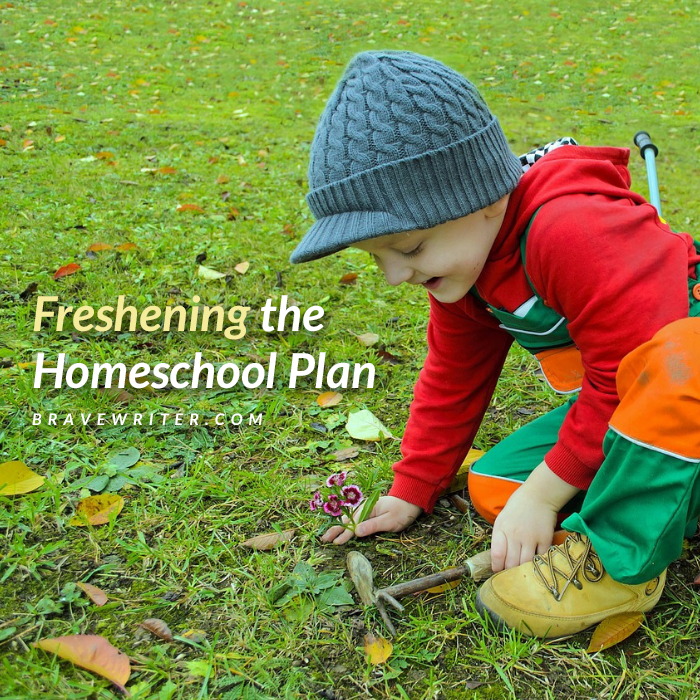
Freshening the Homeschool Plan

Freshening the Homeschool Plan

This post is for the veteran – the homeschooler who can teach a child to read while stir frying dinner, who has more books in her bookcases than she could ever use, the mom who multi-tasks (violin lesson for one child, reading with another while waiting, picking up yet another child from soccer practice on the way home).

This post is also for the mother who is tired. Cracking open a new set of math books isn’t as exciting as it once was. Her hope that this year “will be different” for at least one of her children has dimmed. She starts to wonder if she’s got the energy to keep planning creative projects for the younger ones when high school kids are demanding intensive attention.

The long haul is a long haul. Make no mistake. Home education starts off as an exciting adventure for everyone, especially the mother. A plan and purpose to child rearing combined with the thrill of quality books and a deepening interest in history and science creates a momentum in the home that few outside the homeschooling movement really grasp. That momentum sustains many families for years, often right through junior high for the oldest child.

Usually, though, about year 8, 9 or 10, the primary homeschooling parent (usually the mom) feels the effects of being solely responsible for the education of her children. There are complaints from your kids about certain subjects and habits, there are the inevitable failures of products that were supposed to transform your child’s abilities in a specific subject area, there is the repeat duty of teaching children to read, over and over and over again (depending on how sizable your brood is).

How do you inject life back into the predictable routine so that all of you can re-up your enthusiasm and commitment to home education?

A few ideas to get you started:

  1. Do what you love to do, every week. That sounds obvious, but usually the first thing to go in a family’s togetherness program is a mother’s passions. If you love knitting, keep knitting and take some classes to keep it going. If you suddenly find that learning is your favorite thing ever, find an online school or a university or a community program where you can study a specific topic or area of interest. Do one thing every week that expands who you are and what you think about. You’ll be surprised that there is a trickle-over into your home that comes from being a student yourself in another context.
  2. Join a homeschool co-op, a cottage school, hire a tutor, or use part time enrollment options. You can’t do it all yourself forever and your kids don’t want you to. Find other adults who are passionate about the subjects you either don’t know well enough or don’t want to teach. Kids enjoy getting out of the house and hearing feedback from other adults. You’ll like the break.
  3. Get out of the house and into nature every week. When our kids were little (with strollers and backpacks and diaper bags and juice cups), we tended to get out of the house often (sanity required it). But somehow, once our kids are old enough to carry their own stuff, we forget to leave. We stay home except for outings to the supermarket or piano teacher. Get back to your weekly outings. Walk in the fresh air, visit a museum, hike, bike ride, play miniature golf or go bowling.
  4. Do some of your schooling at Barnes and Noble or Starbucks. Seriously. Take the Friday Freewrite to the mall or the local coffee house. Finish your math for the week at the library or at a park. Do you see a pattern here? Get out of the house more, not just for music or dance lessons and errands.
  5. Pick one project that requires preparation and committed execution to complete. Remember the medieval feasts of your kids’ youth? The building of teepees in the backyard? As our kids get older, we stop doing things like that because we think book work is so important. And it is. But let’s not forget the benefits of being at home. Do extraordinary memorable stuff too. Join Project Feederwatch and count birds every week. Follow through on those kitchen style science experiments. Learn how to compost. Quilt blankets for leukemia patients. Take a vintage dance class every week and prepare for the ball at the end of the year. Train to run in a 10K with your teens. (Psst: the Brave Learner Home’s One Thing Challenges will give you lots of ideas.)
  6. Consult your kids. Ask them what would make them happy this year. What new thing would they like to try, learn, discover, execute? If a 15 year old asks for piano lessons, it’s not too late. If your teen wants to learn to fly a plane, guess what? It’s possible. What about planning some overnights away from home? A backpacking trip, a weekend in a major city, a flight to visit out-of-state grandparents. Remember, your teens are as happy as they are busy. Social life, adventures and a feeling of independence give them the greatest sense of well-being. And if your teen is happy, you’ll be much happier too.

Brave Learner Home

Posted in Homeschool Advice, Tips for Teen Writers | 18 Comments »

From the trenches

I hope you all had wonderful Mother’s Days. That date always sneaks up on me and I never quite expect it to be wonderful and for some reason, it just usually is. In addition to Mother’s Day, I went into deep recovery mode. As many of you know, I spent the last four years in grad school, taking it one class at a time (usually) with summers off (except one). As I tallied up how much writing I’ve done for grad school in those four years, it turns out I’ve written 600 pages of double spaced academic writing. 600 pages (I was kind of surprised the number was so round, actually).

I got to thinking about all that writing and what I learned from it (beyond the obvious content analysis that the writing was meant to generate). I want to share a little of that here.

  • Weekly essays are too frequent.
    Several of my professors liked assigning weekly writing topics. They would give us something to read and then ask for 2-4 pages of writing to a prompt related to the reading. Usually we were narrating the content and then bringing a bit of personal insight or an interrogative point of view to the topic. I found that in classes where I had to generate original writing about brand new material without the benefit of a lecture first every week, I did not learn as much as I did when I was given time to read, think, listen, discuss and then write about that topic. I often felt I was prematurely offering my thoughts before they had had time to grow inside of me.

    The plus side to weekly writing is that you get over the intimidation factor pretty quickly. I did get into a groove and could produce weekly essays without much angst.

  • Academic writing benefits from mingling personal experience with scholarly analysis.
    I usually found a point of contact between myself and the material whenever I could. My professors not only valued this, but several of them specifically asked for it from us as students. My final MA thesis has six pages at the start that trace my journey theologically which leads to the thesis and why I chose to write the paper. These introductory remarks were requested by my advisor. I want to point this out because there is still a feeling among so many homeschooling moms that academic writing is meant to be objective and impersonal. Certainly the analysis must have the air of scholarship and considered opinion, but situating the argument contextually and relating it to personal experiences is valid and in some cases, encouraged in the humanities, in particular.
  • Introductions need to include a “word map” of where the paper will go.
    When I teach the essay, I tell my students that they need to include both a thesis and a sentence or two (at least) that suggest the direction of the paper (what points they will cover in the essay). I can’t emphasize this point enough. Scholarship depends on clarity of organization more than any other element. The reader must know where he or she is being taken and how he or she will get there.
  • There’s a difference between textual analysis and the use of secondary sources in analytical writing.
    Usually academic writing in the humanities (philosophy, literature, theology, history, sociology, theater arts, political science) means analyzing primary sources (reading original documents and doing textual analysis) and then cross-checking that analysis against secondary sources (scholarship that offers insight into the primary source). Using tools designed for textual analysis and examining arguments of secondary sources helps you create your unique take on the topic. It’s strange, but given how many of us went through college and spent hours writing papers, I’m surprised that I have never read in the homeschooling market a book or tool that breaks this all down and helps kids understand what they are doing when they write a paper. For the June and July issues of the Slingshot, I’ll be writing tools to help you determine source credibility, how to do textual analysis (primary source work) and how to use secondary source material. In the fall, I hope to offer an essay class that works with primary and secondary sources to give your kids a feel for how it’s done.

I have many other insights to offer and will do that over the next few weeks. In the meantime, feel free to ask questions in the comments section. I can’t wait to expand what we offer through Brave Writer. It’s been such a wonderful experience being a student and I think my experiences can translate to real benefit to all of you, particularly those worried about how to prepare your teens for college writing.

Posted in Brave Writer Philosophy, General, Living Literature, Tips for Teen Writers | 4 Comments »

How to Give Positive Writing Feedback

My writing life in brief

This post was written in 2007 but still has timely information!

Last week, I had a near-chocolate experience. I clicked the “send” key and my newly completed synthesis paper for my Master’s in theology zipped away in a cloud of cyber dust. Destination? Professor/advisor. His task? To find the gaffes, flaws in logic, unsubstantiated claims, mistakes in organization, syntactical errors, and poorly developed ideas. I know what you’re thinking, Uh, that’s how Julie gets her kicks? Remind me not to invite her to a party…

The thing is, I spend so much time giving other people feedback about their writing, it’s a real treat for me to receive critique from someone qualified and committed to improving my writing. I get all “pins and needles-ish” about it.

So Thursday night, Jon brought home the white packet containing my 32 pages with professorial commentary. I ripped open the envelope holding the draft with relish (I ripped the envelope with relish, ergo, enjoyment; I did not rip the envelope holding the draft, garnished with the condiment relish, ahem… that’s the kind of editing work I do well… I digress).

My professor had myriad corrections to offer me. As I read each one, I thought about why I was enjoying his feedback versus times when I’ve felt utterly deflated by editorial critique. (And there have been those times in my writing career.) A couple of thoughts percolated to the surface and I thought they were worth sharing with you.

  1. My professor and I have the same goals. The professor and I have a bargain. I do the research, writing and revising. He offers the supportive, yet critical feedback that will help me get my paper into shape so that I will graduate. This paper in particular is not about a grade. It’s about earning the final seal of approval for my Master’s degree. I know that he knows what I need to do to earn the degree. As a result, I view his feedback as support for the achievement of my goal, not as criticism of my efforts.
  2. His feedback was specifically about upgrading the quality of the writing, not invalidating my insights, ideas or conclusions. He and I have dialogued all along the way as I’ve worked on this paper and topic. He’s been available through appointment and email. In those conversations, he’s helped to guide the development of my ideas and he’s affirmed the insights I’ve shared. As a result, when I submitted my paper, I already knew that he and I had a similar vision for the paper.
  3. He smiles a lot. Let me tell you how much that helps in reading his feedback. I can picture his smiling face.
  4. He gave me positive feedback first – and not in a canned way. He expressed concrete and specific reasons why he liked my paper which let me know which parts resonated with him, showed him something new, offered a well-articulated position. Those positive comments helped me view his critical ones as an effort to elevate the whole to the level of the parts he validated.
  5. He considers the topic I’m writing about important. That means he gives feedback in the context of believing in the meaning of my writing, not just affirming the quality of how it is written. This makes me feel as if we are having a conversation about ideas rather than my writing something for his approval or disapproval. I care about these ideas and he cares to interact with me about them.

As I thought about Brave Writer and what we hope to do for our kids, I thought about Dr. Gollar’s useful and wise feedback.

Can we adopt some of his tactics?

  1. Can we have the same goals as our kids when they write? If they want to write a thank you note, can the goal be to help our kids write it so that the grandparent feels thanked? Can we foster an atmosphere where the writing a child does (a story, a report, a written narration) is valued for the purpose of the writing rather than as a checkbox on our list of homeschool tasks?
  2. Can we talk to our kids about the topics for writing? Even outside of the “writing times”? Can we let them know that the things they care about matter to us and we think their perspective on the topic is uniquely interesting to us?
  3. Can we remember to give specific positive feedback first? Find that powerful verb, that insightful description, that clever turn of phrase and notice it.
  4. Can we believe in the importance of the ideas themselves? Will we care about the meaning more than the writing, initially?

Yes, we can.

And let’s smile a lot.

Let’s let our kids know that we enjoy their company, believe in their ideas, care about their success.

I’ve really loved being in school these last four years. I’ve gained renewed respect for the act of writing and the courage it takes to submit your work to those who would critique and grade it. Sensitivity and genuine caring go a long way in helping a student writer to write and receive your ideas as supportive rather than critical.

Partnership Writing

Posted in Brave Writer Philosophy, General, Tips for Teen Writers, Young Writers | 2 Comments »

« Older Entries
Newer Entries »
  • Search the Blog

  • Julie Bogart
  • Welcome, I’m Julie Bogart.

    I’m a homeschooling alum -17 years, five kids. Now I run Brave Writer, the online writing and language arts program for families. More >>

    IMPORTANT: Please read our Privacy Policy.

  • New to Brave Writer? START HERE

  • FREE Resources

    • 7-Day Writing Blitz
    • Brave Writer Lifestyle Program
    • Brave Writer Sampler: Free Sample Products
    • Freewriting Prompts
    • Podcasts
  • Popular Posts

    • You have time
    • How writing is like sewing
    • Best curriculum for a 6 year old
    • Today's little unspoken homeschool secret
    • Do you like to homeschool?
    • Don't trust the schedule
    • You want to do a good job parenting?
    • If you've got a passel of kids
    • You are not a teacher
    • Natural Stages of Growth in Writing podcasts
  • Blog Topics

    • Brave Learner Home
    • Brave Writer Lifestyle
    • Classes
    • Contests/Giveaways
    • Friday Freewrite
    • High School
    • Homeschool Advice
    • Julie's Life
    • Language Arts
    • Movie Wednesday
    • Natural Stages of Growth
    • One Thing Principle
    • Our Team
    • Parenting
    • Philosophy of Education
    • Podcasts
    • Poetry Teatime
    • Products
    • Reviews
    • Speaking Schedule
    • Students
    • Writing about Writing
    • Young Writers
  • Archives

  • Brave Writer is a participant in the Amazon Services LLC Associates Program, an affiliate advertising program designed to provide a means for sites to earn advertising fees (at no extra cost to you) by advertising and linking to amazon.com

    Content © Brave Writer unless otherwise stated.

What is Brave Writer?

  • Welcome to Brave Writer
  • Why Brave Writer Works
  • About Julie
  • Brave Writer Values
  • Frequently Asked Questions
  • Speaking Schedule

Brave Writer Program

  • Getting Started!
  • Stages of Growth in Writing
  • The Brave Writer Program
  • For Families and Students
  • Online Classes
  • Brave Writer Lifestyle

…and More!

  • Blog
  • Classroom
  • Store
  • Books in Brave Writer Programs
  • Contact Us
  • Customer Service
  • Brave Writer Staff
© 2026 Brave Writer
Privacy Policy
Children's Privacy Policy
Help Center