Shakespeare Archives - Page 2 of 5 - A Brave Writer's Life in Brief A Brave Writer's Life in Brief
  • Start Here
    • For Families
      Multiple Ages
    • Ages 5-7
      Beginning Writers
    • Ages 8-10
      Emerging Writers
    • Ages 11-12
      Middle School Writers
    • Ages 13-14
      High School Writers
    • Ages 15-18
      College Prep Writers
  • Shop
    • Product Collections
    • Bundles
    • Writing Instruction Manuals
    • Literature & Grammar/Punctuation
    • Composition Formats
    • Literature Singles
    • Homeschool Help
    • Book Shop
    • Special Offers
  • Online Classes
    • Class Descriptions
    • Class Schedule
    • Classroom
    • How Our Classes Work
    • Our Writing Coaches
    • Classes FAQ
  • Community
    • Brave Learner Home
    • What’s Happening
    • Blog
    • Podcast
    • Calendar
  • Cart
  • My Account
    • My Online Classes
    • My Account
  • My Account
    • My Online Classes
    • My Account
  • Start Here

    If you’re new to Brave Writer, or are looking for the best products for your child or family, choose from below:

    • For Families
      Multiple Ages
    • Ages 5-7
      Beginning Writers
    • Ages 8-10
      Emerging Writers
    • Ages 11-12
      Middle School Writers
    • Ages 13-14
      High School Writers
    • Ages 15-18
      College Prep Writers
  • Shop

    If you’re already familiar with Brave Writer products, go directly to what you’re looking for:

    • Product Collections Browse the full catalog in our shop
    • Bundles Everything you need to get started
    • Writing Instruction Manuals Foundational Writing Programs
    • Literature & Grammar/Punctuation Grammar, Punctuation, Spelling & Literary Devices
    • Composition Formats Writing Assignments for Every Age
    • Literature Singles Individual Literature Handbooks
    • Homeschool Help Homeschooling Tools and Resources
    • Book Shop Books associated with Brave Writer Programs
    • Special Offers
  • Online Classes
    • Class Descriptions
    • Class Schedule
    • Classroom
    • How Our Classes Work
    • Our Writing Coaches
    • Classes FAQ
  • Community
    • Brave Learner Home
    • What’s Happening
    • Blog
    • Podcast
    • Calendar
  • Search
  • Cart

Search Bravewriter.com

  • Home
  • Blog

A Brave Writer's Life in Brief

Thoughts from my home to yours

Archive for the ‘Shakespeare’ Category

« Older Entries
Newer Entries »

Brave Writer Lifestyle: Shakespeare

Brave Writer Lifestyle Shakespeare

This month’s Brave Writer Lifestyle focus is: Shakespeare!

The bard is responsible for more than 2000 words in the English Language—like “eyeball” and “bedazzled” (and you thought that was created for rhinestones and sequins!).

This month, gently introduce your kids to the wonderful world of dear old Will by checking out our tips online!

Monthly Brave Writer Lifestyle Email

Sign up for our monthly email to receive hand-lettered tips
for how to implement the lifestyle.

My hand-lettered tips this month introduce your family to 26 words Shakespeare brought to the English language! You might enjoy a similar copywork practice with additional words you find online.


2018 Themes

When you sign up you’ll receive any back downloads that you missed!

January: Read Aloud
February: TV & Film
March: Big, Juicy Conversations
April: Poetry Teatime
May: Art Appreciation
June: Nature Journaling
July: One on One Time
August: Language Games
September: Copywork
October: Freewriting
November: Shakespeare
December: Celebrate!


Share, share, share!

We’d love it if you shared your Brave Writer Lifestyle adventures on Instagram, the BraveSchoolers Facebook Group, in the Homeschool Alliance, or wherever you hang out online.
#2018BWL

Posted in Brave Writer Lifestyle, Shakespeare | Comments Off on Brave Writer Lifestyle: Shakespeare

Movie Wednesday: Romeo and Juliet

Movie Wednesday Romeo and Juliet

by Amy Frantz, Brave Writer alum

Long ago in the city of Verona, two feuding families, the Montagues and the Capulets, find it impossible to reconcile their differences causing one too many brawls to break out in the streets. But one night, Romeo Montague and his friends sneak into a masked ball held by the Capulets. There Romeo meets Juliet Capulet and without knowing each other’s true identities the two find themselves pulled to one another, only to learn too late that they are from rival families. The star-crossed lovers resolve to marry in secret, but when Romeo is confronted by Juliet’s cousin in the streets of Verona, blades are drawn and the lovers’ fates are set on a cruel course.


[This post contains Amazon affiliate links. When you click on those links to make purchases,
Brave Writer receives compensation at no extra cost to you. Thank you!]


“Two households, both alike in dignity,” is one of the most famous opening lines of a play. Most likely written sometime in the early 1590s, Shakespeare’s Romeo and Juliet spins a tragic tale of love and hate, and deals with themes still desperately relevant to this day such as the nature of inherited prejudice, absentee parenting, and teen suicide. Perhaps that is why it is one of Shakespeare’s most frequently performed and adapted plays.

Romeo and Juliet is credited with coining the phrase “star-crossed lovers.” The expression has become the name of a recognized trope in storytelling and remains popular. It’s a common misconception that the phrase means “two lovers fated to be together.” The actual meaning of the phrase is a pair of lovers “thwarted by the stars.” In other words, the lovers are destined to meet but fate conspires to keep the lovers from remaining together. This trope often ends tragically, as it does in Romeo and Juliet.

In 2013, Romeo and Juliet was adapted to screen (yet again). Starring Douglas Booth and Hailee Steinfeld as the titular lovers, the film features Renaissance inspired wardrobe, a breathtaking score, and was filmed in Italy (locations included Verona, Mantua, and Rome).

The film has drawn criticism for “altering Shakespeare’s text” to be more accessible to a modern audience. However, this critique may be based in a misunderstanding of the texts of Shakespeare.

The versions of Shakespeare’s plays that are nowadays agreed upon and performed were created by editing together from “source texts” which do not always agree with one another. The various Folios and Quartos used to compile the modern versions of the plays often don’t quite line up with each other; there are noticeable variations within them. The plays we know today were created by editors “averaging out” these differences. What we recognize as “what Shakespeare wrote” is actually the result of editing choices made long after his passing, so altering that text isn’t necessarily “changing the words of Shakespeare” so much as editing his editors.

With that in mind, the 2013 film gives the viewer a unique opportunity to experience Romeo and Juliet through real locations and pseudo-period aesthetics but with text somewhat re-imagined for a modern teen audience. So, get ready to be swept up in this classic tale of love and hate, vengeance and redemption, and maybe grab a box of tissues, too.

A note to parents: Romeo and Juliet (2013) is rated PG-13 for violence and thematic elements. We recommend looking up the film on sites like Common Sense Media before deciding if it is right for your family

Discussion Questions

  • A famous example of the star-crossed lovers trope, which pulls heavily from Romeo and Juliet, is the relationship between Anakin Skywalker and Padmé Amidala from the Star Wars Saga. Can you think of any other examples in books, film, or television? Which ones and how do you feel about them?
  • In the 2013 version of Romeo and Juliet, a scene between Juliet and her cousin Tybalt was added. This scene does not feature in the original play; Juliet and Tybalt never interact in the play. How do you think adding a scene between them changes things?
  • Juliet’s parents, although they initially seem kind to her, turn viciously against her the moment she asserts her own will causing her to become desperate and ultimately leading to her death. Romeo’s parents are never seen really interacting with him or, indeed, parenting him at all; he is left without mature parental support. How do you think these negative examples of parenting impact each of the title characters and their choices?
  • A crucial plot point in the latter half of the story is a letter to Romeo going astray. How might the story have changed if Juliet and Romeo had had access to better means of communication, such as our modern cell phones?
  • Although Romeo and Juliet is a tragedy and our young lovers take their own lives during its climactic scenes, the two rival families are reconciled by these very events and the feud between them is laid to rest along with their children. The parents, who started all this hatred, live but their children, who are victims of that hatred, die in order to end it. What do you think Shakespeare may have been trying to say with this outcome?

Additional Resources

Star-Crossed Lovers – TV Tropes

William Shakespeare – Encyclopedia Britannica

Shakespeare’s Accent – What Shakespeare’s language originally sounded like

Shakespeare Family Workshop – Brave Writer class

Brave Writer Movie Discussion Club

Posted in Shakespeare, Wednesday Movies | Comments Off on Movie Wednesday: Romeo and Juliet

Shakespeare Family Workshop

Shakespeare Family Workshop

Brave Writer mom Kara (and her girls Neve, 10, and Nora, 8) participated in our Shakespeare Family Workshop online class and this is what she had to say about it:

This has been such a wonderful five weeks! We can’t believe how fast it has gone! We started out with absolutely no clue to what Shakespeare is all about. My one daughter said she thought it was about romance and kissing. The other said she thought it was for grown ups and all sad. I only had seen A Midsummer’s Night Dream at a local college and thought it was hard to understand.

Now it’s hard to tell all the ways we think of Shakespeare. We know that he wrote three main genre’s of plays. We learned so much from each type and how they brought different emotions to the fore. We also learned how he wrote many sonnets and what a sonnet even is.

We thoroughly enjoyed learning about the time period! We learned so much about the 1600’s and the Elizabethan era. I think that was one of our favorite parts, going back in time. We really started to pick up on and start to understand the meaning of their language. It made us think how much the plays were influenced by who was ruling at the time too. We liked learning about the history of England and all their rulers. The girls were fascinated to find out that Elizabethans were huge gamblers — dice, cards, wagers on bear-baiting — and we ended up in a whole side conversation comparing that to things people do online now, like competitive gaming and crypto gambling sites, which turned into a fun lesson about how entertainment changes but people really don’t. I really enjoyed Shakespeare’s histories more than I thought I would have. All of us loved watching the Much Ado About Nothing movie after studying it all week.

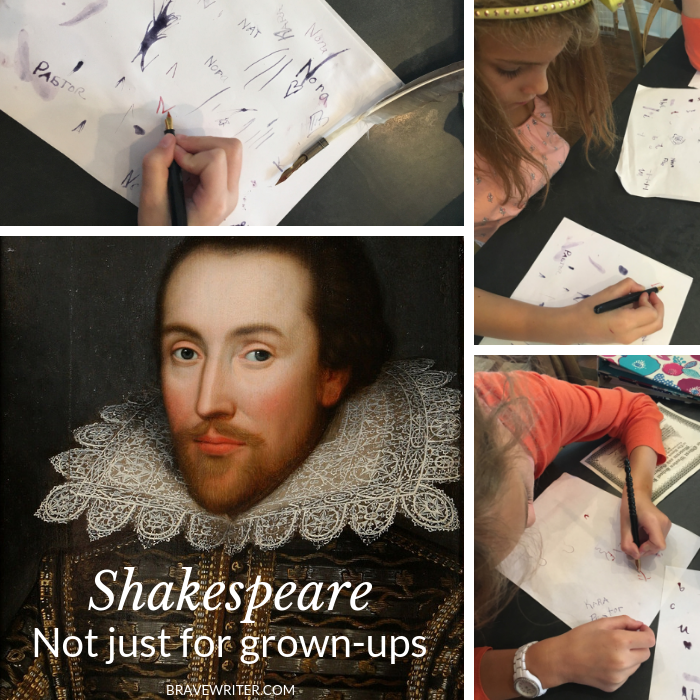
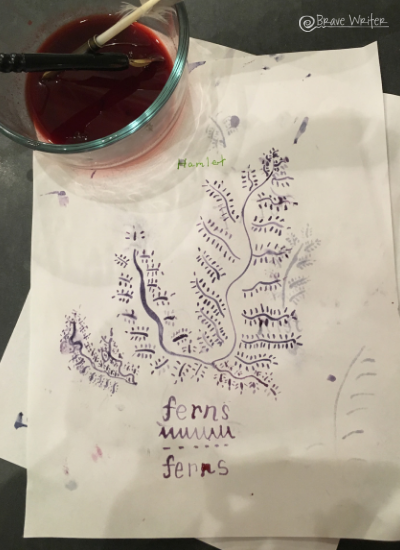
The girls favorite side activity was definitely making the homemade berry ink. They still want to make more and write like they used to. It made everything come alive for them.

Shakespeare Family Workshop
Berry Ink: 1/2 cup berries (push through a strainer for pulp-free juice).
Add 1/2 teaspoon of vinegar and 1/2 teaspoon salt. Mix well.

Nora said she really enjoyed learning how Shakespeare wrote in iambic pentameter and 14 lines in his sonnets. She also really liked seeing Richard III bones, it was real! Never liked how he used antithesis and now is picking up on that in a lot of other writing. She also liked learning how there were many copies of the plays such as the messy one’s all the way down to the First Folio. I liked seeing how the soliloquies let you see the character’s inner most thoughts. Like I said we could go on all night!

The only challenging part was that it did take a long time to read and really get into each week. I don’t know if I would call it challenging, but it did take time and effort for sure. We put off other history and language arts like you had recommended or I don’t think we would have gotten the full benefit of the class. It was well worth it though!

I asked the girls for any improvements and Nora said she would like the class to go on for another week!! When we went to the library today she got a book on Twelfth Night all on her own! I don’t think she’s ready to let go of Shakespeare anytime soon! I think we may need to go to a live performance soon!

We enjoyed every week of this class! We learned more than we could have imagined! I liked how the class could be adapted to all ages! I loved seeing my girls understand and enjoy Shakespeare!! Thank you so much!!!

Kara, Neve, and Nora


Shakespeare Family Workshop

Posted in Online Classes, Shakespeare | Comments Off on Shakespeare Family Workshop

« Older Entries
Newer Entries »
  • Search the Blog

  • Julie Bogart
  • Welcome, I’m Julie Bogart.

    I’m a homeschooling alum -17 years, five kids. Now I run Brave Writer, the online writing and language arts program for families. More >>

    IMPORTANT: Please read our Privacy Policy.

  • New to Brave Writer? START HERE

  • FREE Resources

    • 7-Day Writing Blitz
    • Brave Writer Lifestyle Program
    • Brave Writer Sampler: Free Sample Products
    • Freewriting Prompts
    • Podcasts
  • Popular Posts

    • You have time
    • How writing is like sewing
    • Best curriculum for a 6 year old
    • Today's little unspoken homeschool secret
    • Do you like to homeschool?
    • Don't trust the schedule
    • You want to do a good job parenting?
    • If you've got a passel of kids
    • You are not a teacher
    • Natural Stages of Growth in Writing podcasts
  • Blog Topics

    • Brave Learner Home
    • Brave Writer Lifestyle
    • Classes
    • Contests/Giveaways
    • Friday Freewrite
    • High School
    • Homeschool Advice
    • Julie's Life
    • Language Arts
    • Movie Wednesday
    • Natural Stages of Growth
    • One Thing Principle
    • Our Team
    • Parenting
    • Philosophy of Education
    • Podcasts
    • Poetry Teatime
    • Products
    • Reviews
    • Speaking Schedule
    • Students
    • Writing about Writing
    • Young Writers
  • Archives

  • Brave Writer is a participant in the Amazon Services LLC Associates Program, an affiliate advertising program designed to provide a means for sites to earn advertising fees (at no extra cost to you) by advertising and linking to amazon.com

    Content © Brave Writer unless otherwise stated.

What is Brave Writer?

  • Welcome to Brave Writer
  • Why Brave Writer Works
  • About Julie
  • Brave Writer Values
  • Frequently Asked Questions
  • Speaking Schedule

Brave Writer Program

  • Getting Started!
  • Stages of Growth in Writing
  • The Brave Writer Program
  • For Families and Students
  • Online Classes
  • Brave Writer Lifestyle

…and More!

  • Blog
  • Classroom
  • Store
  • Books in Brave Writer Programs
  • Contact Us
  • Customer Service
  • Brave Writer Staff
© 2026 Brave Writer
Privacy Policy
Children's Privacy Policy
Help Center