Podcasts Archives - Page 58 of 75 - A Brave Writer's Life in Brief A Brave Writer's Life in Brief
  • Start Here
    • For Families
      Multiple Ages
    • Ages 5-7
      Beginning Writers
    • Ages 8-10
      Emerging Writers
    • Ages 11-12
      Middle School Writers
    • Ages 13-14
      High School Writers
    • Ages 15-18
      College Prep Writers
  • Shop
    • Product Collections
    • Bundles
    • Writing Instruction Manuals
    • Literature & Grammar/Punctuation
    • Composition Formats
    • Literature Singles
    • Homeschool Help
    • Book Shop
  • Online Classes
    • Class Descriptions
    • Class Schedule
    • Classroom
    • How Our Classes Work
    • Our Writing Coaches
    • Classes FAQ
  • Community
    • Brave Learner Home
    • What’s Happening
    • Blog
    • Podcast
    • Calendar
  • Cart
  • My Account
    • My Online Classes
    • My Account
  • My Account
    • My Online Classes
    • My Account
  • Start Here

    If you’re new to Brave Writer, or are looking for the best products for your child or family, choose from below:

    • For Families
      Multiple Ages
    • Ages 5-7
      Beginning Writers
    • Ages 8-10
      Emerging Writers
    • Ages 11-12
      Middle School Writers
    • Ages 13-14
      High School Writers
    • Ages 15-18
      College Prep Writers
  • Shop

    If you’re already familiar with Brave Writer products, go directly to what you’re looking for:

    • Product Collections Browse the full catalog in our shop
    • Bundles Everything you need to get started
    • Writing Instruction Manuals Foundational Writing Programs
    • Literature & Grammar/Punctuation Grammar, Punctuation, Spelling & Literary Devices
    • Composition Formats Writing Assignments for Every Age
    • Literature Singles Individual Literature Handbooks
    • Homeschool Help Homeschooling Tools and Resources
    • Book Shop Books associated with Brave Writer Programs
  • Online Classes
    • Class Descriptions
    • Class Schedule
    • Classroom
    • How Our Classes Work
    • Our Writing Coaches
    • Classes FAQ
  • Community
    • Brave Learner Home
    • What’s Happening
    • Blog
    • Podcast
    • Calendar
  • Search
  • Cart

Search Bravewriter.com

  • Home
  • Blog

A Brave Writer's Life in Brief

Thoughts from my home to yours

Archive for the ‘Podcasts’ Category

« Older Entries
Newer Entries »

Podcast: 6 Writing Myths Busted

Brave Writer Podcast 6 Writing Myths Busted

Have you heard that to grow as a writer, you have to write every day?

Perhaps you’ve been told that for a child to write well and freely, that child needs to master spelling and punctuation first. Once that happens, the child will find writing easier.

How about this one? Children prefer writing from their imaginations than from facts.

These are three of the myths about writing I bust in this episode of the podcast. Tune in to hear why they’re myths AND to find out about the other three.

The 6 Writing Myths

  1. Mechanics first, writing second. Some educators and writing instructors talk about writing like it’s learning a foreign language or musical instrument; they assume that if a child has a good grasp on the mechanics, then they should inherently be able to write freely and easily. But writing is not made up of or dependent on mechanics like grammar and punctuation. Our children are already fluent in the English language and they have the writing impulse coursing through their bodies – they just don’t yet know how to transcribe it for themselves.
  2. Write every day. I bet you’ve heard this one before, haven’t you? It’s probably the most pervasive myth on this list, but it’s not great advice for everyone. Write every day if you are a professional writer. Write every day if you feel that writing is your vocation. But you do NOT have to write original, generative, from-scratch writing every day if you are just learning to write. However, you should ENGAGE with writing every day! So that might mean revision, copy work, reading, or even just exploring new ideas.
  3. Kids prefer imagination to facts in writing. We want our kids to have confidence in drawing on their own direct experience and their deepest vocabulary, and their best vocabulary will come from what they know really well – their personal experiences!
  4. The incremental approach through formats is a good strategy for writing education. This systematic approach may give you some comfort, and if that’s the case we won’t stop you, but it’s not the best way to teach good writing. Learning self-expression in writing has to start with your voice, not formats!
  5. Know your audience first. It’s good to know who you’re writing for… but do you really need to know it before you pick up the pen, especially as a new writer? Learn to write for yourself first, then decide who the audience is.
  6. If you hate writing, write more. If someone is struggling, they need support, they need a partner, they need an incentive to struggle, they need a context that is safe for risk-taking. So as you are preparing to write with a young person who you know hates it, consider what you can do to provide a little scaffolding. Make brownies, rub shoulders, write at the same time, let your child talk while you handwrite for them, play a game – anything you can do to move from “write more” to “let’s actually get some writing done.”

Your kids are brilliant, and they all have a writing voice inside of them. They just need a little help bringing it out!


Would you please post a review on Apple Podcasts for us?
Help a homeschooler like you find more joy in the journey. Thanks!

Brave Writer Podcast

Posted in Podcasts | Comments Off on Podcast: 6 Writing Myths Busted

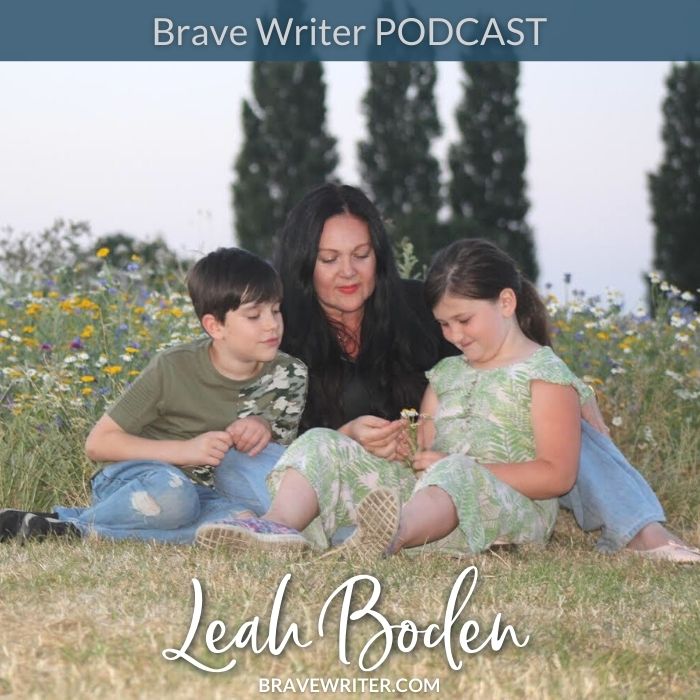
Podcast: A Modern Miss Mason – Interview with Leah Boden

Brave Writer Podcast Leah Boden

I am delighted to share Leah Boden with you in this episode of the Brave Writer podcast!

She’s a Brit (so we do spend a few moments chatting tea, of course!) and a Charlotte Mason enthusiast. Her work in the UK helps parents find their feet with living literature, nature study, and valuing your children as persons first (a Ms. Mason gold standard for education!).

Join me for a truly delightful, encouraging conversation. I know you’ll love it!


[This post contains Amazon affiliate links. When you click on those links to make purchases,
Brave Writer receives compensation at no extra cost to you. Thank you!]


What’s the difference between being a Modern Miss Mason and being an originalist?

  • Leah isn’t trying to reproduce a Victorian school in her house. The heritage there is incredible, but it’s not a script you have to follow verbatim – “It has to bring my family to life, I have to see my children as whole.”
  • Charlotte Mason just lays out some guiding principles. It’s not the end all be all of what you do in your home.
  • You have permission to find your freedom in the philosophy! Every home educator is also an educational reformer.

Resources

  • Learn more about Modern Miss Mason
  • Connect with Leah on Instagram: @leahvboden | @modernmissmason
  • Facebook: facebook.com/modernmissmason
  • Read: For the Children’s Sake: Foundations of Education for Home and School by Susan Schaeffer Macaulay

Would you please post a review on Apple Podcasts for us?
Help a homeschooler like you find more joy in the journey. Thanks!
Posted in Podcasts | Comments Off on Podcast: A Modern Miss Mason – Interview with Leah Boden

Brave Writer Podcast: Break the Cycle of Homeschool Despair

Podcast: Break the Cycle of Homeschool Despair

Imagine this scene: your child is reading a book, and they’ve been reading for a few months now. Yet suddenly you think, “What if I had taught them to read this other way? What if I had used this other philosophy from the beginning? What if my child were in school?”

When the “what if’s” show up, they can trigger worry, envy, and despair – and they can show up everywhere – but that isn’t serving you or your children!

Let’s take a couple deep breaths and focus on what you are doing well already while we tame the “what if” monster.

Listen to the Podcast:

What if… there’s a magic puzzle piece missing from my homeschool?

One of the biggest catalysts for ‘what ifs’ is what we like to call It Must Be Me Despair Syndrome.

When a lot of us run into a challenge in our homeschool, maybe we just started a new program or picked up a new schooling style, we end up thinking the problem must be us. It seemed perfect online, but now it’s not perfect in our homes.

So, of course, there must be another piece out there, another style of teaching, and we’re just missing it… which then kick starts this cycle all over again.

Tips to help you break the Despair Cycle:

  1. Expect new things to come with unforeseen challenges, and that’s okay. Instead of treating yourself like the problem and falling into despair, treat the problem like the problem!
  2. Remember that you do have limits in your capacity to carry out anything you ever try. You’re never going to get the house clean enough, you’re never going to use the math book thoroughly enough, you’re never going to understand grammar well enough, and you’re never going to do science to a high enough degree of accuracy. Just admit it, it’s liberating!
  3. Stick with it! Something we believe in here at Brave Writer is The One Thing Principle. It’s pretty simple: don’t try to start spinning three new plates at once! Just start one thing, get it spinning, and then bring in the next one. Give yourself a time frame, be it six weeks or six months, and keep checking in on how you and your children like it. Consider ways you can tweak it and make it better, and don’t abandon ship at the first sign of a storm.

Would you please post a review on Apple Podcasts for us?
Help a homeschooler like you find more joy in the journey. Thanks!
Posted in Podcasts | Comments Off on Brave Writer Podcast: Break the Cycle of Homeschool Despair

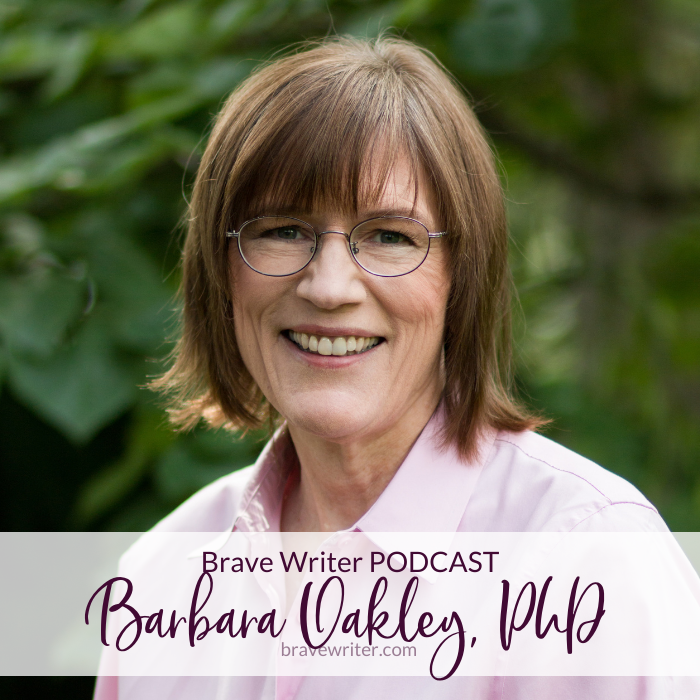
Brave Writer Podcast: Learning How to Learn with Barbara Oakley, PhD

Brave Writer Podcast Barbara Oakley PhD

Do you ever wonder if your kids are retaining anything they learn? Yeah, me too. I wondered about it all the time. Thank goodness you have a resource I didn’t discover until years after I finished homeschooling my kids.

Enter: Barbara Oakley, PhD—the mastermind behind the wildly popular Coursera course “Learning How to Learn.”

Barbara Oakley is a force to be reckoned with. She went from having a math phobia to getting her PhD in Mechanical Engineering (after mastering Russian, by the way). She learned how to learn anything!


[This post contains Amazon affiliate links. When you click on those links to make purchases,
Brave Writer receives compensation at no extra cost to you. Thank you!]


Barbara’s work focuses on the complex relationships between neuroscience and social behavior, and we think that any Brave Writer fan is also going to be a fan of Barbara’s newest book – Learning How to Learn: How to Succeed in School Without Spending All Your Time Studying; A Guide for Kids and Teens – which teaches kids and teens simple tricks for learning difficult subjects, even if they don’t feel like they’re “good students.”

Although learning is quite complex and the most important aspects of it can’t be distilled into a simple list of “three things you can do to learn better,” there are a few vitally important ideas that we’d like to highlight:

  1. You want to create neural links that your short-term memory can call to mind instantly.
  2. You need to have both focused and diffused modes, meaning you sometimes need to give your mind a break and let it wander! If you feel are banging your head against an idea, you are probably overusing the focused mode. Doing something else allows the diffused network to work through the idea.
  3. You need to develop effective tools for dealing with procrastination.

There’s a lot more, of course, but this is a great starting point for learning how to learn!

In the book, these principles are then broken down into practices that children and young adults can do to reinforce the concepts.

And especially for young children, the practice is really important – they need the practice to develop these neural structures in the first place! Unfortunately, it’s pretty clear that the U.S. public education system often does not provide enough practice for these neural patterns to develop.


Would you please post a review on Apple Podcasts for us?
Help a homeschooler like you find more joy in the journey. Thanks!

Brave Writer Podcast

Posted in Podcasts | Comments Off on Brave Writer Podcast: Learning How to Learn with Barbara Oakley, PhD

Podcast: Unschool Undefined, and Other Home Ed Philosophies

Brave Writer Podcast: Unschool Undefined, and Other Home Ed Philosophies

In the raging debate about which philosophies of education are best, many of us feel batted around and inadequate to live up to the expectations of those ideals.

There’s a reason why homeschooling parents live under a cloud of inadequacy. I address that head-on in this podcast.

Tune in and feel relief!

The Seduction of Ideology

When we adopt a particular style of homeschool, we tend to be seduced by ideological purity – we hear the principles, we hear the ideals, and then we believe that the only way to get the benefit is to adopt it perfectly.

But here’s the thing… true ideological purity is impossible, or at least ineffective.

When you believe in a system first, you forget about the human beings in that system and you end up favoring the system over the human beings.

So to protect that radical ideology, whatever it is, you have to get rid of the people who can’t live up to it fully and we start to believe that the principles are perfect.

Find Safe Communities

If you’re ever in a homeschooling context that shames you for your personal experience, it is not a safe space. It is okay to have ideas challenged – but it should be done in a way that takes into account your emotional well-being!

Your kids won’t grow if you threaten them, right? Well you can’t grow if you feel threatened, either.

The Problem with Purity: We’re Complex!

No human being – and no family – can live up to any system perfectly because human beings and families are complex systems.

And there are three important aspects to being a complex system, as it pertains to homeschooling:

  1. Learning doesn’t happen without safety, without the ability to take risks – and that needs to be in partnership with supportive people.
  2. Social science shows us that each person is socially located, meaning you have a culture, age, race, region, native language, and economic framework. That has a real impact on how you perceive the world, so what might work for one family may work completely differently for yours.
  3. We are in process at all times; we are not static. We are constantly changing, growing, and adapting.

If we don’t have self-knowledge about our own complex system, the way we interpret the principles of these philosophies may not be practical.

3 Principles for a Healthy Education

These are principles that you can adopt that don’t have anything to do with a home education philosophy:

  1. Look for sources of inspiration!
  2. You need handholds. It’s almost impossible to follow inspiration and then not know what to do. If you’re suddenly inspired to learn about art, is the best way to learn just to go to the museum? It might be a starting point, but at some point it’s helpful to be taught about art appreciation so that you know more about what you’re looking at and why you’re there – and some of those handholds are pieces of curriculum!
  3. We need tools and models of implementation. In addition to a philosophy, you need someone showing what you’re learning about and tools to practice it.

Would you please post a review on Apple Podcasts for us?
Help a homeschooler like you find more joy in the journey. Thanks!
Brave Writer Podcast

Posted in Podcasts | Comments Off on Podcast: Unschool Undefined, and Other Home Ed Philosophies

« Older Entries
Newer Entries »
  • Search the Blog

  • Julie Bogart
  • Welcome, I’m Julie Bogart.

    I’m a homeschooling alum -17 years, five kids. Now I run Brave Writer, the online writing and language arts program for families. More >>

    IMPORTANT: Please read our Privacy Policy.

  • New to Brave Writer? START HERE

  • FREE Resources

    • 7-Day Writing Blitz
    • Brave Writer Lifestyle Program
    • Brave Writer Sampler: Free Sample Products
    • Freewriting Prompts
    • Podcasts
  • Popular Posts

    • You have time
    • How writing is like sewing
    • Best curriculum for a 6 year old
    • Today's little unspoken homeschool secret
    • Do you like to homeschool?
    • Don't trust the schedule
    • You want to do a good job parenting?
    • If you've got a passel of kids
    • You are not a teacher
    • Natural Stages of Growth in Writing podcasts
  • Blog Topics

    • Brave Learner Home
    • Brave Writer Lifestyle
    • Classes
    • Contests/Giveaways
    • Friday Freewrite
    • High School
    • Homeschool Advice
    • Julie's Life
    • Language Arts
    • Movie Wednesday
    • Natural Stages of Growth
    • One Thing Principle
    • Our Team
    • Parenting
    • Philosophy of Education
    • Podcasts
    • Poetry Teatime
    • Products
    • Reviews
    • Speaking Schedule
    • Students
    • Writing about Writing
    • Young Writers
  • Archives

  • Brave Writer is a participant in the Amazon Services LLC Associates Program, an affiliate advertising program designed to provide a means for sites to earn advertising fees (at no extra cost to you) by advertising and linking to amazon.com

    Content © Brave Writer unless otherwise stated.

What is Brave Writer?

  • Welcome to Brave Writer
  • Why Brave Writer Works
  • About Julie
  • Brave Writer Values
  • Frequently Asked Questions
  • Speaking Schedule

Brave Writer Program

  • Getting Started!
  • Stages of Growth in Writing
  • The Brave Writer Program
  • For Families and Students
  • Online Classes
  • Brave Writer Lifestyle

…and More!

  • Blog
  • Classroom
  • Store
  • Books in Brave Writer Programs
  • Contact Us
  • Customer Service
  • Brave Writer Staff
© 2026 Brave Writer
Privacy Policy
Children's Privacy Policy
Help Center