
Parenting Archives - Page 18 of 25 - A Brave Writer's Life in Brief A Brave Writer's Life in Brief
  • Start Here
    • For Families
      Multiple Ages
    • Ages 5-7
      Beginning Writers
    • Ages 8-10
      Emerging Writers
    • Ages 11-12
      Middle School Writers
    • Ages 13-14
      High School Writers
    • Ages 15-18
      College Prep Writers
  • Shop
    • Product Collections
    • Bundles
    • Writing Instruction Manuals
    • Literature & Grammar/Punctuation
    • Composition Formats
    • Literature Singles
    • Homeschool Help
    • Book Shop
    • Special Offers
  • Online Classes
    • Class Descriptions
    • Class Schedule
    • Classroom
    • How Our Classes Work
    • Our Writing Coaches
    • Classes FAQ
  • Community
    • Brave Learner Home
    • What’s Happening
    • Blog
    • Podcast
    • Calendar
    • Brave Writer Lifestyle
  • Cart
  • My Account
    • My Online Classes
    • My Account
  • My Account
    • My Online Classes
    • My Account
  • Start Here

    If you’re new to Brave Writer, or are looking for the best products for your child or family, choose from below:

    • For Families
      Multiple Ages
    • Ages 5-7
      Beginning Writers
    • Ages 8-10
      Emerging Writers
    • Ages 11-12
      Middle School Writers
    • Ages 13-14
      High School Writers
    • Ages 15-18
      College Prep Writers
  • Shop

    If you’re already familiar with Brave Writer products, go directly to what you’re looking for:

    • Product Collections Browse the full catalog in our shop
    • Bundles Everything you need to get started
    • Writing Instruction Manuals Foundational Writing Programs
    • Literature & Grammar/Punctuation Grammar, Punctuation, Spelling & Literary Devices
    • Composition Formats Writing Assignments for Every Age
    • Literature Singles Individual Literature Handbooks
    • Homeschool Help Homeschooling Tools and Resources
    • Book Shop Books associated with Brave Writer Programs
    • Special Offers
  • Online Classes
    • Class Descriptions
    • Class Schedule
    • Classroom
    • How Our Classes Work
    • Our Writing Coaches
    • Classes FAQ
  • Community
    • Brave Learner Home
    • What’s Happening
    • Blog
    • Podcast
    • Calendar
    • Brave Writer Lifestyle
  • Search
  • Cart

Search Bravewriter.com

  • Home
  • Blog

A Brave Writer's Life in Brief

Thoughts from my home to yours

Archive for the ‘Parenting’ Category

« Older Entries
Newer Entries »

Difficult decisions

Rain Image by Sveta Sunorina

The following message is for homeschooling moms—specifically those of you facing difficult decisions about your marriages and your kids, all while homeschooling.

I’ve had emails and messages asking me for advice in these delicate matters (divorce, separation, single parent homeschooling).

I want to say first that Brave Writer is a writing and language arts curriculum, as well as a philosophy of home education. I am not a therapist nor a lawyer by training, and I don’t want to confuse what Brave Writer is about by tackling legal and mental health issues that are beyond the scope of what I offer through our company.

That said, home education is directly impacted by the context of your family—its warmth, the sense of emotional and physical safety present in it, the shared caring of the parenting team, the security of the financial resources, and the intrinsic experience of happiness and well being of each and every member.

I find it troublesome that we ignore those factors and focus almost exclusively on curriculum choices and homeschool philosophy. If a family and/or marriage is in crisis, no amount of workbook switching will bridge the underlying anxiety that permeates the home. That anxiety/dysfunction must be addressed. Moreover, if you are suffering from chronic rejection in your marriage (in whatever form it takes), it is difficult to be the parent your children need.

I don’t want to articulate a theory about when divorce is justified or not. It’s an enormously personal decision, rarely made glibly (in idealistic families like those who choose to home educate, I’ve never yet met someone for whom divorce was an easy, glib decision—how could it be?). Usually it is the last last exit off a long highway, after every avenue (and both partners) have been exhausted, taken as a kind of defeat—a recognition that there are no more last steps.

The goal in every marriage ought to be: get as much help as you can to have the best marriage that you can for as long as you can. That’s true for everyone from year 1 to year 75.

The usual tools do actually help:

Therapy for you
Developing yourself (school, hobbies, exercise, work)
Reading about how to have healthy relationships

Sometimes just doing these things buys you time—time you can stay married longer than you thought you could, which is often good for kids.

When you come to the point where you know you can’t any more (whatever that means to you), lots of decisions must be made and a clear head (unencumbered by guilty ambivalence) is required.

In most homeschooling circles, a scarlet letter “D” attaches itself to divorce, which leads children and parents who are divorced or separated to feel like they are second-tier homeschoolers—that somehow, the children in a divorced homeschool family are unlikely to achieve the level of success and emotional balance that is available to the other “still-married” version.

It is possible to home educate successfully after a divorce, but it is much more difficult to do for several reasons:

1. Finances: Likely you are a SAHM, without an income. It is also likely you have not kept up with your field. It is much more difficult to home educate and work at the same time—for you, and for your kids. It can be difficult to find work, that fits your homeschool schedule, let alone supports your life.

2. Ex-spouse: Not all exes support home education. Homeschooling might be contested by your ex out of anger, or simply out of disagreement. You may “lose the right” to home educate your kids. It’s not a given that you will get to keep homeschooling, even if you want to.

3. Custody: Today, joint custody (50-50) is common. That means the kids are going between two houses every week. Talk about jumbling the continuity of schoolwork. It also means two sets of routines, two ideas about discipline, two levels of stress.

4. Moving: Not every divorced couple can support two complete households. It is common for families to sell their primary homes (where home education has been happening) and for the kids and mom to move into a much smaller space. The move is disruptive, as is the adjustment to a different standard of living. One study says that the change in standard of living is the most difficult part of divorce for children, even more than the parents living under separate roofs.

5. One adult: With two adults at home, you get a break each day (hopefully). It’s a challenge to be all things to all kids all day every day. It may feel like relief initially (and may in fact be relief), but it is also an enormous responsibility. The immediate relief that comes from not living under the same roof with your alienated spouse today is not necessarily what the long term requirement to live on your own for the rest of your children’s childhoods will feel like down the road.

Think carefully about how you will mitigate these factors. What are your finances? How dependent are you? Will you be able to continue to home educate? How important is that to you and your children? Will your ex support that choice? Will the ex live close enough to you to provide some relief (weekends off, driving to soccer practice)? Is it possible for you to keep the house (it provides enormous continuity for kids, if you can keep them where they are already living)? Is it possible for you to have primary custody?

How emotionally well are you? Are you depressed, checked out, overwhelmed? Can you home educate under these circumstances? What can you do to become a healthier, more stable you?

How are the kids? What emotional toll has the long-term unhealthiness of the family already taken on them? How can you support them in healing and becoming emotionally whole? Just because they seem fine doesn’t mean they are. Studies show that five years after divorce, kids often hit a wall (become depressed, act out), even if they have appeared to cope well before that.

For children, even if they agree that divorce is the right option for their family and experience relief once it is done, there isn’t a single child in the world who is happy to have a divorced family. No one says, “I’m glad that the best option for my family was divorce.” Everyone wishes they had a family where divorce was not necessary at all.

Not only that: problems within a marriage (where it’s clear that there are issues – parents fighting, parents not speaking, parents who take cheap shots, parents who neglect each other) are understood as bumps in the road between two people who love each other. The love is bigger than the problems. Divorce says, “The love is not bigger than the problems.” Kids are introduced to the idea that one parent (sometimes both!) are not as lovable now. That’s a serious idea to introduce to young people who share genes with both parents. We all want to believe that our parents are worth loving, in spite of their flaws.

That is not to say that divorce isn’t the right choice, can’t be survived, and that good can’t come of it. Recovering space for emotional well being is of enormous value for children. Learning to identify abuse or mistreatment, and seeing that cruelty has consequences is important too. Showing your children that they are strong and can stand up for themselves can be life-changing.

Ensuring that the place your children call home is safe, warm, and generous is an act of love and courage. If it can be done while preserving the marriage, so much the better. If it can’t, then consider carefully ways to create as peaceful a transition as possible.

In the end, the most important thing to know is that every life has challenges—married or divorced. Our job is to help our kids learn how to manage the messiness of life, while providing them with strong emotional support as they have their own (different) reactions to our choices than we have.

Homeschooling depends on parents being responsible, emotionally well, stable people who model what it is to have healthy (as healthy as possible) relationships with each other and with their children. It’s your job to become that person for them, however that happens according to your lights.

Cross-posted on facebook.

Posted in Parenting | Comments Off on Difficult decisions

Of trophies, ribbons, and medals

Melting into the Stacks Image by kejoli

A popular meme in parent-discussion groups is to trumpet the valuelessness of trophies, ribbons, and medals for participation in sports or the arts. The idea goes that if everyone gets one, no one earns one.

The thought is that kids need to learn that reward comes from achievement, that losses have a real impact on the outcome of a season or effort, and that the reception of a physical symbol for beating other teams (or perhaps, successfully performing to a higher standard that other performers) is meaningful/important, not rote, not cheapened by “everyone gets one.”

Old school parents trot out their memories of coaches who yelled; and practices that beat up their egos; and trophies they finally won; how worth it, it all was; and how they grew impeccable character by only being rewarded for winning.

Winning proved that all that hard work and pain was worth it! The trophy told a story: these kids were better than everyone else. Their work was more impressive at the end. Beating people and having proof in the form of a trophy produced pride: this group of boys or girls could know that they stacked up as superior people, at least in this sport.

Not so fast, schweetheart.

Spare me the lectures about how soft this generation is becoming. We need to ask the obvious question: Is winning the goal of childhood activities? Should it be?

When I was 10 years old, I joined a swim team at our tennis club. Let’s pause to appreciate that I was in a family who could afford swim team and a tennis club membership. Unlike the typical 10 year old, I was small. As in tiny. My last name was “Sweeney” and I was called “Teeny Sweeney.” The girls on this team ranged from ordinary girl to hefty. And then me.

Needless to say, in four years of competing, I never won a single race. Not one. I never even placed, unless you count “7th” or “last.” My times improved! I beat my own times repeatedly because I went to every practice and I tried hard. I had no ability to beat girls six inches taller than me, however.

I finally quit the team in 8th grade. At my last meet, I won my heat in breast stroke (first time ever)! I would get the chance to swim for a ribbon! Oh wait—the loud speaker crackled to clarity—”Julie Sweeney is disqualified for improper strokes.” My feet had come to the surface too many times. Of course. I couldn’t have beat the other girls without that advantage. I slunk away from the blocks.

The last race of my illustrious career found me swimming the third leg of a relay race. If you know swimming, that is the slowest leg. Naturally, going into the 3rd length of the pool, my team was in first place. Coming out of it, we were in 4th—thanks to my tiny body and short legs. The last swimmer had to make up for my lost time, and did, but we finished 3rd—my one and only swimming ribbon to show for four years of swim team commitment.

I remember the drive home. I felt defeated. I wondered why I had bothered to swim at all. Sure, I had loved getting into a pool in the rain, sweating in the sauna, giggling with my buddies, licking dry green jello out of the palms of my hands for energy before races, huddling under towels shivering and dripping wet cheering for each other. But what was the point? I was a terrible swimmer because—biology! I couldn’t control that. I had failed.

Everything I controlled, I did well—showing up on time, wearing the right gear, trying really hard, applying the coach’s advice, improving my speed and form, being a good teammate, taking criticism. “Nothing to show for it”—that’s how it felt.

Of course, there was a lot to show for swimming. It was good for my health and my self-discipline. It was good to be on a team where I wasn’t a star. When I was in gymnastics, I was the girl who got the good scores. In swimming, I learned humility, and what it was like to work hard even when I wasn’t talented, or a part of the “best team.” I learned to appreciate endurance sports. I became a competent swimmer—in pools, in the ocean. No small thing growing up in southern California.

I spent many happy hours in the pool, with friends, working hard, learning about my body and what it could be pressed to do beyond its natural aptitudes.

Would a pizza party and a little trophy at the end of my seasons have robbed me of those lessons? Would it have undermined how I understood achievement and accomplishment, and led me to a life of mediocrity?

Would a participation trophy have meant “nothing”?

I’d like to suggest the opposite! I might have been able to interpret my years on that team in a different light—in the light of commitment, hard work, and shared joy at my teammates’ successes and struggles. I wish someone had said, “Great having you on the team. Thanks for participating!”

Children and teens should be encouraged to participate in all kinds of sports and activities, regardless of their natural acumen and aptitude. Why should piano only be for the prodigy? Why should baseball only be played by kids with great hand-eye coordination? What good is it to reduce all the effort and learning of playing sports to success on the field or in the pool or on the balance beam?

Why should any sports team for kids be about winning, frankly?!

Winning is a happy end result when several factors are in place:

1. Parents have money to spend on the sport. In some sports, the investment is significant!

2. Parents have time to coach, and know how to do it well.

3. The team winds up with a surprising collection of naturally gifted athletes.

4. The team “gels” and they get on a win streak.

That only happens for one team per league. Literally.

Winning can’t Be Everything. For kids, it should barely BE a thing!

Our children are growing—they are discovering how their bodies work, how to play hard, how to show up when they are cranky and hungry, how to take direction and practice skills, and how to adjust to new locations, other teams, and weather. 99% of our kids will not go on with any sport in college.

If we reduce a team’s season’s success to whether or not they got more wins than all the other teams, we are saying that all that effort that went into the sport is not valued. We are forgetting to honor and recognize the achievements that will build self esteem (the real kind of self esteem that comes from team play and hard work, not the kind that comes only from being the ones who “trounced” the other teams).

It’s fine to give an “extra trophy” for winning—go ahead and make it good sized. It’s equally (perhaps more) important to also honor the season’s effort and commitment by the “losers.” Trophies and pizza seem to be doing a good job, in my opinion.

Real life says that there is room for Coke and Pepsi. Heck, there’s room for homemade sweet tea at the local diner, in addition to the big brand names. Not everything any of us does depends on a “will to win” or even “being the best.” Sometimes being “not the best” is the best choice!

In fact, being a team player who loses graciously would be a fabulous outcome of a season. We could use more adults like that.

As home educators, we give our children the gift of valuing their growth, efforts, and curiosity every day—without grades, without measurements that tell them how they stack up with other kids. We do this because we’ve come to believe that their success as people doesn’t depend on being better than others, but being the best people they can be, given their limits and talents.

Their milestones are worth celebrating. Their efforts deserve rewards and respect. Their achievements are respectable whether or not they are at the top of their field, class, grade level, or age. Why? Because their achievements are theirs.

If we teach kids to value their efforts and show them all that they learn when they participate with commitment and energy, besides “winning,” we help them become people who build their self-understanding from the inside-out (rather than outside-in). They will not be dependent on others to tell them who they are. They will have a right, sober, honest perspective of themselves that they’ve built from the myriad experiences they chose to explore that comes from self-awareness, not a Championship Trophy.

That self-understanding is worth an Extra Large Pepperoni and a little gold statue in my book. At least that.

Cross-posted on facebook

Posted in Homeschool Advice, Parenting | 1 Comment »

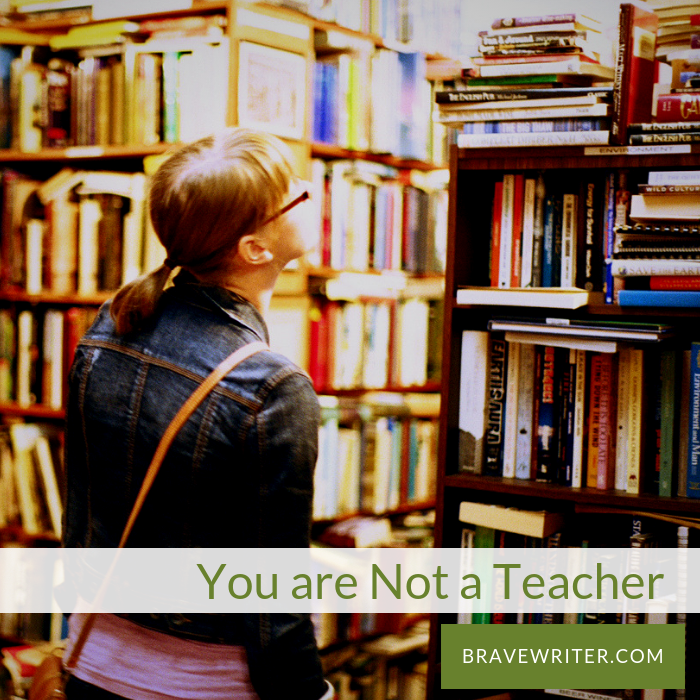
You are Not a Teacher

You are not a teacher


As a career goal, wanting to be a “teacher” is not one I would choose. I might choose to teach (for instance, I love teaching theology at Xavier University, I love teaching writing to my students at Brave Writer, and I loved teaching acting to the homeschool co-op students). But without a specific subject area, teaching in and of itself doesn’t interest me. Being a “teacher” is less interesting to me than participating in the learning process in subjects I care about.

We grew up in schools, most of us. We are aware of adults who choose teaching as careers. Some choose to teach because they love children. Some choose to teach because they love lesson-planning and creating a classroom environment. Many choose to teach because once proficient in their favorite subject, they enjoy passing that information on to the next generation. Of course there are those who choose to teach because they’ve seen teaching modeled as an adult career for 12+ years of their lives, and they can envision themselves in that role in a way they can’t imagine themselves into any other adult field.

In homeschool, we are in an entirely different environment from school. “Teaching” in its school sense is counterproductive to your goals.

You won’t likely stand in front of a dry erase board, poised to lecture your four kids. You don’t consult a set of criteria delivered to you by the board of education and figure out how to squeeze that into your year.

What you can do and do almost effortlessly, though, is model learning. Your enjoyment of the books you read aloud, your passion to track down information about a historical fact, your curiosity about nature and art create an appetite for learning in your home. This lifestyle of learning starts with you, a learner—not you, the teacher. You don’t teach kids to value learning. You learn. You value it. You live it.

I like to say that we should live our passionate curiosities in front of our kids. If reading about Charlotte Mason’s advocacy for art appreciation has piqued your interest in art, dive in. No lesson plan. No script for exciting children about art. Simply get interested in art:

  • Buy the books with large photos of paintings and pore over them while you sip your morning coffee.
  • Leave them on the coffee table and page through them while you nurse the baby.
  • Load the DVD player with Sister Wendy’s Story of Painting and watch—right in the middle of the morning, when “school” should be happening.
  • Get out the charcoal pencils and try your hand at drawing your hand. You can do this while a child is working on math. At the same table.

Likewise, if reading a book about the Sioux tribe to your children makes you want to know more information about what happened to Native Americans in South Dakota, Google it. Read the information to yourself, for yourself. You can share it, if a child is interested. But you be interested. Learn it for yourself.

Sometimes what matters to your child will overlap with what matters to you. Reveal how connections (the science of relations) creates a tapestry of education. Perhaps the artwork you are looking at depicts an era in history that is a current fascination of your son’s. Show the paintings as snapshots in time of the very era being studied in text. Discuss. Perhaps several different painters (in different eras) depict the Greek myths according to the tastes of their time. If you and your children are enjoying reading the myths, these paintings could be a wonderful companion to that study. Compare. Consider.

You might be passionate about much more mundane subjects, too. I spent about a decade obsessed with the rock band, U2. I read daily articles, books, watched films, went to concerts, listened to their albums. My kids watched me develop a passion that led to so much in my life (from music to politics to theology to geography to published writing—mine about the band!).

What sets homeschooling apart is the ability to lead a life of learning with your children (not in addition to, not instead of, not on purpose to “teach” something). You get to pursue what interests you, and in the process your children will see a real living model of learning. THAT education is worth dozens of textbooks. You are giving your children a template for how to be self-teaching, how to cultivate a curiosity, how to pursue a passion.

That’s the real education. That’s the best kind of teaching.

Brave Learner Home

Image by Laura D’Alessandro (cropped, tinted, text added)

Posted in Brave Writer Philosophy, Homeschool Advice, Parenting | Comments Off on You are Not a Teacher

« Older Entries
Newer Entries »
  • Search the Blog

  • Julie Bogart
  • Welcome, I’m Julie Bogart.

    I’m a homeschooling alum -17 years, five kids. Now I run Brave Writer, the online writing and language arts program for families. More >>

    IMPORTANT: Please read our Privacy Policy.

  • New to Brave Writer? START HERE

  • FREE Resources

    • 7-Day Writing Blitz
    • Brave Writer Lifestyle Program
    • Brave Writer Sampler: Free Sample Products
    • Freewriting Prompts
    • Podcasts
  • Popular Posts

    • You have time
    • How writing is like sewing
    • Best curriculum for a 6 year old
    • Today's little unspoken homeschool secret
    • Do you like to homeschool?
    • Don't trust the schedule
    • You want to do a good job parenting?
    • If you've got a passel of kids
    • You are not a teacher
    • Natural Stages of Growth in Writing podcasts
  • Blog Topics

    • Brave Learner Home
    • Brave Writer Lifestyle
    • Classes
    • Contests/Giveaways
    • Friday Freewrite
    • High School
    • Homeschool Advice
    • Julie's Life
    • Language Arts
    • Movie Wednesday
    • Natural Stages of Growth
    • One Thing Principle
    • Our Team
    • Parenting
    • Philosophy of Education
    • Podcasts
    • Poetry Teatime
    • Products
    • Reviews
    • Speaking Schedule
    • Students
    • Writing about Writing
    • Young Writers
  • Archives

  • Brave Writer is a participant in the Amazon Services LLC Associates Program, an affiliate advertising program designed to provide a means for sites to earn advertising fees (at no extra cost to you) by advertising and linking to amazon.com

    Content © Brave Writer unless otherwise stated.

What is Brave Writer?

  • Welcome to Brave Writer
  • Why Brave Writer Works
  • About Julie
  • Brave Writer Values
  • Frequently Asked Questions
  • Speaking Schedule

Brave Writer Program

  • Getting Started!
  • Stages of Growth in Writing
  • The Brave Writer Program
  • For Families and Students
  • Online Classes
  • Brave Writer Lifestyle

…and More!

  • Blog
  • Classroom
  • Store
  • Books in Brave Writer Programs
  • Contact Us
  • Customer Service
  • Brave Writer Staff
© 2026 Brave Writer
Privacy Policy
Children's Privacy Policy
Help Center