Brave Writer Philosophy Archives - Page 62 of 84 - A Brave Writer's Life in Brief A Brave Writer's Life in Brief
  • Start Here
    • For Families
      Multiple Ages
    • Ages 5-7
      Beginning Writers
    • Ages 8-10
      Emerging Writers
    • Ages 11-12
      Middle School Writers
    • Ages 13-14
      High School Writers
    • Ages 15-18
      College Prep Writers
  • Shop
    • Product Collections
    • Bundles
    • Writing Instruction Manuals
    • Literature & Grammar/Punctuation
    • Composition Formats
    • Literature Singles
    • Homeschool Help
    • Book Shop
  • Online Classes
    • Class Descriptions
    • Class Schedule
    • Classroom
    • How Our Classes Work
    • Our Writing Coaches
    • Classes FAQ
  • Community
    • Brave Learner Home
    • What’s Happening
    • Blog
    • Podcast
    • Calendar
  • Cart
  • My Account
    • My Online Classes
    • My Account
  • My Account
    • My Online Classes
    • My Account
  • Start Here

    If you’re new to Brave Writer, or are looking for the best products for your child or family, choose from below:

    • For Families
      Multiple Ages
    • Ages 5-7
      Beginning Writers
    • Ages 8-10
      Emerging Writers
    • Ages 11-12
      Middle School Writers
    • Ages 13-14
      High School Writers
    • Ages 15-18
      College Prep Writers
  • Shop

    If you’re already familiar with Brave Writer products, go directly to what you’re looking for:

    • Product Collections Browse the full catalog in our shop
    • Bundles Everything you need to get started
    • Writing Instruction Manuals Foundational Writing Programs
    • Literature & Grammar/Punctuation Grammar, Punctuation, Spelling & Literary Devices
    • Composition Formats Writing Assignments for Every Age
    • Literature Singles Individual Literature Handbooks
    • Homeschool Help Homeschooling Tools and Resources
    • Book Shop Books associated with Brave Writer Programs
  • Online Classes
    • Class Descriptions
    • Class Schedule
    • Classroom
    • How Our Classes Work
    • Our Writing Coaches
    • Classes FAQ
  • Community
    • Brave Learner Home
    • What’s Happening
    • Blog
    • Podcast
    • Calendar
  • Search
  • Cart

Search Bravewriter.com

  • Home
  • Blog

A Brave Writer's Life in Brief

Thoughts from my home to yours

Archive for the ‘Brave Writer Philosophy’ Category

« Older Entries
Newer Entries »

Home Sweet Home

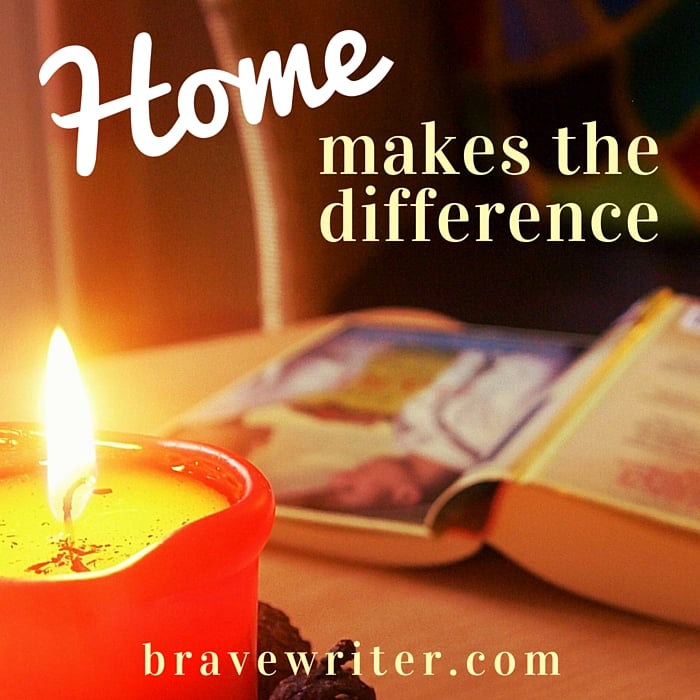
Home makes the difference

We’ve talked about the key difference in home education versus school being the word “home.” Home makes all the difference. If we are at home, with family, living a lifestyle of learning, how we educate will be different than what happens in a school building. We may also have a different set of goals or expectations for home learning than a school has.

For instance, how can Algebra foster close family relationships?

Algebra only fosters close family relationships if

  • the child has bought into the idea that Algebra is a necessary part of his or her future success,
  • and the parents are willing to help a child who finds it challenging by working side-by-side, trying new curricula, or hiring outside help to enable the student to develop competence without debilitating frustration, tedium and failure.

On the flip side, in a family where Algebra is an expectation and not a goal the child has owned for himself, where the curriculum is tedious or difficult, where frustration attends the daily schoolwork, family relationships will suffer as the child resists learning the subject matter and finds ways to subvert the learning process leaving the homeschooling parent exasperated and discouraged.

Inspiration First

Let’s look at one particular homeschool subject I know well: writing. There are two aspects of writing: the mechanics and the inspiration. Traditional academic settings tend to focus first on mechanics and then on creation, inspiration. Brave Writer reverses that order. We start with inspiration. We create a context for writing to spring to life for the child first, through reading quality literature, through jotting down a child’s thoughts and sharing them with an interested audience, through nursery rhymes and poetry, through word play, through celebrating a child’s attempts to write without help even while the writing is not legible or has mechanical errors.

Home is a great place for inspiration to occur. Parents make natural cheerleaders, they seek connections that are personally tailored to the child, they offer time and commitment to a child’s interests and use those as a means to enliven a subject area like writing.

The Mechanics Follow

Once a child discovers the joy of writing, learning how to read, hold a pencil, handwrite, spell, punctuate, incorporate literary elements, revise, and publish will follow naturally because these are what make it possible to participate in the joy of writing. They can be accomplished in ways that inspire:

  • copywork
  • dictation
  • reading novels
  • reading non-fiction
  • freewriting
  • funneling a topic
  • poetry teatimes
  • keeping a journal
  • writing a screenplay for a favorite story…

Home becomes a place where skills are married to joyful acquisition, not to painful subjection. Over time, new challenges in writing offer a child not only the opportunity to develop new skills, but to explore uncharted territory, to have a fresh adventure. The point is that writing is not a subject to be endured because a parent says to do it. Writing becomes a means to an end, that end being, the purposeful use of writing in the child’s real life.

For kids who find that writing (for example) is not their passion, they may still discover its uses in their lives in a home that celebrates writing as relevant and approachable. Perhaps those kids will also see writing as a means to an end: an effective tool for academic pursuits. If that is the case, the child who has been taught writing through inspiration followed by perspiration (the joy followed by the mechanics) will have more success in studying the essay format and preparing for an essay exam than a child who has only learned to hate writing or who has had minimal success to that point.

Writing can be taught to a student for whom it has a utilitarian function. Not all of us have to love every subject, skill equally. Still, the key then is tailoring the kind of writing instruction and opportunities to the objectives of the child. A student who is preparing for college will approach writing differently than a child who is planning to go into a trade (like auto mechanics or culinary school or cosmetology).

Does relaxed schooling mean that a child never feels strained or that a big effort is not required of him or her? Not at all. If any of you have kids who love console games or play sports at a high level, you know that putting in big effort is key to their success. You also know that they don’t mind working hard when the objective is meaningful to them.

So here’s the trick of home education:

Parents are responsible to facilitate their children’s goals using whatever tools create the most conducive environment for joyful learning.

See if you can apply some of those principles to other subject areas. How can we take advantage of the intrinsic value of any subject matter to first, bring it to life (inspiration) and then second, to develop competence (mechanics)?

Brave Learner Home

Posted in Brave Writer Philosophy, Homeschool Advice | Comments Off on Home Sweet Home

New Pages on Brave Writer

I’ve updated two pages on the Brave Writer website:

About Us

Brave Writer Values

I’ve posted these instead of a new blog today. (Spent all my time writing them last night.) Enjoy!

(By the way, I’ve discovered that my comments on this blog still aren’t working very well. If you’d like to comment on any of the blog posts, feel free to do so over on the Scratch Pad public forum on the Brave Writer website. We are having some great conversations. :))

Posted in Brave Writer Philosophy, General | Comments Off on New Pages on Brave Writer

To study or not to study… is that the question?

We work really hard as homeschooling moms. Harder than we need to.

We want to make learning a pleasure, we want to cover everything (every single thing), we want to do a better job at teaching every single thing than the schools and we want to be sure that our kids retain everything.

Every single thing.

It would be criminal to think that our kids might forget some gem, some mathematical sequence, some grammatical construction, some aspect of the freaking Cold War after we had so lovingly and conscientiously taught it to them, right?

In fact, did you know that no elementary-aged self-respecting homeschooled child has ever missed a math problem? Seriously. It’s a proven fact. Moms make their kids re-do every missed problem, that’s how neurotic (and adorable) we are.

Yes, we’re a tad paranoid about doing a good, stupendous, outrageously effective job.

Though most homeschool discussions ask, Should I follow a more structured approach to education or allow for a natural, relaxed approach?, the real question is more like this:

Help! How do I keep from ruining my kid?

About now would be a good time to spike your herb tea with forbidden sugar cubes.

Ready? Let’s tackle this tiger.

The chief difference between home education and school is the word “home.” School happens in a building with teachers and dozens of other age-mates who must work through a set curriculum for each subject so that the school system can measure its effectiveness in achieving goals and standards of education. Fair enough.

Home is a whole other animal and that’s why we have such difficulty figuring out if what we’re doing is working, or whether or not we are producing comparable results to school. Let’s just admit right up front: we don’t do a good job of duplicating what school does. In point of fact, we signed up for this homeschool gig in order to not produce all the things school does.

But that admission needs to make us brave, not cowards. If the conditions of education at home are not the same as school, then Pysch Reseach 101 teaches us that the results will be different.

If it’s a foregone conclusion that our results will not be the same as school, it’s time for us to assess what results we’re looking for so that we measure ourselves by a different yardstick. Right?

I offer the following list as a set of realistic, humble expectations for home education:

  • Reading
  • Handwriting
  • Math facts
  • Reading aloud
  • Tea times
  • Music lessons
  • Fostering curiosity
  • Personalized learning goals coordinated with a child’s vision of her future
  • Facility with the library (and affection for it!)
  • Home arts (cooking, repairs, sewing, cleaning, knitting, yard work, crafts)
  • Extended, uninterrupted play
  • Narrating (talking about interests, questions, ideas, experiences in a one-on-one setting)
  • Mastering areas of interest using as much time as needed (no set end-point for a topic or subject)
  • Tackling a subject at a personalized pace
  • Computer literacy
  • Awareness of current events
  • Conversations with parents that both nurture and challenge
  • Socialization (learning to relate to siblings and parents with respect, working out problems patiently and with parental support)
  • Lots of free time (to use any way the child wants)
  • Nature observation (both through a window and in outings)
  • Trips to cool places
  • Running a business
  • Time to discover what one wants to learn
  • Learning from mom and dad what they know
  • Use of television and movies for learning
  • Depth involvement in sports or the arts without competing schoolwork
  • All subjects open for learning (no stigmatized subjects)
  • Vast variety of learning models which can be attempted and discarded or adopted
  • Close family relationships
  • Hands-on learning (no need for canned workbooks for things like counting money, for instance)

As you can see, this list doesn’t itemize subject matter like the four year cycle of history or geometry and calculus or the academic essay. These subject areas are important (I’m not minimizing them). But they will need to fit into these other goals of home education so that they are a natural part of home life rather than a sudden imposition of “school” on the home.

How can Algebra 2 foster close family relationships? How does the academic essay become an extension of narrating and dialog between parents and students? How does research involve computer use as well library skills? What does the television enable us to teach? See what I mean? That’s the trick. Education must flow through the nurturing and less structured world of home for it to work. And when it does, it’s breath-taking. When school is brought into the home, all that goodwill and imaginative, peronsalized power goes down the proverbial drain.

Next installment will look at some creative ways to transform this list of home education strengths into fulfilling academic requirements. 🙂

Posted in Brave Writer Philosophy, General, Homeschool Advice | 2 Comments »

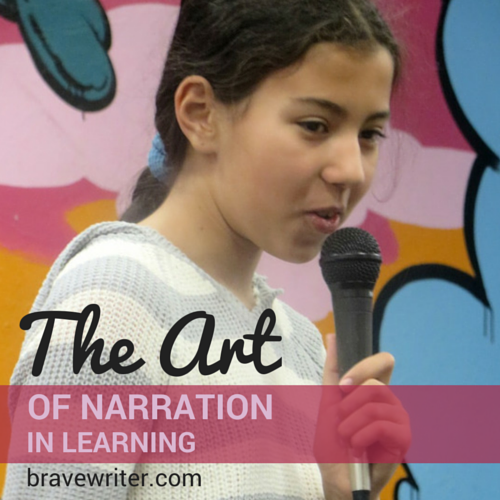
The art of narration in learning

The Art of Narration in Learning

My aunt and uncle live in Italy. She’s American; he’s Italian. They have two kids. Their daughter took her exams to complete junior high in June. My aunt sent me the following email that described what exams for that age group look like:

Lara [my cousin] spent between 2 and 4 hours each day for 4 straight days on her essay tests (not multiple choice) in Italian (Composition), English, French and Math (no essay there, obviously!). That was last week. This afternoon she had her orals in Italian (Literature), History, Geography, Art History, Science, Technical Studies, English, French, Music and Physical Education. (No, I’m not kidding around, they actually had to prepare a several-page report on a sport! She chose figure skating.)

She was in the room (with all the teachers for the above subjects and the Exam Committee Officer, who is a teacher from another school, to prevent partiality) for about 30 minutes, but the first 5 were spent discussing the results of the written tests. In addition to separate presentations on specific topics for Art History, P.E., French and English (she brought pictures of our trip to California last year and talked about most of you guys [the relatives]!), she had to prepare one of the topics covered during the last school year from a multi-disciplinary perspective.

She chose the Cold War and its consequences, and trekked through History (dates, people, policies, causes, effects), Geography (characteristics of the Western and Eastern blocks), Literature (passages dealing with the Cold War, the bomb dropped on Hiroshima and the Viet Nam War) and Science (the atomic bomb and nuclear energy in general) during her presentation. She wasn’t allowed to read any of this. She could look at an outline, but the content all had to be from memory.

I read this litany of objectives and exams, and headed straight for the bottle of Nyquil (drug of choice when I want to knock myself out and sleep through the pain). Argh! The Cold War?! The freaking Cold War in Italian? Okay, I was a bit loopy from the meds, but it sounds harder to do in Italian… doesn’t it?

I clicked out of that screen, mopped the sweat off my forehead, hyperventilated, and then, in a frenzy of irrationality, yanked children off computers, away from TVs and magazines. I hustled my English-speaking chicks to the kitchen table and downloaded as much Cold War info as I could remember directly into their spongy brains, quizzing them every seven seconds to be sure they were retaining my pearls of educational lecture.

We got through it… that momentary panic, the fear of orange-jumpsuits and police locking me up for scholastic neglect. Once I’d ignored the email for about three months, made a cup of tea and spent more than a panicky fifteen minutes castigating myself in my imagination, I did happen to notice some commonalities between our homeschool and Lara’s more organized, traditional school.

In fact we may be achieving similar results and you may too, without having an exam period. And it may be that our kids are not necessarily versed in the Cold War (though mine are now, thankyouverymuch), but they may be able to give this kind of integration to any number of other interests and studies.

Notice, for instance, how important the art of narration is to the Italian system of evaluation. The examiners are looking for the ability to do the following:

  • to orally retell what the student has learned, as well as to write it. Both of these are forms of narration.
  • to form connections between subject areas. Lara (my niece) had to be able to relate the history of the Cold War to geography, science, technology, and literature.
  • to prepare a field of study. Rather than the examiners creating a test that the student must study for blindly (hoping to guess what material is of most interest to the examiner), the student was expected to use materials read and studied during the year to prepare a narrative that wove together what she had learned. Certainly the examiners may have asked questions that would reveal ignorance, but because the exam was oral, she would have a chance to fill in incomplete detail, to add support to a weak assertion, to follow a trail of questions determined by the examiner in dialog (rather than having to guess it).

Whose style of education does this remind you of? (Now that you can breathe again.)

Charlotte Mason, of course! (She’s the British educator who placed great emphasis on the art of narration through oral and written exams.) Charlotte says that narration ought to be a pleasure to the child and that exams ought to be a chance to reveal what the student knows rather than to expose what a child has not yet mastered.

How can we apply this idea of narrating and mastery to the way our kids learn? In the Brave Writer Lifestyle, we take each area of interest and explore it as far as a child’s interest and enthusiasm carry us. As we do, we provide opportunities to talk and write about those interests (using freewriting, conversations, even presentations if appropriate) to give language to those interests and fields of study.

Narration lets us know that the child is learning, that he or she has taken in information and can now make connections. Some children thrive on conversation while others gear up for a more formal examination. We’ve done both. One year, for fun, I used a tape recorder and in December, right before Christmas, I prepared some open-ended exam questions in four areas: literature, history, math and poetry. The kids got to sit alone with me and tell me in their own words as much as they could about the things we’d studied together while I recorded their answers. To a child, they loved this. It was very gratifying to me at the time as well to listen to them formulate answers, to put things together in a narrative whole. I was repeatedly surprised at which aspects of the topic they retained and how those fit with their overall schema of life.

We’ve also used freewriting as a kind of narration exam. After studying a period of history or a novel, I’ll suggest freewriting all that can be remembered (perhaps with a question to help focus the writing) about that historical period or book. Sometimes that little bit of closure gives both mom and child a lift!

The Homeschool Alliance

Image of girl by EdenPictures (cc flipped, cropped, text added)

Posted in Brave Writer Philosophy, Email, Homeschool Advice | 4 Comments »

Checking Boxes

This past week, I received several emails from moms who want to be more relaxed in their approach to home education but who feel like “type A” mommas. They like to make to do lists, and to check off activities, to know they’ve accomplished stuff. How do they make life more relaxed without feeling out of control, unable to set a goal and see it fulfilled?

It’s true that some curricula lends itself to check boxes. You can say “read pages 100-152 by Friday” with a little box next to it and you’ll know that it was finished when the child marks it with an ‘X’.

So can a more structured personality run a more relaxed homeschool? Yes! We just need to update the content of those little check lists. What if you made a ‘to do’ list that looked more like this?

___ I made each of my kids laugh today.

___ I found a way to get one of my kids to say “That was so much fun!”

___ We read aloud and I heard the words I read, and noticed one great simile and one great word pair.

___ We followed one rabbit trail today (someone brought up a subject that made me stop what I was doing to go do a google search, to look for a movie or book on the topic, to talk about it and follow it up with a plan of some kind).

___ We used one freewrite prompt.

___ I hugged each of my kids.

___ I listened to one child tell me a long story about something important to him.

___ I learned how to do something today that one of my kids taught me.

___ I read a blog or book or magazine about relaxed schooling.

___ I didn’t do one thing that I hate to do.

___ I didn’t make my kids do _________ today.

___ I did one thing that made me supremely happy today.

Posted in Brave Writer Philosophy, General, Homeschool Advice | Comments Off on Checking Boxes

« Older Entries
Newer Entries »
  • Search the Blog

  • Julie Bogart
  • Welcome, I’m Julie Bogart.

    I’m a homeschooling alum -17 years, five kids. Now I run Brave Writer, the online writing and language arts program for families. More >>

    IMPORTANT: Please read our Privacy Policy.

  • New to Brave Writer? START HERE

  • FREE Resources

    • 7-Day Writing Blitz
    • Brave Writer Lifestyle Program
    • Brave Writer Sampler: Free Sample Products
    • Freewriting Prompts
    • Podcasts
  • Popular Posts

    • You have time
    • How writing is like sewing
    • Best curriculum for a 6 year old
    • Today's little unspoken homeschool secret
    • Do you like to homeschool?
    • Don't trust the schedule
    • You want to do a good job parenting?
    • If you've got a passel of kids
    • You are not a teacher
    • Natural Stages of Growth in Writing podcasts
  • Blog Topics

    • Brave Learner Home
    • Brave Writer Lifestyle
    • Classes
    • Contests/Giveaways
    • Friday Freewrite
    • High School
    • Homeschool Advice
    • Julie's Life
    • Language Arts
    • Movie Wednesday
    • Natural Stages of Growth
    • One Thing Principle
    • Our Team
    • Parenting
    • Philosophy of Education
    • Podcasts
    • Poetry Teatime
    • Products
    • Reviews
    • Speaking Schedule
    • Students
    • Writing about Writing
    • Young Writers
  • Archives

  • Brave Writer is a participant in the Amazon Services LLC Associates Program, an affiliate advertising program designed to provide a means for sites to earn advertising fees (at no extra cost to you) by advertising and linking to amazon.com

    Content © Brave Writer unless otherwise stated.

What is Brave Writer?

  • Welcome to Brave Writer
  • Why Brave Writer Works
  • About Julie
  • Brave Writer Values
  • Frequently Asked Questions
  • Speaking Schedule

Brave Writer Program

  • Getting Started!
  • Stages of Growth in Writing
  • The Brave Writer Program
  • For Families and Students
  • Online Classes
  • Brave Writer Lifestyle

…and More!

  • Blog
  • Classroom
  • Store
  • Books in Brave Writer Programs
  • Contact Us
  • Customer Service
  • Brave Writer Staff
© 2026 Brave Writer
Privacy Policy
Children's Privacy Policy
Help Center