Julie Bogart, Author at A Brave Writer's Life in Brief - Page 240 of 482 A Brave Writer's Life in Brief
  • Start Here
    • For Families
      Multiple Ages
    • Ages 5-7
      Beginning Writers
    • Ages 8-10
      Emerging Writers
    • Ages 11-12
      Middle School Writers
    • Ages 13-14
      High School Writers
    • Ages 15-18
      College Prep Writers
  • Shop
    • Product Collections
    • Bundles
    • Writing Instruction Manuals
    • Literature & Grammar/Punctuation
    • Composition Formats
    • Literature Singles
    • Homeschool Help
    • Book Shop
  • Online Classes
    • Class Descriptions
    • Class Schedule
    • Classroom
    • How Our Classes Work
    • Our Writing Coaches
    • Classes FAQ
  • Community
    • Brave Learner Home
    • What’s Happening
    • Blog
    • Podcast
    • Calendar
  • Cart
  • My Account
    • My Online Classes
    • My Account
  • My Account
    • My Online Classes
    • My Account
  • Start Here

    If you’re new to Brave Writer, or are looking for the best products for your child or family, choose from below:

    • For Families
      Multiple Ages
    • Ages 5-7
      Beginning Writers
    • Ages 8-10
      Emerging Writers
    • Ages 11-12
      Middle School Writers
    • Ages 13-14
      High School Writers
    • Ages 15-18
      College Prep Writers
  • Shop

    If you’re already familiar with Brave Writer products, go directly to what you’re looking for:

    • Product Collections Browse the full catalog in our shop
    • Bundles Everything you need to get started
    • Writing Instruction Manuals Foundational Writing Programs
    • Literature & Grammar/Punctuation Grammar, Punctuation, Spelling & Literary Devices
    • Composition Formats Writing Assignments for Every Age
    • Literature Singles Individual Literature Handbooks
    • Homeschool Help Homeschooling Tools and Resources
    • Book Shop Books associated with Brave Writer Programs
  • Online Classes
    • Class Descriptions
    • Class Schedule
    • Classroom
    • How Our Classes Work
    • Our Writing Coaches
    • Classes FAQ
  • Community
    • Brave Learner Home
    • What’s Happening
    • Blog
    • Podcast
    • Calendar
  • Search
  • Cart

Search Bravewriter.com

  • Home
  • Blog

A Brave Writer's Life in Brief

Thoughts from my home to yours

Author Archive

« Older Entries
Newer Entries »

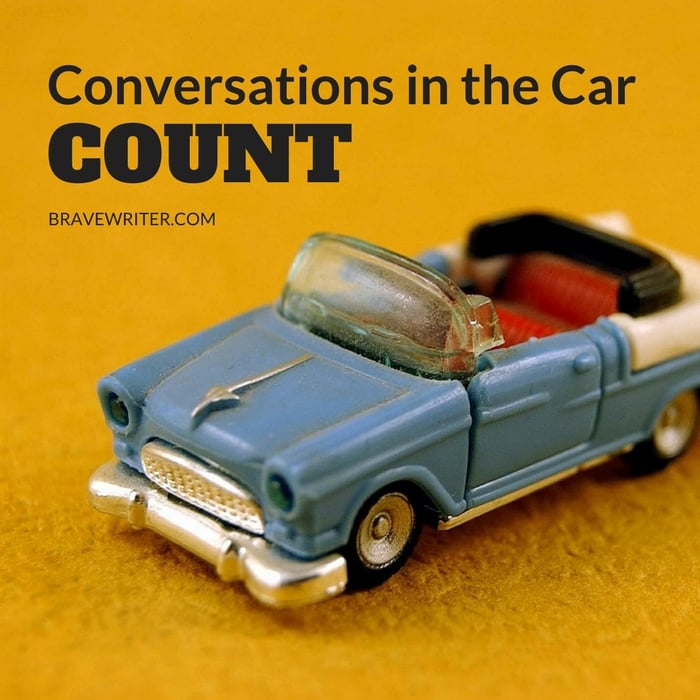
Conversations in the Car Count

Conversations in the car count

You’re driving along discussing how far the sun is from the earth when one of your kids wants to know if the song on the radio is by OneRepublic, another one asks if you can stop by the store to get a starfruit because she heard about it from a book she’s reading, and then another one declares that he knows a shortcut home. The toddler takes this opportunity to throw his pacifier to the floor, and the nine year old steps on it while trying to pick it up. Of course.

In the span of fifteen minutes, you’ve covered all kinds of interesting information, as well as heard snippets of what is filling your kids’ heads all day.

Count it all.

Write it down.

It’s okay that you have incomplete discussions. You’ll circle back to them over time. Remind yourself that conversation is the homeschool equivalent of a classroom lecture.

Conversations are often best had in a car, anyway. It’s when you’re all trapped in one space and talking is the main thing that can be done in that space. Use it well!
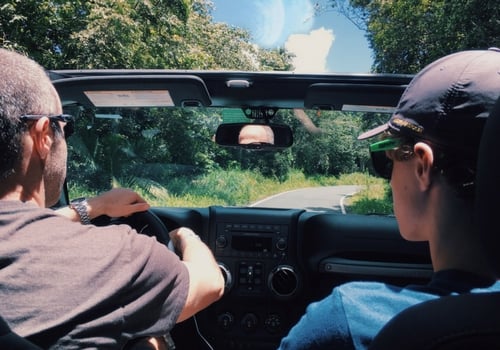
Conversations in the car count

Some Ideas

  • Pose a provocative question: “How many basketballs could we fit in that semi?” Brainstorm ideas, take guesses, figure it out when you get home.
  • Talk about the lyrics of a song.
  • Comment on the birds on the telephone wire, wondering which ones they are.
  • Ask about a game recently played or a book being read.

Talk in the car! Count it. So much good education happens, literally, along the way.

Need a Homeschool Coach?
Join Brave Learner Home!

Posted in Homeschool Advice | Comments Off on Conversations in the Car Count

Stick Up for Yourself Inside

Stick Up for Yourself Inside

15+ years ago, I started an online discussion board for (mostly) homeschool mom friends called The Trapdoor Society. The concept was this: Because our days were filled with small children and home-keeping demands, we needed an escape—a trapdoor through which we could pursue our own self-education: art, literature, film, politics, religion, poetry, and more. We’d be friendly and supportive when we disagreed and we’d help each other expand our worlds together…

In other words, Internet Utopia.

In other words, good luck with that.

We did become incredible friends (there are still about 40 of us in touch today). But those friendships also survived some truly painful clashes of personality, belief systems, emotional meltdowns, and even a version of trolling (though that word didn’t exist back then). I remember spending hours crafting response posts in my head when I felt maligned or judged or misunderstood.

Underneath that surface reason, though, was an invisible-to-me-at-the-time one. Fear. I didn’t want to be wrong. I didn’t want to be misunderstood. I didn’t want to have made an irrevocable choice.

When criticism came my way, I wanted to fight back—to not take it. I fought back on the outside.

If I could get everyone out there to agree that I was okay, then I would finally allow myself to feel okay in here.

The benefit of aging is the increasing awareness that it is nigh to impossible to get all the people out there to all agree that you are perfectly wonderful as you are. (I know, I’ve tried.) No one likes you enough to do that for you. They’re all too busy trying to get you to tell them that they are okay, as they are.

One of the reasons it’s tough to hear our kids tell us that some of our choices were painful to them is that we especially want their approval—after all, we are “sacrificing” careers, manicures, a good tennis game, grad school, hobbies, and beautifully decorated homes to ensure they have the best possible childhoods. How they can’t know that, can’t see that, can’t forgive us for our foibles is incomprehensible.

If you resist the temptation to defend

The only way out is inner confidence—to firm up your shaky insides with your resilient belief that you are conscientious, intentional, and sincere. These three qualities won’t prevent mistakes or over-reach. They won’t guarantee romanticized notions of success. But they can be the firm base from which you continue to grow, revise, and expand your life’s vision.

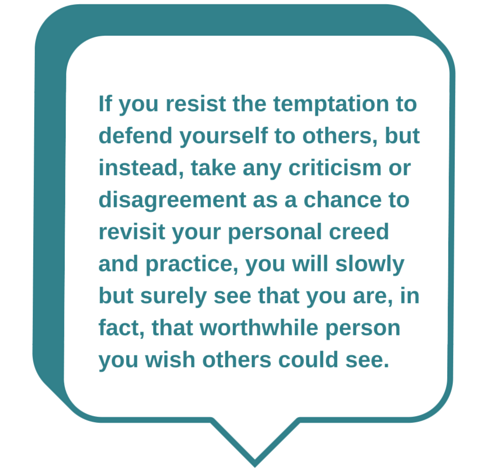
If you resist the temptation to defend yourself to others, but instead, take any criticism or disagreement as a chance to revisit your personal creed and practice, you will slowly but surely see that you are, in fact, that worthwhile person you wish others could see. You’ll know it from the inside—that your choices and your vision are perfectly valid for you.

Meanwhile, rather than eviscerate your persecutors with better arguments or lengthy diatribes, go soft on the outside.

It is often the perfect response to children—respond in the opposite spirit. They come with anger and force, you respond with internal strength and gentle words: “I hear you. That sounds awful. I want better for you.”

Strong on the inside, soft on the outside.

Stick up for yourself to yourself.

Trust—you don’t know the outcome of this grand risky experiment. The only way forward is one day at a time, with your conscientiousness, sincerity, and intentionality to guide you.


Brave Learner Home

Posted in Brave Writer Philosophy, Julie's Life | Comments Off on Stick Up for Yourself Inside

15 Ways to Leave a Love Note

15 ways to leave a love note

Leave a love note!

Today’s task is to leave a love note for someone. Everyone in the family can participate. Help the ones who can’t transcribe their own thoughts (who don’t read or may not write, yet) to get in on the act. They can add little picto-graphs or stickers, if they like.

Leave the love notes in surprising locations and use unusual tools.

For instance:

  1. Write a note on the bathroom mirror with lipstick.
  2. Use Post-it notes and leave little notes all over the house for someone (or all over the inside of their car or all over their office or bedroom).
  3. Write a love note on the brown paper bag used to take a lunch to work or to a park day.
  4. Send a text!
  5. Post a status update on Facebook tagging the person you want to love up.
  6. Tuck love notes inside the book the person is reading, a few pages ahead of where they are.
  7. Write love notes on the edges of today’s newspaper for the newspaper reader.
  8. Put a love note (use a Post-it note) on the favorite beverage of your loved one that is lurking in the refrigerator.
  9. Sock drawers are a great place for love notes.
  10. Stick a love note on the left and right shoes of a favorite pair (maybe make a pun about left and right).
  11. Use shaving cream to squirt a note on the shower wall before your loved one showers.
  12. Stomp a note (maybe just a word) into the snow in the front yard. View from an upstairs window.
  13. Create a love note out of seashells and spell it on the kitchen table for a center piece.
  14. Write a love note on your palm. Close your hand into a fist. Approach the loved one. Tell them to tap three times for a surprise. When they do, open your hand and show your palm.
  15. Create a love coupon (in any form) and tuck it into your loved one’s purse or wallet.

Or think of your own!


Brave Writer Lifestyle

Posted in Activities, Parenting | Comments Off on 15 Ways to Leave a Love Note

Are You Training Your Kids to NOT Help?

Don't Turn Down Help

Do you wish you didn’t have to ask your family for help?

  • with the dishes
  • taking out the over-flowing garbage
  • changing the toilet paper tube (why this is difficult, I still don’t understand)
  • clearing a table
  • putting away the dozens of pairs of mis-matched shoes strewn through the halls
  • moving a wet load of laundry to the dryer and a new load into the washer
  • shoveling snow
  • unloading groceries
  • replenishing the food and water bowls for the dog and cats

And so on…

Let me flip this around on you. What do you do when someone offers to help?

Think about it for a moment. Imagine this setting. You’re in the kitchen unloading the dishwasher and preparing to load it. In a surprising instance of charity and awareness, your teenager who is watching TV says, “Do you need help Mom?”

What do you say?

Do you tell the teen that yes, you need help, and that he can turn off his favorite program to take over for you at the sink? Do you do then walk away leaving him to it while you go get a bubble bath or hop back onto the computer?

Or do you think to yourself, “That’s so nice that he asked, I’m going to reward him by saying he doesn’t have to help me and he can go on watching his program”? Some unconscious version of this one—you turn down help because you feel generous when you do.

Another instance: You’re folding laundry and the five year old wants to help. The five year old will offer five year old skills to the job. Do you accept that? Or do you send the child away to play so you can get it done correctly and quickly?

Another time: You’re making dinner and it’s the favorite meal of your 11 year old daughter. She offers to peel or chop and you send her to set the table. She doesn’t particularly want to set the table—she wanted to help by peeling and chopping. You know she will slow you down if she peels and chops so you ask her to do what feels helpful to you: setting the table. She does a poor job with the table and you feel resentful that she isn’t being helpful… perhaps.

If any of these resonate—take a moment to consider this idea.

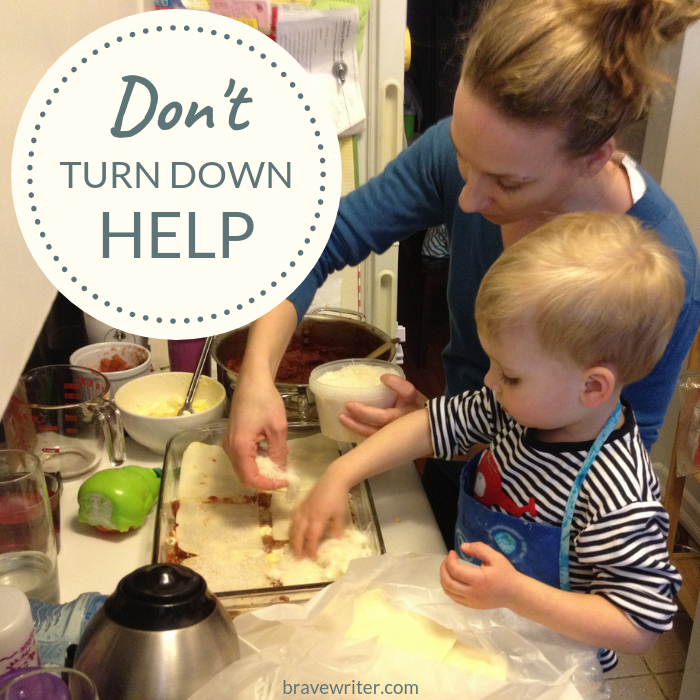
When you turn down help (whether you do so out of a desire to be generous, or because you are better at it, or because the offer doesn’t match what you thought you needed), you train your family to NOT HELP you.

In other words—if you want helpers in your family, accept the help they offer with enthusiasm, support them in being helpful by teaching them the skill that they want to offer, and if they are capable of doing the task without you, walk away and let them do the whole job so that they see they were helpful (not merely supervised and scolded). Let them see that you are relaxing and enjoying the help they are giving you.

It’s not easy.

It’s a reflex to simply take over, move quickly, do what needs to be done, and leave everyone in the status quo space of not helping.

Then what happens? Resentment builds. We start believing that no one cares about us, when in fact, we may have trained our roommates to let us do everything for them!

How do you get back to offers of help if you’ve already extinguished them? You ask for help! You say things like, “Who wants to help me make dinner? I’ve got sharp knives and electric tools for anyone who wants to hang out in the kitchen with me. I’ll set the table while you frappe and slice.”

You ask for help like this:

“I’m exhausted. Anyone willing to do the dishes for me tonight? I will be eternally grateful. I just need one hour to unwind in a tub? Anyone? Anyone?”

If no one offers, you do them and keep going and ask again another night. Over time, your vulnerability in needing help will reappear on the radar. Someone (one of your kids) will recognize that he or she can actually make you happy by helping (not make you worried or annoyed). And that child will offer, freely, out of the blue.

People want to be helpful. Sometimes we train them to lose that desire.

We can turn it around.

Principles:

  • Always accept the help being offered (don’t change the offer to something else).
  • Help your helpers be helpful—give them lessons, show them how, appreciate their efforts.
  • Get out of the way—competent helpers should be left to help, not hovered over. You should benefit from the help by not being there, doing something else you enjoy.
  • Thank them. Not effusively, but genuinely. “Thank you for cleaning up. That was helpful.”

Go forth and be helped!

Top image by Paul Ashley (cc cropped, text added)


A Gracious Space series

Posted in Homeschool Advice | Comments Off on Are You Training Your Kids to NOT Help?

Stealth Attack Learning

Stealth Attack Learning

Rather than teach, lead. Rather than talk, act. Rather than following the curriculum or opening the book, express what it is you wish to be known.

The secret of a vibrant homeschool is not in a book. It’s you. You are the secret weapon. You don’t have to be a good teacher. In fact, it helps if you are not.

It’s better if you are an enthusiast—someone for whom the feast of ideas is so compelling, you sneak time to follow up on the material you read to the kids to get the adult perspective. You are the best home educator when you can’t wait to make dinner because that’s when you park the kids in front of PBS to watch Arthur while you listen to Jane Austen on Audible.

There’s no magic here apart from the contagious energy that oozes from your engaged, fascinated mind! This is why home education actually works! It’s why you don’t need teacher training. Yes, you might learn something about how to impart the mechanics of writing or the formulas of math. Of course! But you don’t need to know how to give lectures or prepare worksheets or organize data into incremental chunks to be mastered through quizzes and grades.

You get to lead by passionate example.

We wonder why our kids don’t jump on the train with us? Usually it’s because we take that raw energy for the material we are about to learn with them and turn it into something schoolish. We say things like, “Let me check the lesson plan book” or “Go get me the teacher’s manual” or “I wonder what X curriculum has us doing today.”

When we delegate the work of homeschool to a company, we dilute the natural curiosity and energy with someone else’s prescriptive expectations.

But what would happen, say, if you read the manual before bedtime? What if you committed 10-15 minutes a day to simply looking at the material you hoped to cover the next day? If in doing so, you could authentically lead with that material the next day without referring to a program or a schedule or a system, what might happen?

Here’s what I mean.

It’s one thing to open a Brave Writer writing program in front of your kids and to say, “We’re going to do Project Six which is called Body Art. Come here. I need you to lie on the floor.”

It’s another entirely to get up from the breakfast table and say to one of your kids: “I’m going to lie on top of this long sheet of butcher paper. Would you mind tracing around my body with this big Sharpie? Thanks.”

Once the child has done it, you get the scissors and begin cutting your body out. Your kids are going to wonder what you are doing at some point. In the meantime, you keep going. You clip words from Pottery Barn Catalogs and you glue them to your body-butcher paper.

As you work, you ask for help: “Hand me the glue stick, would you?” and “Do you think the word ‘sparkly’ describes me?”

Before you know it, someone is going to want to have their body drawn and clipped and words stuck to their elbows and forehead too.

This is leading and immersing and playing and learning all rolled into one. Stealth attack style—the same way you taught your kids to kick a soccer ball or play peek-a-boo or decorate a Christmas tree. There was no moment where you said to your 8 year old: “Now let’s see—the planner for childhood says you need to learn how to hold a kite string and it will take six steps.”

Kill the atmosphere

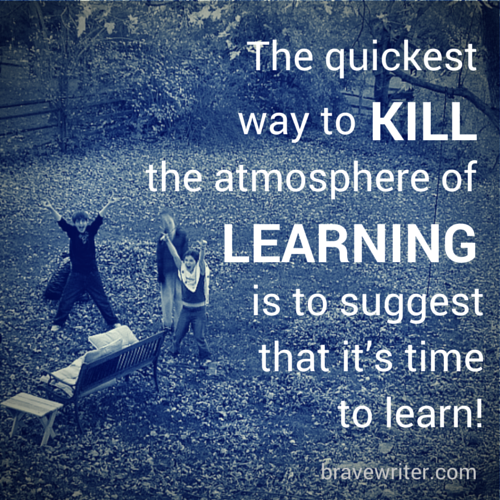
The quickest way to kill the atmosphere of learning is to suggest that it’s time to learn!

What do you do with those pesky skills that require some incremental work? You do the best you can to support a rich atmosphere—you add treats, you rub shoulders, you sit next to your struggling second grader, you give encouragement, you try the process yourself in front of your child, you use calculators, you use Spell Check, you add brownies and candles and nature hikes before or after.

LIFE is appealing to everyone. Everyone. Life is learning. Invest in what feels alive and good and curiosity making.

If what you want to learn is not on the agenda of your child, YOU go learn it in your off minutes. Read an extra chapter. Check out the adult version of the event from the library or online (book, DVD, podcast). Your appetite need not be held back by an 11 year old’s boredom with the abolition movement. You are free to read all about the Underground Railroad now—without your child coming along.

Trust me: if you become passionate about the topic, you will naturally talk about it in your children’s presence and at some point, they will find it interesting or they will have absorbed it simply by sharing oxygen and square footage with you. Perhaps as teens. Perhaps as college students home on break.

If you’re looking for a way to start a new trajectory, stealth lessons are the way to go. Set the table with the materials or stack up the books, all after the kids are in bed. Get up and begin, without a word, without explanation or mission or objective or preamble. No one wants to be told “We’re going to have fun today.” The moment they hear the words, they want to prove you wrong! So simply begin.

If the lesson today is all about homonym confusion in the editing process, resist the temptation to talk about the problem your child is having with homonyms. A surefire way to kill any interest in learning about homonyms.

Instead, what if you tried this? Before breakfast, fill a white board with homonyms (as obscure and surprising a set as you can find) and then play a game—ask everyone to make the meaning clear of each word on scratch paper with either drawings, synonyms, sentences, or definitions. Can they Google? Of course! That’s how adults learn everything!

Get back to enthusiasm, creativity. Remind yourself of that tedious classroom where you watched the tick tick tick of the clock desperately waiting for the sentence-in-your-seat to end. That will help you remember to keep it real at home—open, direct, clear, interesting—HOME.

You can do this!

Image woman and book by Amy (cc cropped, text added)


Brave Learner Home

Posted in Brave Writer Philosophy, Homeschool Advice | 3 Comments »

« Older Entries
Newer Entries »
  • Search the Blog

  • Julie Bogart
  • Welcome, I’m Julie Bogart.

    I’m a homeschooling alum -17 years, five kids. Now I run Brave Writer, the online writing and language arts program for families. More >>

    IMPORTANT: Please read our Privacy Policy.

  • New to Brave Writer? START HERE

  • FREE Resources

    • 7-Day Writing Blitz
    • Brave Writer Lifestyle Program
    • Brave Writer Sampler: Free Sample Products
    • Freewriting Prompts
    • Podcasts
  • Popular Posts

    • You have time
    • How writing is like sewing
    • Best curriculum for a 6 year old
    • Today's little unspoken homeschool secret
    • Do you like to homeschool?
    • Don't trust the schedule
    • You want to do a good job parenting?
    • If you've got a passel of kids
    • You are not a teacher
    • Natural Stages of Growth in Writing podcasts
  • Blog Topics

    • Brave Learner Home
    • Brave Writer Lifestyle
    • Classes
    • Contests/Giveaways
    • Friday Freewrite
    • High School
    • Homeschool Advice
    • Julie's Life
    • Language Arts
    • Movie Wednesday
    • Natural Stages of Growth
    • One Thing Principle
    • Our Team
    • Parenting
    • Philosophy of Education
    • Podcasts
    • Poetry Teatime
    • Products
    • Reviews
    • Speaking Schedule
    • Students
    • Writing about Writing
    • Young Writers
  • Archives

  • Brave Writer is a participant in the Amazon Services LLC Associates Program, an affiliate advertising program designed to provide a means for sites to earn advertising fees (at no extra cost to you) by advertising and linking to amazon.com

    Content © Brave Writer unless otherwise stated.

What is Brave Writer?

  • Welcome to Brave Writer
  • Why Brave Writer Works
  • About Julie
  • Brave Writer Values
  • Frequently Asked Questions
  • Speaking Schedule

Brave Writer Program

  • Getting Started!
  • Stages of Growth in Writing
  • The Brave Writer Program
  • For Families and Students
  • Online Classes
  • Brave Writer Lifestyle

…and More!

  • Blog
  • Classroom
  • Store
  • Books in Brave Writer Programs
  • Contact Us
  • Customer Service
  • Brave Writer Staff
© 2026 Brave Writer
Privacy Policy
Children's Privacy Policy
Help Center