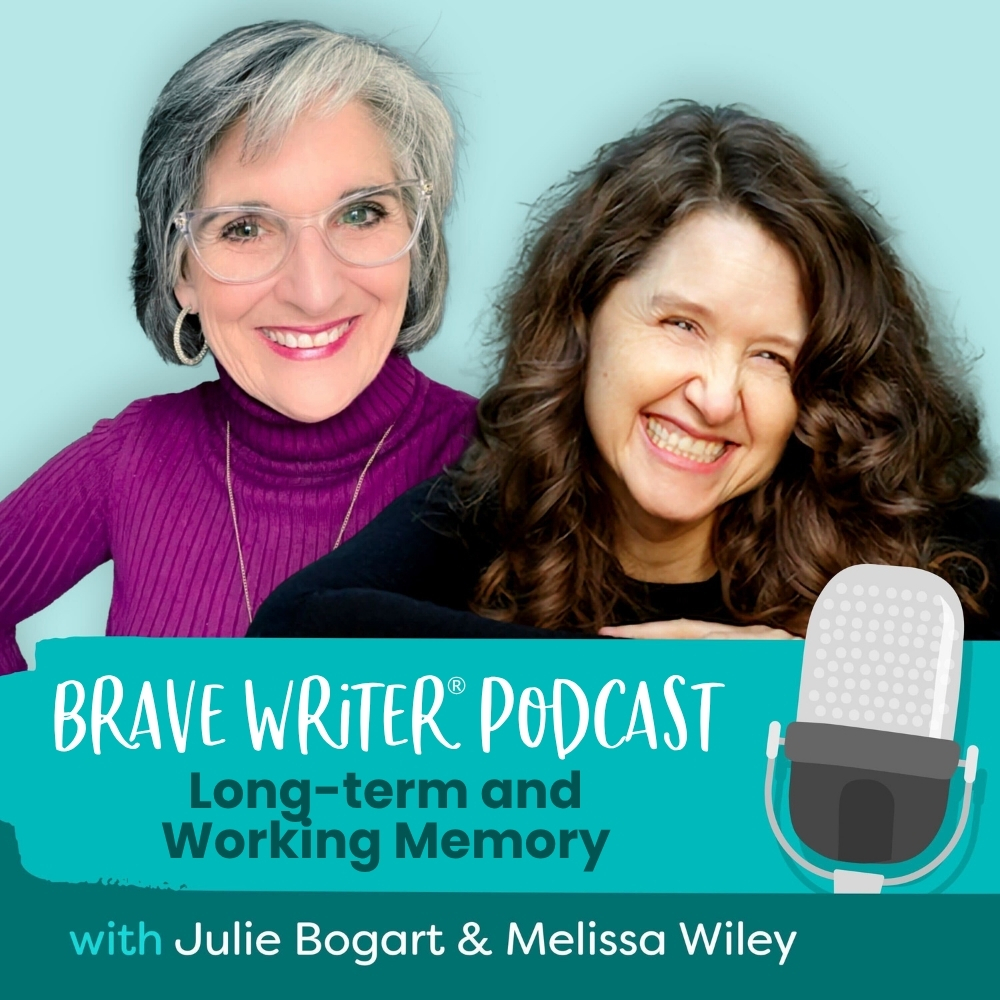
[Podcast #332] Long-term and Working Memory
Why does a child understand something one day and forget it the next?
In this Brave Writer podcast episode, we explore what neuroscience reveals about how learning actually works. Drawing from Uncommon Sense Teaching and Make It Stick, we unpack the difference between working memory and long-term memory—and why retrieval, repetition, and even mistakes play a vital role in lasting learning.
We also share practical strategies like:
- jotting notes,
- sketching ideas,
- and spaced repetition to help knowledge stick.
When we understand the brain’s learning process, we can guide our kids with more patience and confidence. Listen in and discover how to turn everyday lessons into lasting knowledge.
Show Notes
When Learning Doesn’t “Stick”
Every homeschooling parent has experienced it: yesterday your child understood the concept perfectly. Today, it seems completely gone.
It can feel confusing—or even discouraging. But what if that cycle of remembering and forgetting is actually part of how learning works?
Research into cognitive science shows that learning depends on the interaction between two systems: working memory and long-term memory. Understanding the difference between the two can transform how we approach teaching our children.
Working Memory vs. Long-Term Memory
Working memory is like the brain’s temporary workspace. It holds information briefly while we use it, but it has limited capacity. Young children especially have much smaller working memories than adults.
That means when we give a child multiple instructions—change clothes, brush teeth, make the bed, and come downstairs—they may only remember the first step.
Long-term memory is different. Once information moves there, it becomes durable and accessible. Think about a childhood phone number or song lyrics you learned decades ago. They’re simply there.
The challenge in education isn’t storing information in the brain. Our brains have astonishing storage capacity. The real challenge is helping children retrieve what they’ve learned.
Retrieval Builds Memory
One of the most powerful discoveries in learning science is that retrieving knowledge strengthens it.
When students struggle to recall information—without looking at their notes—they strengthen the neural connections that store that knowledge.
That’s why practices like narration are so effective. When a child retells a story, explains a concept, or summarizes a reading in their own words, they are reinforcing the pathways that move information into long-term memory.
Even getting something wrong can help. The moment of struggle activates deeper processing in the brain, making the eventual correction more memorable.
Practical Ways to Reinforce Learning
Small strategies can make a big difference in helping learning stick.
One effective approach is student jotting—having kids record ideas in their own words.
They might:
- Write brief notes explaining a math process
- Sketch scenes from a history story
- Jot keywords after reading a chapter.
Drawing can be particularly powerful. A simple comic-style sequence of events can help a child reconstruct an entire narrative.
Another helpful practice is spaced repetition. Before starting a new lesson, ask your child to recall what they learned yesterday. That small act of retrieval strengthens memory and builds continuity between lessons.
The Gift of Time
Perhaps the most reassuring insight from learning science is this: children develop working memory gradually. Adult-level capacity often isn’t reached until around age fourteen.
So when a child forgets something they understood yesterday, it isn’t a sign of laziness or lack of intelligence.
It’s simply the brain doing the work of learning.
Our role as homeschool parents is not to rush that process but to support it—to model, practice together, and give children opportunities to retrieve and apply knowledge over time.
Education isn’t about finishing learning by eighteen. It’s about building the habits and foundations that allow learning to continue for a lifetime.
Resources
- Listen to our episode “Make It Stick: How to Know If Your Kids Are Retaining What They Learn”
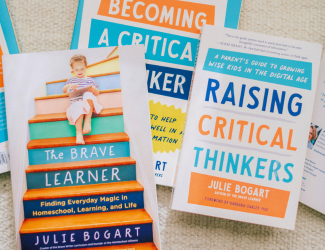
- Find Uncommon Sense Teaching and Make It Stick in the Brave Writer Book Shop
- Brave Writer class registration is open!
- Visit Julie’s Substack to find her special podcast for kids (and a lot more!)
- Purchase Julie’s new book, Help! My Kid Hates Writing
- Find community at the Brave Learner Home
- Learn more about the Brave Writer Literature & Mechanics programs
- Start a free trial of CTCmath.com to try the math program that’s sure to grab and keep your child’s attention
- Subscribe to Julie’s Substack newsletters, Brave Learning with Julie Bogart and Julie Off Topic, and Melissa’s Catalog of Enthusiasms
- Interested in advertising with us? Reach out to media@bravewriter.com
- Sign up for our Text Message Pod Ring to get podcast updates and more!
- Send us podcast topic ideas by texting us: +1 (833) 947-3684
Connect with Julie
- Instagram: @juliebogartwriter
- Threads: @juliebogartwriter
- Bluesky: @bravewriter.com
- Facebook: facebook.com/bravewriter
Connect with Melissa
- Website: melissawiley.com
- Substack: melissawiley.substack.com
- Instagram: @melissawileybooks
- Bluesky: @melissawiley.bsky.social
Produced by NOVA