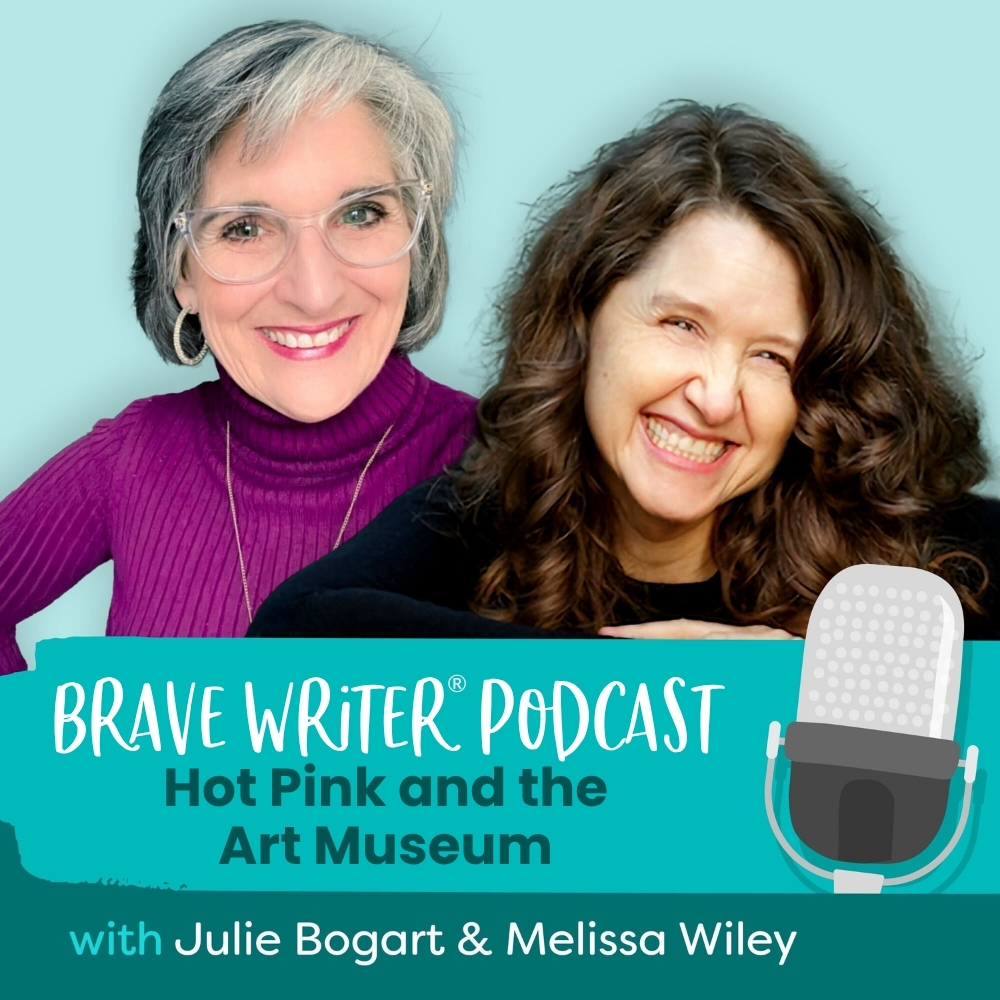
[Podcast #351] Hot Pink and the Art Museum
What changes when we stop rushing children toward the lesson we planned and start noticing the learning already unfolding?
A visit with Julie’s six-year-old granddaughter becomes a fresh look at poetry, reading, art museums, and the remarkable power of one-on-one attention.
We explore:
- how treasure hunts turn worksheets into quests,
- why a child’s “wrong” answer contains useful logic,
- and how patient observation helps us see familiar subjects differently.
Homeschooling does not always provide daily proof of progress. Often, we collect a few luminous moments surrounded by plenty of ordinary space. Join us as we learn to trust that the pearls are enough.
Show Notes
The Pearls Are Enough
One of the hardest parts of homeschooling is living without daily proof.
We teach, read, discuss, play, explain, and try again. Some days end with a beautiful breakthrough. Many do not. A child forgets the rule we reviewed yesterday. The writing project fizzles. The museum visit drifts toward the room we had planned to skip.
We may wonder whether any of it is working.
Learning rarely presents itself as a tidy sequence of visible achievements. More often, it develops beneath the surface through overlapping experiences. A poem connects to a rhyme. A game strengthens spelling. A museum treasure hunt sharpens observation. A conversation in the car retrieves an idea encountered months earlier.
For a while, it can look as though nothing is happening. Then everything happens at once.
Give Learning a Purpose
Children become more attentive when they know what they are looking for.
Imagine handing your child a math worksheet and saying, “Somewhere on this page, you’ll find an answer of nine. Tell me when you discover it.” The problems have not changed, but the experience has. The worksheet has become a quest.
We can do the same thing with reading. Preview the page and choose a word to hunt for. At an art museum, search for a horse, a baby, a moon, or an unexpected color. During a nature walk, look for three kinds of edges or five different shades of green.
A small purpose activates curiosity. The child is no longer completing an anonymous task. They are finding something.
Begin With the Child’s Logic
Children also show us what they know through their mistakes.
Suppose a child adds two fractions by combining the numerators and denominators. The answer may be incorrect, but the child has not acted randomly. They used the addition skills available to them and applied a reasonable pattern.
We can begin there.
“You added those numbers accurately. Fractions have a strange rule. Let’s see what makes them different.”
That response respects the child’s interior logic. It turns an error into a doorway rather than a verdict.
The same principle applies beyond academics. A child who ignores the famous paintings and studies glass vases is not failing at the museum. They are having their own encounter with beauty. Our tools, background knowledge, and plans can enrich that encounter, but they do not need to control it.
Practice the Patience of Presence
Some parental patience is simple endurance. We stack the same blocks again because we love the two-year-old who wants us nearby.
Another kind of patience asks us to stop living ten steps ahead. We become available to what is happening now, even when it is not what we expected.
This does not mean abandoning leadership. Children bring the interest; adults bring resources, experience, transportation, money, and perspective. We follow the child while helping that interest become possible.
Over time, these encounters become the memories that reassure us. Most days may feel like an empty chain. Then comes a poem at breakfast, a newly read word, an unexpected question, or a hot-pink highlight in a painting. We string that pearl onto the chain.
There may be more empty space than pearls.
The pearls are still enough.
Resources
- Registration is open now for Movie Discussion Club: Captivating Stories (Christopher Nolan) and many other Brave Writer classes!
- You can find “Every Face I Look at Seems Beautiful to Me” on Melissa’s blog, Here in the Bonny Glen
- Check out the special offer at Talkbox.MOM/brave and start speaking a new language with your kids from day one!
- Start a free trial of CTCmath.com to try the math program that’s sure to grab and keep your child’s attention.
- If you’ve ever thought of trying out online music lessons, now is the time! Claim your free Maestro Music lessons at Free Music Lessons for Brave Writer Families | Maestro Music.
- Find our favorite readalouds and nonfiction in the Brave Writer Book Shop
- Visit Julie’s Substack to find her special podcast for kids (and a lot more!)
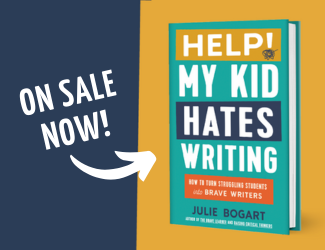
- Purchase Julie’s new book, Help! My Kid Hates Writing
- Find community at the Brave Learner Home
- Learn more about the Brave Writer Literature & Mechanics programs
- Subscribe to Julie’s Substack newsletters, Brave Learning with Julie Bogart and Julie Off Topic, and Melissa’s Catalog of Enthusiasms
- Sign up for our Text Message Pod Ring to get podcast updates and more!
- Send us podcast topic ideas by texting us: +1 (833) 947-3684
- Interested in advertising with us? Reach out to media@bravewriter.com
Connect with Julie
- Instagram: @juliebogartwriter
- Threads: @juliebogartwriter
- Bluesky: @bravewriter.com
- Facebook: facebook.com/bravewriter
Connect with Melissa
- Website: melissawiley.com
- Substack: melissawiley.substack.com
- Instagram: @melissawileybooks
- Bluesky: @melissawiley.bsky.social
Produced by NOVA