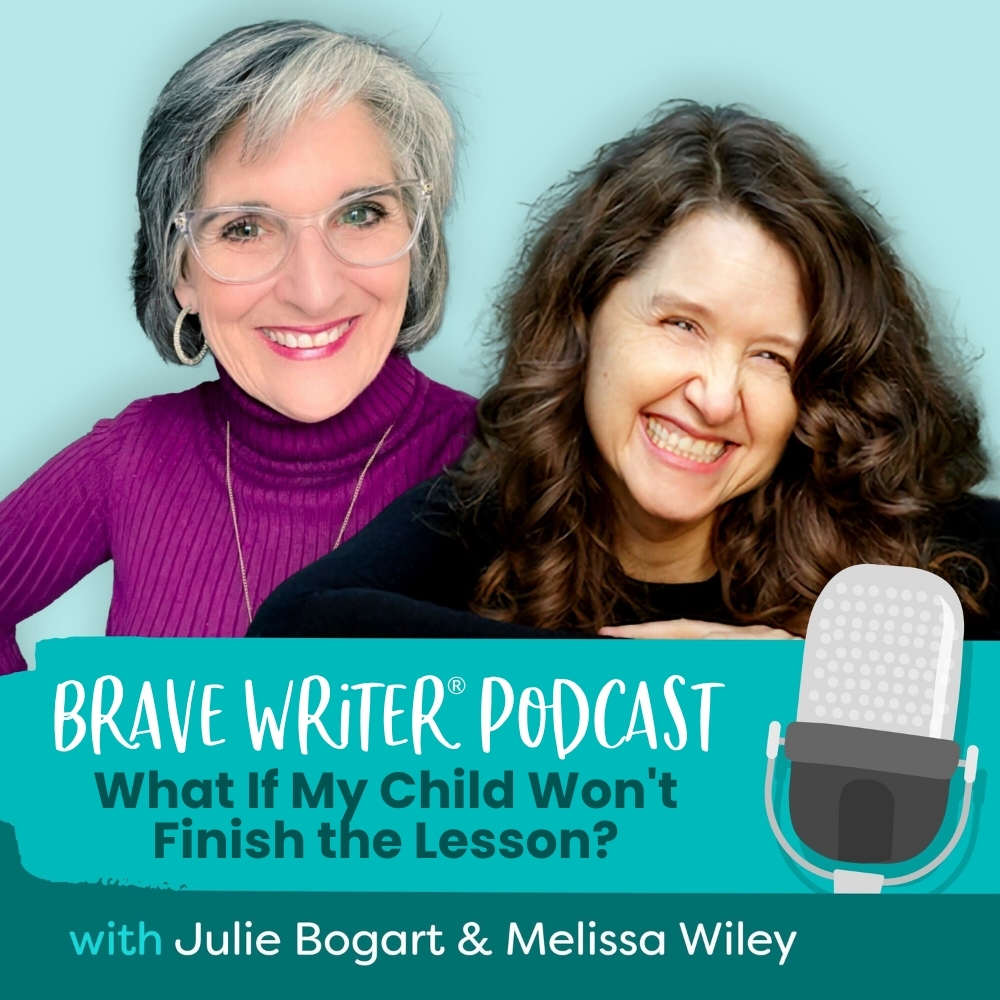
[Podcast #341] What If My Child Won’t Finish the Lesson?
When is schoolwork really finished? If your child refuses the last five math problems, drags through copywork, or resists the assignment you carefully planned, the issue may not be laziness or defiance. It may have meaning.
In this Brave Writer podcast episode, we rethink what completion really means in homeschool. We explore:
- intrinsic motivation,
- rote practice,
- sensory needs,
- Charlotte Mason’s wisdom,
- gaming “grind,”
- and the parent’s role as coach rather than taskmaster.
We also talk about how to document learning without turning home into school.
Join us as we trade arbitrary finish lines for meaningful progress.
Show Notes
When Is Homeschool Work Really Finished?
Every homeschooling parent has faced it: the assignment is almost done, but your child is finished in every way except the one you had in mind.
There are five math problems left. Three more sentences. Half a copywork passage. One last page.
And suddenly the whole homeschool day turns into a negotiation.
We tend to think the problem is that our child won’t finish. But what if the bigger question is this: who decided what “finished” means?
Completion is not always learning
In school, finishing is tied to assignments, tests, grades, and calendars. A course ends because the semester ends. A worksheet is complete because every blank is filled in. A grade communicates progress to someone who was not in the room.
Home works differently.
At home, learning is not limited to a bell schedule or a stack of completed pages. It is relational, responsive, and often much more personal. A child may demonstrate understanding after five math problems, even if ten were assigned. A child may write one careful sentence with full attention, then lose the stamina to continue well.
That matters.
If the goal is learning, completion cannot be measured only by quantity. We have to ask: What are we actually trying to grow?
Ask the better question
One of the most useful questions we can ask ourselves is: What is my objective right now?
If the objective is to master a math concept, there may be several ways to get there. A worksheet is one option. So is a board game, a video game, a cooking project, a shopping list, or a conversation.
If the objective is perseverance, then the task changes. Now we are coaching a child through discomfort. We are helping them learn how to stay with something hard, how to take breaks, how to notice fatigue, and how to return with support.
Those are different goals. They require different kinds of partnership.
Meaning comes before motivation
Children are not automatically motivated by the adult reasons we carry in our heads. We want them educated, and we see the long arc. We know that skills accumulate over time.
But an eight-year-old is not thinking about adulthood. They are thinking about the moment they are in.
That is why meaning matters. A child may grind through a boring task in Minecraft because the result matters to them. They may practice free throws because they care about the game. They may sound out words because they desperately want to read the sign, the comic, or the next chapter.
Our work is to help make the connection visible.
Remove the barriers
Sometimes resistance has nothing to do with the subject. A child may be hungry, tired, lonely, itchy, uncomfortable, bored, overwhelmed, or stuck with a pencil that feels terrible in their hand.
The body is part of learning.
A footstool, a clipboard, a couch, a snack, a fidget, a different pencil, or five minutes of movement can change everything. These are not indulgences. They are accommodations. We understand that a child who cannot see clearly needs glasses. A child who cannot focus in a hard chair with dangling feet may need a different setup too.
Try finishing for now
Instead of asking, “Did we finish the assignment?” we can ask, “Did we give this our full attention? Did we work with excellence for the capacity available today? Did we learn something we can build on tomorrow?”
That shift protects the child from the habit of sloppy endurance. It also protects the relationship.
Because the goal is not to win a standoff over three more sentences. The goal is to build a learning life.
Sometimes the most honest finish line is simple:
- We’re finished for right now.
- We’ve learned enough about this for today.
- Tomorrow, we begin again.
Resources
- Register for the Brave Writer Book Reveal on June 1st and 2nd – our biggest event of the year
- Sign up for our free training webinars in June. It’s professional development for parent educators!
- Find our favorite readalouds and nonfiction in the Brave Writer Book Shop
- Brave Writer class registration is open!
- Visit Julie’s Substack to find her special podcast for kids (and a lot more!)
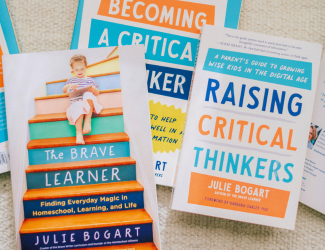
- Purchase Julie’s new book, Help! My Kid Hates Writing
- Find community at the Brave Learner Home
- Learn more about the Brave Writer Literature & Mechanics programs
- Start a free trial of CTCmath.com to try the math program that’s sure to grab and keep your child’s attention
- Subscribe to Julie’s Substack newsletters, Brave Learning with Julie Bogart and Julie Off Topic, and Melissa’s Catalog of Enthusiasms
- Sign up for our Text Message Pod Ring to get podcast updates and more!
- Send us podcast topic ideas by texting us: +1 (833) 947-3684
- Interested in advertising with us? Reach out to media@bravewriter.com
Connect with Julie
- Instagram: @juliebogartwriter
- Threads: @juliebogartwriter
- Bluesky: @bravewriter.com
- Facebook: facebook.com/bravewriter
Connect with Melissa
- Website: melissawiley.com
- Substack: melissawiley.substack.com
- Instagram: @melissawileybooks
- Bluesky: @melissawiley.bsky.social
Produced by NOVA