[Podcast #340] Family Favorites: Resources and Routines Beloved by Melissa’s Kids
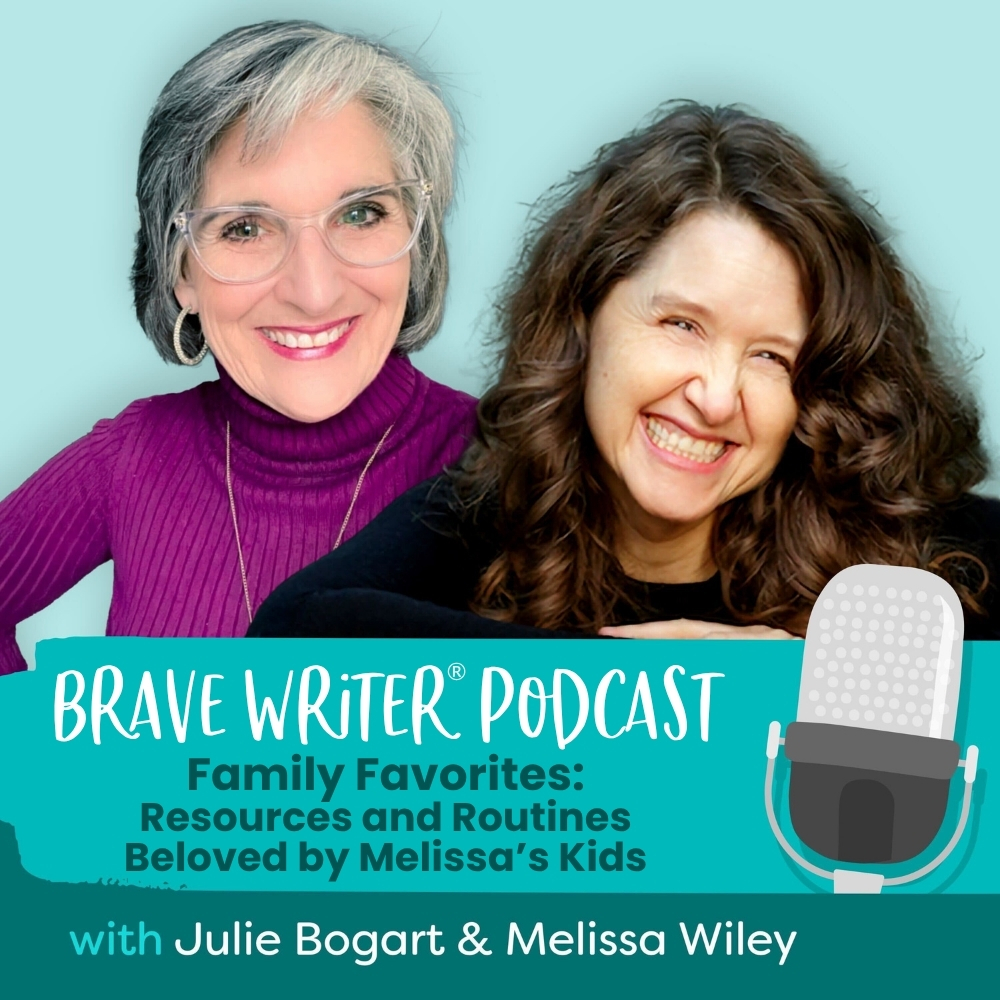
What if your best homeschool resources are the small routines, songs, snacks, and tools your kids remember years later?
In this Brave Writer podcast episode, we gather a treasure chest of family-tested ideas:
- read-alouds,
- Signing Time,
- Bob Books,
- captions,
- morning songs,
- poetry memorization,
- skip counting,
- quiet time,
- seasonal books,
- geography games,
- Postcrossing,
- DragonBox Algebra,
- Snap Circuits, and more!
Along the way, we talk about why the imperfect moments often become the brightest memories, from dry Lucky Charms at Shakespeare Club to circus animal cookies at a recital.
Join us as we celebrate practical, playful ways to make learning stick.
Show Notes
The Homeschool Resources Our Kids Actually Remember
Every homeschooling family has a few things that become legendary.
Not always the beautiful curriculum. Not always the well-planned unit study. Sometimes it’s the gas station peanut butter sandwiches, the dry cereal served in paper cups, the song you played every time the house needed cleaning, or the little flag stuck in putty that traveled around the globe during read-alouds.
Those ordinary details matter. They become the texture of family learning.
One of the most freeing truths about homeschool is that education does not have to depend on perfect systems. It can be built on repeatable rhythms, meaningful tools, playful hooks, and a willingness to notice what works for the children in front of us.
Reading begins with a language-rich life
We often think reading must begin with a curriculum. Sometimes it does. But reading can also grow from a home full of language.
Read aloud constantly. Read to toddlers, big kids, teens, and even each other as adults. The cadence of written language enters a child’s body through the ear long before they read fluently on their own.
Then add visual reinforcement. Captions on a favorite show can help children connect spoken words to printed ones. Sign language videos, especially programs like Signing Time, add movement, music, visual memory, and language all at once. Bob Books can offer gentle phonics practice without turning reading into a high-pressure event.
None of these tools has to carry the whole burden. Together, they create a rich environment where literacy has many doorways.
Routines give learning a place to land
A homeschool day does not need to begin with a bell. It can begin with a song.
A short morning ritual can become an anchor: stretch, sing, recite a poem, toss bean bags while skip counting, then move into copywork or math. The repetition is the gift. Over time, a few lines of poetry become a memorized poem. Skip counting becomes multiplication. A simple song becomes family lore.
Quiet time can serve the same purpose. An hour after lunch for reading, music, independent play, or one-on-one time with a parent gives everyone space to reset. In a busy home, quiet can be as important as instruction.
Learning sticks when it has a hook
Songs help memory. Schoolhouse Rock, Horrible Histories, Latin chants, presidents songs, musicals, and even Broadway cleaning soundtracks can give facts a rhythm.
Geography can come alive with a globe, a map, postcards from around the world, or apps like Stack the States and Stack the Countries. Math can become less abstract through a birthday analogy for telling time or a playful algebra app like DragonBox. Writing can feel new again with beeswax crayons, dip pens, or a personal stationery kit.
Hands-on kits like Snap Circuits offer more than science. They teach children how to follow directions, troubleshoot, and use reading for a real purpose.
The imperfect moments count too
We put so much pressure on ourselves to prepare the perfect snack, plan the perfect activity, or present the perfect lesson. But children often remember the moments when we improvised.
The paper cups. The circus animal cookies. The snacky dinner pulled from whatever was in the fridge.
These moments tell our children something important: family life does not have to be polished to be meaningful. Learning does not have to be flawless to be memorable.
Sometimes the best homeschool resource is the one already in your hand.
Resources
- DragonBox Math Apps – International Award Winning Series
- Postcrossing: Postcards connecting the world
- Find books and other resources mentioned in this episode in the Brave Writer Book Shop
- Brave Writer class registration is open!
- Visit Julie’s Substack to find her special podcast for kids (and a lot more!)
- Purchase Julie’s new book, Help! My Kid Hates Writing
- Find community at the Brave Learner Home
- Learn more about the Brave Writer Literature & Mechanics programs
- Start a free trial of CTCmath.com to try the math program that’s sure to grab and keep your child’s attention
- Subscribe to Julie’s Substack newsletters, Brave Learning with Julie Bogart and Julie Off Topic, and Melissa’s Catalog of Enthusiasms
- Sign up for our Text Message Pod Ring to get podcast updates and more!
- Send us podcast topic ideas by texting us: +1 (833) 947-3684
- Interested in advertising with us? Reach out to media@bravewriter.com
Connect with Julie
- Instagram: @juliebogartwriter
- Threads: @juliebogartwriter
- Bluesky: @bravewriter.com
- Facebook: facebook.com/bravewriter
Connect with Melissa
- Website: melissawiley.com
- Substack: melissawiley.substack.com
- Instagram: @melissawileybooks
- Bluesky: @melissawiley.bsky.social
Produced by NOVA