[Podcast #339] Facing Our Limits as Parent Educators
What does it mean to prepare our children for a future we can’t predict?
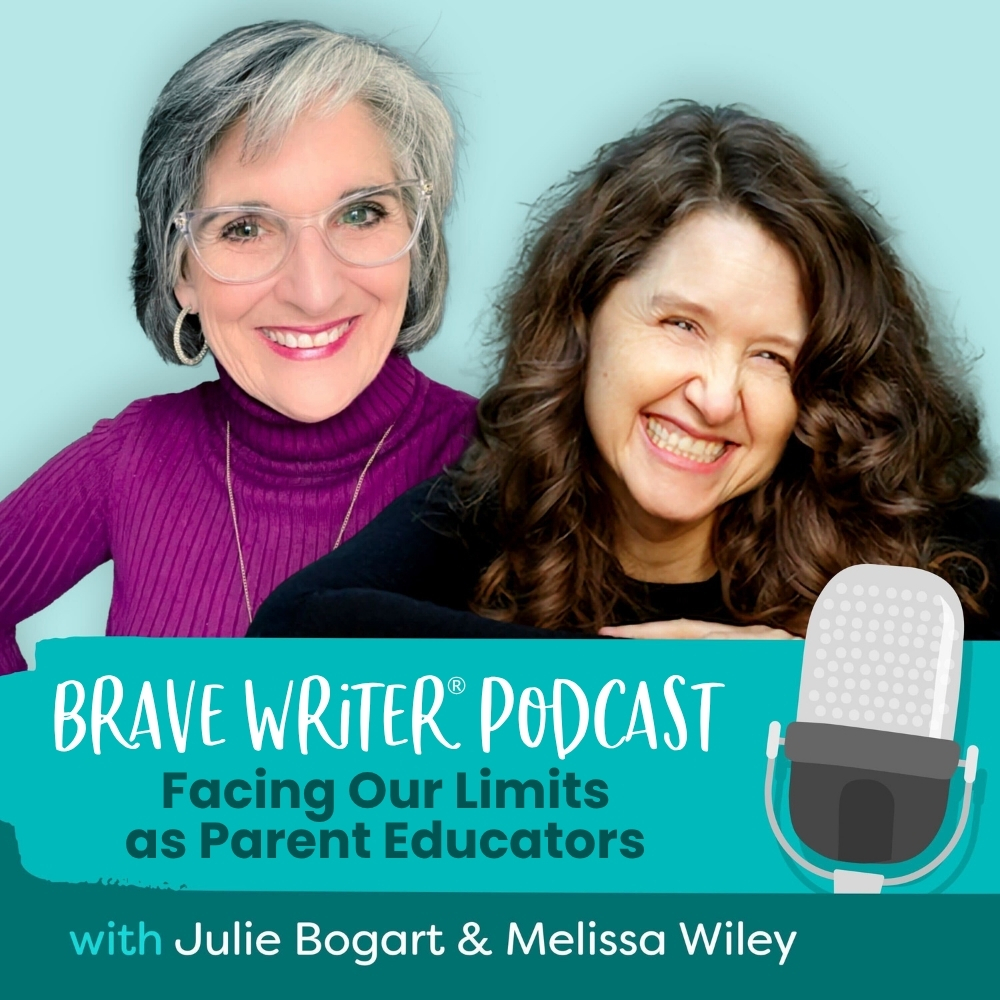
In this Brave Writer podcast episode, we reflect on homeschooling, parenting, adult children, and the tender reality of endings.
We talk about:
- why “success” may be the wrong measure for family life,
- how love becomes the truest through-line,
- and why our kids’ adult reflections deserve to be heard without defensiveness.
From changing job markets and AI uncertainty to theater outings, cancer treatment, and raisin bread metaphors, we explore how to keep relationship at the center.
Join us as we make room for love, complexity, feedback, and joy.
Show Notes
When Homeschooling Ends: Measuring Success by Love, Not Outcomes
Every homeschooling parent begins with a vision.
We imagine the books, the projects, the conversations, the cozy mornings, the curiosity. We picture our children growing into capable adults who know how to think, learn, work, love, and make wise choices. We hope the years we spend together will add up to something beautiful.
But what happens when the homeschooling years end?
That question can catch us by surprise. We prepare for beginnings. We research curriculum, choose math programs, set up bookshelves, join co-ops, and imagine the kind of family life we want to create. We prepare for transitions too: kindergarten, middle school, high school, college applications.
But endings are different.
One day, the last phonics lesson is over. The last read-aloud closes. The last math struggle passes. The last child graduates. Then the people we poured ourselves into begin building lives of their own, lives shaped by our choices but not controlled by them.
That is where a deeper definition of success begins.
Success is not the performance of the child
It is tempting to measure our parenting by what our children achieve. Grades. Test scores. College admissions. Musical skill. Athletic success. Career stability. Financial independence.
Those things matter, but they are not the heart of parenting.
When we make a child’s performance the proof that we did well, we place a burden on them they were never meant to carry. Their lives become our report card. Their choices become our validation. Their struggles become our indictment.
Love asks for something different.
Love stays open. Love listens. Love makes room for the child’s own experience, even when it differs from ours.
Our children are not preparing for the world we knew
The world our children inherit is not the one we imagined when they were small. The job market changes. Technology changes. AI changes the landscape. College costs rise. Trades reemerge. Tech jobs shift. A path that once looked secure may not feel secure ten years later.
That uncertainty can make us second-guess everything.
Did we do enough STEM? Did we leave enough doors open? Should we have pushed harder? Should we have backed off sooner?
But our deeper work is not to predict every future job. It is to raise people who know how to learn, adapt, notice what gives them purpose, and build lives that hold meaning.
Some children may want ambitious careers. Some may want work that ends at 5:00 so they can go home to a cat, a game, and writing for fun. Some may build a life around surfing, coffee, art, farming, or family. Work can serve a life. It does not have to consume it.
Adult children get to tell their own stories
This may be the hardest part.
Our children may grow up and remember homeschooling differently than we do. They may cherish it. They may critique it. They may wish parts had been different. They may name pain we did not intend to cause.
Our first instinct may be to defend the choices we made with such devotion.
But the relationship asks us to listen.
We can honor our commitment and still make room for their truth. We can say, “I loved you. I was doing my best with what I knew,” and also say, “Tell me what that was like for you.”
That is not failure. That is love still doing its work.
The memories that last
Children may not remember every lesson. They may not remember the carefully chosen curriculum or the educational theory behind our decisions.
They will remember how it felt to live with us.
They will remember laughter at the table. The inside jokes. The funny thing someone said that got written down. The ballet where the six-year-old bounced in her seat and still had a wonderful time.
Homeschooling gives us many gifts, but one of the greatest is time to build a shared life.
Not a flawless life. A real one.
A raisin bread life, where sweetness and chewy complications sit side by side.
So as we think about success, maybe the better question is not, “Did everything turn out the way we hoped?”
Maybe the better question is, “Can our children still bring us their truth and find love waiting there?”
That is the relationship worth protecting.
Resources
- Find our favorite readalouds and nonfiction in the Brave Writer Book Shop
- Brave Writer class registration is open!
- Visit Julie’s Substack to find her special podcast for kids (and a lot more!)
- Purchase Julie’s new book, Help! My Kid Hates Writing
- Find community at the Brave Learner Home
- Learn more about the Brave Writer Literature & Mechanics programs
- Start a free trial of CTCmath.com to try the math program that’s sure to grab and keep your child’s attention
- Subscribe to Julie’s Substack newsletters, Brave Learning with Julie Bogart and Julie Off Topic, and Melissa’s Catalog of Enthusiasms
- Sign up for our Text Message Pod Ring to get podcast updates and more!
- Send us podcast topic ideas by texting us: +1 (833) 947-3684
- Interested in advertising with us? Reach out to media@bravewriter.com
Connect with Julie
- Instagram: @juliebogartwriter
- Threads: @juliebogartwriter
- Bluesky: @bravewriter.com
- Facebook: facebook.com/bravewriter
Connect with Melissa
- Website: melissawiley.com
- Substack: melissawiley.substack.com
- Instagram: @melissawileybooks
- Bluesky: @melissawiley.bsky.social
Produced by NOVA