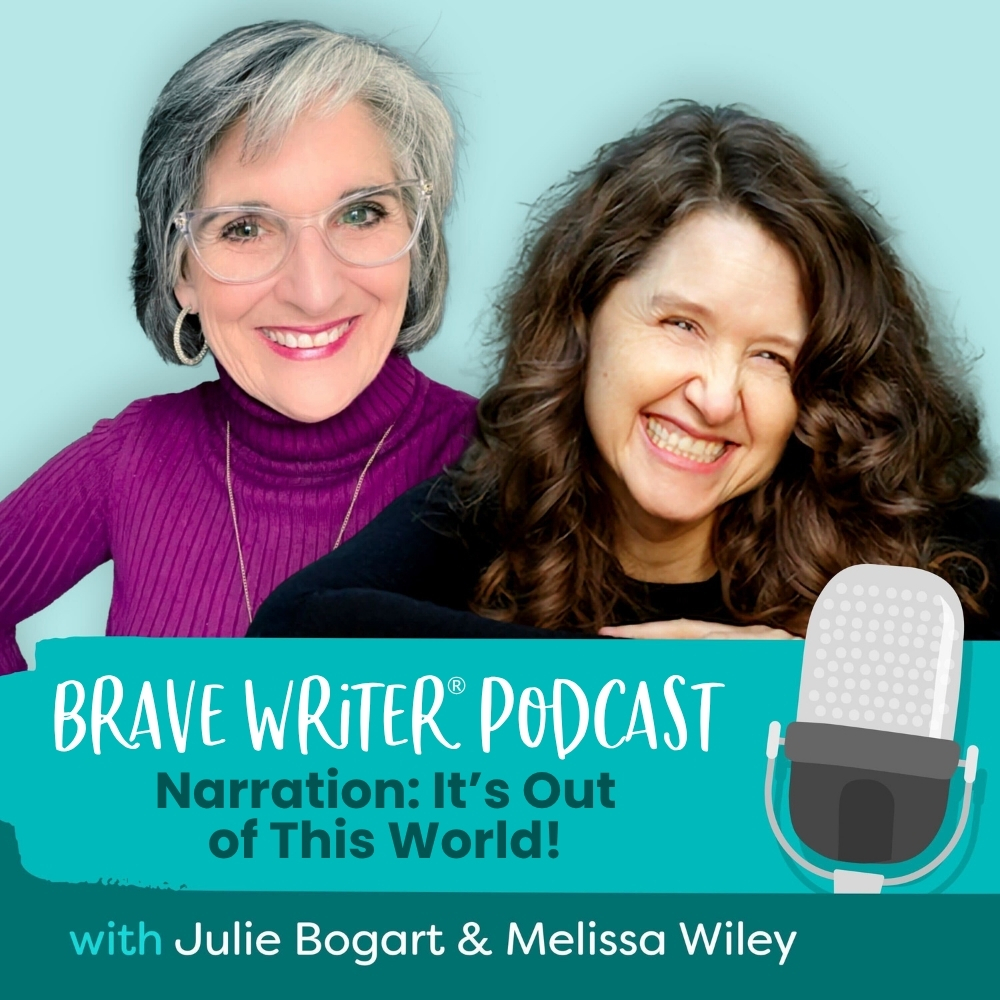
[Podcast #338] Narration: It’s Out of This World!
What if your child’s long, winding stories are not a distraction from learning, but the very foundation of it?
In this Brave Writer podcast episode, we explore the art of narration: the natural ability children have to tell what they:
- notice,
- remember,
- imagine,
- and understand.
Inspired by Charlotte Mason and the astronauts of Artemis 2, we look at how vivid description, precise vocabulary, metaphor, and careful listening help kids turn experience into language.
We also talk about oral narration, written narration, jot-it-down practices, observation, public speaking, and why parents can become a child’s own Mission Control.
Tune in, and let’s learn how to say: Copy kid joy!
Show Notes
The Art of Narration: How Telling What We Notice Becomes Real Learning
Children are natural narrators.
Before they can write essays, before they can summarize chapters, before they can produce tidy paragraphs, they are already telling us the world as they see it. They describe the dog racing across the yard. They explain the video game level in elaborate detail. They tell us exactly what happened when the toddler climbed too high or why the moon looked strange through the window.
Sometimes, as parents, we hear too many words.
We want the point. We want the summary. We want the assignment completed. But what if all those words are not a detour from education? What if they are the ground plan for it?
Narration begins with attention
Narration is the act of telling back what we have seen, heard, read, imagined, or experienced. It is not limited to a formal report. It can happen in the car, at the kitchen table, during a walk, after a read-aloud, while looking at a painting, or while watching the moon.
When children narrate, they show us what captured their attention. They may not summarize the whole chapter. They may remember one vivid scene. They may not offer a tidy beginning, middle, and end. They may linger over a single funny moment, a color, a sound, or a surprising detail.
That is not failure. That is learning taking shape.
Summary is an advanced skill. Young children often need years of rich, detailed language before they can compress an experience into its main idea. First, they need permission to notice. They need to practice saying what they see.
The more we look, the more we see
Observation grows vocabulary.
A child may begin with “blue,” but after comparing shades to crayons, colored pencils, paint chips, or the sky at different times of day, “blue” becomes turquoise, cornflower, navy, slate, or periwinkle. A round shape becomes a circle, dome, sphere, oval, crater, or ring.
This is why narration belongs in every subject. Science depends on it. Art depends on it. History depends on it. Writing depends on it.
Even astronauts need narration.
When the Artemis II crew observed the moon, their work was not only technical. They had to describe what they saw so the rest of us could come close to experiencing it too. Their language carried us there. They noticed color, shadow, terrain, shape, and metaphor. They helped us imagine a place we could not see with our own eyes.
That is what our children are doing too. They are looking out the window of their own spaceship and telling us what is there.
Narration does not have to start in handwriting
Many children can speak far more freely than they can write. That matters.
If we ask a young child to write a narration too soon, the richness of their thought may shrink to match the limits of their handwriting, spelling, and punctuation. A full oral narration becomes two stiff sentences on the page.
So we can jot it down for them.
We can let them speak while we transcribe. We can invite them to copy one sentence afterward. We can ask them to draw first, then tell. We can let narration take the form of a diagram, a labeled sketch, a dramatic reenactment, a video for Grandma, or a conversation over hot chocolate.
All of it counts.
Narration prepares children for real life
A child who practices telling what they know is preparing for more than school.
They are preparing to speak in an interview, explain a medical history to a doctor, give a toast, comfort a friend, teach a skill, advocate for themselves, or tell a story that makes someone laugh at exactly the right moment.
Public speaking begins in ordinary conversation. Writing begins in spoken language. Confidence grows when a child discovers, again and again, “My words can carry my experience to another person.”
That is why listening matters so much.
We can be Mission Control for our kids. We do not have to correct every tangent or demand a perfect summary. We can receive the joy underneath the narration.
- Copy moon joy.
- Copy video game joy.
- Copy soccer joy.
- Copy kid joy!
When we listen with that kind of welcome, we teach children that their observations matter. Their words matter. Their minds matter.
And that is where education begins.
Resources
- Learn more about Brave Writer’s Worldbuilding class and other enthusiasm-sparking online classes!
- Explore NASA’s “Observe the Moon Like an Astronaut” activity
- Find our favorite readalouds and nonfiction in the Brave Writer Book Shop
- Brave Writer class registration is open!
- Visit Julie’s Substack to find her special podcast for kids (and a lot more!)
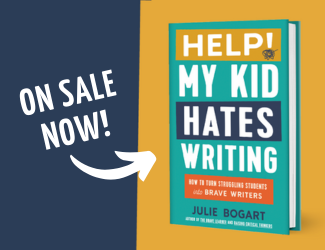
- Purchase Julie’s new book, Help! My Kid Hates Writing
- Find community at the Brave Learner Home
- Learn more about the Brave Writer Literature & Mechanics programs
- Start a free trial of CTCmath.com to try the math program that’s sure to grab and keep your child’s attention
- Subscribe to Julie’s Substack newsletters, Brave Learning with Julie Bogart and Julie Off Topic, and Melissa’s Catalog of Enthusiasms
- Sign up for our Text Message Pod Ring to get podcast updates and more!
- Send us podcast topic ideas by texting us: +1 (833) 947-3684
- Interested in advertising with us? Reach out to media@bravewriter.com
Connect with Julie
- Instagram: @juliebogartwriter
- Threads: @juliebogartwriter
- Bluesky: @bravewriter.com
- Facebook: facebook.com/bravewriter
Connect with Melissa
- Website: melissawiley.com
- Substack: melissawiley.substack.com
- Instagram: @melissawileybooks
- Bluesky: @melissawiley.bsky.social
Produced by NOVA