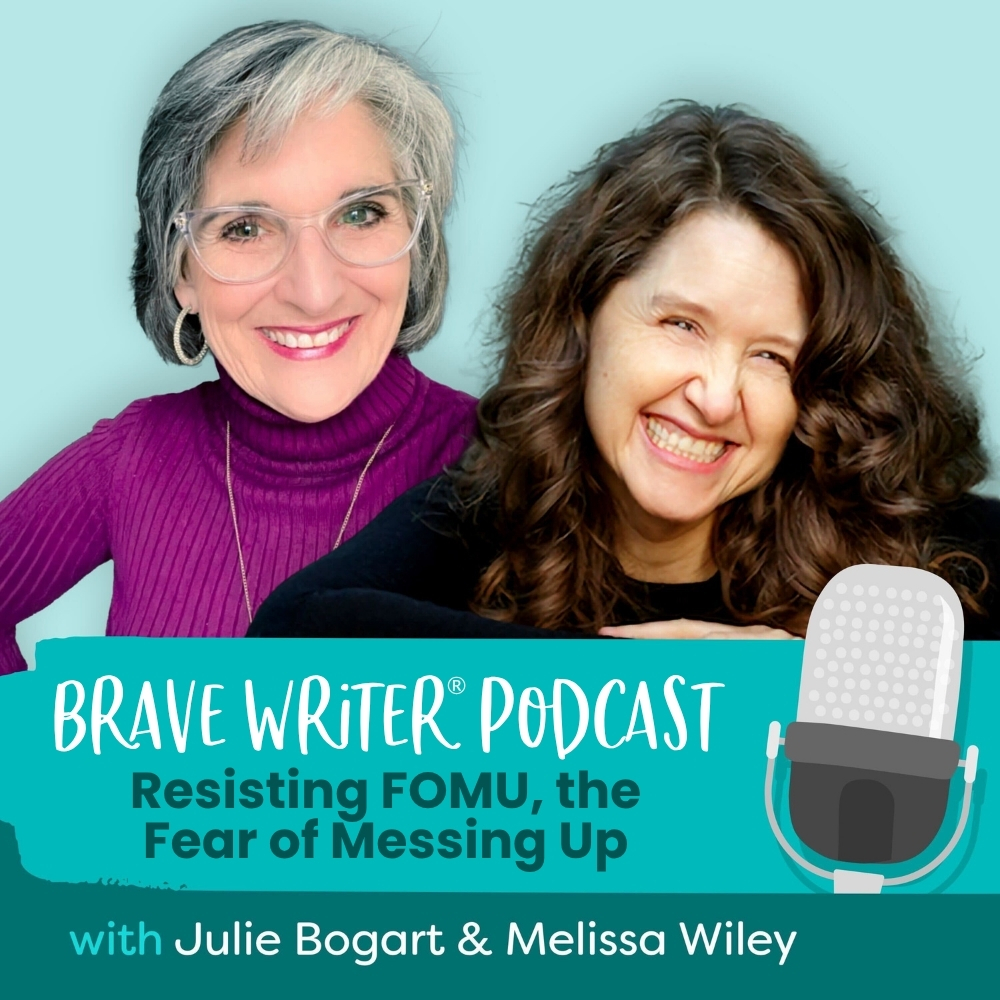
[Podcast #333] Resisting FOMU, the Fear of Messing Up
What if the biggest obstacle in your homeschool isn’t what you’re missing—but the fear that you’re doing it wrong?
This week on the Brave Writer podcast, we explore “fear of messing up” and how perfectionism quietly shapes our expectations, decisions, and confidence as parent educators.
We unpack:
- where that pressure comes from,
- how it shows up (hello, endless curriculum switching),
- and why chasing the “perfect” method keeps us stuck.
We also share practical ways to shift your focus toward connection, curiosity, and process—plus tools like interval training and a flexible writing app to support real learning.
Ready to trade perfection for progress? Let’s rethink what success actually looks like.
Show Notes
Let Go of Getting It Right
Every homeschooling parent has felt it: the quiet worry that you might be doing it wrong.
You plan carefully, choose materials thoughtfully, and try to create meaningful learning experiences. But then your child resists, or something doesn’t click, or you see another family doing it differently—and suddenly, doubt creeps in.
What if that fear isn’t a sign you’re failing—but a sign you’ve been taught to expect perfection?
Much of us were shaped by systems that measured success by correctness. One hundred percent. Right answers. Completed work. Over time, we internalized the idea that learning should look polished and predictable.
But real learning rarely looks like that.
The Myth of the “Right Way”
It’s easy to assume there’s a correct path through education—a sequence of subjects, skills, and milestones that guarantees success.
Once you start homeschooling, that assumption quickly unravels.
Different philosophies emphasize different things. Some prioritize structure and sequence. Others focus on curiosity and exploration. Even school systems don’t agree on what should be taught or when.
There is no universal roadmap.
That realization can feel unsettling at first. But it also offers relief. If there isn’t one right way, then you’re free to respond to the learners in front of you.
The goal shifts from “getting it right” to “paying attention.”
Process Over Outcome
When we fixate on outcomes—reading by a certain age, mastering a concept on schedule—we start to measure every moment against a future result.
That creates pressure. And pressure often leads to frustration for both parent and child.
Learning happens in the present.
It happens when your child wrestles with a problem, asks a question, or makes a connection. It happens in the middle of the attempt, not just at the moment of success.
When we focus on process instead of outcome, we begin to notice those moments. We see growth where we once saw gaps.
And we create space for learning to unfold.
The Trap of the Endless Quest
One common response to uncertainty is to keep searching for something better.
A new curriculum. A different method. A promising system that seems like it might finally make everything work.
But constant switching often creates more disruption than progress.
Children need time to settle into a rhythm. What looks imperfect on the surface may actually be working just fine underneath.
Before changing course, it helps to ask: is something truly broken, or am I reacting to discomfort?
Sometimes the most productive choice is to stay the course.
Building Competency and Confidence
If perfection isn’t the goal, what is?
A more helpful aim is competency and confidence.
- Competency grows through practice, variation, and time. It doesn’t require flawless performance—just steady engagement.
- Confidence grows when children feel safe to try, struggle, and try again. Mistakes become part of the process, not evidence of failure.
- Progress includes missteps. Choosing a program that doesn’t work or hitting resistance in a subject is information, not failure.
- Growth happens when we stay responsive—adjusting, supporting, and continuing forward rather than starting over.
This applies to us as well.
We are learning how to homeschool in real time. We will choose materials that don’t fit. We will have days that feel off. We will question our decisions.
None of that means we’re doing it wrong.
It means we’re in the middle of learning.
The Long View
There will be moments that feel like missteps. A program that didn’t work. A subject that took longer than expected. A season that felt unproductive.
But those moments are not the whole story.
Learning is built over time—through repetition, adjustment, and lived experience.
What matters most is not whether every decision was perfect, but whether you stayed engaged, responsive, and willing to keep going.
That’s where growth happens.
And that’s more than enough.
Resources
- Pacemaker: pacemaker.press
- Julie’s Substack post on this topic: http://juliebogart.substack.com/p/fomu-fear-of-messing-up
- Find books mentioned in this episode in the Brave Writer Book Shop
- Brave Writer class registration is open!
- Visit Julie’s Substack to find her special podcast for kids (and a lot more!)
- Purchase Julie’s new book, Help! My Kid Hates Writing
- Find community at the Brave Learner Home
- Learn more about the Brave Writer Literature & Mechanics programs
- Start a free trial of CTCmath.com to try the math program that’s sure to grab and keep your child’s attention
- Subscribe to Julie’s Substack newsletters, Brave Learning with Julie Bogart and Julie Off Topic, and Melissa’s Catalog of Enthusiasms
- Sign up for our Text Message Pod Ring to get podcast updates and more!
- Send us podcast topic ideas by texting us: +1 (833) 947-3684
- Interested in advertising with us? Reach out to media@bravewriter.com
Connect with Julie
- Instagram: @juliebogartwriter
- Threads: @juliebogartwriter
- Bluesky: @bravewriter.com
- Facebook: facebook.com/bravewriter
Connect with Melissa
- Website: melissawiley.com
- Substack: melissawiley.substack.com
- Instagram: @melissawileybooks
- Bluesky: @melissawiley.bsky.social
Produced by NOVA